
Inter–Napoli arrives as early as matchday three, so any reading of the new season needs to be treated with caution. Two matches are far too few to define a complete identity, but they can already reveal behaviours worth watching.
Inter opened the league season with a 4–1 win over Monza and a 1–0 win at Cagliari. Napoli, after their matches against Genoa and Como, arrive at San Siro with one major complication: Scott McTominay will be unavailable.
There is also a precedent that makes this match particularly interesting.
Last season Massimiliano Allegri, then Milan coach, faced Cristian Chivu’s Inter twice in the league. Both matches ended 1–0 to Milan.
Two matches are not a formula for beating Inter. They can, however, help us understand which problems Allegri has already managed to create for them.
Data sample. The analysis combines Inter and Napoli’s first two Serie A matches of 2026/27 with the two league derbies from 2025/26, used as additional references for selected Inter attacking patterns. The figures shown in each exhibit are therefore match-specific, not season averages.
Allegri has already shown one possible answer
The first clue comes from the way Inter entered the final third against Milan.
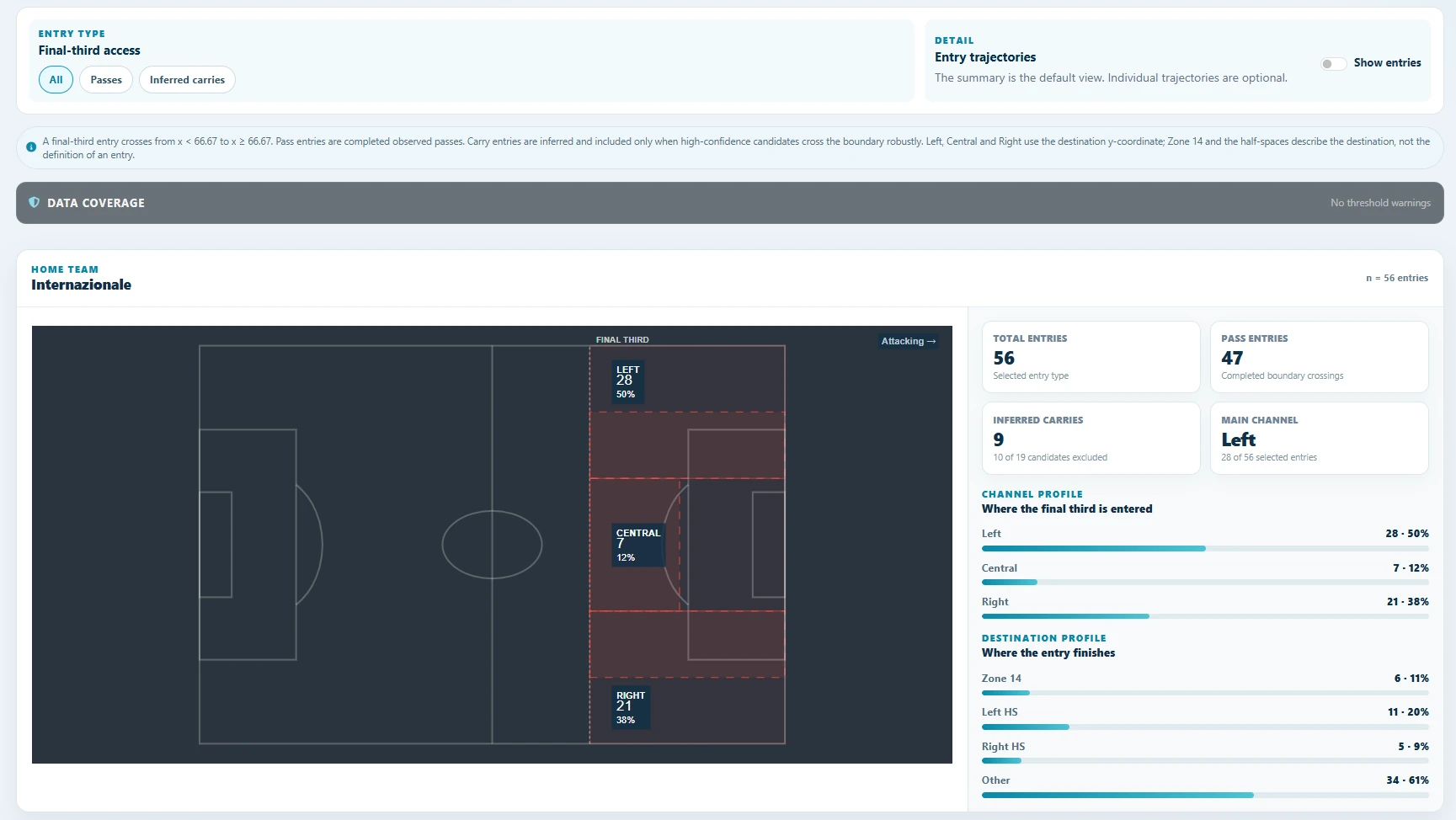
In the first of the two derbies analysed, Inter recorded 56 final-third entries. Only 7, 12%, came through the central channel.
The rest were distributed almost entirely across the two sides: 28 on the left, 21 on the right.
The pattern matters because it was repeated in the other derby: 62 total entries and only 9 central.
Across the two matches, then, Inter accumulated 118 final-third entries, but only 16 through the centre.
This helps clarify Allegri’s possible idea.
Milan did not stop Inter from advancing. They did not necessarily deny them territory or possession. Instead, they tried to decide where Inter would advance from.
That distinction matters.
Against a side with Inter’s technical quality, trying to stop every progression would probably be unrealistic. The problem becomes a different one: protect the most dangerous channels and guide possession towards areas where the defence can remain organised.
The cross is not the problem in itself
Once Inter have been pushed outside, however, the problem is not solved.
The second derby is particularly useful for this reason.
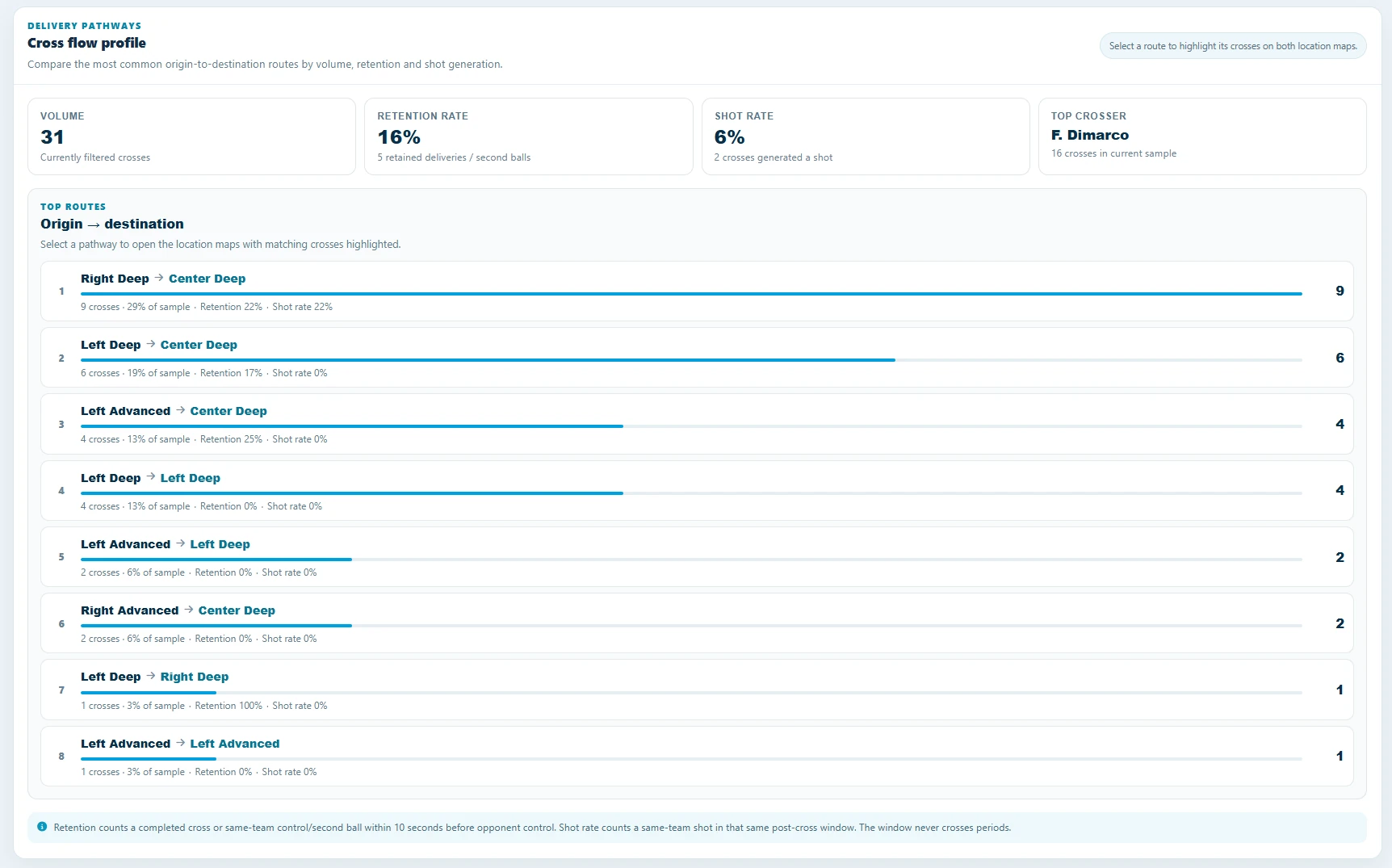
Inter produced 31 crosses. Dimarco alone delivered 16. A huge volume.
Yet the return from those deliveries remained very low: 16% retention, just five situations in which Inter retained possession or controlled the second ball; 6% shot rate, only two crosses that generated a shot in the following attacking window.
This is probably the most interesting part of Allegri’s precedent.
The point is not to prevent every wide delivery. It is to reach the crossing phase with pressure on the crosser, the box already occupied, the weak side controlled and, above all, players ready to contest the second ball.
The comparison with Cagliari makes the idea even clearer. There Inter produced only 17 crosses, almost half the derby total. But 65% generated a shot in the next phase of the move.
Less volume, far more threat.
So Napoli’s possible cue is not simply to push Inter wide. It is to push them outside without allowing them to arrive there with their attacking structure already set to attack the box.
Protecting the box is not enough: there is also Çalhanoğlu
This creates a second problem.
The natural response against a team that fills the box well is to drop the midfield progressively, add bodies around the centre-backs and protect the penalty area.
Against this Inter, however, that can also be dangerous.
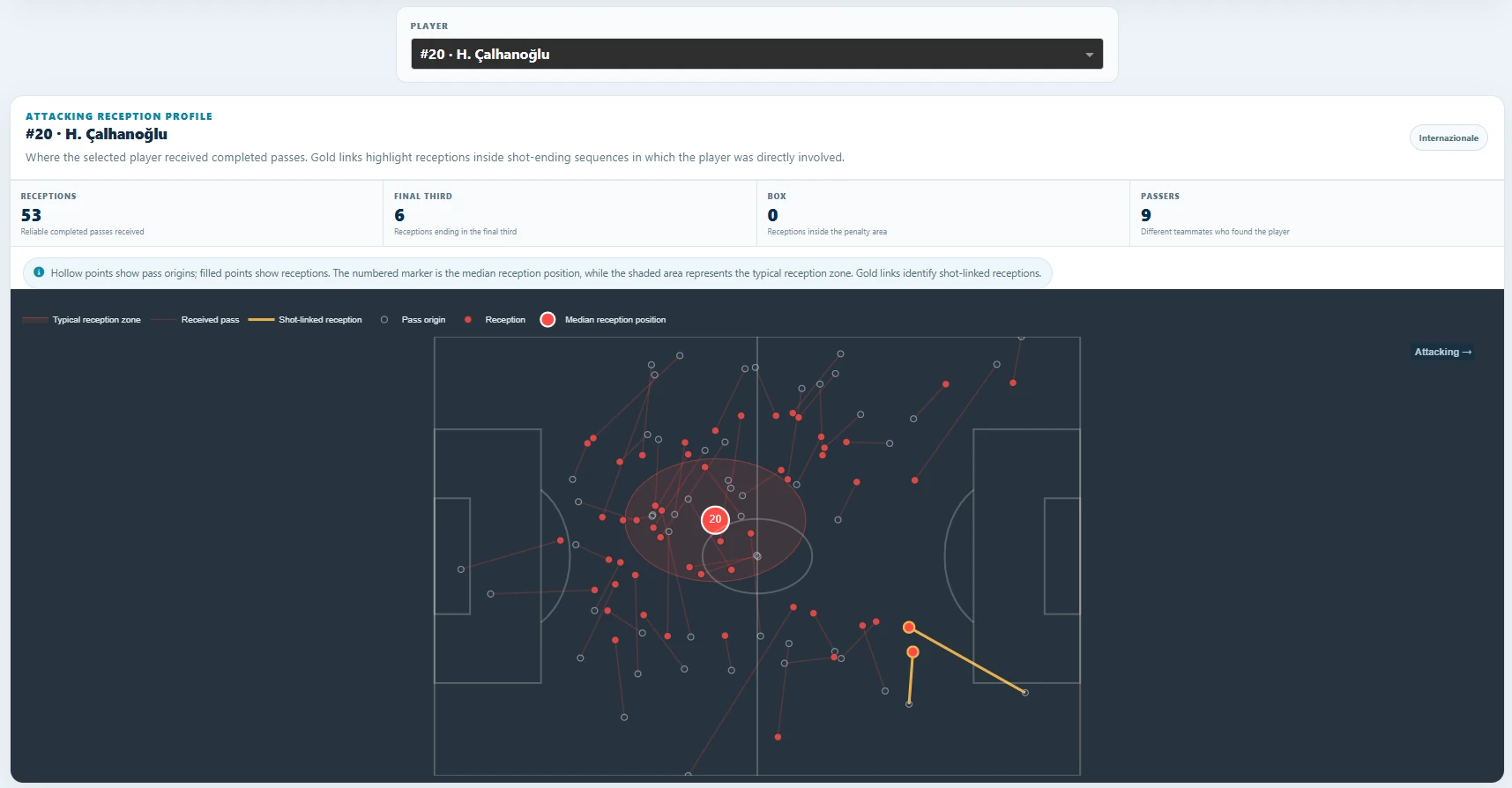
Çalhanoğlu scored in the first two rounds two goals from outside the box. Against Monza he shot from x=73.5; against Cagliari from x=77.5.
So it does not look like a marginal solution in the new season: in the first two matches alone it has already been used successfully twice.
That is exactly what creates the dilemma.
Napoli will have to protect the box, but they cannot allow the midfield to collapse indiscriminately onto the defensive line.
Because if everyone follows the first ball into the box, the second phase can become Çalhanoğlu’s territory.
Inter do not necessarily finish the move with the first entry into the box. They can continue after a clearance, collect a second ball or recycle possession backwards.
Without McTominay, what kind of game do Napoli want to play?
This is where Scott McTominay’s absence becomes more than a simple unavailable player.
This type of match seems to demand exactly some of his qualities: physical presence, duelling, protection in front of the box, the ability to attack second balls and ground covered in both directions.
But his absence also opens another possibility.
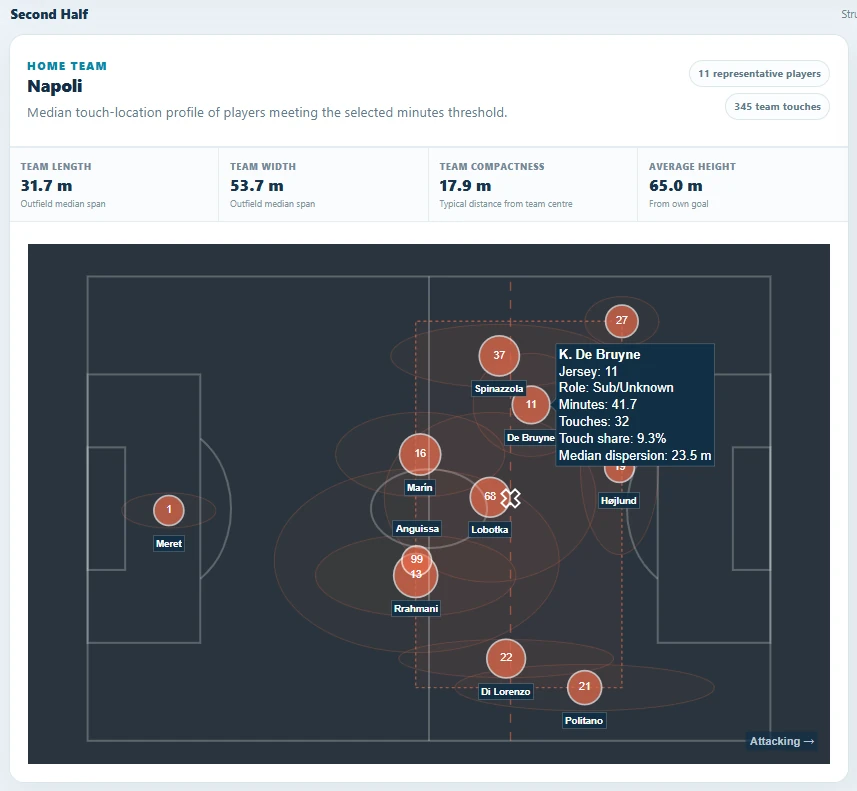
Against Como, in the 55th minute De Bruyne came on directly for McTominay. That does not mean the two are interchangeable. Quite the opposite: that match shows how different they are.
Lobotka remained fully involved in Napoli’s circulation and finished with 53 passes, 47 completed and 89% accuracy. The limitation is what that volume produced in terms of progression: 4 progressive passes and no key passes.
Lobotka maintains the connections. He keeps possession alive.
With De Bruyne, the function changes.
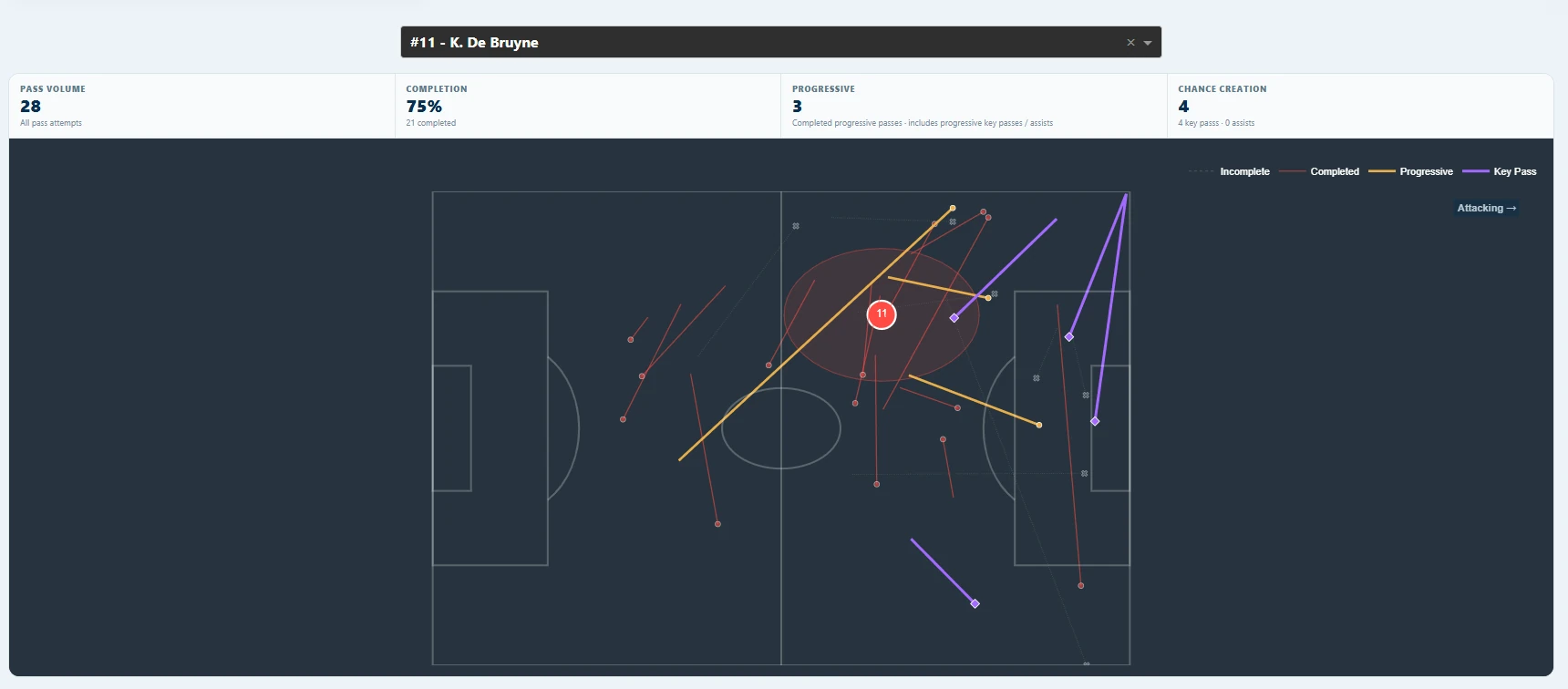
The Belgian played just over half an hour and finished with 28 attempted passes, 21 completed, 3 progressive passes, 4 key passes and 5 sequences ending in a shot. In four of those five sequences, one of his passes directly preceded the shot.
The comparison is not meant to establish who played better. Roles, minutes and responsibilities were different. It is useful instead to show two different types of control in possession.
Lobotka helps Napoli maintain the connection. De Bruyne looks to turn it into an attacking advantage more quickly.
The individual data becomes even more meaningful when linked to the collective structure.
After the triple substitution in the 55th minute, Napoli managed to shift the game for a spell. Between the 55th and 65th minutes they produced three shots to Como’s zero. In the second half their average height rose to 65 metres from their own goal, while Como’s dropped to 46.7.
With McTominay, Napoli would probably have more presence in the physical battle around crosses, clearances and second balls.
With a greater role for De Bruyne, they could instead have more ability to force Inter to defend.
It is not necessarily an advantage or a disadvantage. It is a trade-off in characteristics.
The key could be the complementarity between Lobotka and De Bruyne: the former to play through pressure and consolidate, the latter to accelerate once the first line has been beaten.
Napoli cannot live only in their own half
This is probably the point that prevents Inter–Napoli from being read simply as a game of resistance.
Against Como, the data identifies 71 attacking transitions.
Within the active window following the regain, 46, or 65%, reach the opposition half; 26, or 37%, reach the final third; 8 enter the box and 7 produce a shot.
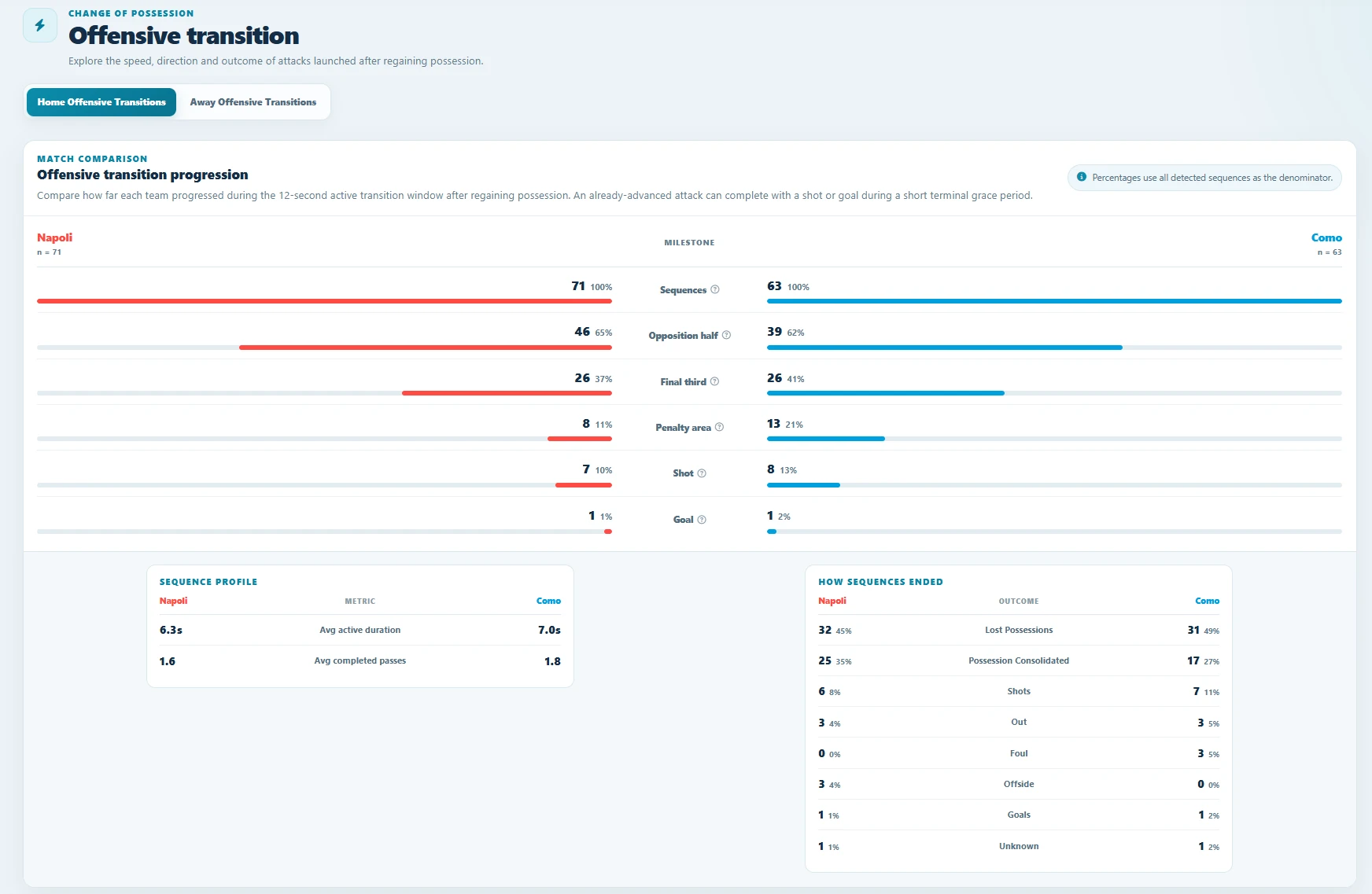
That is not enough to define Napoli as a transition team. More importantly, the sample is still too small to claim that Inter are structurally vulnerable in this phase.
A more cautious reading is this: Napoli already have a tool that could be particularly useful in a match in which they may have less of the ball.
In the first two rounds, moreover, almost half of Napoli’s attacking transitions started from pass interceptions.
That could be especially relevant against a team that uses its wing-backs heavily and sends several players beyond the ball.
If Napoli can read a pass and regain possession while Inter’s structure is still open, the window will be short. The first pass will become decisive.
And this is where the two themes meet.
It can be interception → De Bruyne → immediate pass beyond one line → attack the space vacated by a wing-back.
It is a different way of interpreting transition play. Based not only on running speed, but on speed of perception.
Two versions of Napoli within the same match
The opening rounds have already shown how much Allegri can alter the team’s behaviour.
Against Genoa, Napoli defended in a generally lower block and pressed with greater intensity. Against Como, they experienced a much more complex match: in the first half they conceded possession and territory; after the break they pushed their position higher and increased the quality between the lines.
That variability could be important against Inter.
There will probably be phases in which Napoli have to accept defending deeper, protect the box and guide Inter wide. But there also need to be phases in which they manage to move the game into Inter’s half.
If that never happens, defending well may not be enough. Sooner or later Inter’s attacking volume could begin to accumulate.
That is why the real objective should not simply be to resist. It should be to alternate different forms of control.
The precedent suggests that Allegri already knows one possible route to reduce Inter’s threat: close the centre, accept some wide volume and stay organised when the cross arrives.
But reproducing that plan with Napoli does not simply mean dropping deep and waiting.
Across the first two rounds, Inter have already shown two different ways of punishing a defensive structure: inside the box, when crosses generate continuations and second actions; in front of the box, where Çalhanoğlu has already scored twice.
Napoli therefore need to protect the heart of the box without emptying the edge of it, close the centre without allowing clean crosses, and accept spells without the ball without spending ninety minutes inside their own half.
And then they have to attack.
McTominay’s absence makes everything more complicated, but it also opens an interesting tactical question: will Allegri try to rebuild the balance he loses, or use more attacking quality to force Inter to worry about what happens behind them as well?
That may be where the match is decided: not in choosing between defending and attacking, but in the ability to do both without one undermining the other.
Four things to watch
- Where will Inter enter the final third?
In the two derbies, Allegri’s Milan drastically reduced central access. Can Napoli guide Inter outside again, or will Barella, Çalhanoğlu and the forwards find clean receptions through the middle? - What kind of crosses will Inter produce?
Volume matters less than quality. Will we see the low-return crosses from the derbies against Allegri, or deliveries that immediately generate second actions and shots, as happened at Cagliari? - How much space will Çalhanoğlu have in front of the box?
Protecting the penalty area cannot mean abandoning its edge. After two goals from distance in the first two rounds, it will be worth watching how often he can receive facing goal with time to set up the shot. - How will Napoli change without McTominay?
Will Allegri mainly try to replace McTominay’s physicality and balance, or increase De Bruyne’s role? And if the Belgian gets more space, can Napoli turn regains and consolidated possession into chances before Inter can reorganise?