
Napoli–Arsenal could spend long stretches with Arsenal on the ball and Napoli already set in their defensive shape.
Given the historical traits of Massimiliano Allegri’s teams and what his Napoli have shown so far, the most plausible scenario is not ninety minutes of ultra-aggressive pressing. It is a Napoli side willing to accept phases without the ball, protect space and choose carefully when to step out of the block.
That changes the central question of the match.
High pressing still matters, but as a secondary scenario: a goal kick, a back-pass, a closed body position or a moment when Allegri decides to push the team higher. That is when Raya and the second ball become central. Before that, there is another match to understand.
Data sample. The Arsenal reading combines three 2026/27 references — Chelsea, Aston Villa and Manchester City — with Inter–Arsenal from January 2026 as an additional European comparison. The matches come from different contexts: the numbers are used to test recurring behaviours, not to build a season average.
Allegri will probably concede the ball
Accepting Arsenal possession does not necessarily mean giving them what they want.
A mid or low block — a team defending closer to its own goal — can remove immediate depth, reduce space in behind and make direct attacks through the middle harder. Against Arsenal, though, compactness can itself become something to manipulate.
The Chelsea match offers a useful case study. In the phases when Chelsea dropped into a very compact 5-4-1, Arsenal did not simply circulate the ball in front of the block. They built rotations and overloads, especially on their right: White, Saka, Ødegaard and Havertz could occupy different heights, with Rice available to add an extra player or keep the move flowing.
The principle is simple: bring players to the ball side and force the block to move. If the opposition line slides too far, an inside reception or a switch of play opens up. If it stays too narrow, Arsenal can keep playing outside with a local numerical advantage.
That is exactly the type of dilemma Napoli may face.
Allegri can choose to protect the centre and concede territory. But he must do it without allowing Arsenal to decide continuously where Napoli’s block has to move.
Arsenal use the right side to move the defence
In the selected sample, direction is the most stable trend.
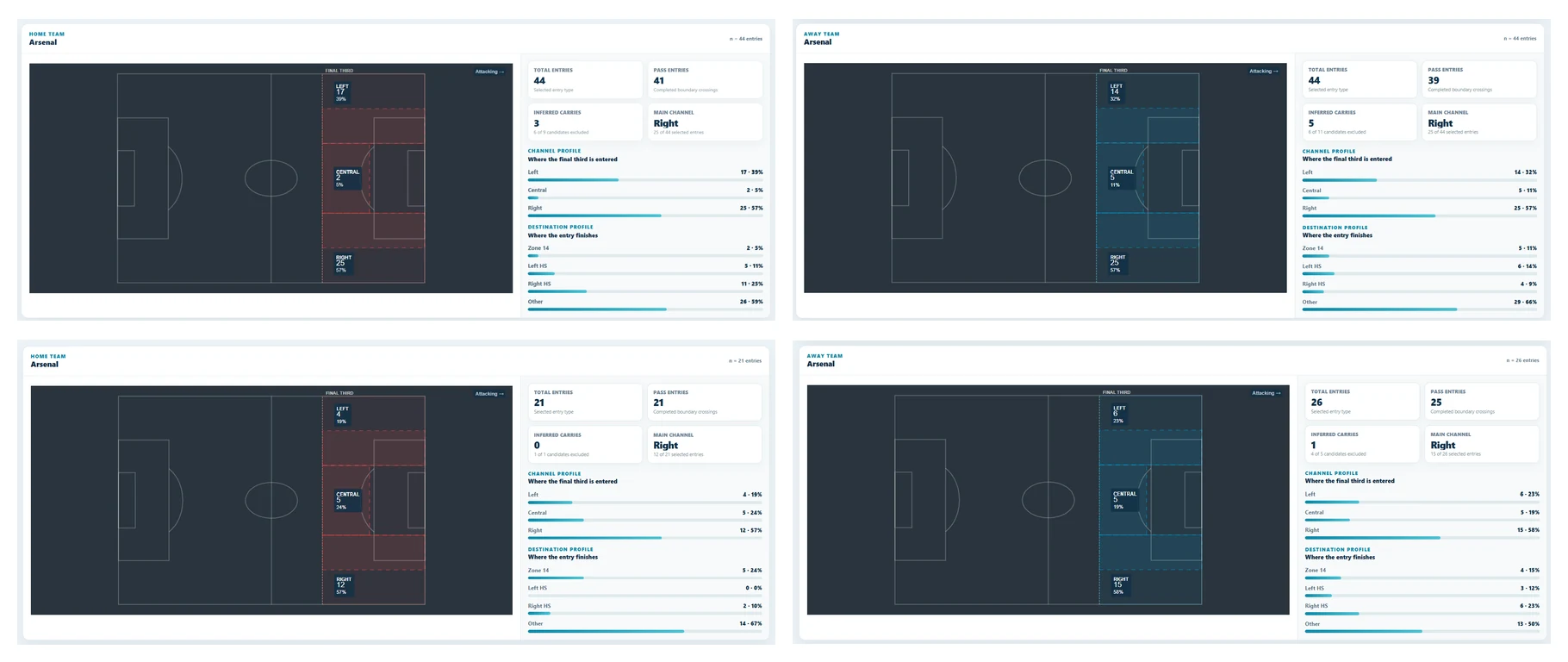
The share of Arsenal’s final-third entries coming from their right side is 57% against Chelsea, 57% against Aston Villa, 57% against Manchester City and 58% against Inter.
That does not mean every attack goes through that side or that Arsenal are predictable. It does mean that once they settle high up the pitch, the right is the side from which they build with the greatest consistency.
For Napoli, then, the issue is not simply protecting the centre. It is understanding how far they can slide towards Saka without losing control of the inside channel and the far side.
The first reference is always there
Bukayo Saka makes the structure immediately recognisable.
Against Chelsea he records 32 total receptions. Of those, 25 come in the final third and 4 inside the box.
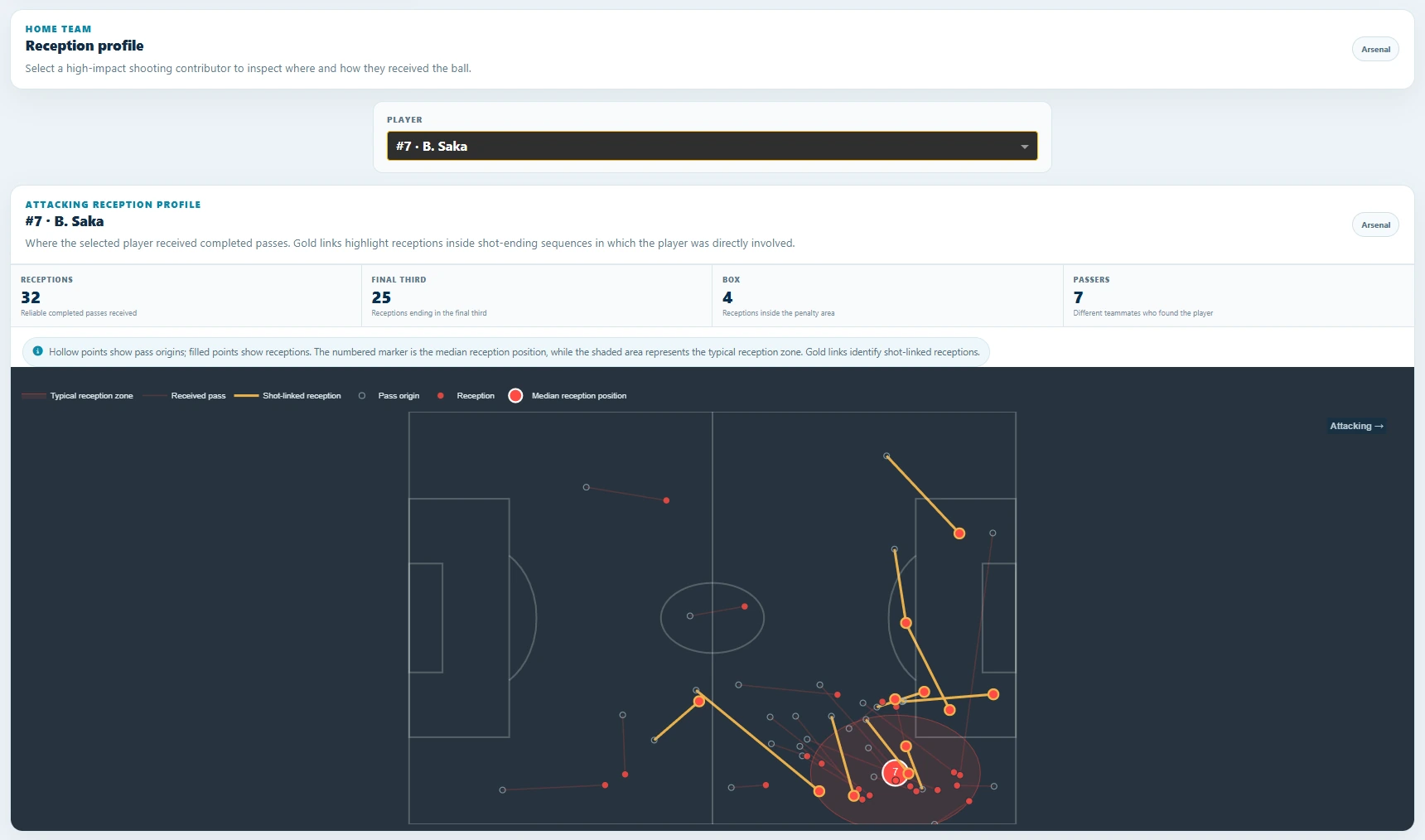
If Saka receives high with the full-back or Ødegaard already close, Napoli are defending more than a one-v-one. They have to read a small structure: width, inside channel, overlap or a movement towards the centre.
That is why reducing the issue to the individual duel would be misleading. The objective is to stop Saka receiving with too many connections available at the same time.
It is not only where Ødegaard receives, but how he can receive
The comparison between Ødegaard against Chelsea and Manchester City helps avoid an overly simple conclusion.
Against Chelsea he records 50 receptions, with 25 in the final third and 3 in the box. Against Manchester City he actually has 52 receptions, but only 8 come in the final third and none in the box. Aston Villa sits in between: 40 receptions, 14 in the final third and one in the box.
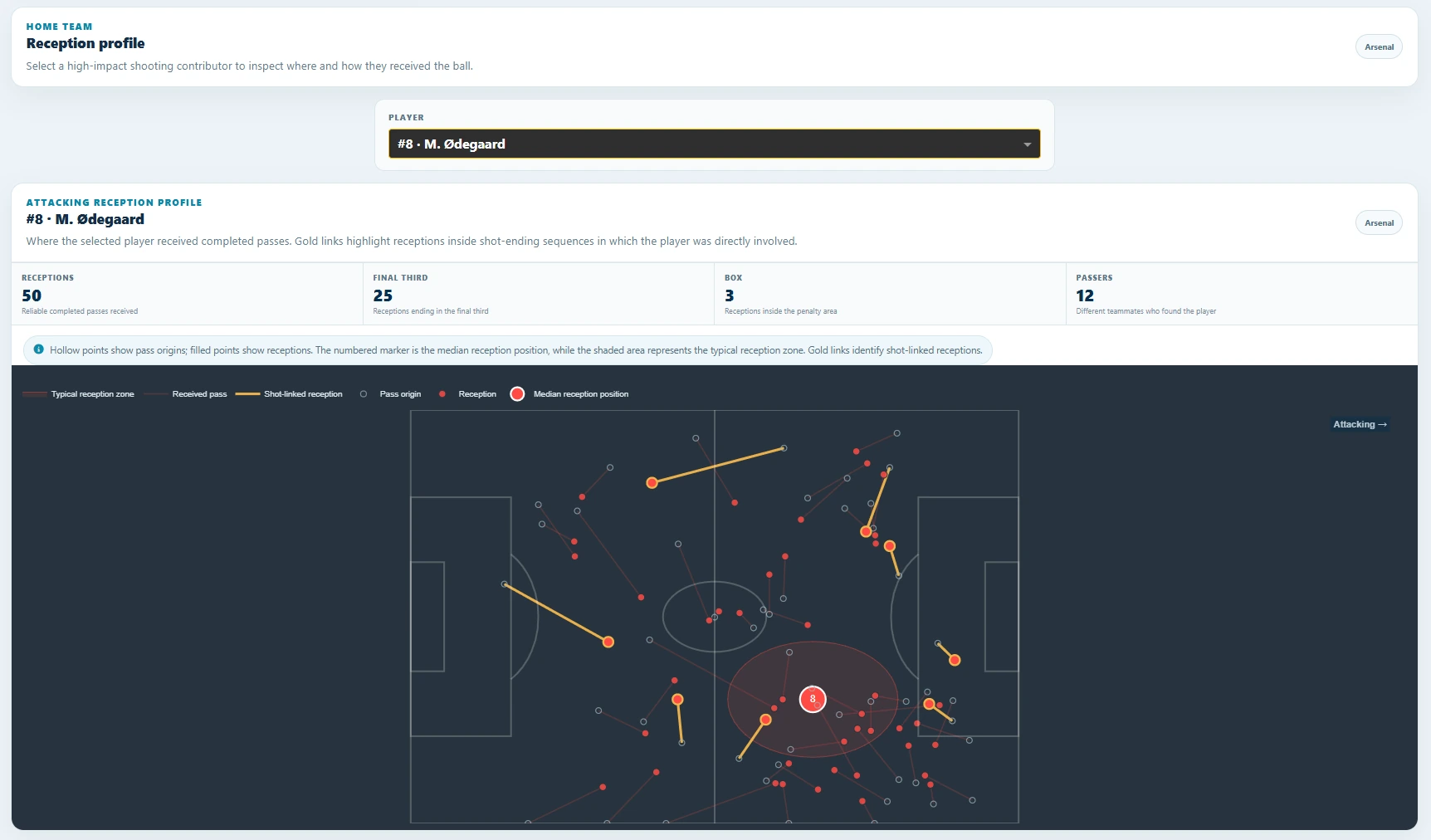
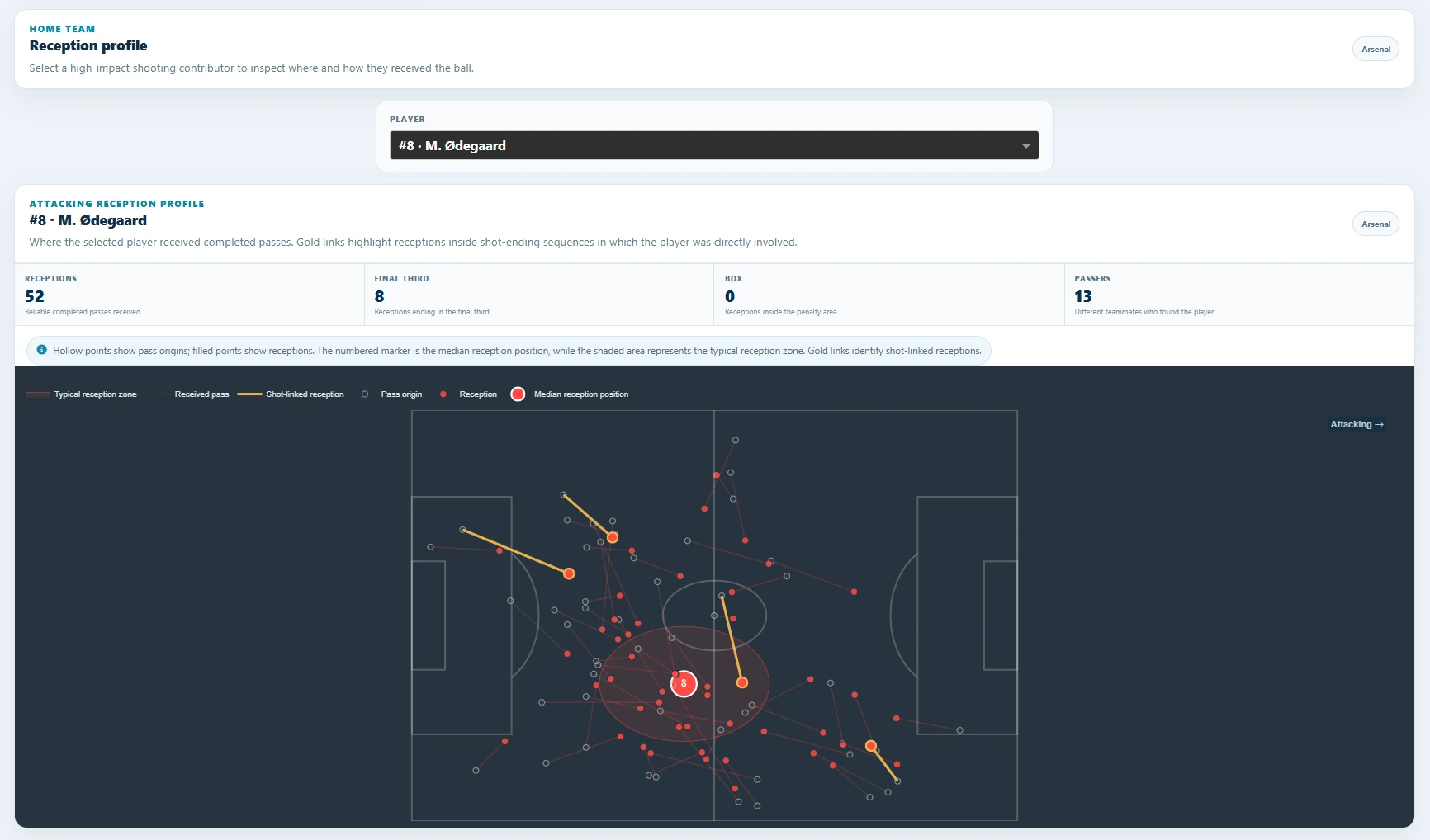
The 3–0 against City therefore does not show that Ødegaard is more useful when he receives deeper. In that match Arsenal record only 21 final-third entries to City’s 64, 9 shots to 12 and 436 passes to 614. Two of Arsenal’s three goals come in attacking transition, meaning quick attacks started immediately after winning the ball.
Chelsea is a different context: Arsenal produce 16 shots, 28 box entries and 2.57 xG (expected goals) against a side that also spends long phases defending in a set block. That is precisely where Ødegaard is brought much higher.
Distance on its own says little. A reception 45 metres from goal can be dangerous if Ødegaard is facing forward and has already bypassed a line. A higher reception can be far less dangerous if it comes with his back to goal, under pressure and with the right side screened.
The real variable is the combination of zone, body orientation, pressure received and available connections.
If Allegri steps out, the risk changes
So far we have described the main scenario: Napoli set in their block, Arsenal trying to manipulate it.
But no team can defend for ninety minutes without ever stepping out. There will be goal kicks, back-passes, wide balls or phases when Napoli try to squeeze higher up the pitch.
That is when the reading changes.
When Arsenal try to start from the back on the ground, they do not always progress immediately. Against Aston Villa, 38% of these moves reach the opposition half and 12% get as far as the final third; against Manchester City the figures fall to 22% and 4%; against Inter to 18% and 0%.
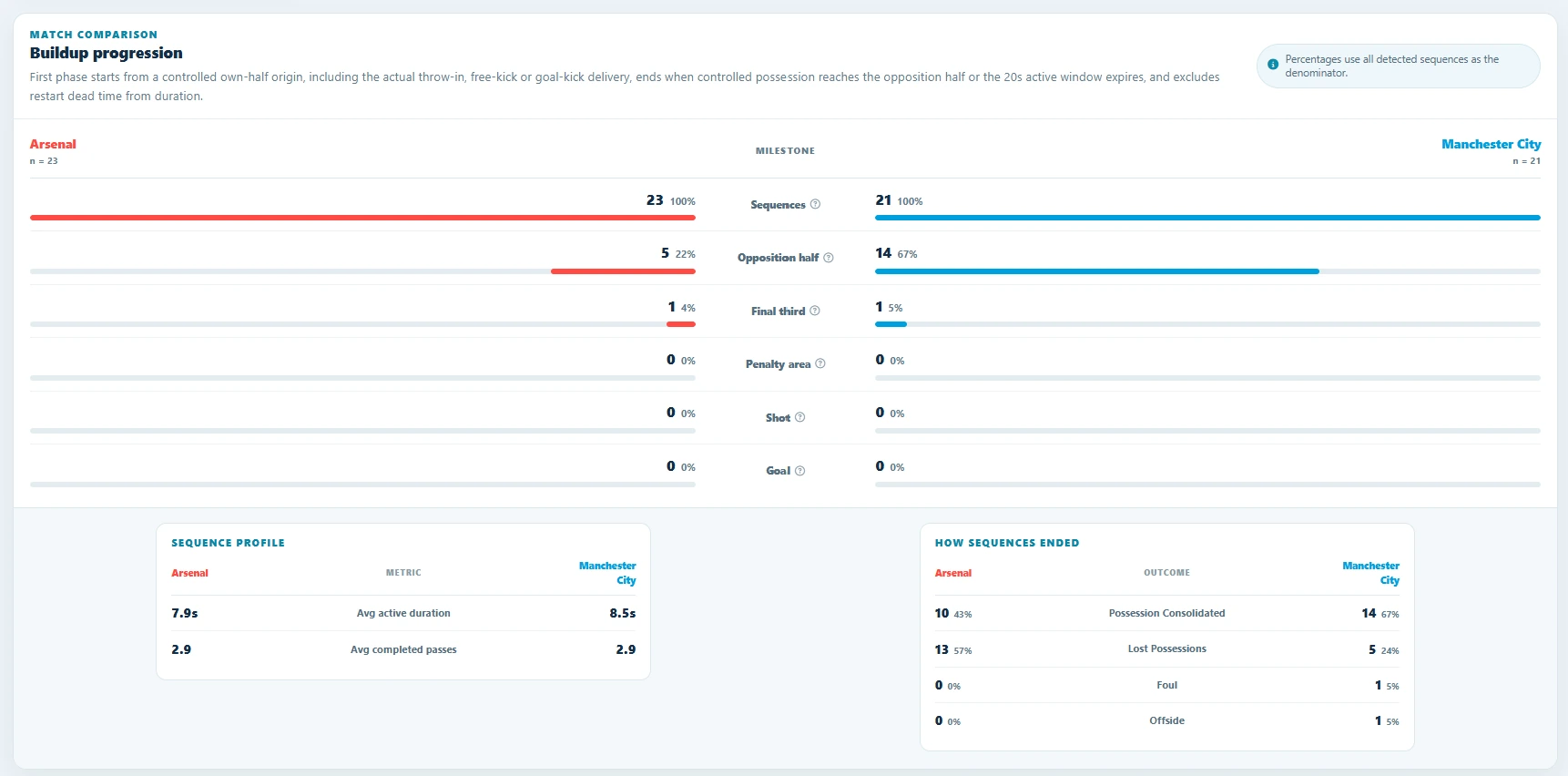
Arsenal can accept that difficulty because they have a second route: bypass the first press directly with a long ball.
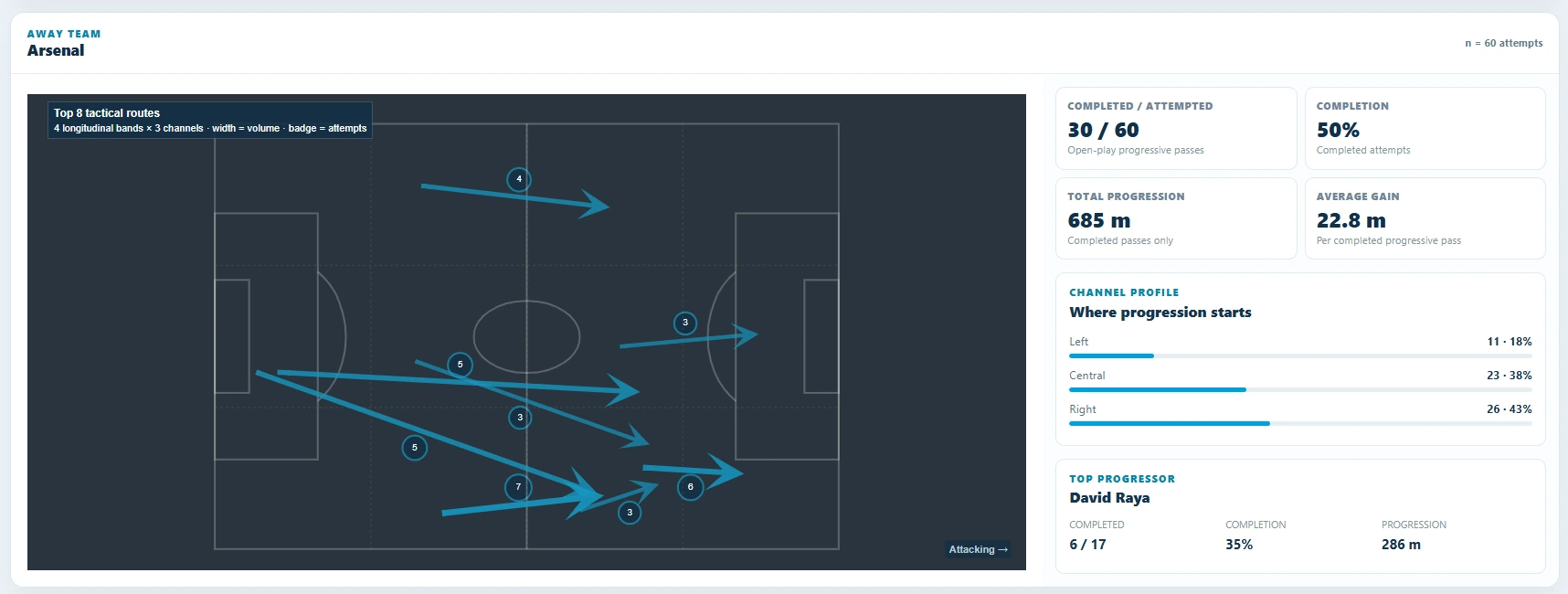
Arsenal choose that solution frequently from the start of the move: 46% of the time against Aston Villa, 43% against Manchester City and 32% against Inter. Raya also contributes strongly to direct progression: his passes move Arsenal forward by 169 metres against Villa, 211 against City and 286 against Inter.
Napoli’s window appears when they beat Arsenal’s immediate pressure
The same structure that allows Arsenal to attack with many players can also give Napoli their moment.
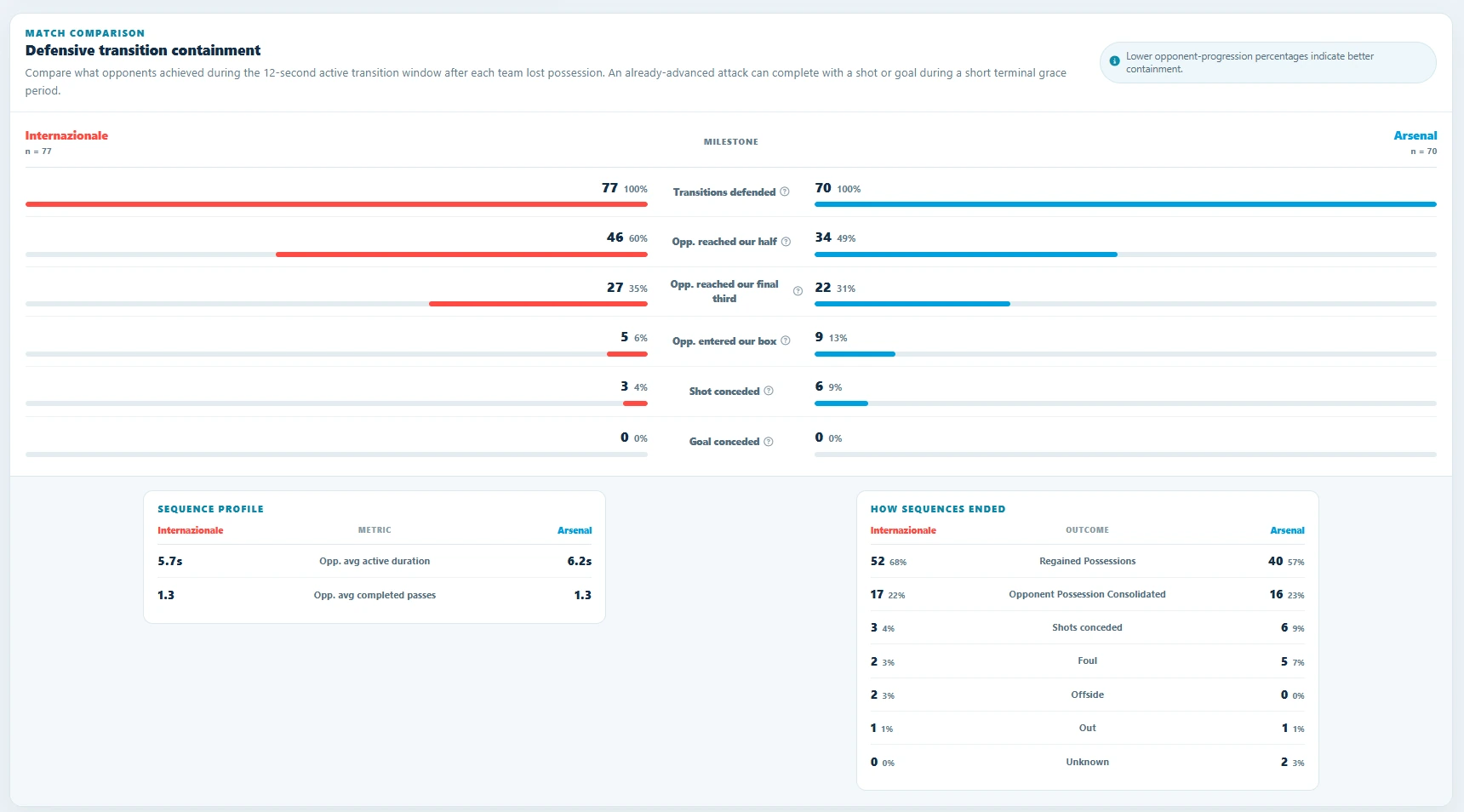
In defensive transition — the seconds immediately after losing the ball — Arsenal win it back straight away in 63% of the sequences analysed against Aston Villa and Manchester City and 57% against Inter. That immediate pressure makes any slow Napoli regain risky.
But it is not a closed door.
When opponents do escape that first pressure, they still reach the final third in 33% of cases against Aston Villa, 37% against Manchester City and 31% against Inter. Against Inter, 13% of those moves reach the box.
Napoli’s first three league matches show how much this phase can change from one game to another.
Against Como, Napoli produce 71 moves that begin immediately after winning the ball: 46 reach at least the opposition half, 26 the final third and 7 end with a shot. Against Inter the problem is the opposite: 47 of 67 such moves, 70%, end with another loss of possession; only 9 allow Napoli to keep the ball in a stable way.
Against Arsenal, then, keeping the ball may not be the first objective. It could matter more to find the free player beyond the first pressure immediately and then accelerate: a third-man support, a reception between the lines or a quick switch of play.
Lobotka and De Bruyne can offer different but complementary functions here. The first can help Napoli find the way out of the initial pressure; the second can raise the quality of the next action. The point is not to assign them an automatic solution, but to avoid wasting the regain in the area where Arsenal are trying to win the ball back immediately.
Arsenal’s strong right-side orientation also opens one hypothesis to test: when they lose the ball after committing players around Saka’s side, the opposite flank may become the first space to look for. The available data are not enough to call this a structural weakness. It is, however, a tactical matchup worth watching.
Four things to watch
- How deep will Napoli choose to defend?
The main scenario is a mid-to-low block, but its effectiveness will depend on Napoli staying compact without being shifted around by Arsenal’s right-side rotations. - What kind of receptions will Ødegaard get?
More than distance from goal, body orientation, pressure received and his connection with Saka will matter. How often can he receive between the lines already ready to play forward? - When Napoli step high, what happens after Raya goes long?
The press can disrupt the first phase, but the real duel may move to the second ball and the distances behind Napoli’s first line. - When Napoli beat Arsenal’s immediate pressure, can they accelerate?
The window exists, but it is short. The post-match will have to check whether Napoli regains become forward progress or another immediate turnover.
Two risks, one match
Napoli–Arsenal may force Allegri to live with two opposite risks.
If Napoli stay in their block, Arsenal will have time to search for the rotations that move the defence, especially around Saka and Ødegaard. If Napoli decide to step out, the press has to come with control of depth and the second ball, because Raya can bypass the first line directly.
So this is not simply a choice between pressing and waiting.
The match may lie in Napoli’s ability to wait without becoming passive, step out without losing compactness and accelerate as soon as Arsenal give them the first real window.