
Probable Genoa XI
Bijlow; Marcandalli, Østigård, Vásquez; Norton-Cuffy, Frendrup, Sow, Ellertsson; Baldanzi, Vitinha; Colombo.
The opening round makes any pre-match analysis more uncertain than usual. Napoli 2026/27 do not yet have a competitive track record: a new coach, new mechanisms and no league match to use as a sample. That makes the opponent the more stable starting point. Genoa have retained De Rossi and, at least in the probable pre-match XI, many of the players who shaped the previous season.
The question is therefore not “exactly how will Genoa play?”, but a more useful one: which problems have they consistently tried to create, and which of those are likely to survive the summer?
Limited control on the ball, far more aggression without it
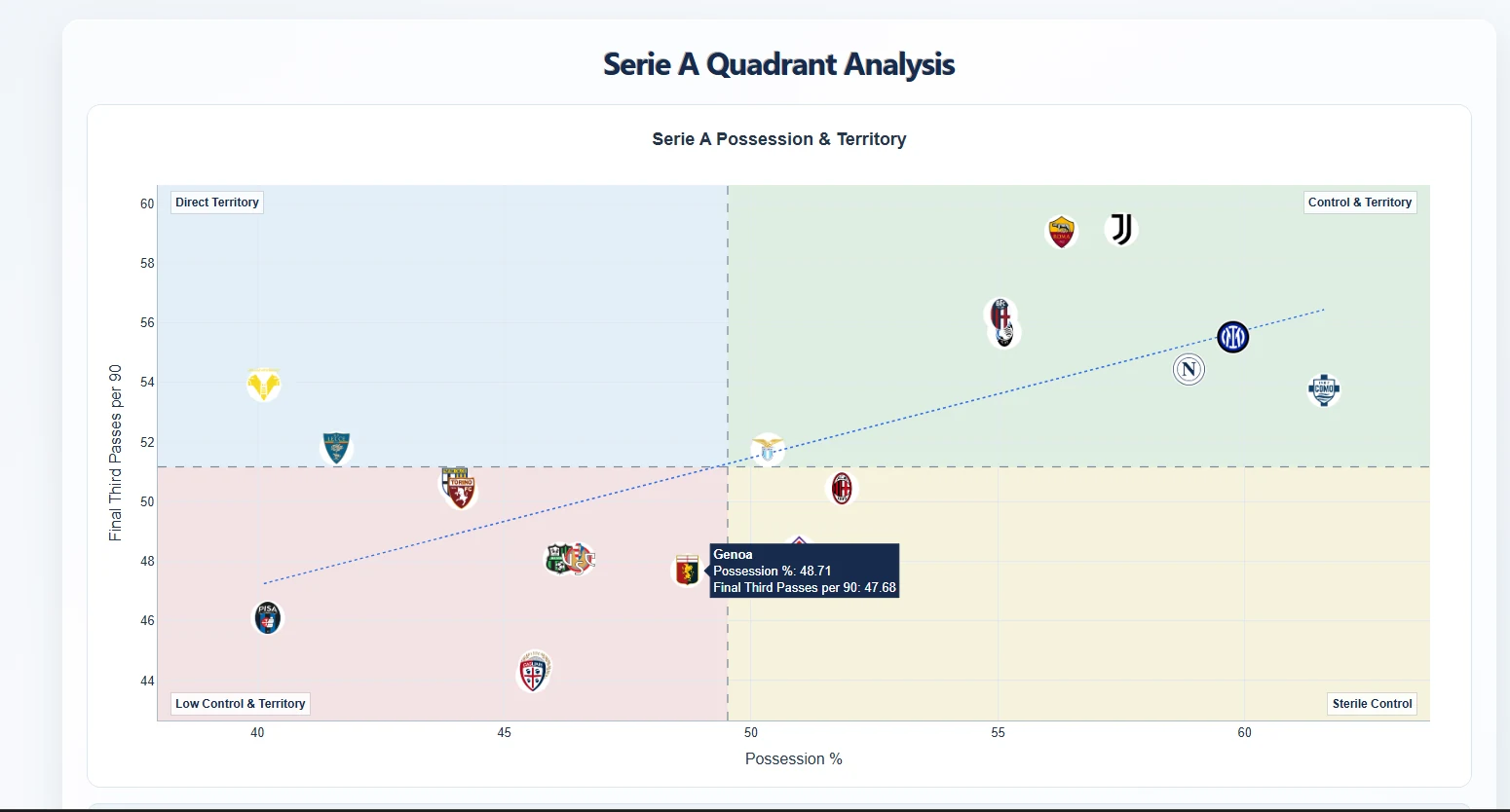
Genoa's 2025/26 statistical profile describes an unusual side. Their average possession was 48.7%, pass completion stopped at 80.5%, and their volume of final-third passes was among the lowest in Serie A. This was not a team built to control matches through long possession sequences.
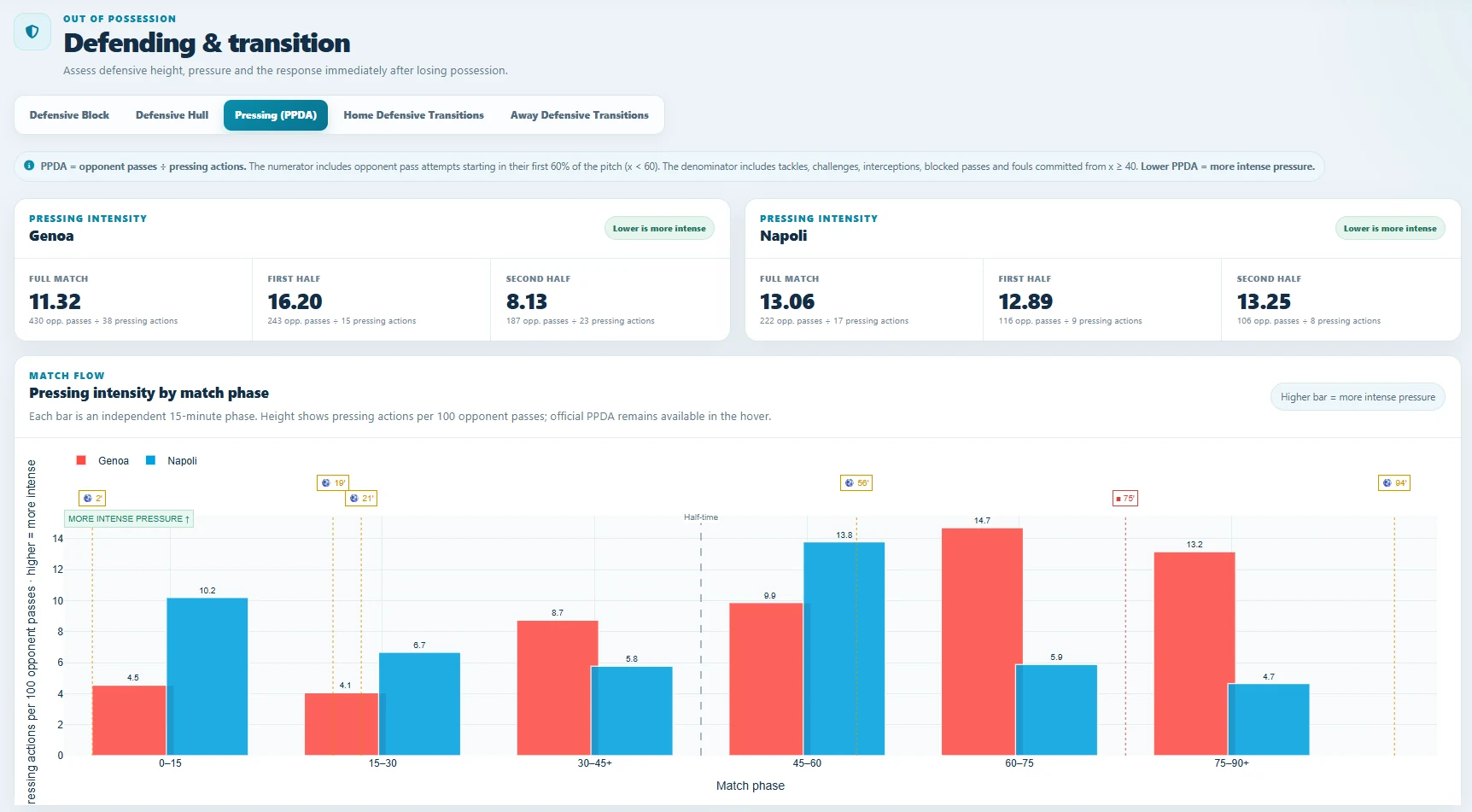
The picture changes when the ball belongs to the opponent. With a PPDA of 11.13, Genoa ranked among the league's more aggressive pressing sides.
Pressing is part of the identity, but the intensity changes with the match state
The latest head-to-head almost perfectly confirms the seasonal number. In Genoa-Napoli on 7 February 2026, Genoa's PPDA was 11.32, almost identical to their season average of 11.13.
The aggregate hides a huge difference between the two halves: 16.20 in the first and 8.13 in the second. Genoa significantly increased their pressure after the break, with peak activity between the 60th and 75th minutes. Rather than a constant high press, the picture is of a side able to modulate its intensity and raise it quickly when the context demands it.
There is an important qualification. Genoa's first goal comes virtually from kick-off, after only seven seconds. The striker's pressure disrupts Alessandro Buongiorno in the first phase: the defender tries to play back towards Meret, Vitinha steals the ball, attacks the goalkeeper immediately and wins the penalty for 1-0.
The episode is a reminder that average pressing intensity and the quality of an individual pressing trigger are not the same thing. Genoa may not attack every possession with the same intensity, but can become extremely aggressive when they recognise a favourable situation. One match is not enough to code those triggers with certainty, but it already highlights the problem Napoli will need to solve.
When Genoa build, they look for verticality quickly
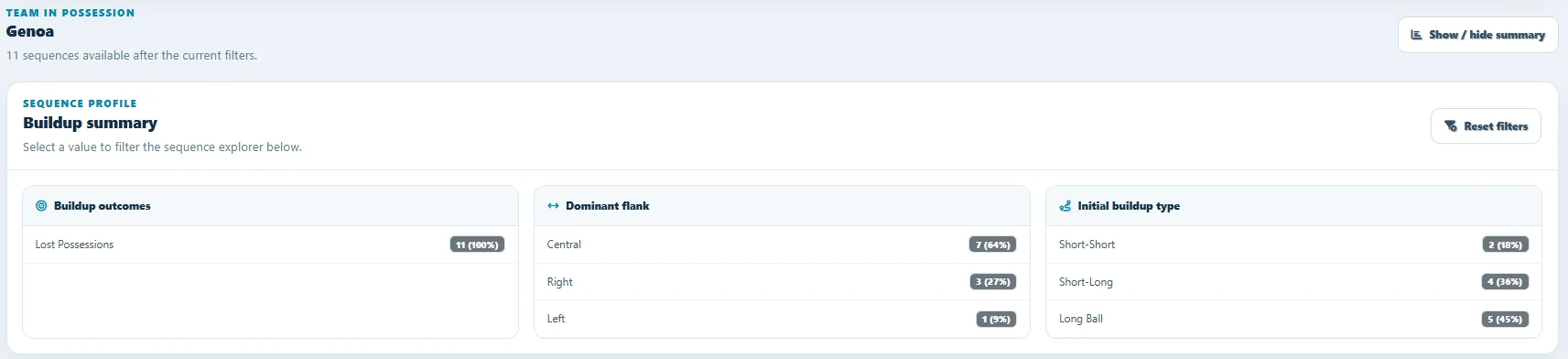
Genoa do not need to develop long sequences from the back. Against Napoli, 11 buildup sequences were identified.
- Short-short: 2 — 18%
- Short-long: 4 — 36%
- Long ball: 5 — 45%
In other words, 9 of 11 buildups — 81% — introduced a long solution early. Only 36% of the sequences reached the opposition half and just 18% the final third; none led directly to a shot.
The tactical point is not simply that Genoa “play long”. The long ball can be an intentional solution to avoid progressing through multiple passing lines.
Napoli therefore cannot judge the quality of their press only by the number of high regains. If the pressure forces Bijlow long but Genoa consistently win the second ball, the plan is still working for the home side.
Progression comes mainly from the first line
The progressive passing numbers reinforce that reading. Against Napoli, Genoa recorded 71 attempts, 31 completed, a 43.7% completion rate and 741 metres of total progression gained.
The more interesting detail is who provides that progression. Vásquez, Marcandalli, Østigård and even goalkeeper Bijlow appear among the leading progressive passers. With 173 metres, Bijlow gained more ground through progressive passing than any other player.
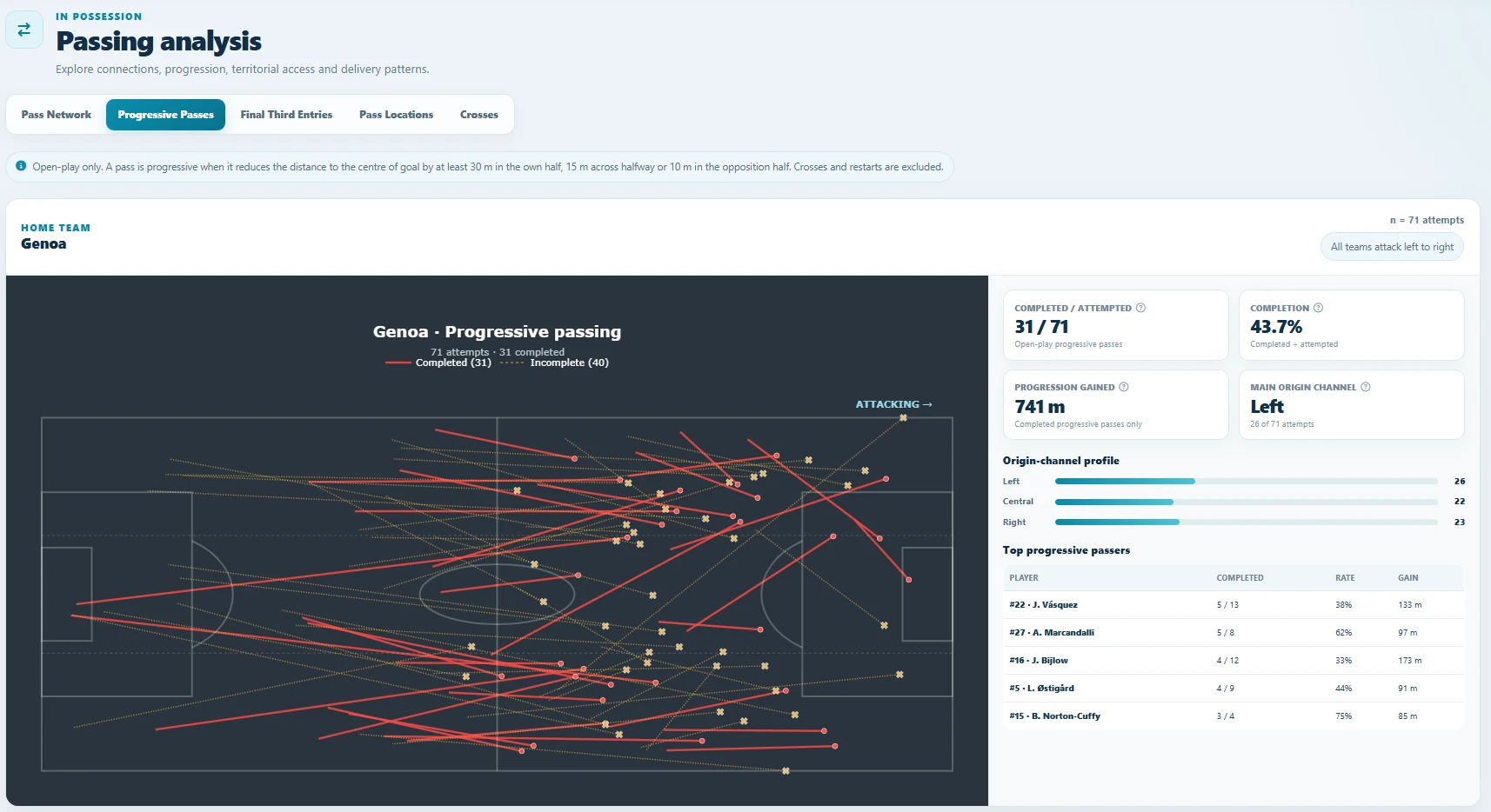
Napoli's press will therefore need to control both the ball carrier and the possible vertical destination. Blocking the short pass without managing what happens behind the first line of pressure may be exactly what Genoa want.
The final third is reached mainly through the sides
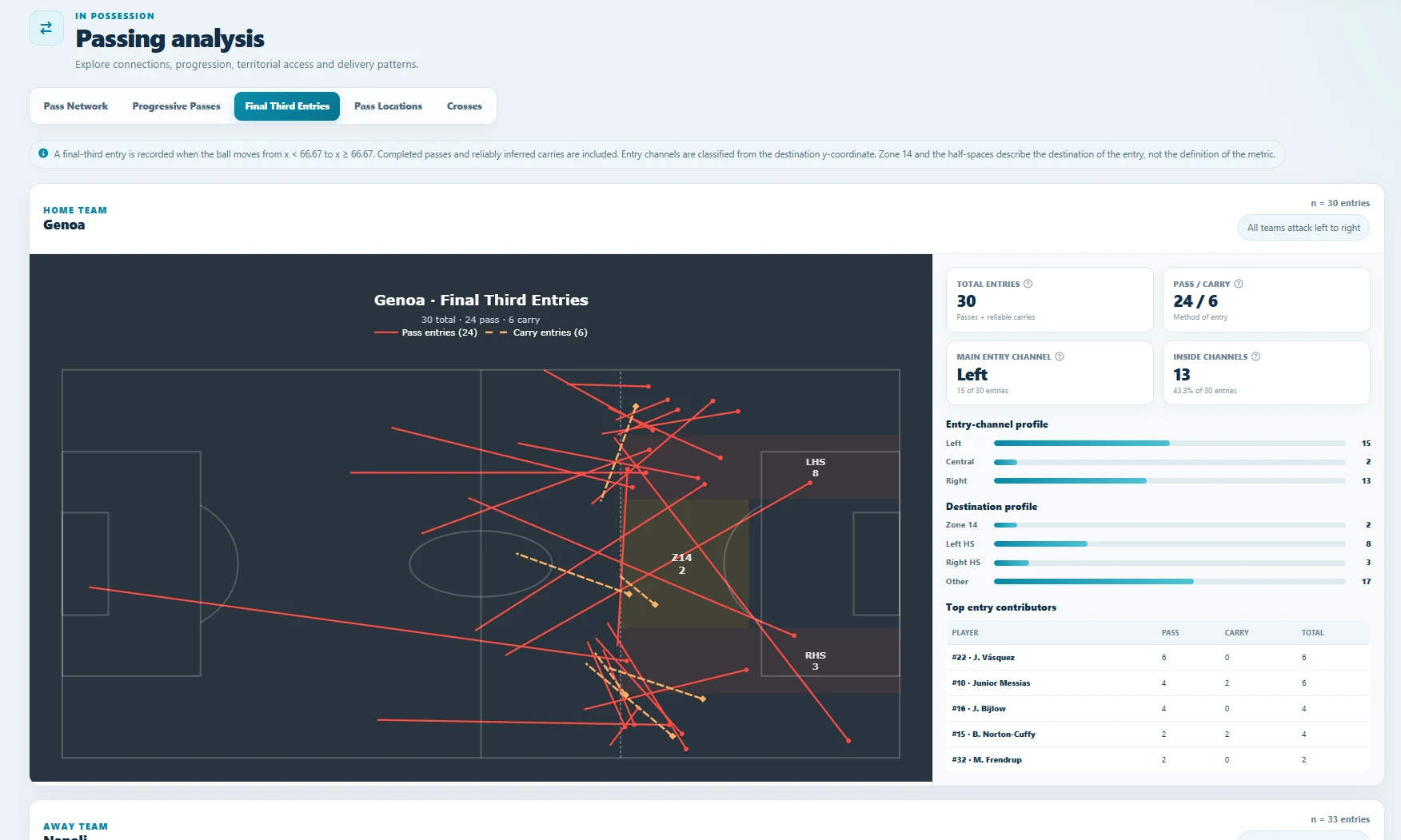
Final-third access shows another very clear direction. In the previous meeting Genoa recorded 30 total entries:
- 15 on the left;
- 2 through the centre;
- 13 on the right.
Twenty-eight of the thirty entries therefore came through wide areas. In the more advanced zones, there were also eight entries through the left half-space, three through the right half-space and only two through zone 14.
The crossing data is consistent with the same pattern: 27 Genoa crosses to Napoli's 8, with 23 of Genoa's coming in open play. Vitinha, Aarón Martín, Malinovskyi and Norton-Cuffy were among the main crossers, so this does not appear to be a solution tied to a single specialist.
The overall pattern becomes recognisable: first line → verticality → flank or half-space → cross.
When Genoa regain the ball, they look for goal immediately
This is probably the most important point in the analysis. In the latest Genoa-Napoli, 76 Genoa attacking transitions were detected. Within 12 seconds of the regain:
- 75% reach the opposition half;
- 43% reach the final third;
- 9% enter the penalty area;
- 11% produce a shot.
The average duration is just 5.5 seconds, with only 1.0 completed passes per sequence.
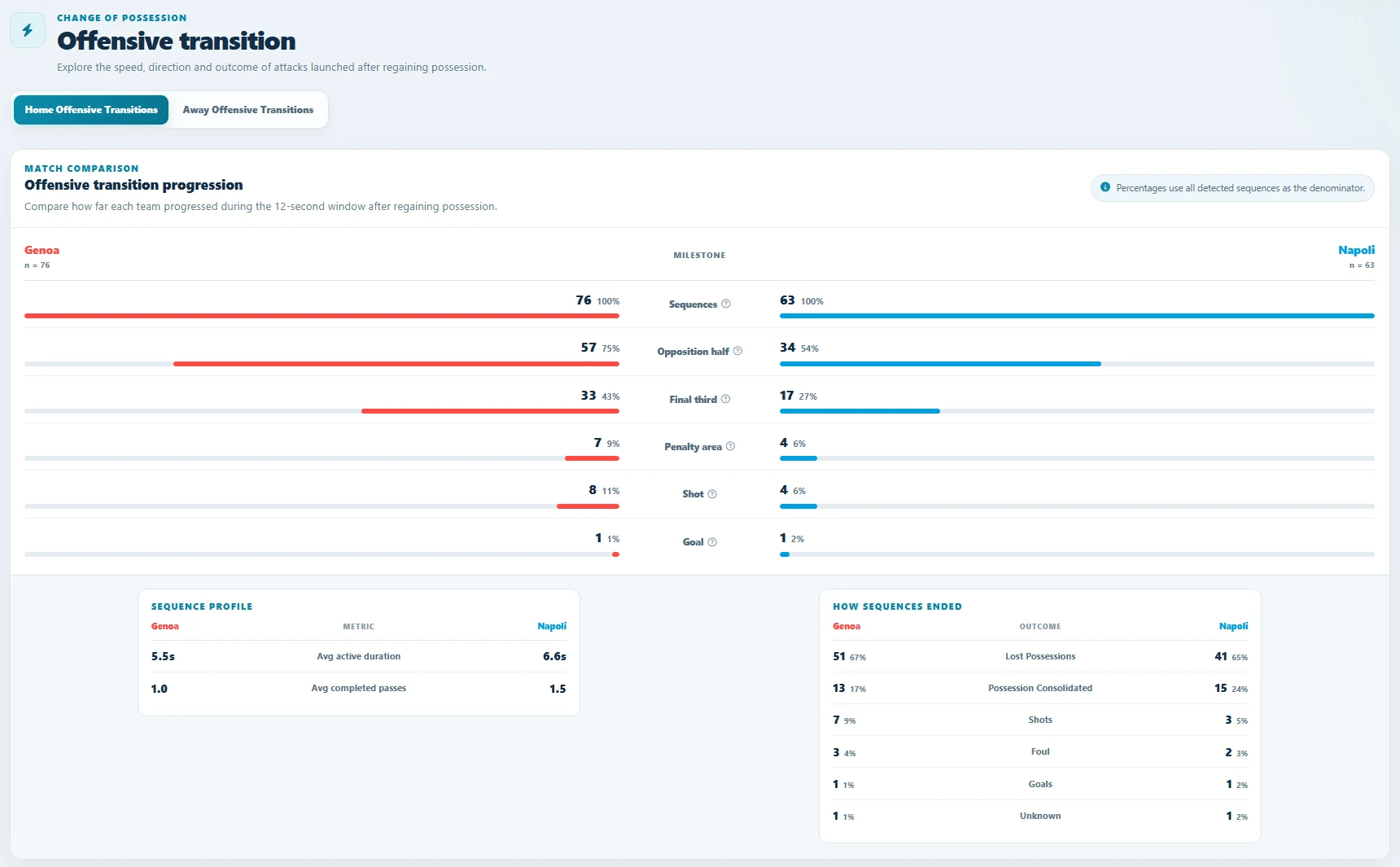
Those numbers describe a team that does not necessarily need to consolidate possession after a regain. But the principle becomes clearest in the two goals Genoa scored against Napoli.
The first goal: pressure, error, penalty
Around seven seconds after kick-off, pressure on the first phase puts Buongiorno in difficulty. Vitinha wins the ball, attacks Meret immediately and earns the penalty converted by Malinovskyi.
The second goal: another high regain and direct attack
In the 56th minute, the dynamic is strikingly similar. Buongiorno is again put under pressure while managing the ball; Colombo steals it and can attack Meret directly, beating him one-v-one.
Two different goals in form, but generated by the same macro-principle: first-phase error → regain → immediate attack on goal.
It would be too strong to conclude that De Rossi had specifically identified Buongiorno as a weakness: two incidents against the same player are not enough to prove that. A more robust conclusion is that Genoa showed an ability to turn opposition first-line errors into very high-value chances at speed.
Where can Napoli find space?
Opponent analysis is not only about understanding what the opposition wants to do. It should also suggest where opportunities may emerge.
Genoa 2025/26 showed a particularly interesting defensive combination: relatively aggressive pressure, a volume of shots conceded not far from the league average, but a comparatively high average quality of chances allowed. In practical terms, the issue is not so much the absolute number of shots they concede, but that once the first pressing structure is beaten, Genoa tend to allow situations with a more dangerous average value.
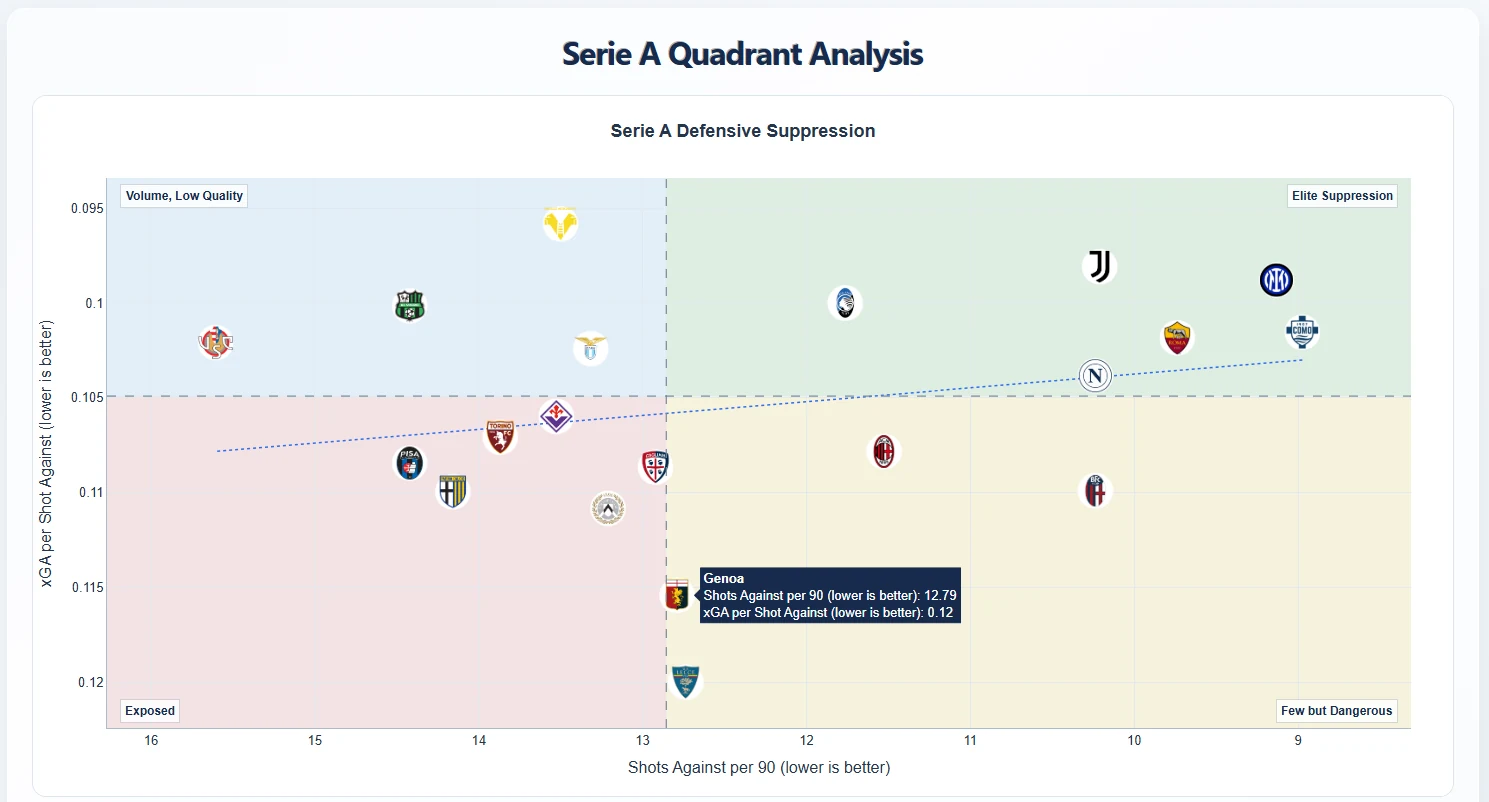
For Napoli, the key may therefore be not only to escape the first press cleanly, but to do so with the right quality and timing. If Genoa are drawn out of shape, the spaces that open can produce better chances than the raw shot volume conceded might suggest.
The latest Genoa-Napoli provides an example. McTominay's goal for 1-2 comes after a Genoa step-out or duel is beaten and Napoli can attack a structure that is no longer fully organised.
Once the first defender is eliminated, continuing with conservative passes could allow Genoa's block to rebuild. The most interesting window may be the moment immediately after the first line of pressure is beaten.
Three problems Napoli will probably need to solve
1. Protect the first phase
The precedent is clear: both Genoa goals came from regains while Napoli were managing the first line. Napoli will need to create superiority around the ball and, above all, always have a safe solution when Genoa activate the press.
2. Win the second ball
Forcing Genoa long does not necessarily mean winning the tactical duel. The structure around the landing point will probably be fundamental. The real objective is: force long → win the first ball → control the second.
3. Control the width without emptying the centre
In the latest meeting Genoa produced 28 wide entries out of 30 and 27 crosses. Preventing every cross is unrealistic. The quality of the defending will therefore depend on pressure on the crosser, occupation of the box, control of the weak side and management of the second ball outside the area.
What we don't know — and why it matters
This analysis does not attempt to describe with certainty the Genoa of 22 August. It is the opening round of the season, and over the summer De Rossi may have changed elements of the build-up, pressing triggers, half-space occupation, wing-back responsibilities and several details in transition.
For the same reason, specific set-piece patterns are not explored in depth. Genoa 2025/26 produced very interesting numbers from restarts, but corners, blocks, targets and individual responsibilities can change radically during a summer preparation period.
High: relatively aggressive pressure; limited territorial control through possession; significant progression from the first line.
Medium-high: quick search for verticality; importance of second balls; use of width; frequent crossing; immediate acceleration after regains.
To verify: specific pressing triggers; any side preference; new principles introduced during the summer; set-piece patterns; precise individual responsibilities.
A single Genoa-Napoli does not represent an entire season. Match data is therefore used mainly when it confirms the seasonal profile or as a concrete example of a behaviour, not as definitive proof.
Four things to watch on Saturday
- How early will Genoa look long?
If Napoli shut down the first short outlet, it will be worth watching whether Bijlow and the three centre-backs again try to bypass midfield quickly. - Who controls the second ball?
This could be one of the decisive tactical battles: forcing Genoa long means little if the next ball consistently falls back to the home side. - When will the press actually trigger?
Rather than simply asking whether Genoa press high, the more interesting question is which situations activate the aggression on Napoli's first phase. - What will Napoli do once the first press is beaten?
If Genoa retain some of their 2025/26 characteristics, that may be the moment when the most valuable spaces open.