
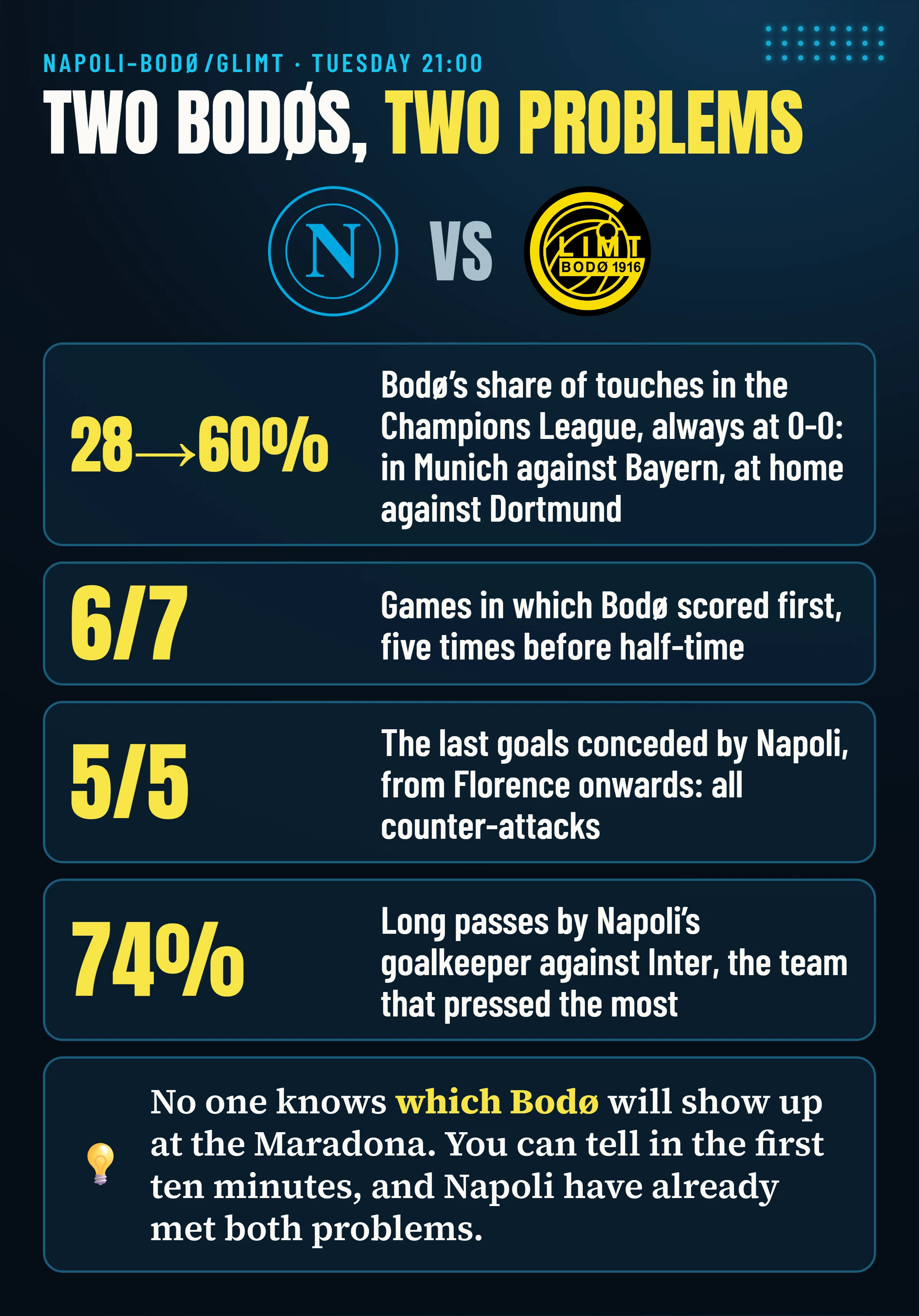
Napoli–Bodø/Glimt, on Tuesday at 21:00 at the Maradona, is the third matchday of the Champions League league phase. Napoli still have no points (0-1 against Arsenal, 1-3 at Villarreal) and come off the defeat at Venezia, the fifth in nine games. Bodø have three, after the 0-5 in Munich and the 1-0 against Dortmund, and are top of the table in Norway.
After the defeat at Venezia, Allegri said: “If you look at the results, it is normal that there can be concern, but we look at the performances.” This game, however, depends on a question that no data can answer: which Bodø turns up in Naples? In the Champions League they have played two, and they were two different teams. For each of them Napoli have already met a similar problem. Here we try to work out which ones, and how to recognise them while the game is on.
The news, one day before the game
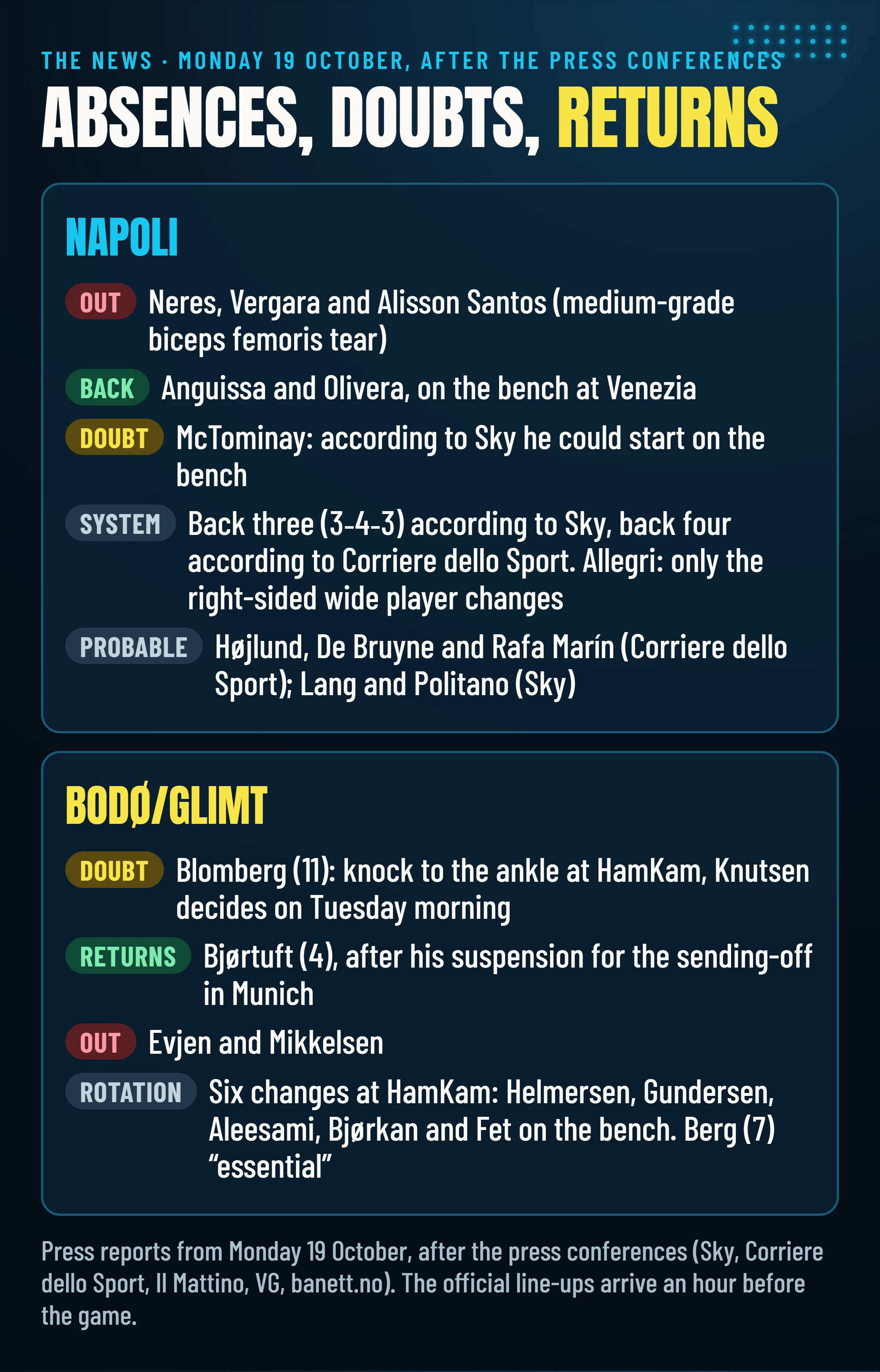
The news comes from the press and is updated to Monday 19 October, after the press conferences. The official line-ups arrive about an hour before the game.
Napoli have at least three absences and one doubt. Neres and Vergara are out; Alisson Santos, who returned at Venezia after 38 days out, has a medium-grade tear of the left biceps femoris, as the club announced. Anguissa and Olivera are back. McTominay, still not at his best, could start on the bench. Allegri has had the flu and missed training on Sunday, but spoke at the press conference on Monday; De Laurentiis has dropped the pre-match retreat.
The press is split on the system. According to Sky, Napoli will play with a back three in a 3-4-3 with Lang and Politano; according to Corriere dello Sport, Allegri is considering a back four, with Højlund (19), De Bruyne (11) and Rafa Marín (16) starting. At the press conference Allegri made clear that the difference is small: “Between three and four, only the wide player on the right changes.” With Di Lorenzo Napoli are more defensive, with one of Politano, Lang and Giovane (the names are his) more attacking.
Bodø have one doubt and one piece of good news. The doubt is Blomberg (11), who went off before half-time at HamKam with a knock to the ankle: Knutsen said he does not know whether he will play and that he will decide on Tuesday morning, after trying him in training (“it looks positive”). The good news is Bjørtuft (4), available again after his suspension for the sending-off in Munich. Evjen and Mikkelsen are missing. Knutsen also said that Berg (7) is essential in front of the defence and that Bodø will try to surprise Napoli.
On Saturday, at HamKam, Knutsen changed six starters and left Helmersen (9), Gundersen (6), Aleesami (5), Bjørkan (15) and Fet (19) on the bench: it is a clear clue as to who will play in Naples. The most likely line-up is the one that beat Dortmund, with Bjørtuft able to return to the defence.
Data sample. The analysis uses Bodø’s seven games (two in the Champions League and five in the Eliteserien, against much weaker opposition) and Napoli’s nine (seven in Serie A and two in the Champions League). For Bodø in Europe we have only two games: they point to a behaviour, not a rule.
One team, two heights
In the Champions League Bodø stayed at 0-0 for the whole first half, in both games. But each time they looked like a different team.
In Munich they defended deep: half of their defensive actions took place less than 24 metres from their own goal. They had 28% of the touches and a single shot in the first half, against Bayern’s twelve. Against Dortmund, at home, it was the opposite: a block at 44 metres, 60% of the touches, nine shots to one in the first 51 minutes. Then Sjøvold (20) scored from a cross by Auklend (8), Bodø dropped to 14 metres and Dortmund had 64% of the touches in the following 25 minutes and 74% in the last 16, shooting eight times.
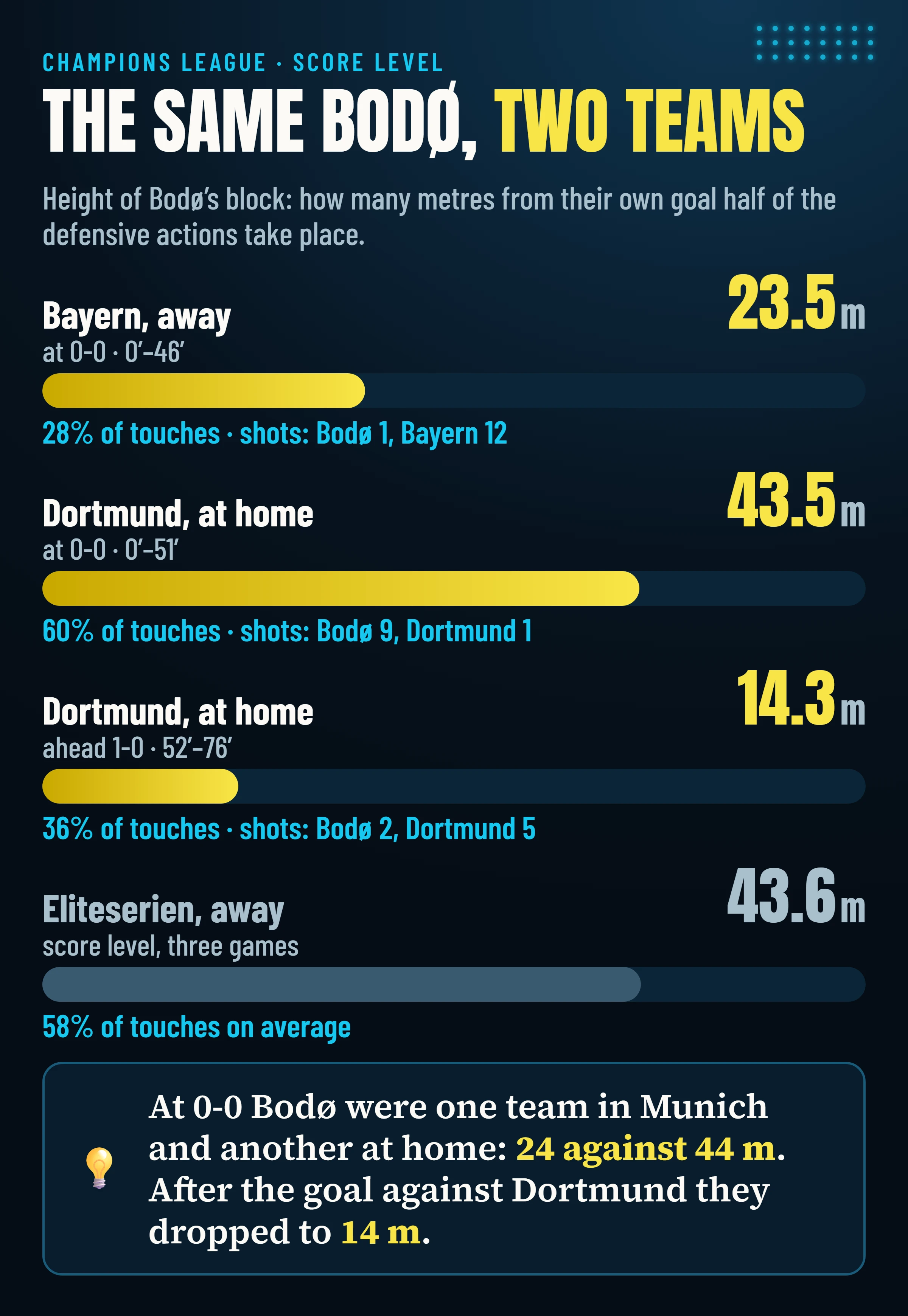
With two games, we cannot say what it depends on. In the league, away and with the score level, Bodø defend at about 44 metres: the low block in Munich seems tied to the opponent, Bayern, more than to playing away. Napoli are not Bayern, but they are not Fredrikstad either. That is why the first thing to watch in Naples is where Bodø defend in the first minutes. There is a clue in the set-up: Knutsen’s Bodø play a 4-4-2 by default (five games out of seven) and the 4-3-3, with an extra midfielder, they used only once, in Munich. Knutsen does not help: after the 0-5 in Munich (“I take responsibility for it”) he promised that in Naples “we will surprise you”.
Another thing Bodø often do, whatever the opponent: they score early. In six games out of seven they took the lead first, five times before half-time. The only time they conceded first was in Munich.
If Bodø press: the Inter precedent
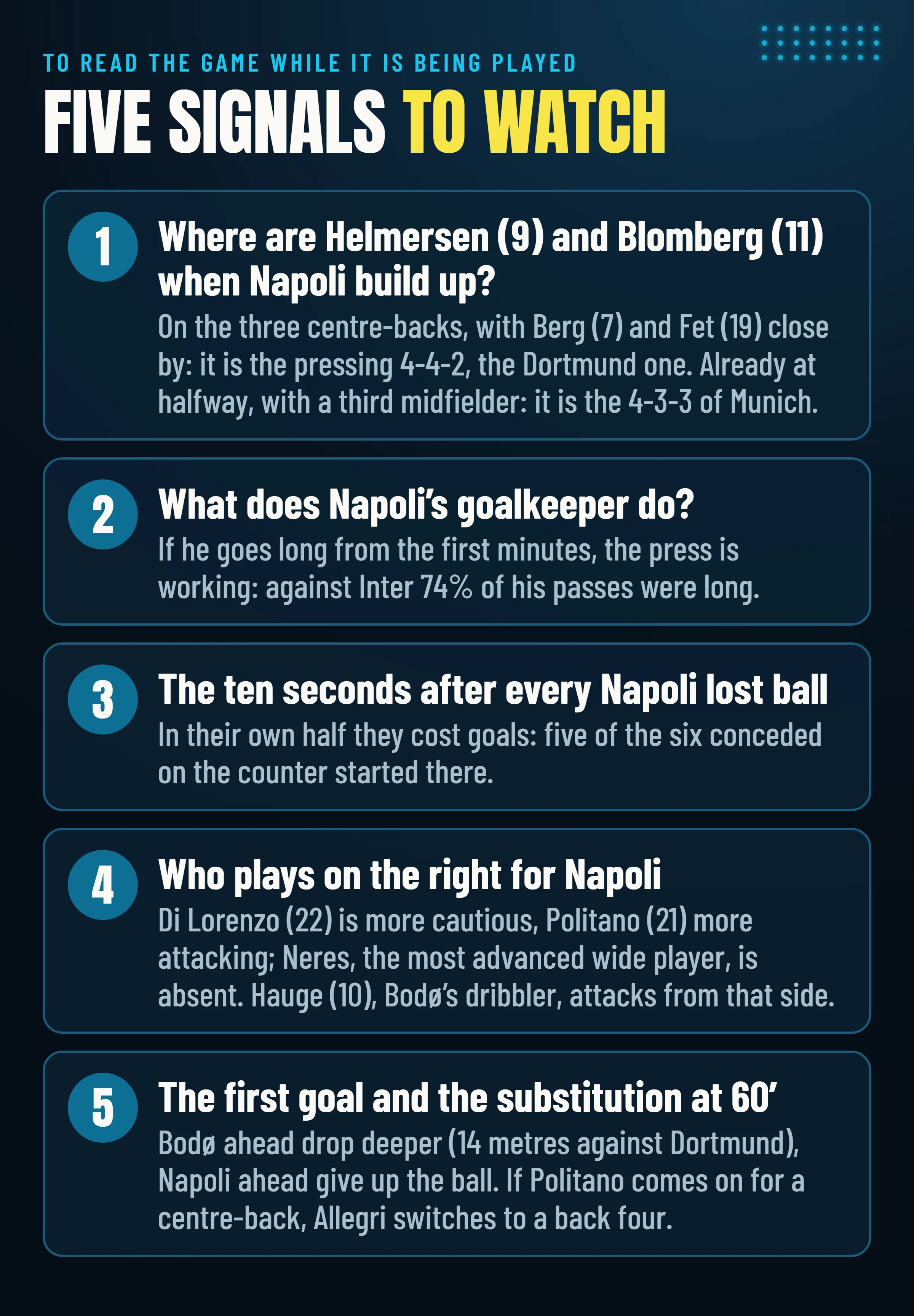
If the Bodø of Dortmund show up, two strikers will go up onto Napoli’s centre-backs. Napoli have already lived through a game like that: at San Siro against Inter, the team that pressed the most of the nine opponents. Pressing is measured with PPDA, how many passes you let the opponent make before stepping in: the lower the number, the more the team presses. Inter were at 8, the other eight between 13 and 36.
Against Inter, Napoli’s goalkeeper went long on 74% of his passes, Napoli lost the ball 45 times in their own third (in the other games between 7 and 26) and conceded 29 shots. They lost 3-2 after being two goals up.
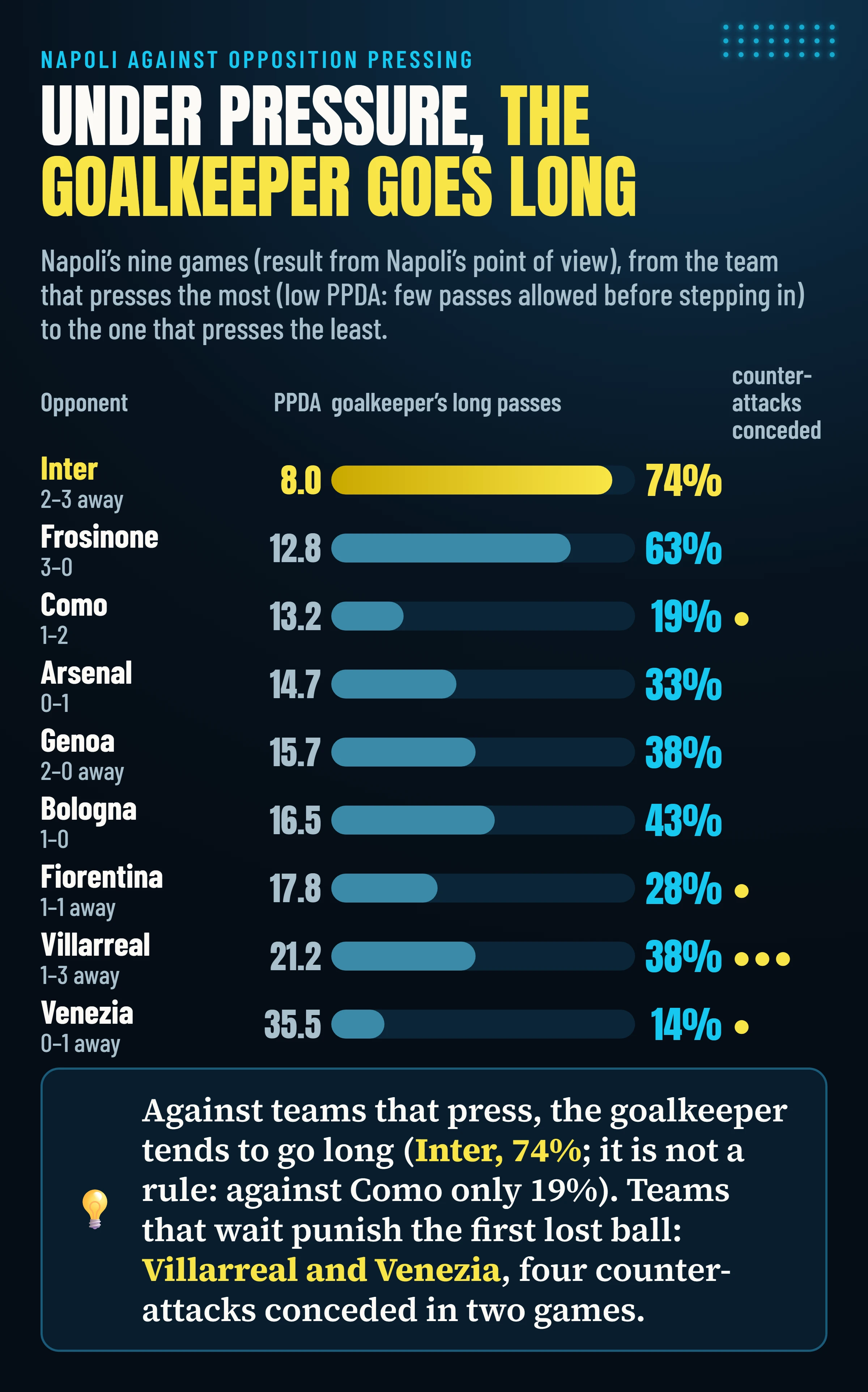
It is not a rule: against Como, who pressed almost as much as Frosinone, the goalkeeper went long on only 19% of his passes. But across the nine games the trend is there: the more the opponent presses, the more the goalkeeper goes long. Live, you can see it straight away. If Napoli’s goalkeeper kicks long already in the first minutes, Bodø’s press is working; if he finds a free centre-back and Napoli move up with the ball on the ground, they have beaten it.
If Bodø wait: the Villarreal and Venezia precedent
If instead the Bodø of Munich show up, Napoli will have the ball and must avoid losing it where they are most exposed. Allegri knows it: at the press conference he said that Bodø are “very good at playing with a low block and on the counter-attack” and that Napoli lack something “in some moments when we concede goals, as at Venezia and in Milan”. It is the problem that has cost them the most: of the eleven goals conceded this season, six are counter-attacks, and the last five (Fiorentina, Villarreal three times, Venezia) all are. By counter-attack we mean here a goal that came a few seconds after a lost ball.
The mistakes are different, the scene is similar. At Villarreal, in the 22nd minute, Politano (21) misplaces a pass on the right, 25 metres from goal, and three seconds later Mikautadze scores; three minutes later Rafa Marín (16) misplaces a long pass and Mouriño scores ten seconds later. At Como the goal comes two seconds after a pass from Rrahmani (13), ten metres from goal, is blocked. The exception is Venezia: Kike Pérez blocks a pass from Lucca (20) 67 metres from Meret’s goal and nine seconds later Adams scores.
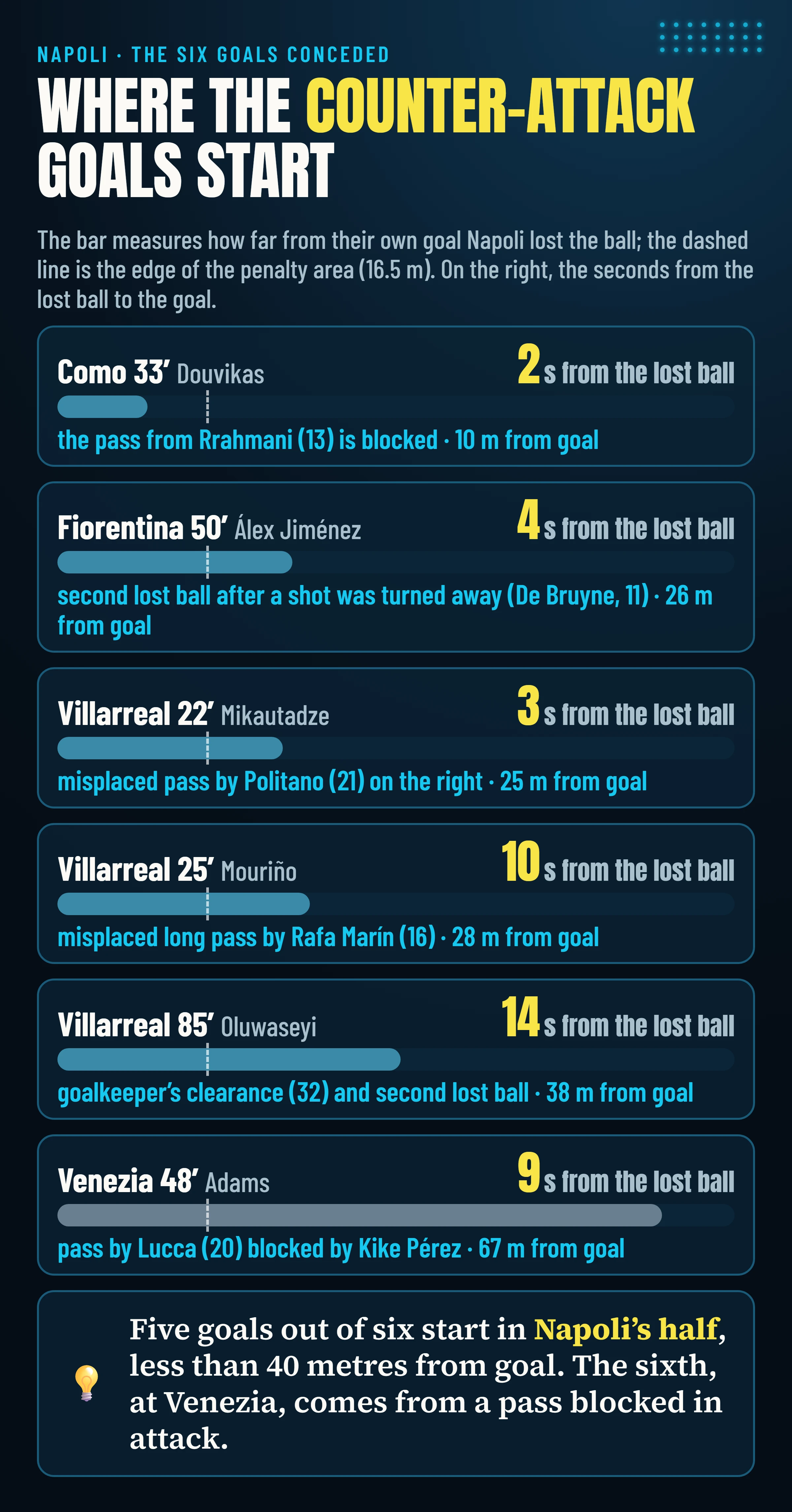
It is not a flaw of Napoli’s alone. Bodø also lose the ball 79 times per game on average, like Napoli, and after a lost ball in their own third they concede a shot 22 times out of 100 (Napoli 24). The difference is that Napoli, with those mistakes, have already lost points: at Como, at Florence, at Villarreal and at Venezia. And Bodø know how to counter-attack: four of their twelve goals came from a counter-attack, like Mvuka’s at HamKam, which started with Berg (7).
Live: the ten seconds after every Napoli lost ball in their own half. Who wins it, and where Hauge (10) and Blomberg (11) are at that moment.
Where the line-ups fit together
On the board we drew the 3-4-2-1 indicated by the previews and the 4-4-2 that is Bodø’s default set-up. Napoli have played with a back four in six games out of nine and with a back three in the last three (Frosinone, Villarreal, Venezia): with the back three all four goals conceded were counter-attacks, with the back four two out of seven. These are small samples. With the back three the right wing-back has been Di Lorenzo (Frosinone, Venezia) or Politano (Villarreal, with Di Lorenzo moved to the left); the most advanced wing-back, almost a third striker, was Neres, who is now missing. Lang has played on the left or as a centre-forward. On the board there are three points of contact.
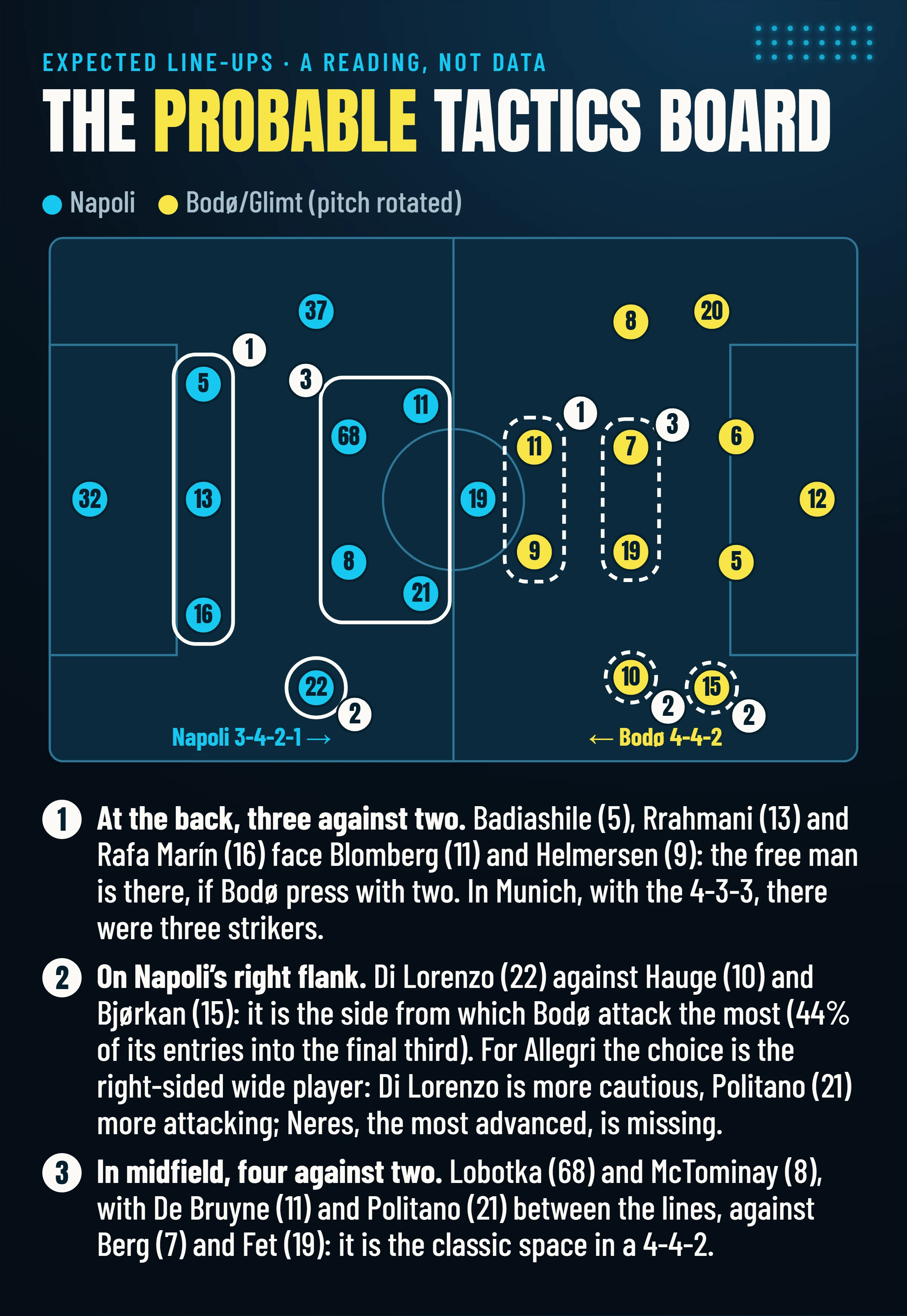
Note. This is a reading of the probable line-ups, not a measured figure: the official line-ups may change it.
Six players to watch
Three players per team show where the game may go. The numbers are per 90 minutes and come from all the games analysed.
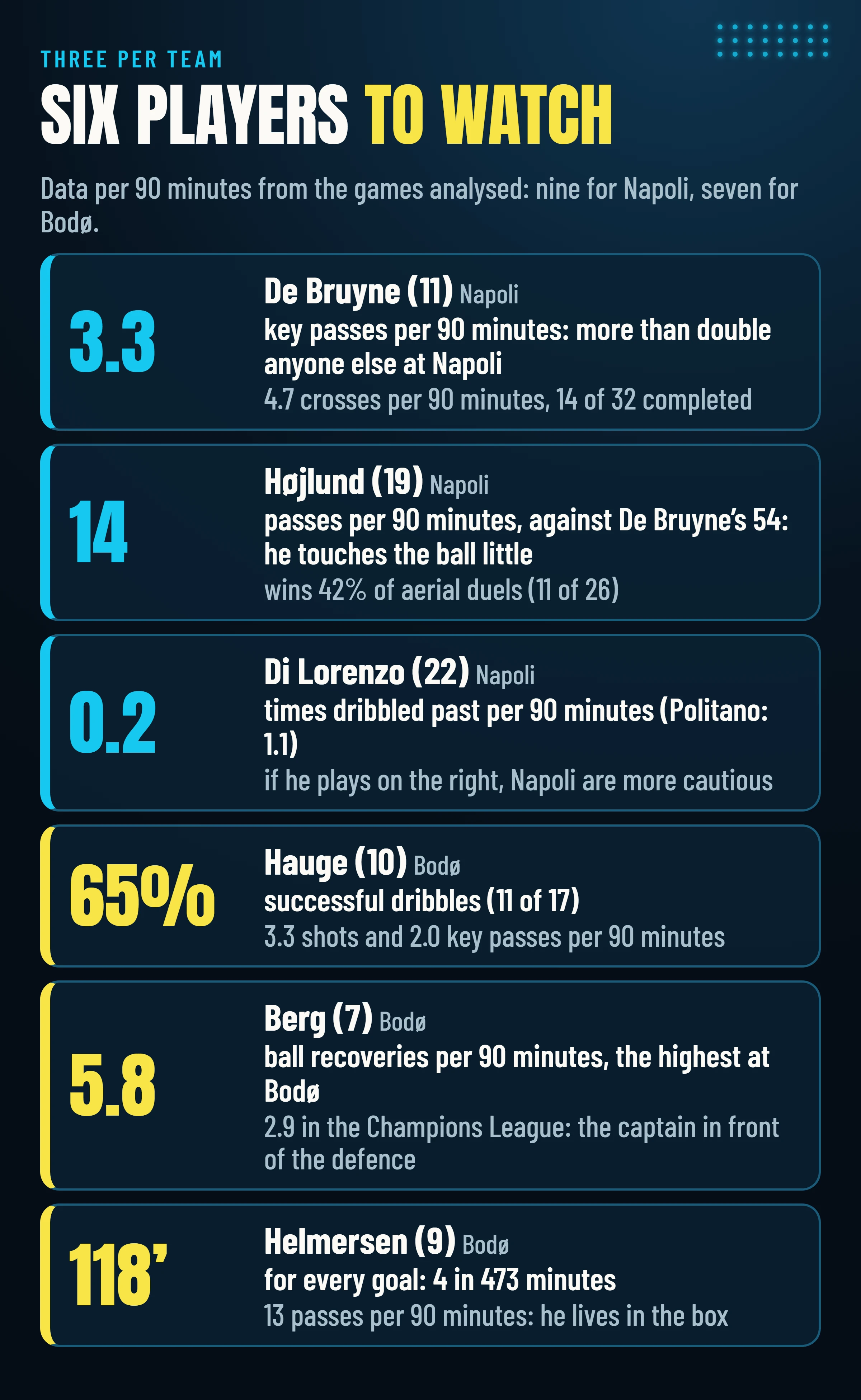
De Bruyne (11) is the one who creates most consistently: 3.3 key passes per 90 minutes, more than double anyone else at Napoli (among those who have played at least 300 minutes). He has started five games out of nine; in the other four he came on between the 53rd and 66th minute. Against a 4-4-2 he is the one who can receive where the two midfielders cannot reach.
Højlund (19) has not scored since 5 September, six games. He touches the ball little: 14 passes per 90 minutes, against De Bruyne’s 54, and wins 42% of his aerial duels. Bodø’s centre-backs win more of them (Aleesami 6 of 9, Gundersen 9 of 14, Bjørtuft 11 of 20): the cross is not the best terrain for him.
Di Lorenzo (22) and the right flank: Allegri said that the choice between a back three and a back four comes down to the right-sided wide player. Di Lorenzo is dribbled past 0.2 times per 90 minutes, Politano (21) 1.1: with the first Napoli are more cautious, with the second more attacking. Without Neres, the most advanced wide player, the choice is between those two.
Hauge (10) is Bodø’s dribbler: 11 successful dribbles out of 17 (65%), 3.3 shots and 2.0 key passes per 90 minutes. He has started only four games out of seven; if he starts, he attacks from the left, that is, on exactly the side where Napoli have their right wing-back: it is the duel to watch.
Berg (7) is the captain and the midfielder in front of the defence: 5.8 ball recoveries per 90 minutes, the highest at Bodø (2.9 in the two European games). Knutsen said he is managing him alongside the Norway national team and that he needs him: after every Napoli lost ball he is the first man to watch.
Helmersen (9) has scored four goals in 473 minutes, one every 118, but touches the ball little (13 passes per 90 minutes): against Dortmund 38% of his touches were followed by an opposition challenge, against 12% for the team. The duel is with Rrahmani (13), who wins 67% of his aerial duels (37 of 55).
Where the game can be decided
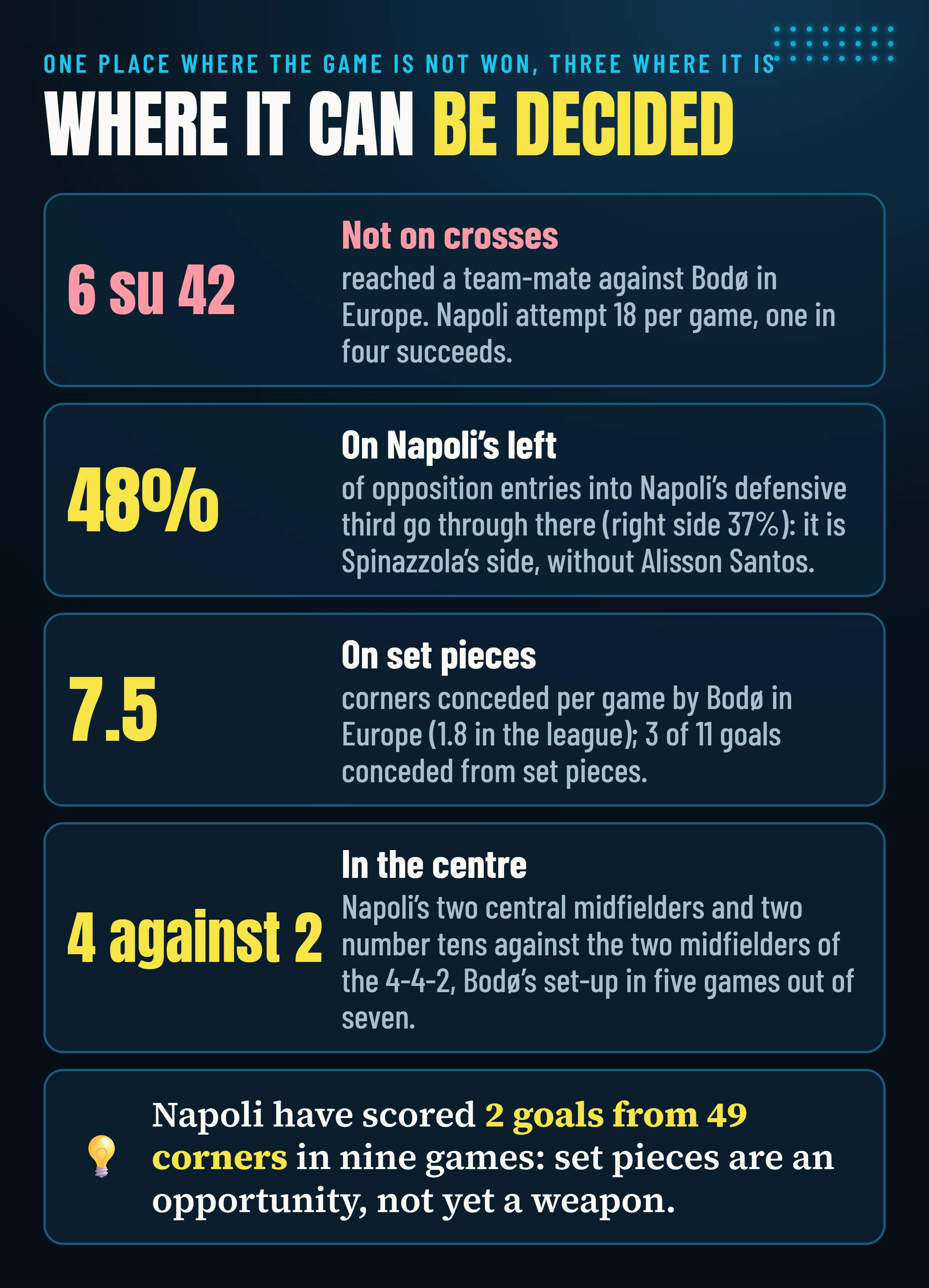
Four places, and one where the data say not to look.
Not on crosses. Napoli attempt 18 per game and one in four finds a team-mate (163 in nine games, 40 successful). Bodø, in Europe, have conceded 42 and only 6 reached a team-mate (3 of 27 against Dortmund, 3 of 15 against Bayern). Højlund wins 42% of aerial duels against centre-backs who win more than half of theirs.
On Napoli’s left. 48% of opposition entries into Napoli’s defensive third go through there, against 37% on the right: it is Spinazzola’s side, without Alisson Santos. Sjøvold (20), Bodø’s right-back, is the one who builds the most (86 passes per 90 minutes, 16.6 of them forward by at least ten metres) and plays on exactly that side.
On set pieces. Bodø, defending deep, concede corners: 7.5 per game in Europe against 1.8 in the league, and three of the eleven goals they have conceded come from set pieces (Kane and Davies in Munich, Alvheim against Kristiansund). Napoli take 5.4 per game but have scored only two from 49.
In the centre. It is point 3 on the board: four against two, if Bodø play a 4-4-2.
If the game changes: personnel and set-up
The first goal and the substitutions: there are precedents for both teams.
If Napoli score, they tend to give up the ball: 46% of the touches when ahead against 52% with the score level, and 12 touches in the final third every ten minutes against 20. Against Inter, when they were ahead, they dropped to 22-28% of the touches and at Villarreal to 41%; against Bologna and Frosinone, two wins, they stayed above 50% on average. Bodø, when chasing the game, push up: against Brann, from the 68th to the 83rd minute, 87% of the touches and a block at 50 metres. Two Napoli goals (Genoa 86′, Frosinone 93′) came with the opponent chasing the game.
If Bodø score, they drop deeper: against Dortmund, a block at 14 metres and 36% of the touches (in the league, when going ahead, it falls from 46 to 38 metres). Napoli attack in waves, as at Venezia: 74% of the touches and twenty shots in 46 minutes, without scoring.
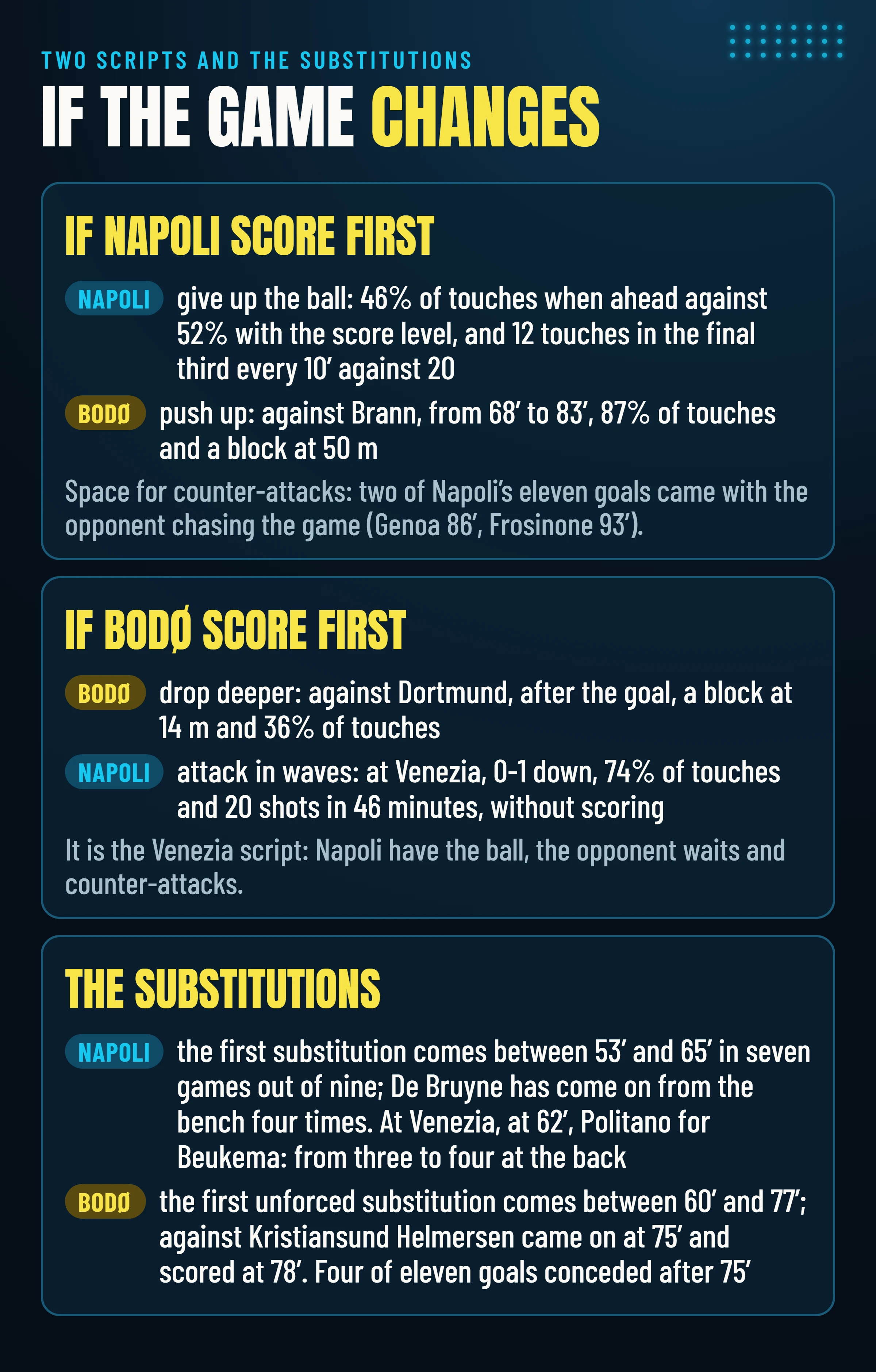
Allegri makes his first substitution between the 53rd and 65th minute in seven games out of nine, often several at once: at Venezia, in the 53rd minute, Højlund, Alisson Santos and De Bruyne together, in the 62nd Politano for Beukema, that is, from three to four at the back. Without Alisson Santos, Neres and Vergara, writes Corriere dello Sport, Napoli have fewer players “able to change the pace”.
Knutsen substitutes later, with the first unforced change between the 60th and 77th minute, and from the bench come Brynhildsen (17), Saltnes (14) and Mvuka (22). Against Kristiansund Helmersen came on in the 75th minute and scored in the 78th. Bodø have conceded four goals out of eleven after the 75th minute: Munich three times, Sandefjord in the 90th.
The five signals to watch on Tuesday
Two Bodøs, two problems
In Europe Bodø have been two teams: one that presses and takes control, one that waits and defends deep. Napoli have already paid a bill with each. Against the side that presses, they went long and lost the ball in their own third; against the side that waits, the first lost ball became a goal. There are few ways to win: not crosses, but the centre, set pieces and the left side that needs protecting.
No one knows which Bodø will show up at the Maradona, but you can tell in the first ten minutes: watch where their two strikers stand when Napoli build up from the back.