
Before the match we had framed one simple question: who would decide where, when and at what speed Napoli–Como would be played?
The game produced a fairly clear answer.
Como won 2-1 at the Maradona, but the scoreline tells only part of the story. Cesc Fàbregas' side finished with 645 passes to Napoli's 480, 89.5% pass completion and 21 shots to 13.
Above all, the first half unfolded inside the type of game Como prefer.
Then the picture changed. Napoli pushed higher, Allegri changed personnel and shape, and Como gradually lowered their average position.
But they did not simply stop playing. They changed the way they controlled the match.
That is probably the best key for reading the 2-1 at the Maradona.
The first half is played on Como's terms
One of the pre-match points was that Como were unlikely to come to the Maradona simply to defend.
The game went even further.
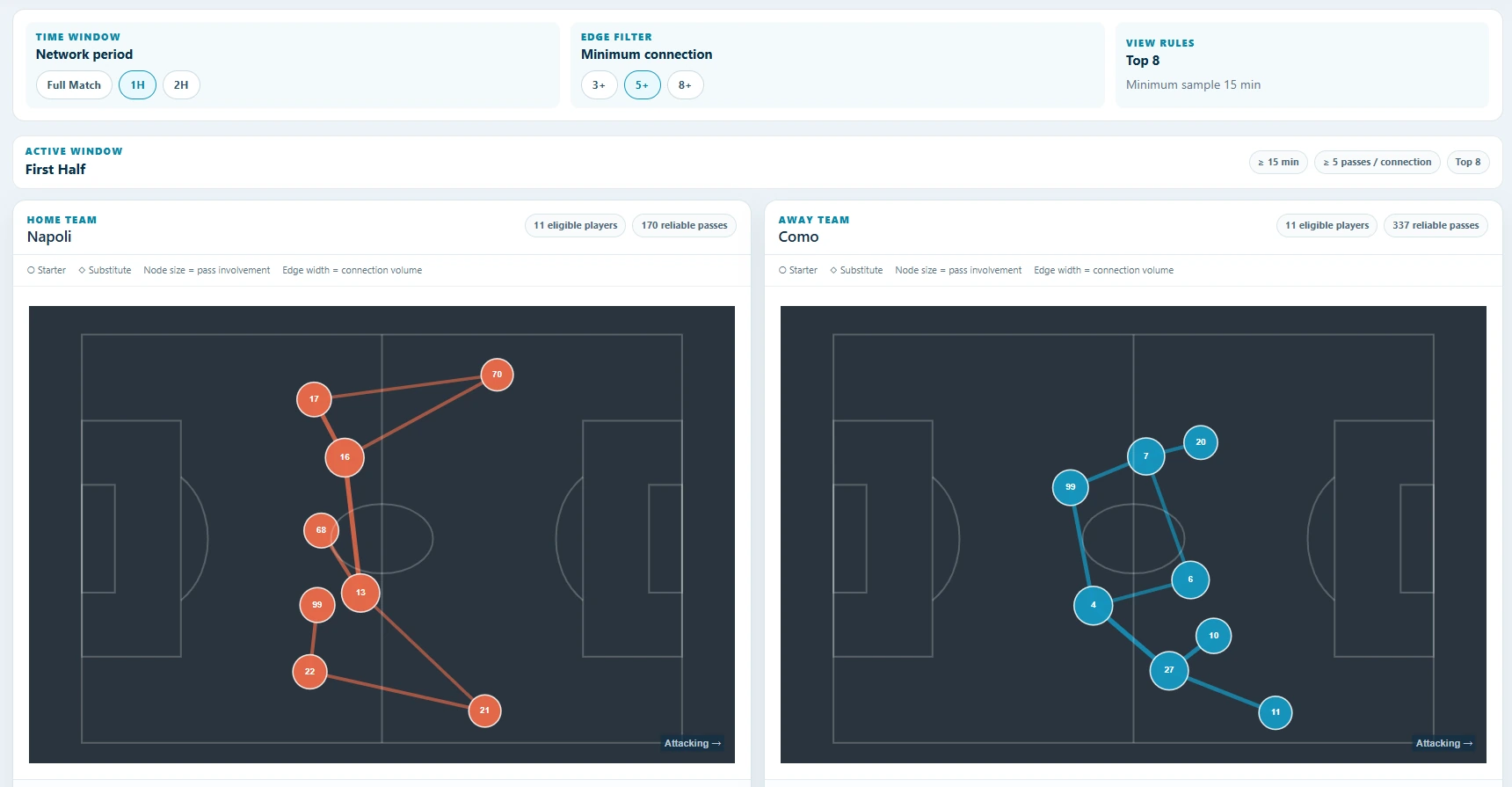
In the opening 45 minutes Fàbregas' side attempted 377 passes to Napoli's 204, completing 342 of them: 90.7%.
And it was not sterile circulation. Como ended the half with 13 shots to 5, 7 on target to 2 and 5 corners to 0.
The opening phase is perhaps even more revealing. In the first fifteen minutes: 165 Como passes, 64 Napoli.
This is not the story of an away side keeping the ball well whenever the opportunity arises. Como try from the start to install the game in the territory and tempo they prefer.
Not just more of the ball: Como also play higher
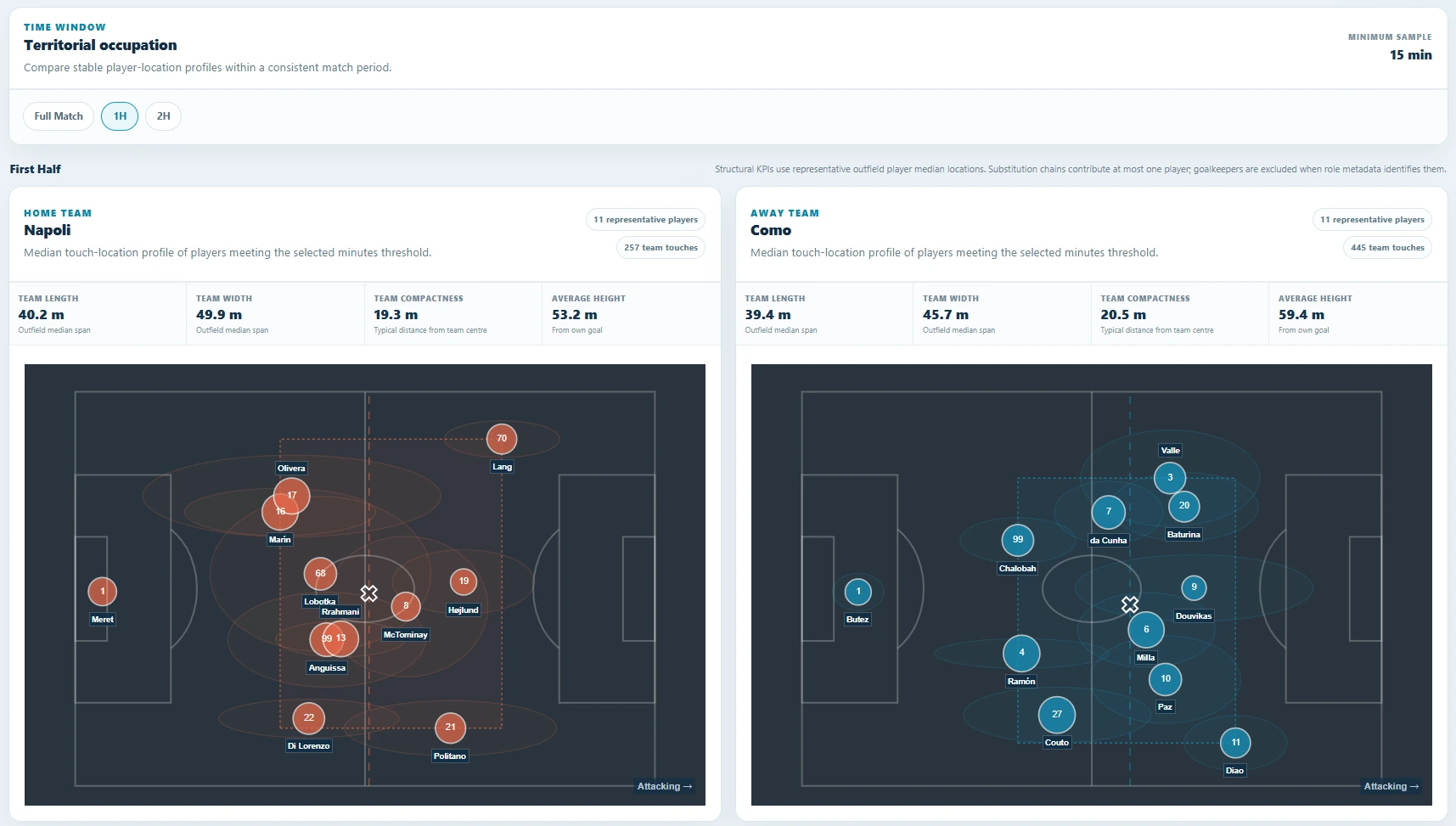
The passing network is only part of the picture. Territorial occupation completes it.
In the first half Como's average height is 59.4 metres from their own goal. Napoli's is 53.2 metres.
So Como are not simply accumulating passes in their own half. They are playing, on average, six metres higher than Napoli despite being the away side.
This is where the idea of control from the pre-match becomes tangible. Keeping the ball does not always mean creating a chance immediately. It can also mean choosing where the game lives.
Territorial Occupation and Mean Positions are derived from touches and match events. They describe the distribution of players in event data, not continuous tracking positions.
Possession and pressure belong to the same system
Before the match we described Como as a side able to move continuously from possession to loss, pressure, recovery and possession again.
That part of their profile appeared as well.
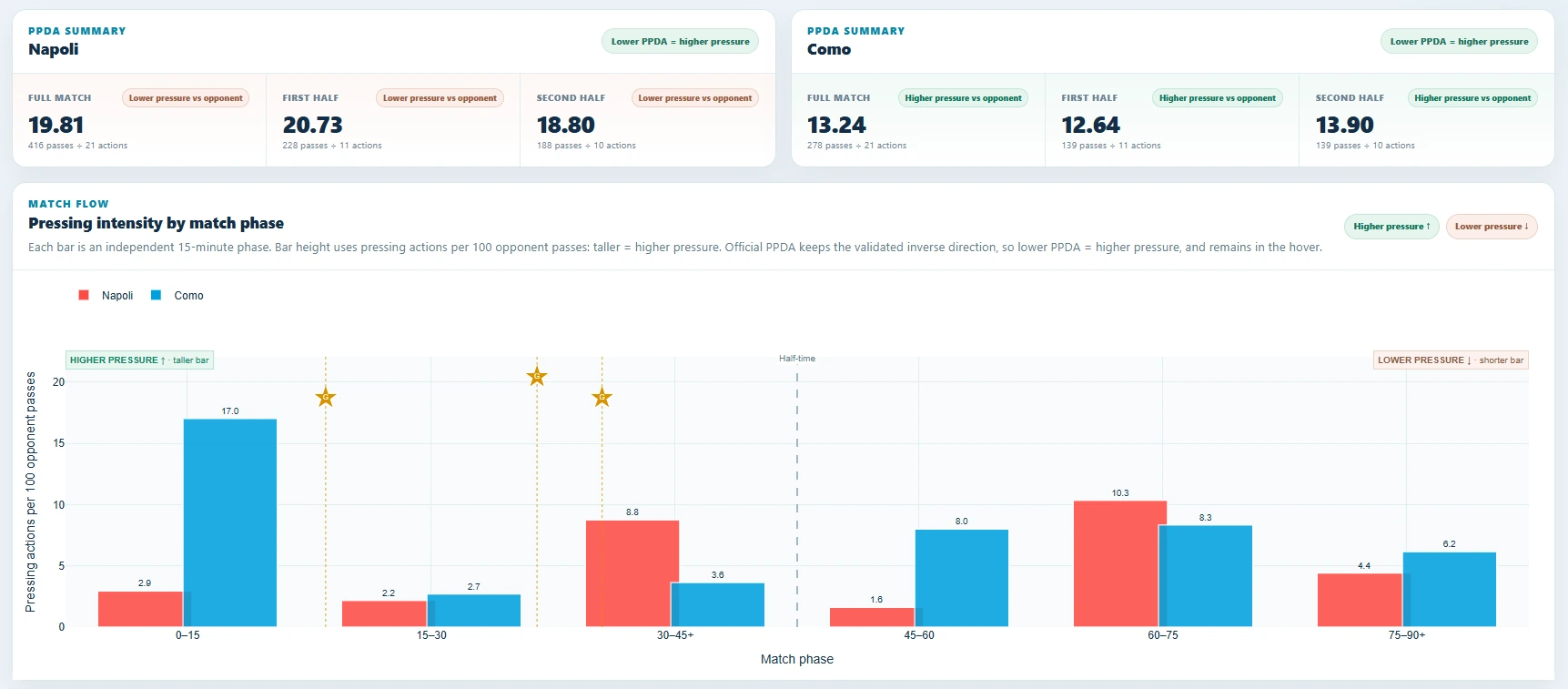
Como's first-half PPDA is 12.64. Napoli's is 20.73. A lower value indicates more aggressive pressure.
The fifteen-minute blocks make the opening especially clear. Between 0' and 15', Como produce roughly 17 pressing actions per 100 opponent passes. Napoli: 2.9.
That helps explain why the start of the game is so one-sided. Fàbregas does not choose between keeping the ball and pressing. Como do both.
Milla confirms his role, but the player next to him changes
Luis Milla had been one of the main new elements in Como's 2026/27 structure before this match.
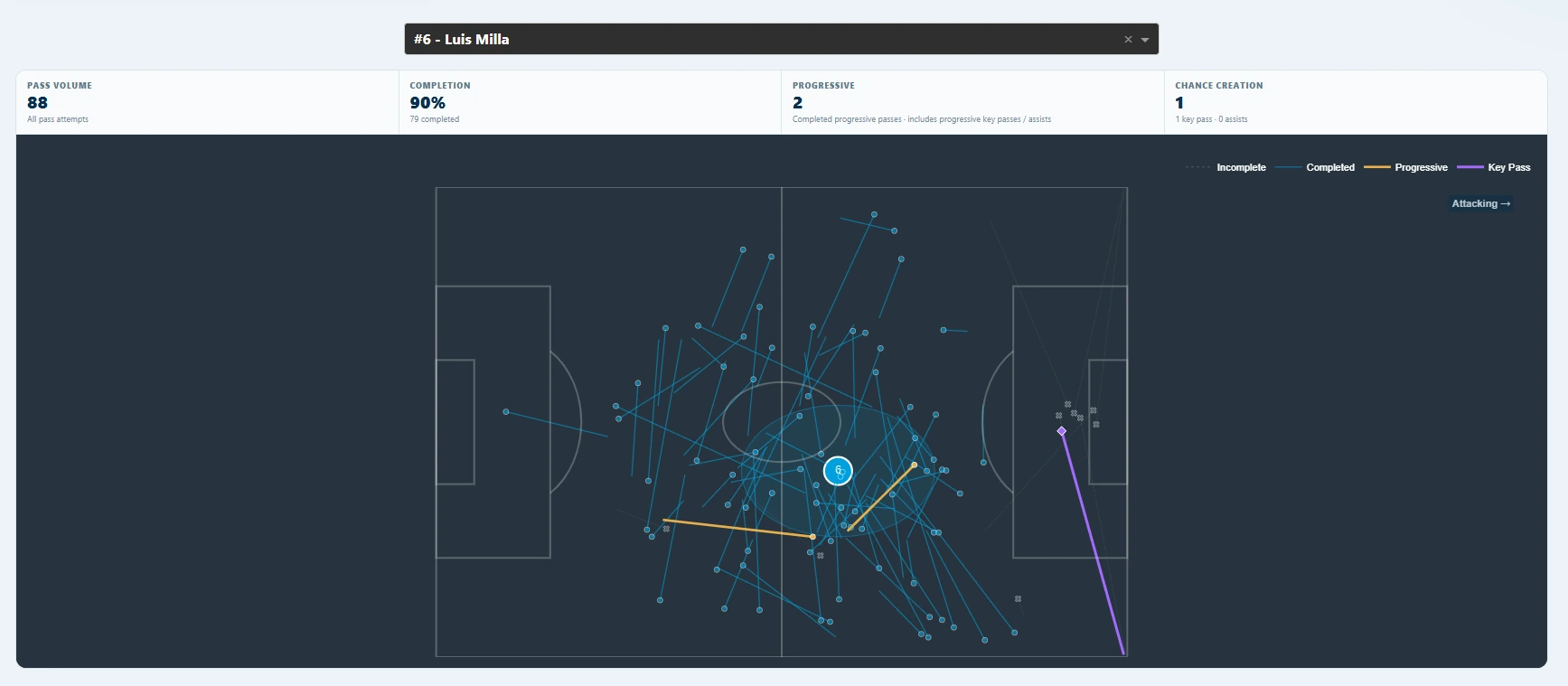
He made 89 passes against Udinese on the opening day. At the Maradona: 88. The continuity is striking.
But the game also adjusts part of the pre-match reading. We had expected Milla–Perrone to be the central pairing to manage. Perrone starts on the bench.
Fàbregas chooses Da Cunha, who finishes with 60 passes — 58 completed — and plays a direct role in the build-up to the first goal.
The conclusion becomes more precise. Milla looks like the stable reference point of Como's circulation. The player alongside him can change according to the match plan.
His pass map also shows what kind of reference he is: 88 passes, 90% completion, 2 progressive passes and 1 key pass.
He is not a midfielder constantly forcing vertical passes. His main value is keeping the system connected.
Two different ways to turn control into danger
Set pieces were one of the pre-match areas of attention as well. The first goal, however, changes the mechanism.
About eleven seconds separate the restart from the finish. Da Cunha opens almost the whole pitch for Diao; Olivera gets the timing wrong and Diao beats him with an oriented first touch that already takes him towards the box. The move continues from there to Baturina's goal.
The pre-match principle still stands: Como's restarts demand attention. The game adds a more precise detail. It is not only the restart itself, but how quickly Como open the weak side and turn an individual technical advantage into immediate box access.
Before the match we highlighted one priority: avoid central gifts in the first build-up phase. Here Como turn the mistake into a shot immediately.
This does not need to be described as a long transition. There are no fifty metres to attack. It is simply error → recovery → shot.
Como therefore confirm one of the mechanisms already seen in the other matches analysed: when the opponent makes a mistake while trying to build, Fàbregas' side can turn the pressure into an attack immediately.
Being involved is not the same as controlling the game
Before the match we identified Lobotka as one of Napoli's possible keys to escaping Como's pressure.
His performance is interesting precisely because it cannot simply be described as being outside the game.
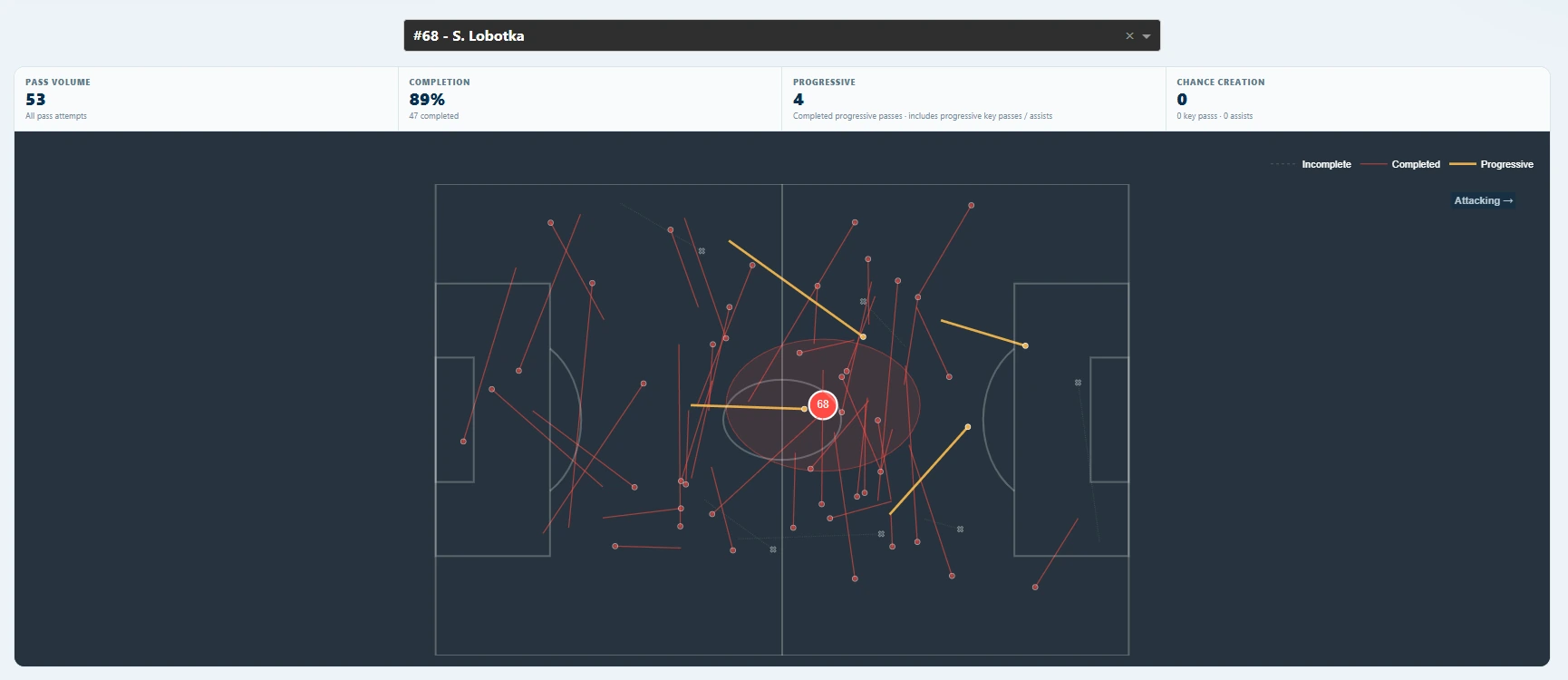
Lobotka attempts 53 passes, completes 47, with 89% accuracy. He sees plenty of the ball.
The issue lies elsewhere: he completes only 4 progressive passes and produces no key pass.
His map shows a player who keeps Napoli connected centrally, but rarely becomes the point from which the structure is broken.
That is different from saying Como erase him. The more precise reading is: Como do not remove Lobotka from Napoli's possession; they reduce his influence on progression.
Napoli's solution and the players who change the picture
Despite a first half largely controlled by Como, Napoli still find one effective route.
On 29 minutes Rrahmani carries the ball forward and finds Højlund directly. The striker receives, protects the ball against Jacobo Ramón and finishes. Goal.
The move matters because it shows one way Napoli can attack Fàbregas' structure: bypass part of the block and find the striker before Como can close around him.
The problem is that the solution remains episodic. Højlund finishes with 9 passes, 8 completed, 2 shots and 1 goal.
Nico Paz does not score, but his profile confirms another pre-match point. He should not be read only as a final-pass player.
Against Napoli he finishes with 56 passes, 52 completed, 5 shots and 3 on target. Once again he contributes to build-up and also arrives to finish attacks.
The decisive player of the first half, however, is someone else: Martin Baturina.
He scores the opener and, on the second goal, reads Rrahmani's misplaced pass before Douvikas' high recovery.
It is one of the elements the pre-match did not place strongly enough in focus. That matters: pre-match analysis narrows the field of possibilities; the match always adds details that cannot be known in advance.
Baturina is one of those details.
When Napoli push higher, Como change shape
The second half adds the most interesting tactical layer.
Allegri acts on 55 minutes. De Bruyne, Spinazzola and Alisson Santos come on, and De Bruyne immediately gives Napoli a different quality between the lines.
Despite playing little more than half an hour, the Belgian finishes as Napoli's second-ranked player for offensive passing contributions and first for involvement in shot-ending sequences. He completes 3 progressive passes, produces 4 key passes and is involved in 5 shot sequences; in four cases, one of his passes directly precedes the shot.
Those numbers coincide with the phase in which Napoli finally manage to move the game higher. Between 55' and 65' they produce 3 shots to Como's 0 and find connections in the attacking half with greater continuity.
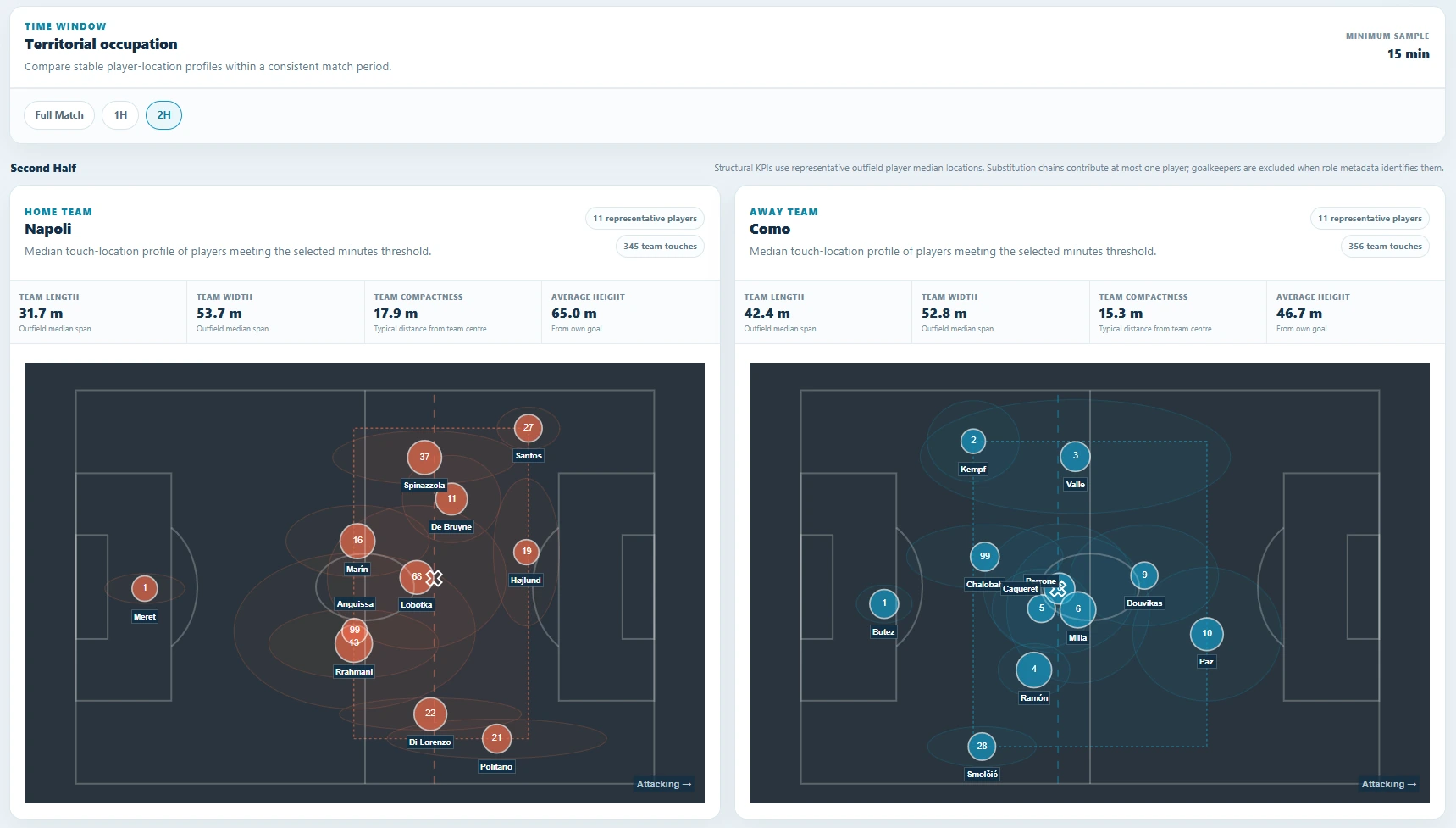
The geography of the match changes too. Napoli's average height in the second half rises to 65.0 metres, while Como drop to 46.7. Como had been at 59.4 metres in the first half. This is the period in which Napoli gain territory and force Fàbregas' side to defend deeper.
Como drop by almost 13 metres. But compactness is just as revealing: 20.5 m in the first half, 15.3 m in the second.
The team move deeper and become narrower at the same time. Caqueret, Smolčić, Kempf and Perrone enter progressively; the structure becomes much more cautious and starts to resemble a back five.
The Como side that controlled the first half mainly through the ball now begin to control through density, shorter distances, central protection and game management.
Average height and compactness are again derived from the distribution of touches and events, not continuous tracking data.
Dropping deeper does not mean giving up the ball
This is what makes the second half more interesting.
Como do not move directly from dominance to being pinned back. The second-half passing network records 211 reliable passes for Napoli and 201 for Como. Almost even.
The half also ends with 8 shots for Napoli and 8 for Como.
Como accept playing deeper, but still retain an ability to escape pressure and manage possession.
Reducing the half to Como simply defending the score would miss the point. The control remains. Its form changes.
From pre-match to the pitch
Which questions held up, and which ones changed
The value of the comparison is not to present the pre-match as a prediction. It is to understand which questions remain useful once the game begins.
| Before the match | On the pitch | Reading |
|---|---|---|
| Como willing to contest control even at the Maradona | 377 passes vs 204 in the first half; 13 shots vs 5 | Confirmed |
| Milla as the new circulation hub | 88 passes after 89 on opening day | Confirmed |
| Milla–Perrone as the central pairing to manage | Perrone starts on the bench; Da Cunha partners Milla | Adjusted by the game |
| Paz as more than a final-pass player | 5 shots, 3 on target | Confirmed |
| Avoid dangerous losses in the first build-up phase | Rrahmani error → high recovery → Douvikas goal in roughly 2 seconds | Strongly confirmed |
| Baturina was not one of the main pre-match keys | Goal + decisive intervention in the 2-1 move | New element |
The game within the game
The most interesting thing about Napoli–Como is not that Como had more possession.
It is how they used different forms of control within the same match.
First half: ball, territory, pressure.
Second half: compactness, space protection, management.
Napoli manage for short periods to push the game higher and find an effective route by reaching Højlund directly.
They simply do not do it often enough.
Before the game, the question was straightforward: who would decide where, when and at what speed the match would be played?
For most of the afternoon, the answer was Como.