
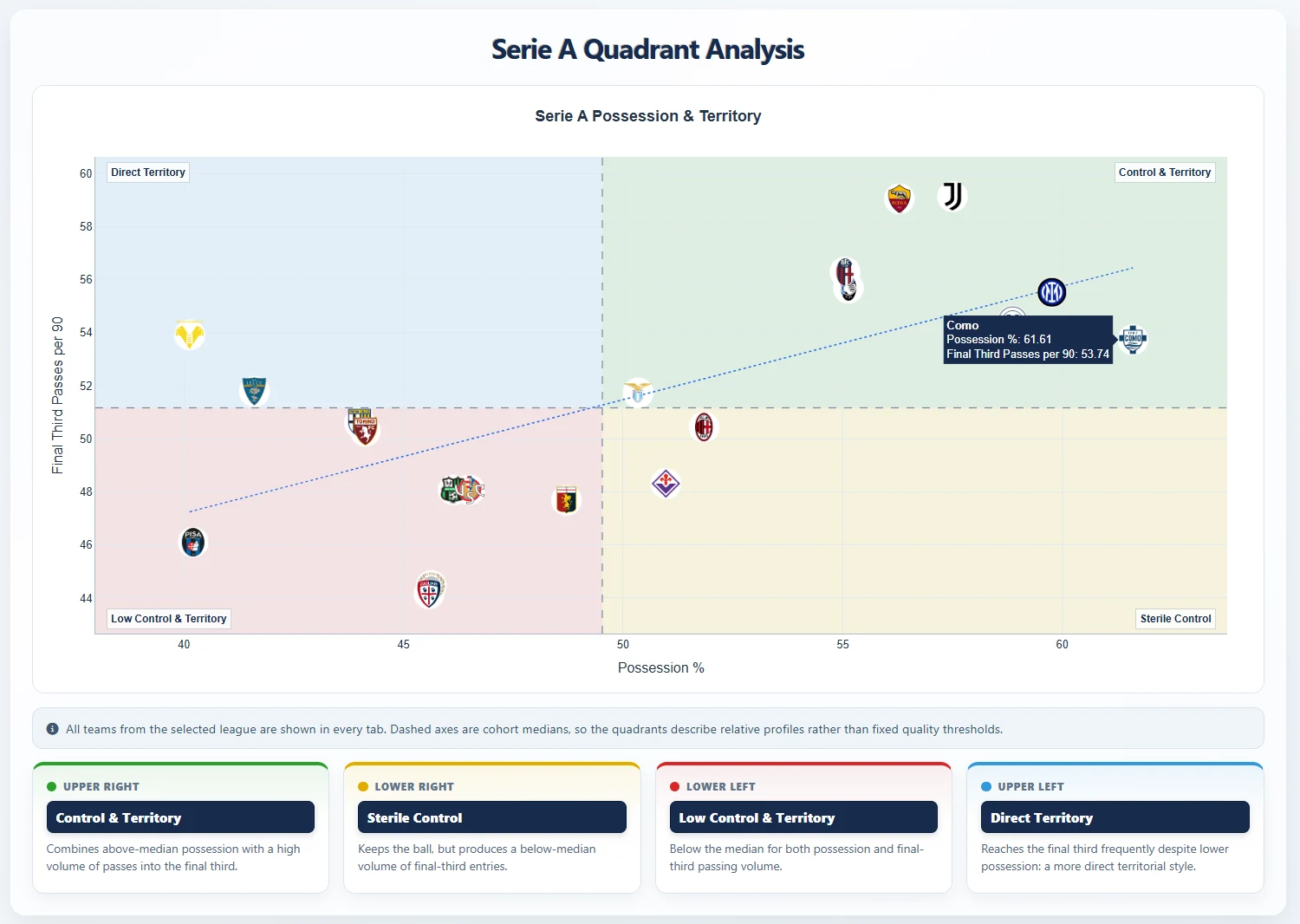
Como arrive at the Maradona as more than a simple possession team. For Fàbregas' side, the ball is not only a way to create chances: it is above all a way to control the match.
Last season's Serie A numbers explain it well. Fourth place, 61.6% average possession, 87.4% pass completion, 1.43 NPxG/90 and 1.71 goals/90. But perhaps the most revealing figure is another one: Como also posted the lowest PPDA in the league, 8.85 — lower means more aggressive pressure — while allowing only 8.97 shots per 90.
On the pitch, that means Como use the ball to keep the game away from their own goal and, when they lose it, try to win it back before the opponent can breathe.
Possession is also protection
The first point to fix is this: Como's possession is not decorative. It is not there simply to display technical quality or pile up passes. It is there to decide where the game is played.
With the 4-2-3-1 used in 34 of 38 league matches last season, Como often built games in which opponents touched fewer balls in comfortable areas and had less time to organise. A team that keeps the ball this well is not only attacking: it is also protecting itself. It plays farther from its own box, defends less while running backwards and is in position to counter-press immediately after losing possession.
For Napoli, that is already one of the key themes. It may not matter much who finishes with the higher possession percentage. What may matter more is who manages to impose their own rhythm on possession: Como to slow and control, Napoli to beat the pressure and attack the space behind it.
The new Como look even more patient
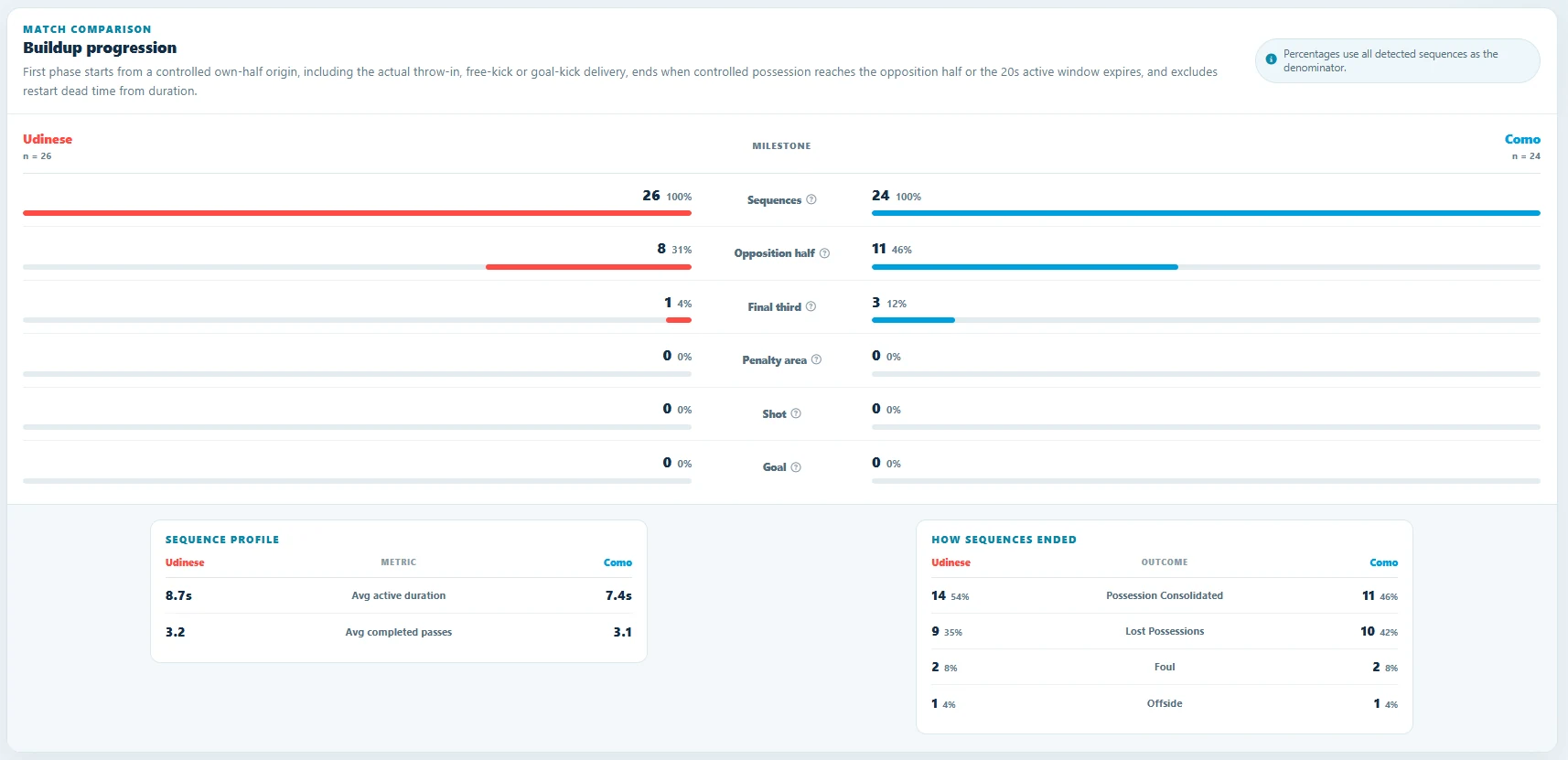
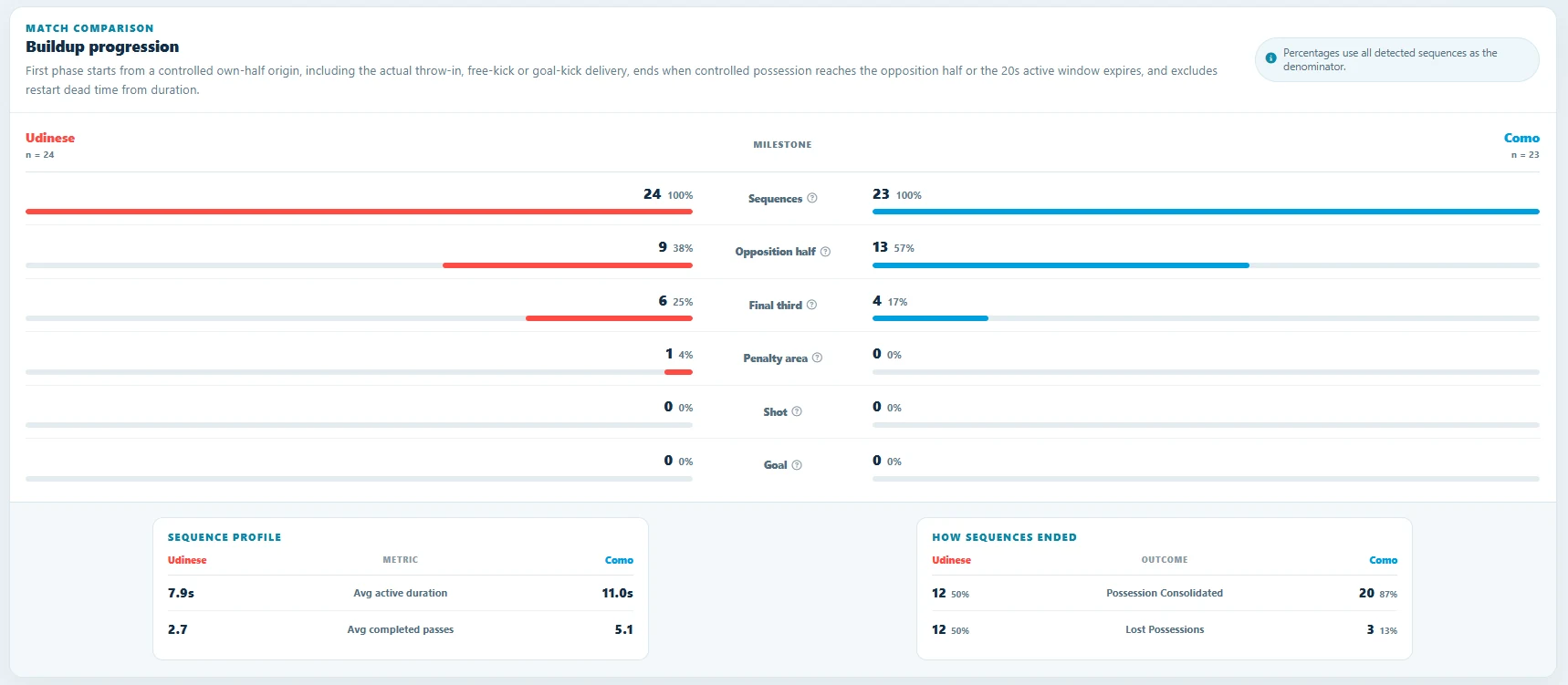
There is also an early signal from the new season. It needs caution because it comes from a single competitive match, but comparing Udinese–Como in April 2026 with Udinese–Como in August 2026 points towards an even more secure first phase.
In April, Como made 477 passes, with build-ups averaging 7.4 seconds and 3.1 completed passes per sequence. Forty-six percent reached at least the opposition half, while 42% ended with possession lost.
In August the picture changes significantly: 614 passes, build-ups averaging 11 seconds, 5.1 completed passes per sequence, 57% reaching at least the opposition half and only 13% ending with a loss.
One match is not enough to say this will define Como throughout 2026/27. But it is enough to identify the first signal: a side that looks more patient, less rushed and cleaner in the first phase.
They will not come just to defend
The previous meeting at the Maradona also removes one possible misconception. Como have already shown that they do not want to approach this trip simply as a survival exercise.
In the previous 0-0 between Napoli and Como, Fàbregas' side finished with 506 passes to Napoli's 426, better completion — 84.6% to 81.0% — and an even shot count at 13-13. The first half was even more telling: 228 passes to 177 and 9 shots to 6.
That game should not be used to describe the current Napoli because the coach has changed. It is useful, instead, to describe Como's competitive courage: Fàbregas has already shown that he will not necessarily come to the Maradona only to sit deep and survive.
Morata also missed a penalty that day, but this does not mean Como deserved more. It does show that they were able to stay in the game with personality, even in a theoretically difficult context.
When they win it back, the speed changes
If Como can be patient with the ball, they can also change speed very quickly without it. Across the two matches against Udinese, their attacking transitions last around 5–6 seconds on average, with only 1.2 completed passes.
That tells us what the threat looks like: not long, elaborate counter-attacks, but sharp attacks in the few seconds while the opponent is still open.
Juventus–Como offers the most useful example for preparing this game. After a Juventus attacking corner, Como clear, Sergi Roberto recovers and the ball moves quickly through Perrone and Da Cunha to Caqueret for the goal. The entire sequence takes roughly eight seconds.
An attacking corner can quickly become an attack against you. This is where rest defence matters: how Napoli remain protected while they are attacking.
Sequence identified in the event data with Match Explorer and simplified here for readability.
The window opens after a central turnover
Precision matters here, because it would be too easy to say generically that Como struggle in transition. The data do not support that.
The more accurate reading is this: when Como lose the ball centrally while their structure is still open for possession, there is a short window before they can compact again. It is not a permanent weakness; it is a precise moment that has to be recognised and attacked quickly.
The opening match against Udinese gives a clear example. Nico Paz loses the ball centrally and, before Como can close the spaces, Udinese attack vertically. Roughly eight seconds later, the move ends with Kamara scoring.
The issue is not 'transition' in general. It is the short interval between a central turnover and the moment Como rebuild their defensive structure.
Sequence identified in the event data with Match Explorer and simplified here for readability.
This is exactly where Napoli's player profiles can matter. Kevin De Bruyne, for example, is one of those players who can recognise an open defence before it has time to reset: he can receive and play forward in very few touches, or immediately find the pass that takes the move beyond the first counter-press.
Against Genoa he came off the bench and affected the final phase. That does not mean he has to start against Como, or that the match depends on him. But if situations like the one seen against Udinese appear, his speed of thought is particularly well suited to this matchup.
And the idea is not only about De Bruyne. The first signals from the new Napoli also show Lobotka as an important inside reference in build-up and Di Lorenzo as a useful route for progressing down the right. Against aggressive pressure, the quality of the first pass and the ability to find the free man inside can decide whether Como counter-press successfully or are forced to run towards their own goal.
The players who shape Como's circulation
Within this structure there are several names worth watching.
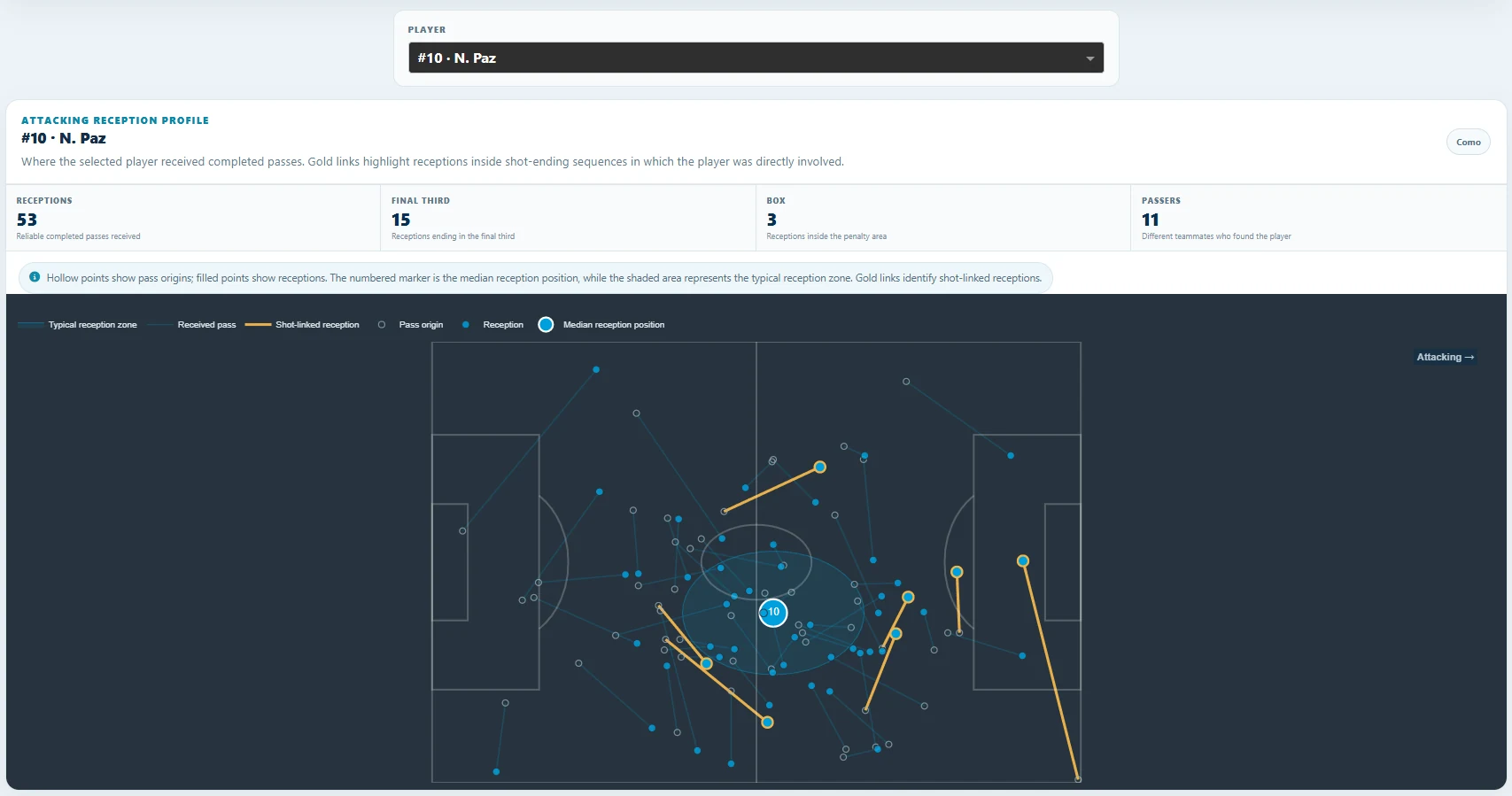
Nico Paz is the first. Reducing him to a simple assist provider would miss the point. Paz takes part in the build-up, moves between the lines and is also brought regularly into shooting positions. In the previous Napoli–Como he recorded 53 passes and 4 shots; against Udinese in 2026/27 he again reached 4 shots and remained heavily involved in shot-ending sequences.
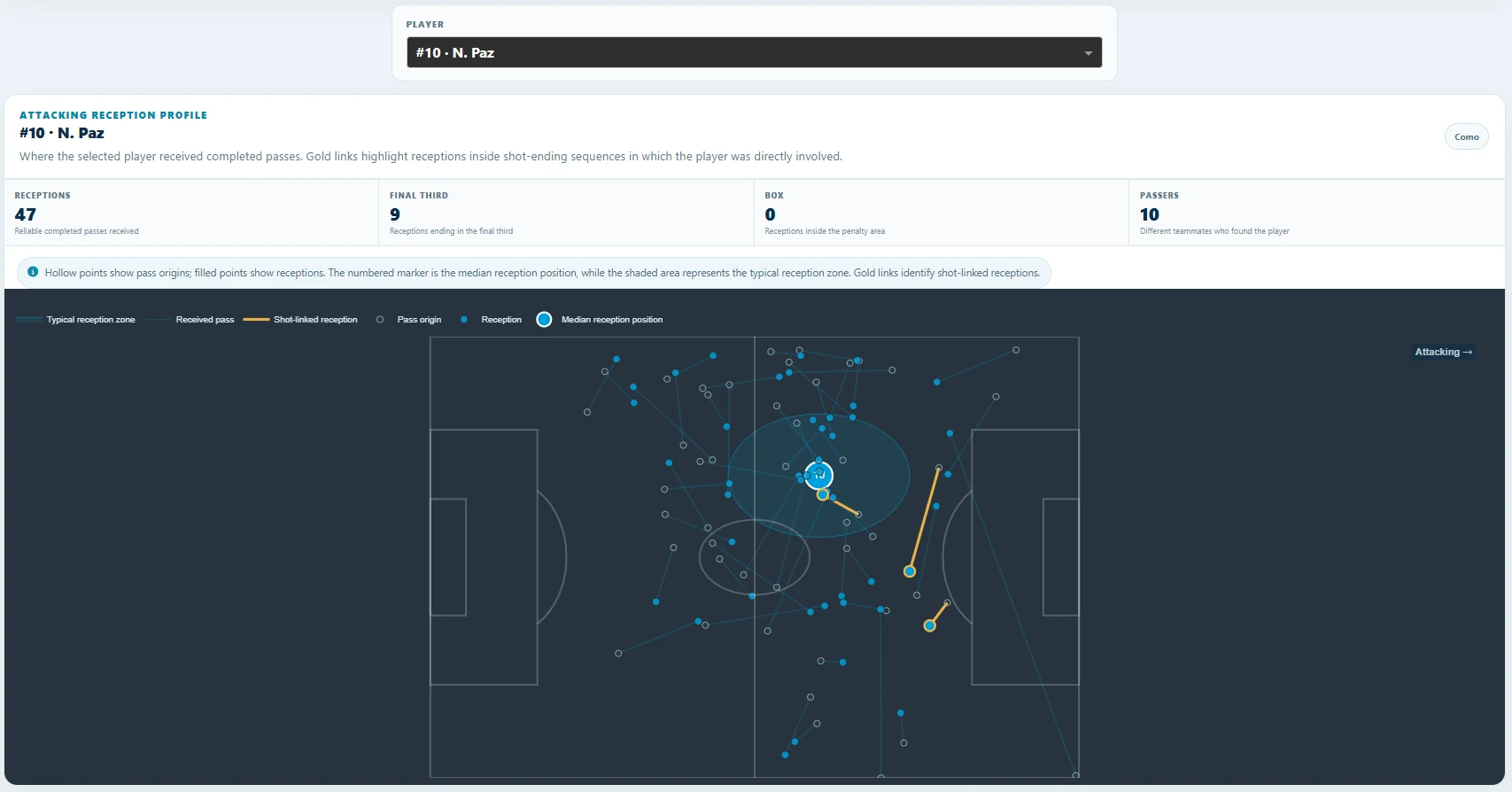
Alongside him there is a selection decision between Luis Milla and Da Cunha. Tactically, the choice should not radically change Como: both can give continuity to possession, move through similar inside connections and support the move between midfield and the line behind the striker.
With Milla, one detail becomes especially important: set-piece delivery. Against Udinese in 2026/27 he attempted 89 passes and produced 5 key passes, but 4 of those 5 came from corners. He should therefore be read more as a circulation hub and set-piece specialist than as Como's main open-play creator.
Máximo Perrone remains one of the most stable references in possession. Against Udinese he played 49 passes, completing 46; last season he registered 65 passes against Napoli, 60 against Juventus and 54 against Udinese.
The danger continues after the first ball
There is another key area that should not be underestimated: set pieces. Como produced 0.51 set-piece xG per 90 in 2025/26, the third-best figure in Serie A.
The opening match confirmed the same idea. The goal against Udinese came from a Luis Milla corner, a Chalobah shot, an Okoye save and Douvikas scoring the rebound. The sequence is useful because it shows something simple: against Como, defending the first ball is not enough. You also have to win the second one.
Defending the corner is not enough: against Como you also have to defend what happens after the first clearance.
Four things to watch on Sunday
- Where is the game played?
If Como consolidate possession, they can move the match towards their own rhythm. If Napoli keep the game higher, the geography of the match changes. - Who beats the first pressure?
Como press high and do it well. The quality of Napoli's first exit will be one of the central themes. - What happens in the 5–8 seconds after a turnover?
That is the window in which Como can accelerate after a recovery, and the one in which Napoli can hurt them if Como lose the ball centrally. - Who wins the second phase on set pieces?
Corners and second balls may matter more than the total shot count. The first duel does not necessarily end the action. And more than possession itself, Sunday may come down to who decides where the game is played and when to accelerate.