
Napoli–Frosinone, tonight at 20:45 at the Maradona, is not the comfortable game the table might suggest.
Napoli will almost certainly have more of the ball, more quality and more chances. But Frosinone don’t need to build to hurt you: they only need to intercept a pass and break. And in the data from recent games, that is the situation Napoli have conceded most often.
That is why the question is not whether Napoli will dominate possession. It is what happens in the seconds when they lose it.
A depleted Napoli against a Frosinone who never lose away
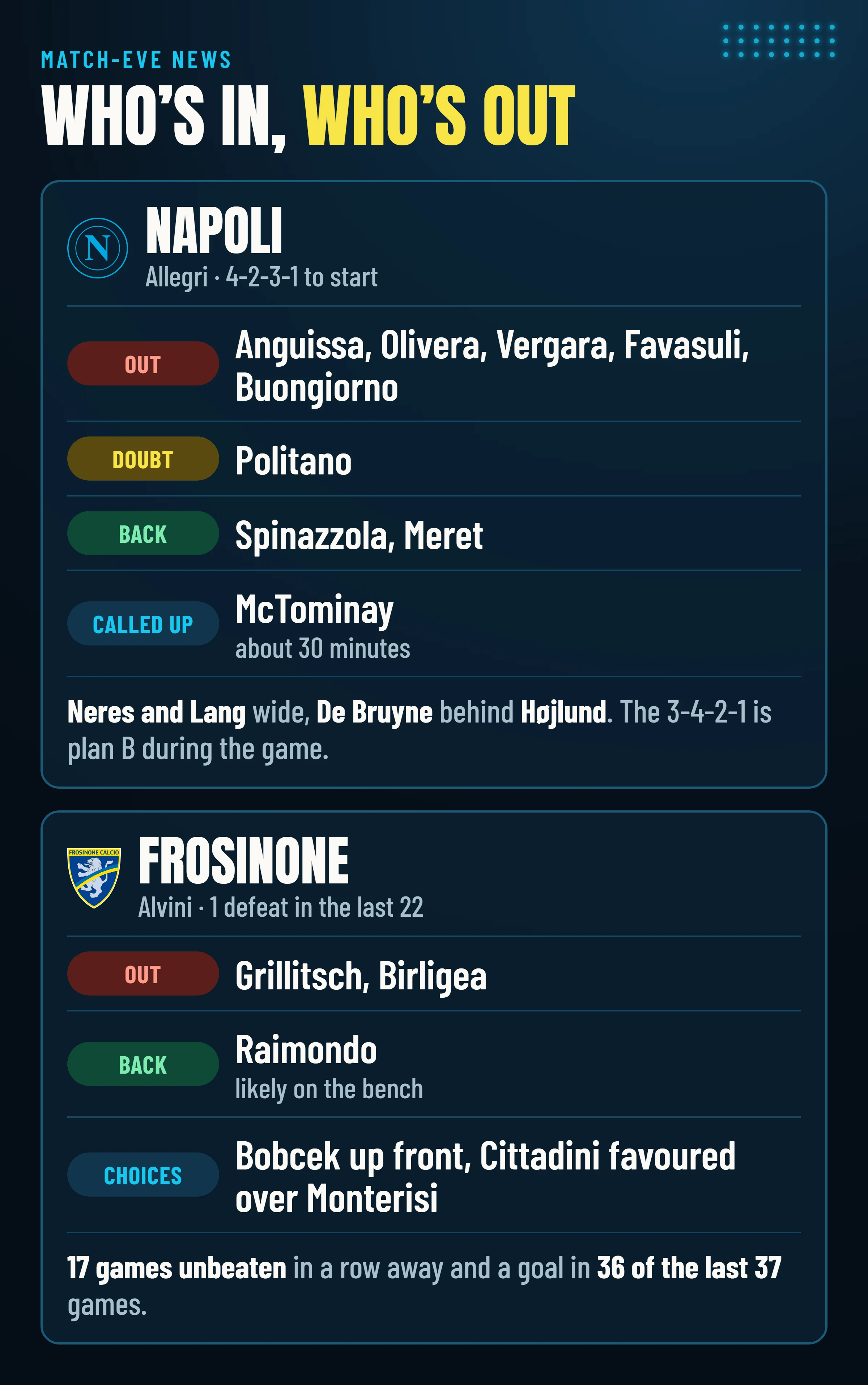
Allegri’s eve of the match is full of absences. Anguissa, Olivera, Vergara, Favasuli and Buongiorno are out. Politano is not at his best and on Tuesday there is the Champions League tie with Villarreal, so managing energy matters. Spinazzola and Meret are back, while McTominay is called up: Allegri spoke of about thirty minutes available.
The pre-match indications point to a 4-2-3-1 with Neres and Lang on the flanks, De Bruyne behind Højlund. The 3-4-2-1 tried at Castel Volturno looks like a plan B for during the game. The sources are not unanimous, so no certainties on the shape. In his press conference Allegri asked for “zero excuses”: Napoli come off four defeats in their last seven games at the Maradona.
On the other side is a Frosinone who are not there by chance. Just one defeat in the last 22 official games, against Juventus on 23 August. Seventeen unbeaten games in a row away, with 9 wins and 8 draws, and goals scored in 36 of the last 37 games.
Alvini has recovered Raimondo, but the indication is that Bobcek will start up front. Grillitsch and Birligea are not available, and in defence Cittadini is favoured over Monterisi.
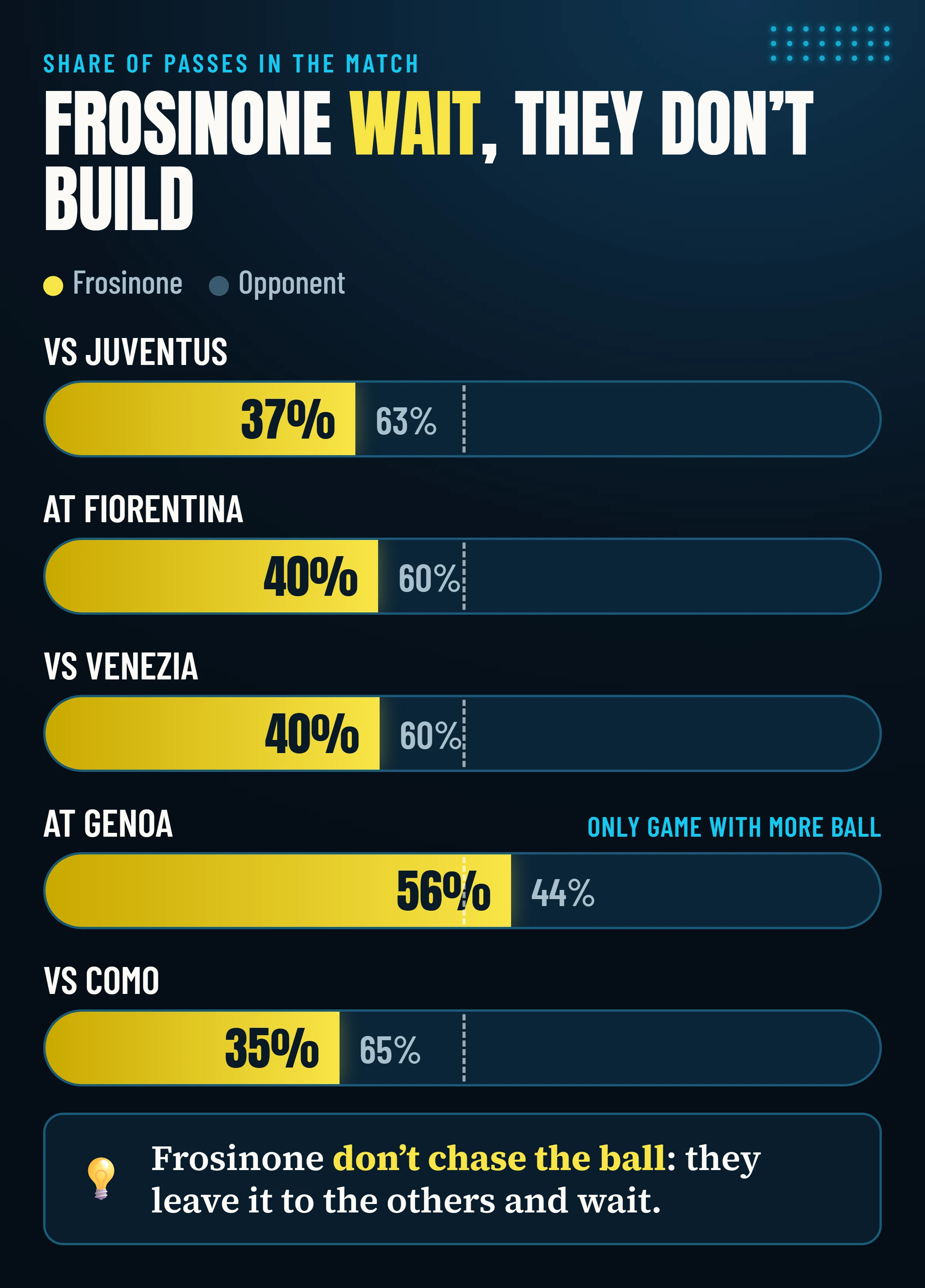
Data sample. The analysis uses Napoli’s last six games (five in the league plus Napoli–Arsenal in the Champions League) and Frosinone’s first five. These are few matches: the numbers show tendencies, not certainties. Genoa–Frosinone, the only game in which the Ciociari had more of the ball, is treated as an exception.
Napoli will have the ball, Frosinone will wait for it
In the last five games Frosinone have had the ball between 35% and 40% of the time in four cases out of five. The exception is the 56% against Genoa. They almost never try to build short from the back: their first option is often the goalkeeper’s long ball, completed less than half of the time.
When Napoli face teams that don’t dominate possession, they raise the intensity of their press: a PPDA between 10 and 11, against values between 17 and 21 when they meet opponents who keep the ball better. PPDA measures how many passes you allow the opponent before stepping in: the lower it is, the more aggressive the press. Frosinone fall into the first group, the one against which Napoli press with most conviction.
But Frosinone don’t seem to worry about it. Their build-ups from the back fail between 55% and 75% of the time and, out of 126 sequences analysed, only one produced a shot. It is not a failed plan: it is simply the plan.
For Napoli this means spending much of the evening against a team set up in its own half, with tight lines and little interest in coming out. Possession will come without effort: the real question is what to do with it. Every misplaced vertical pass is a gift, because it is exactly what Frosinone are waiting for.
The real risk is not possession, it is the second after losing the ball
This is where the most important point of the game comes in.
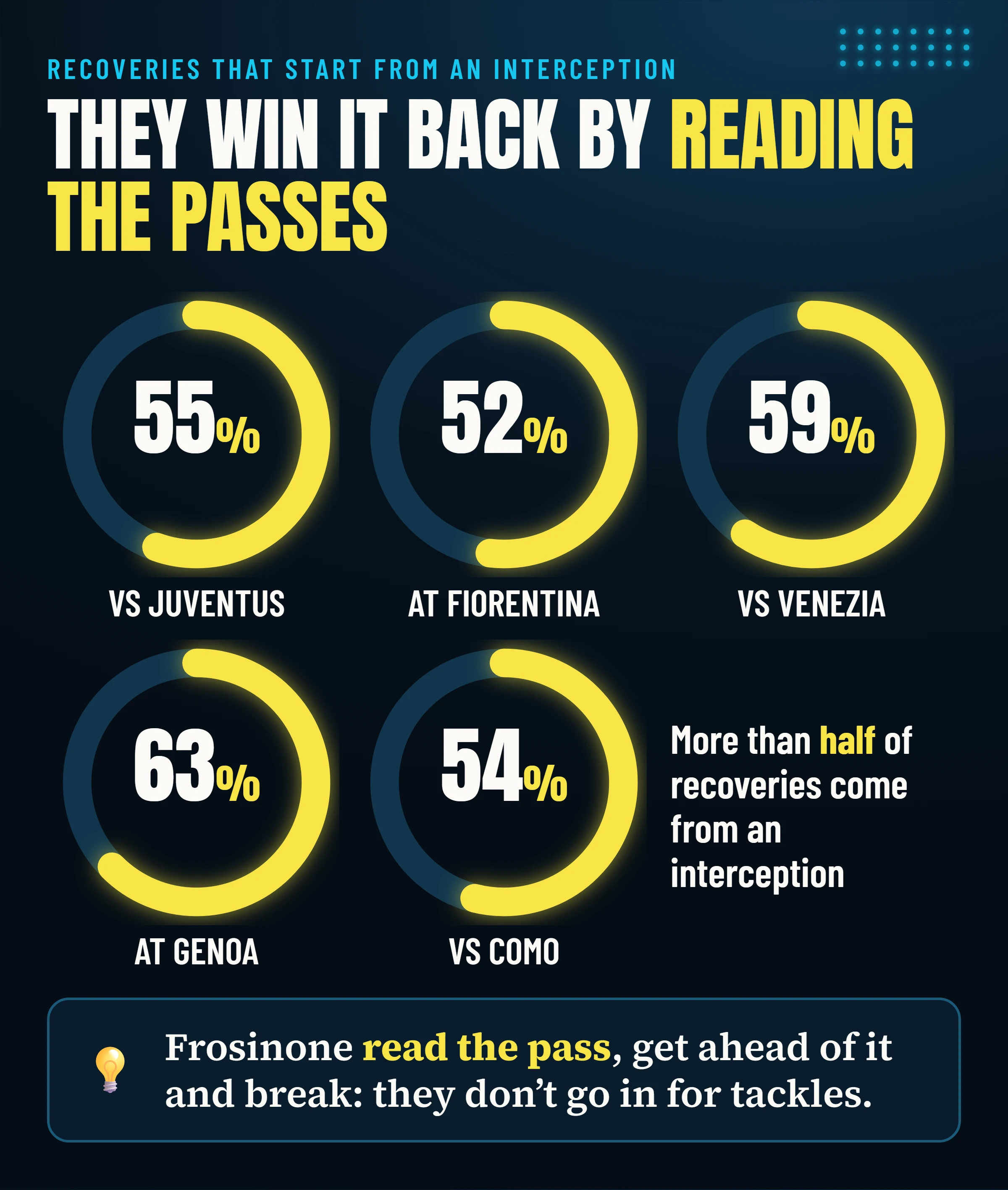
The way Frosinone win the ball back is very consistent: between 52% and 63% of their recoveries, in all five games analysed, come from an interception, not a tackle. They read the opponent’s passing lanes, get ahead of them and break straight away, vertically.
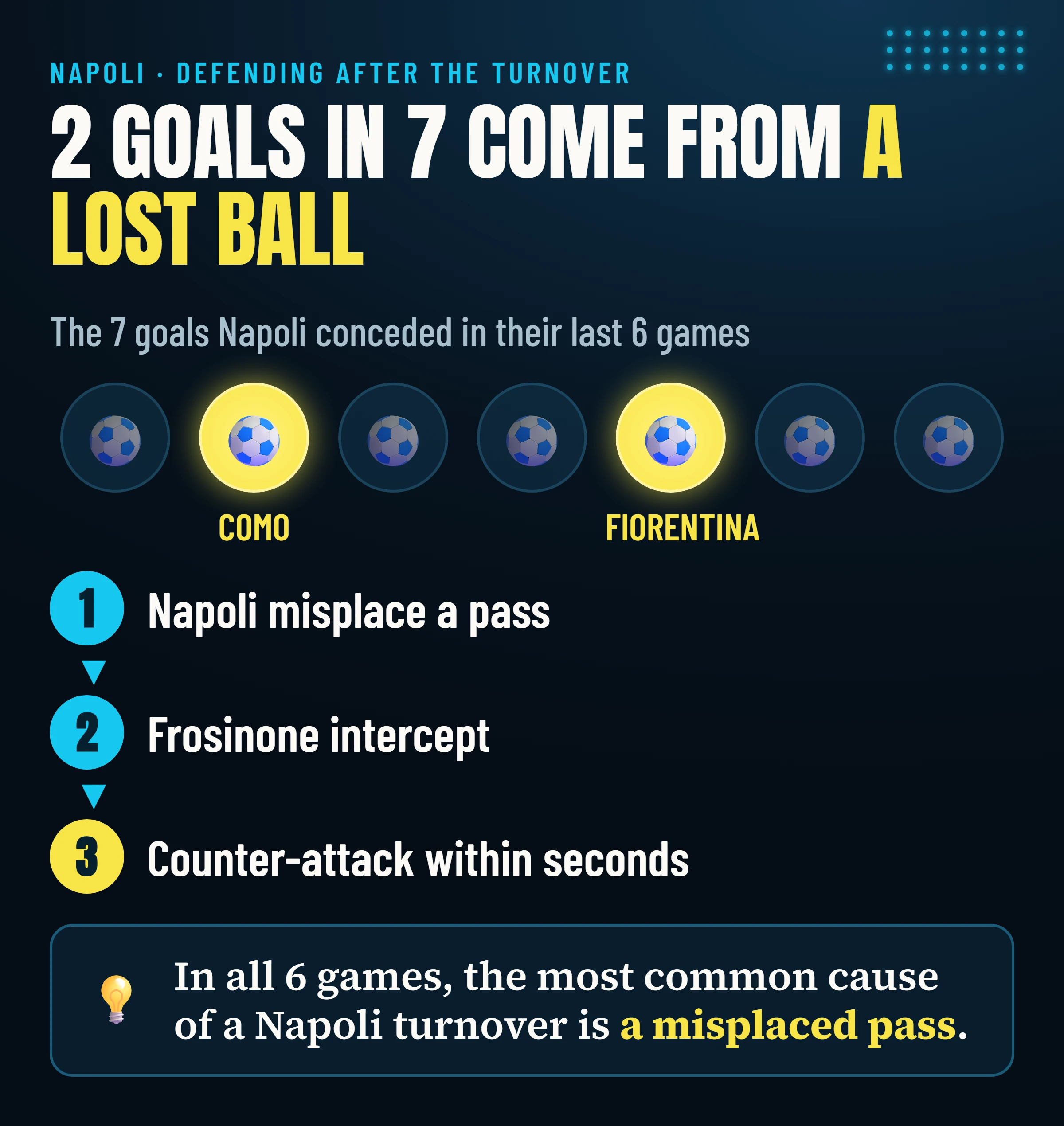
Napoli, over the same period, have shown a complementary habit: the most frequent cause of every turnover, in all six games analysed, is a misplaced pass. And two of the seven goals conceded in the sample, against Como and Fiorentina, came from there: a lost ball that within seconds turned into a counter-attack.
Just picture the scene. Napoli build, perhaps with De Bruyne dropping deep to receive. A slightly misjudged pass, a Frosinone interception and, within two or three seconds, the Azzurri back line finds itself running backwards. No special scheme: it is a situation that recurs regularly in the data of both teams.
It is not a case to force: it is already written in the profiles of the two teams. That is why discipline with the risky pass, in build-up and in midfield, could matter more than any visible tactical choice, including the shape.
Frosinone's right side is waiting for Napoli's left
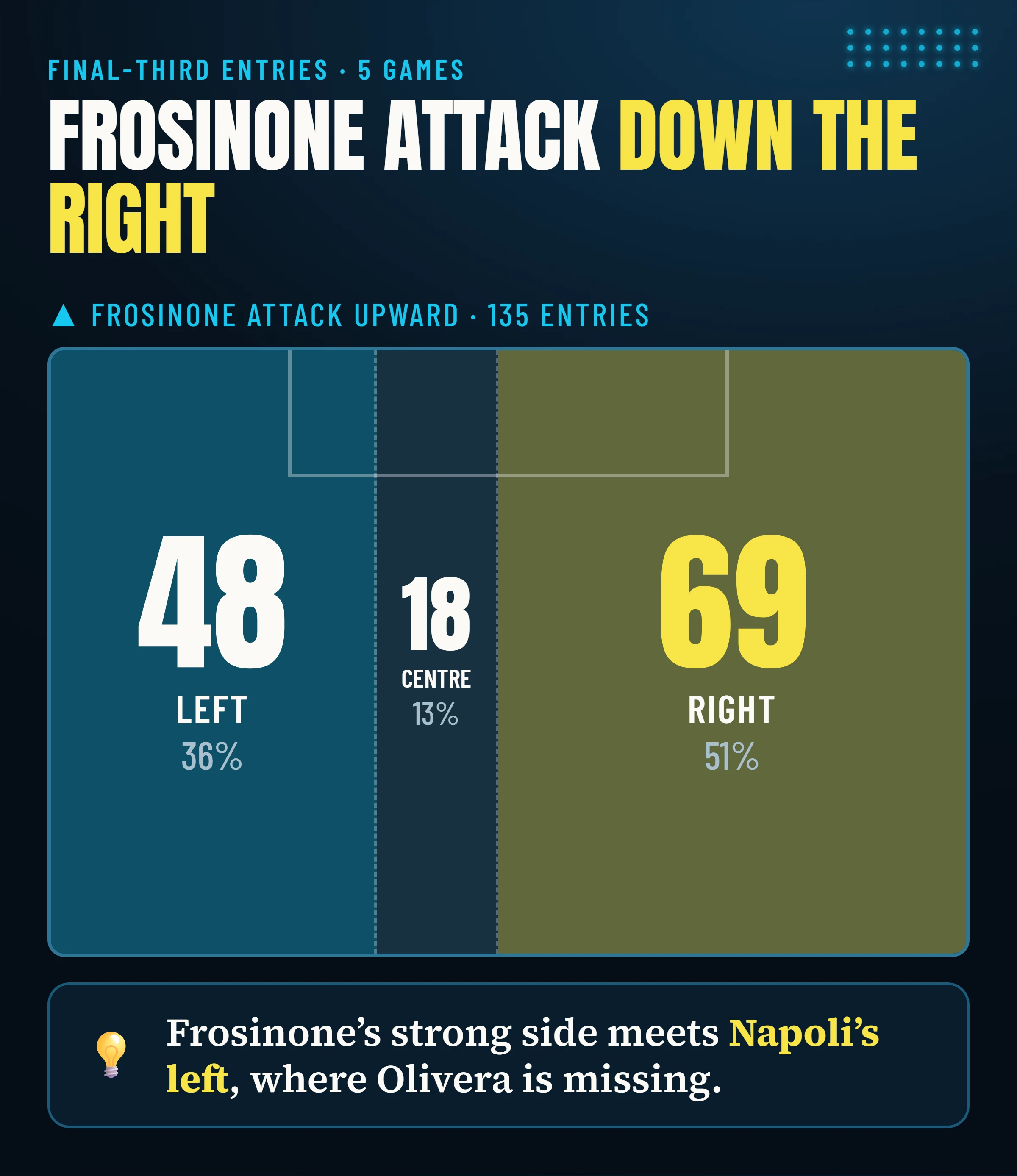
When Frosinone manage to attack, they almost always do it from the same side. In the sample their entries into the final third are 69 from the right against 48 from the left, and the route that most often leads to a cross, from the right flank towards the centre of the box, was the main one in four games out of five.
This points straight at Napoli’s left, where Olivera, the starting full-back in the last three games analysed, is missing. His place goes to Spinazzola, back from injury, with Lang, according to the pre-match indications, in front of him. They are the pair who must absorb the impact in the area where Frosinone try to hurt most.
Spinazzola returns after injury and Allegri will have to decide how far to push him: if he goes too high, a space is left behind him that Frosinone know how to attack. If he stays low, Napoli lose width precisely on that side. They are two opposite readings of the same problem, and neither is free.
Calò: one player, three roles
If there is one player who tells you how Frosinone play, it is Calò. In three games out of five he is the player most involved in the team’s play, in one he is level with Schmid, in all five he is the best crosser, and he takes corners and free kicks in every game of the sample.
Three things that in a team are usually shared among several players go through him: circulation, crosses and set pieces. Limiting his freedom to receive and play forward does not erase Frosinone’s threat, but it makes it much more dependent on less usual solutions.
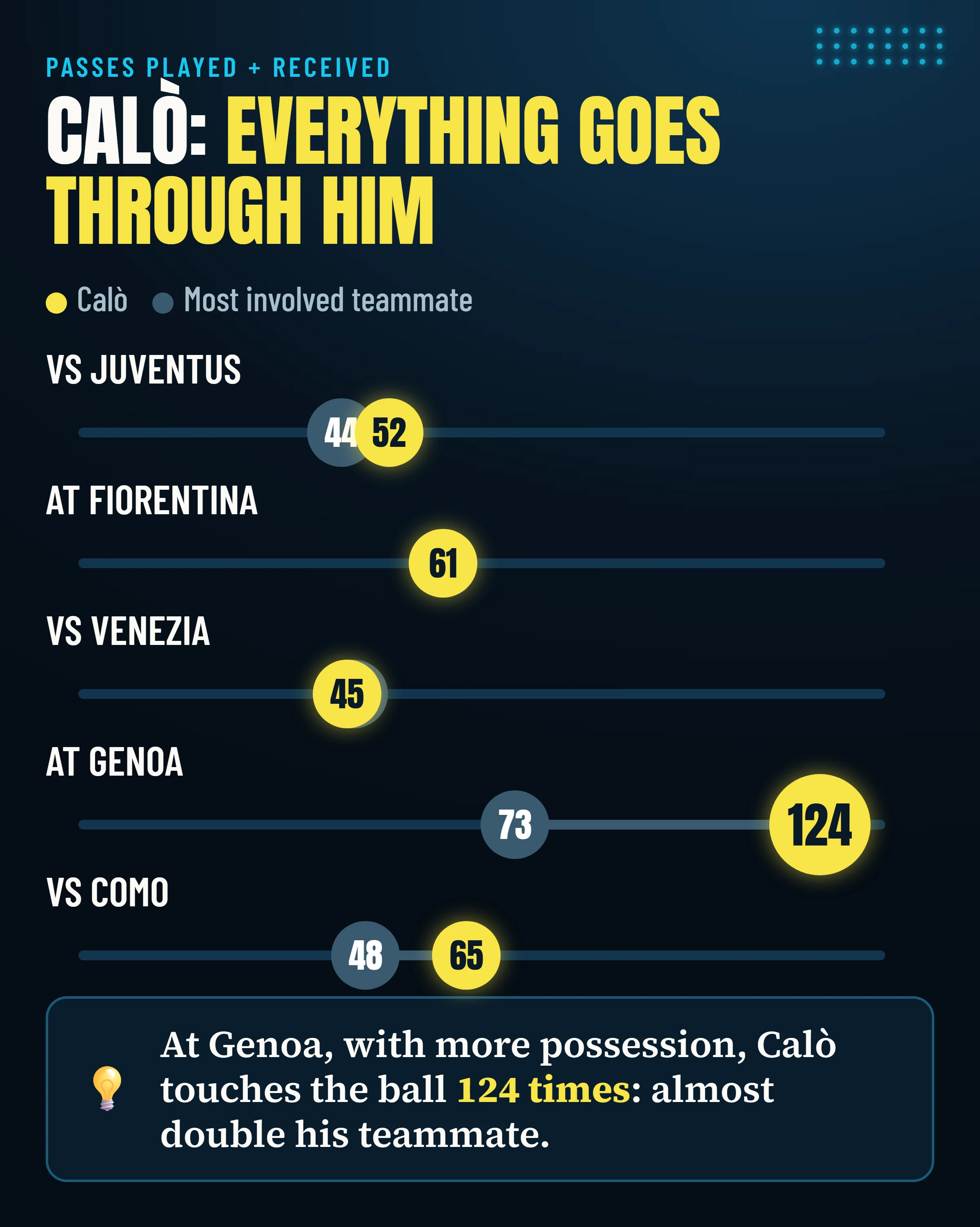
The clearest figure is the one from Genoa. In the only game in which Frosinone had more of the ball than the opponent, Calò played or received 124 passes, against 73 for the most involved teammate. When the team has the ball, the ball goes through him.
The set-piece danger continues after the first ball
Two of the four goals Frosinone conceded in the sample came from corners, both headed in by an opposing centre-back. They are episodes that point to a specific fragility: the ball arrives, and the defence does not manage to settle in time.
Napoli, however, can do the same thing at the other end. Gilmour’s goal in Florence came from a rehearsed routine: on Politano’s corner the Azzurri emptied the zone from the penalty spot to the edge of the area, and Gilmour, left alone in that space, hit it on the volley. If Frosinone drop deep and concede corners, that kind of variation can become a weapon.
The opposite is also true: five of the nine goals Frosinone scored come from possessions started with a throw-in, in three different games. It is not enough to talk about a planned weapon, but it is a detail to keep an eye on in Napoli’s defence.
If Frosinone go ahead, the game changes face
Frosinone scored first in four of the last five games, almost always within the first half-hour. They are also, together with Udinese, the team with the most goals in the last 15 minutes of the first half. And in all four occasions on which they found themselves ahead, they responded the same way: they dropped deep and conceded more space and more shots, without looking for the second goal.
If the pattern repeats at the Maradona, Napoli could find themselves facing a low, compact block rather than an open game. In that context patience matters: over 80% of the Azzurri’s entries into the final third go through the flanks and almost always arrive with a pass, not a dribble. Frosinone, for their part, go through the centre in only 13% of their entries: they are a team built to defend in width.
For Allegri it will also be a question of in-game choices. With McTominay available for only half an hour and Tuesday’s Champions League tie, every substitution carries double weight: it serves to unlock the game, but also to avoid paying with energy that will still be needed on Tuesday.
That is why the data do not make Frosinone an opponent to underestimate or to fear. They make them an opponent who knows exactly what they want: to defend in order and strike the moment Napoli make a mistake.
The four things to watch tonight
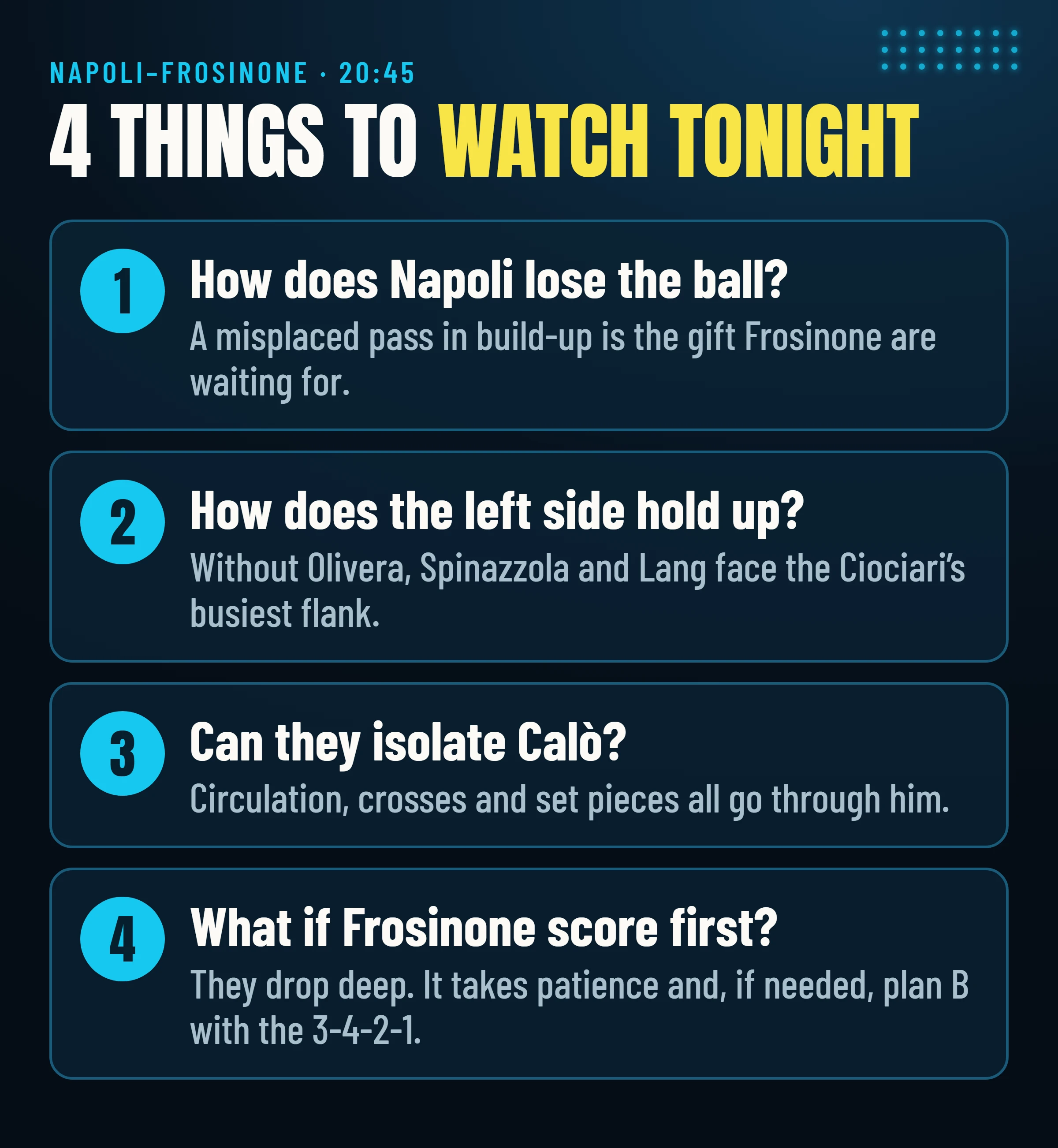
Not a game of possession, a game of moments
On paper, Napoli–Frosinone looks like a one-sided game. The numbers describe a Napoli superior in controlling the game and a Frosinone built to defend and hit on the counter, but also a team that hasn’t lost away from home for months.
In a game like this, details weigh more. Frosinone don’t need elaborate moves: a misplaced Napoli pass, an interception and a few seconds of open space are enough.
The game will be decided less in the possessions and more in the seconds when the ball changes hands.