
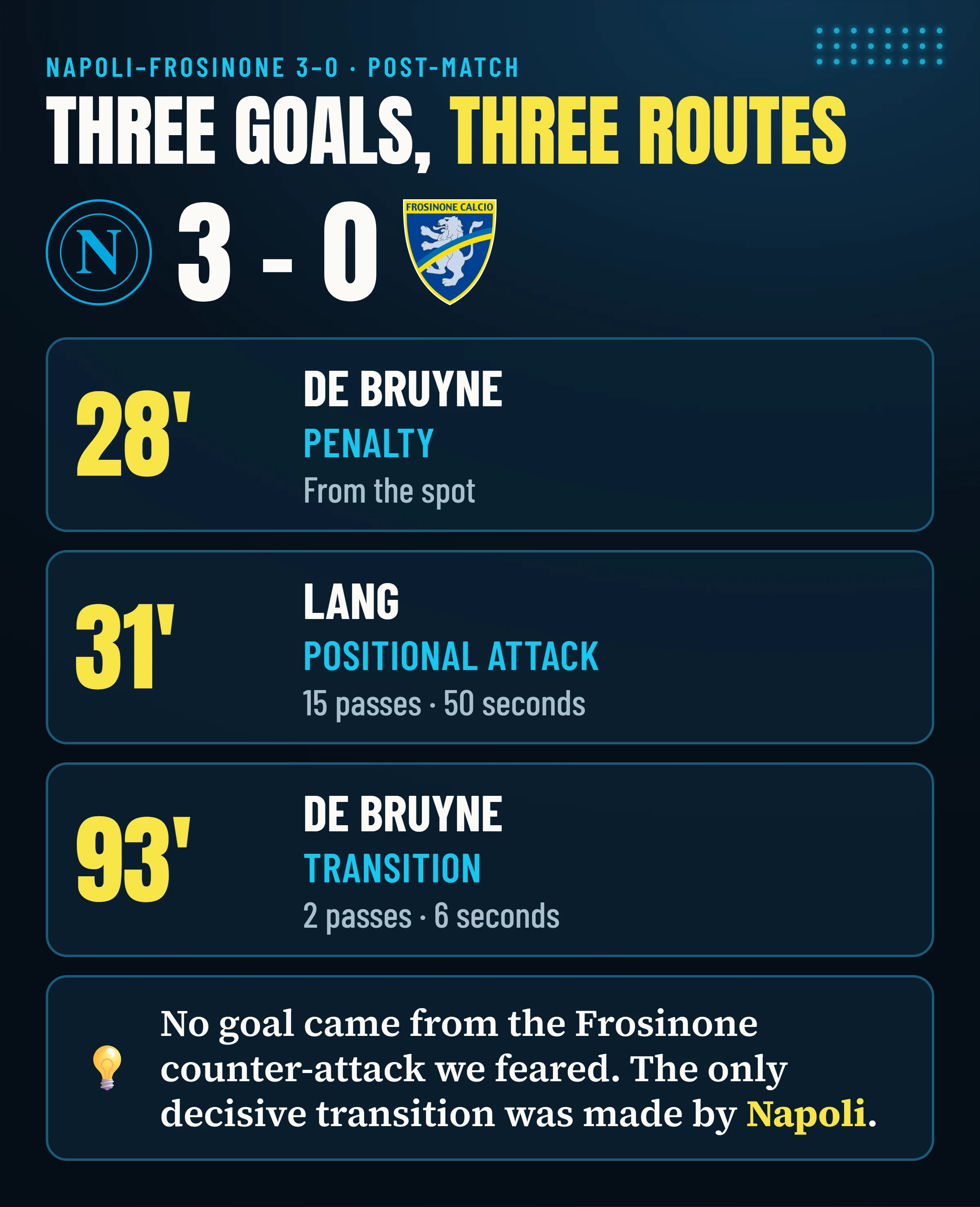
Napoli–Frosinone ended 3-0. In the pre-match we wrote that Napoli’s risk was not possession, but the second after losing it.
The data say that mechanism was really there. But it was not what decided the game.
To understand it you have to separate two things: how often Napoli lost the ball and what Frosinone did with it.
Napoli scored in three different ways
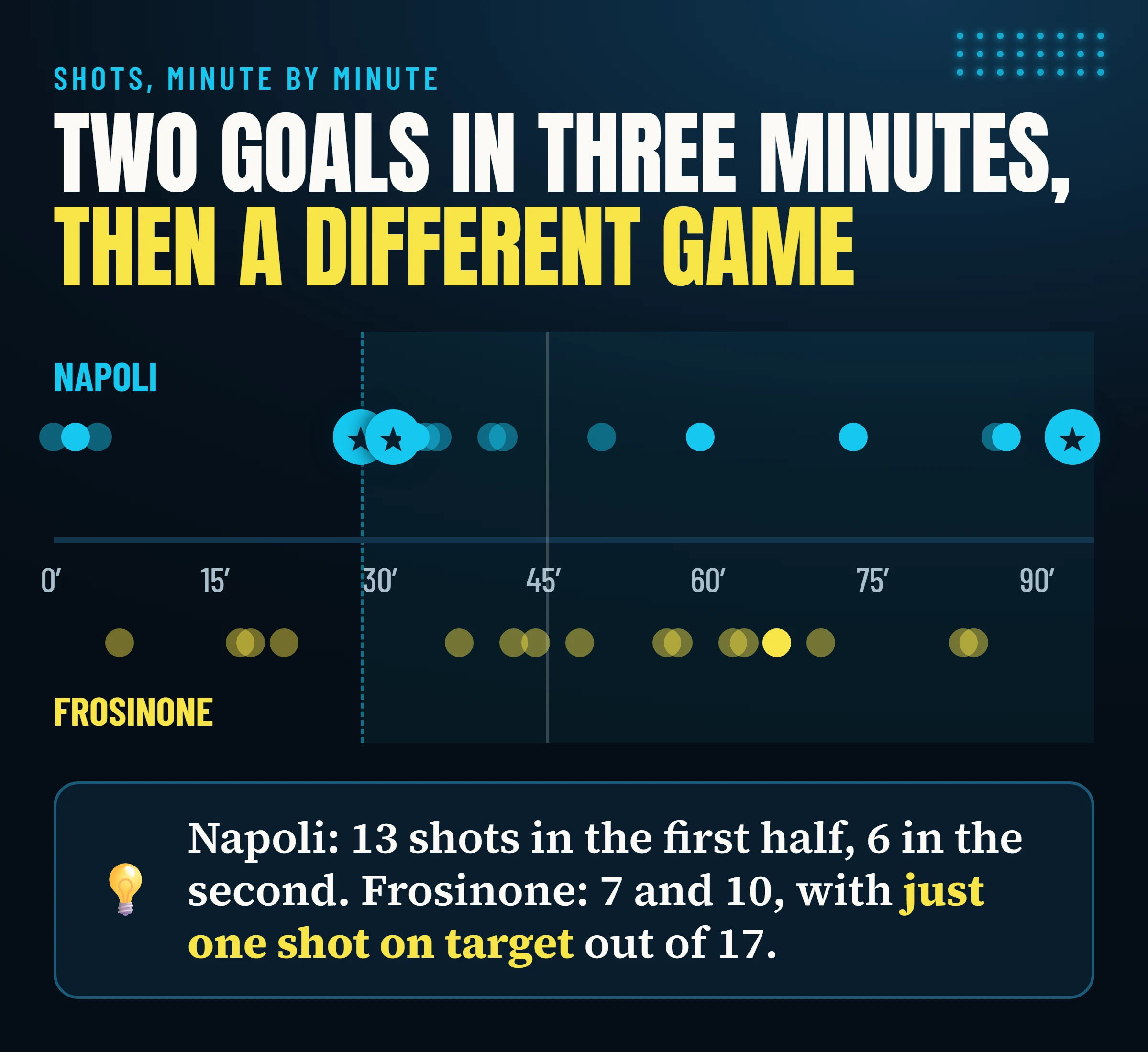
At the 28th minute De Bruyne scored from the penalty spot. Three minutes later, at the 31st, came Lang’s goal: a throw-in, a positional attack of 15 passes and 50 seconds, Di Lorenzo’s shot saved and the rebound into the net.
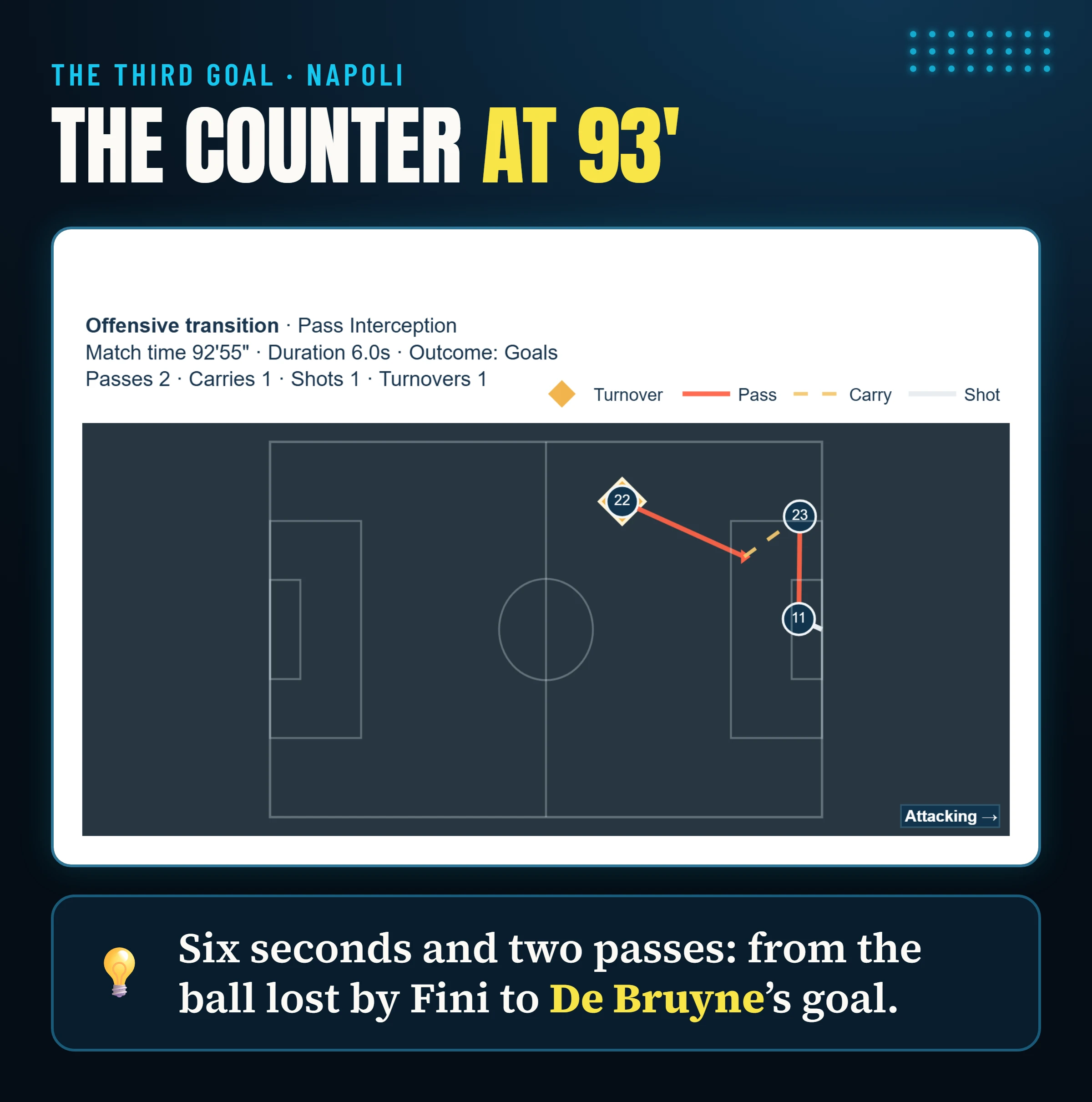
The third goal came in stoppage time, at the 93rd minute. A misplaced pass from Fini, Di Lorenzo breaks, Giovane finds De Bruyne and it’s a goal: two passes, six seconds.
It is a small irony. The only decisive transition of the game, the one we had pointed to as Napoli’s weak spot, was made by Napoli, with Frosinone still chasing.
Napoli played with three at the back
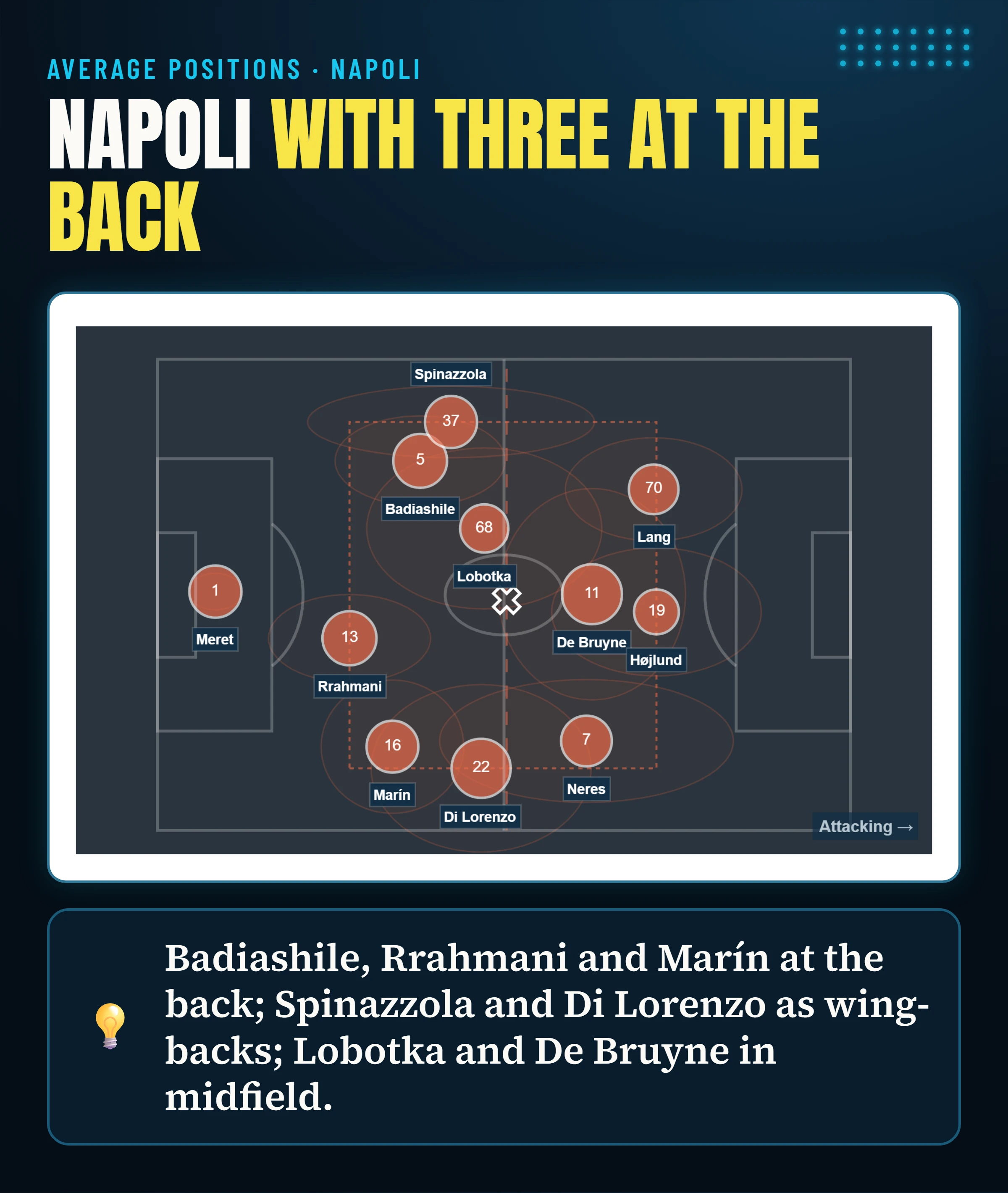
In the pre-match we had indicated the 4-2-3-1 as the most likely shape and the 3-4-2-1 as plan B. Allegri started with plan B straight away. At the back, a line of three with Badiashile on the left, Rrahmani in the middle and Marín on the right. In front of them Spinazzola and Di Lorenzo as wing-backs (full-width players running the whole flank), De Bruyne and Lobotka in the middle, Neres and Lang behind Højlund.
You can already see it in the average positions: a team gathered mostly in its own half, with two wing-backs pushing up the flanks and two number tens close to the striker.
Napoli attacked mostly from the left: 22 final-third entries out of 43, against 14 from the right. It is the side of Badiashile, Spinazzola and Lang, who with five shots was the most dangerous player of the game.
The player who held everything together was De Bruyne. He was the most involved in Napoli’s play (94 passes played or received), scored two goals, made more forward passes than anyone (8) and is also the Napoli player with the most defensive actions (14).
Napoli lost plenty of balls. They paid little
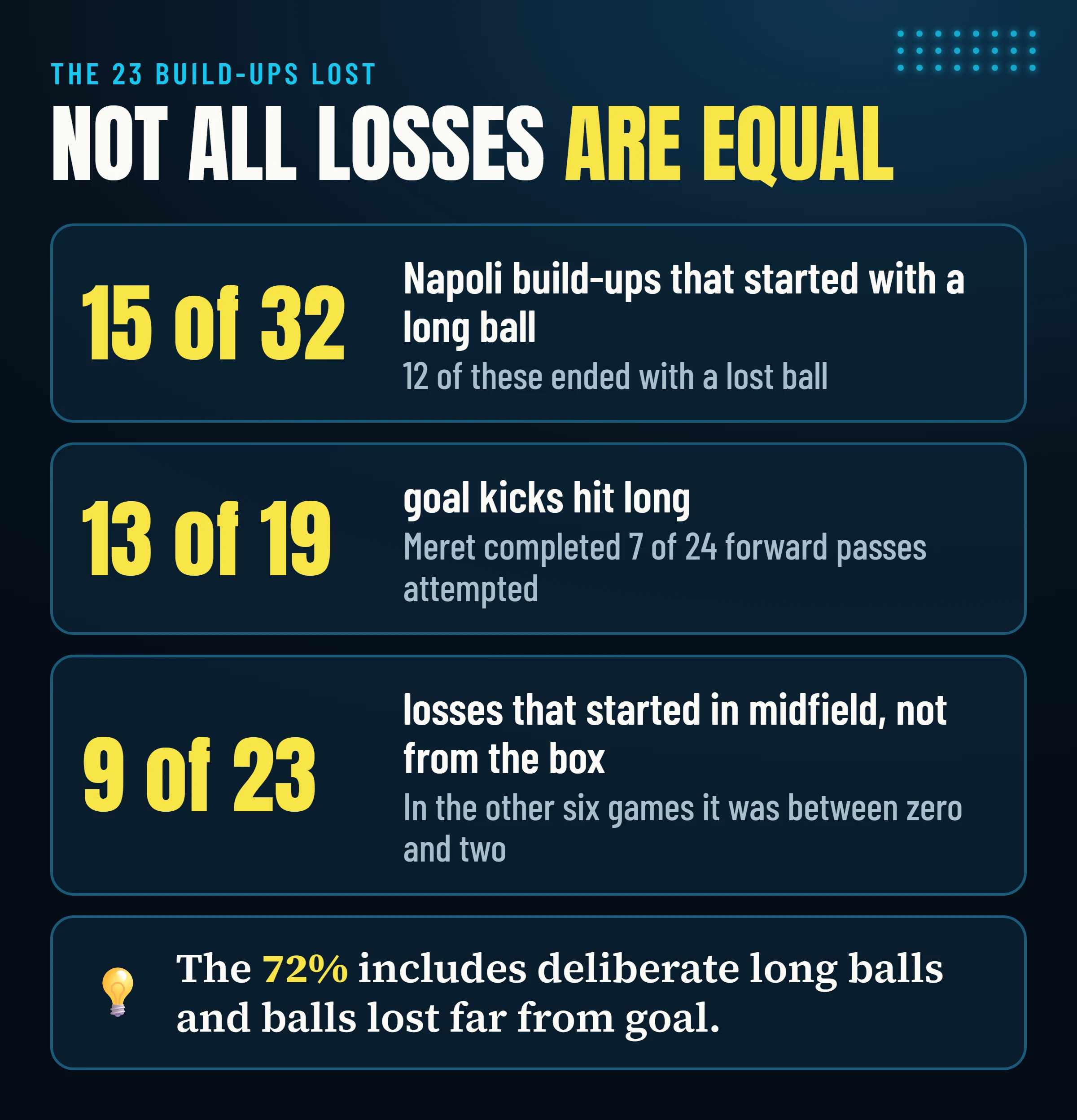
Napoli lost 72% of their build-ups from the back: 23 out of 32. It is the highest value of the seven games analysed. The previous maximum was 61%, against Inter.
And the cause was the one we had pointed to. Out of 103 turnovers, 70 came from a misplaced pass.
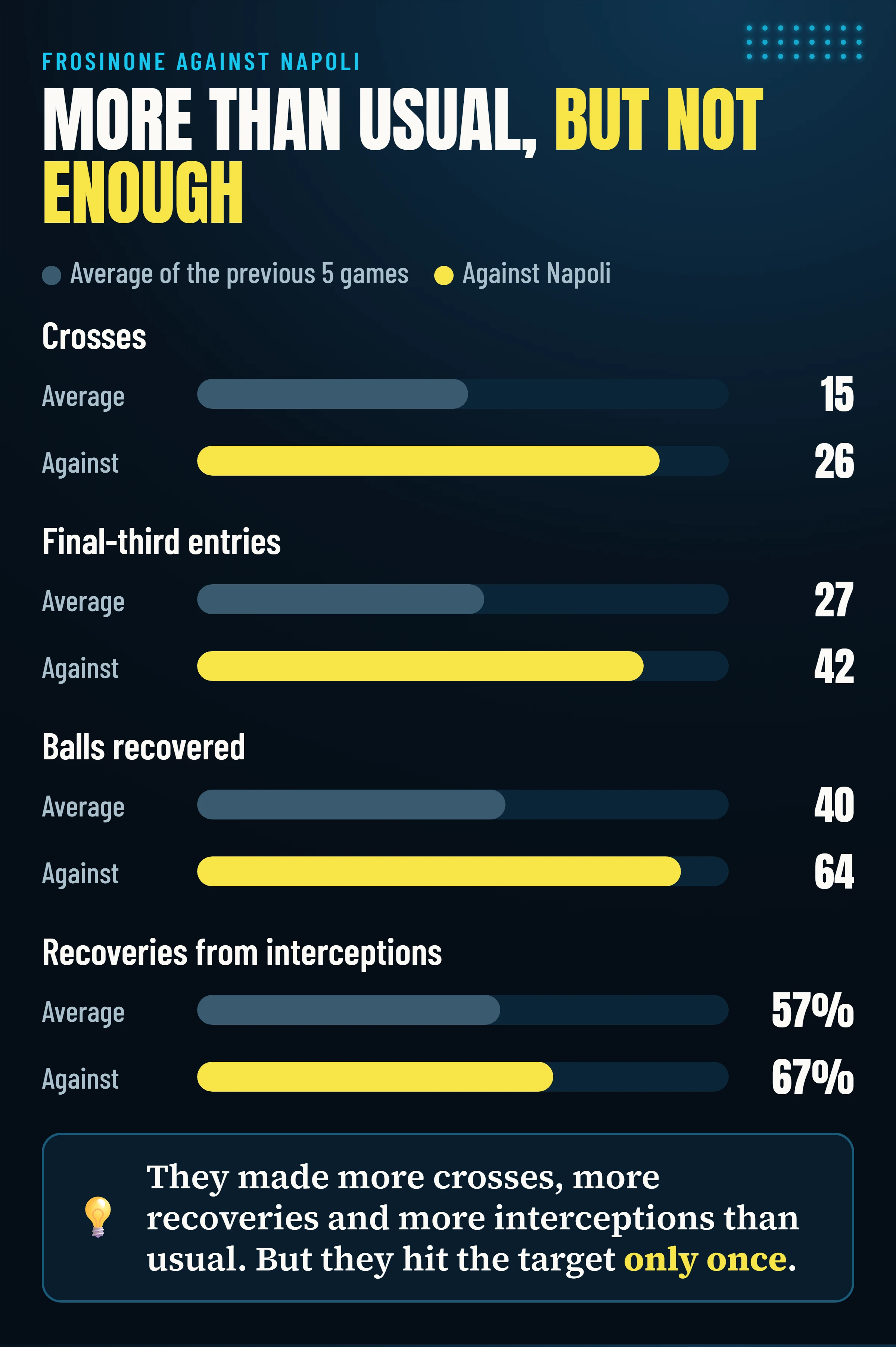
Frosinone did their job: they recovered 64 balls, more than in any other game analysed, and two out of three with an interception.
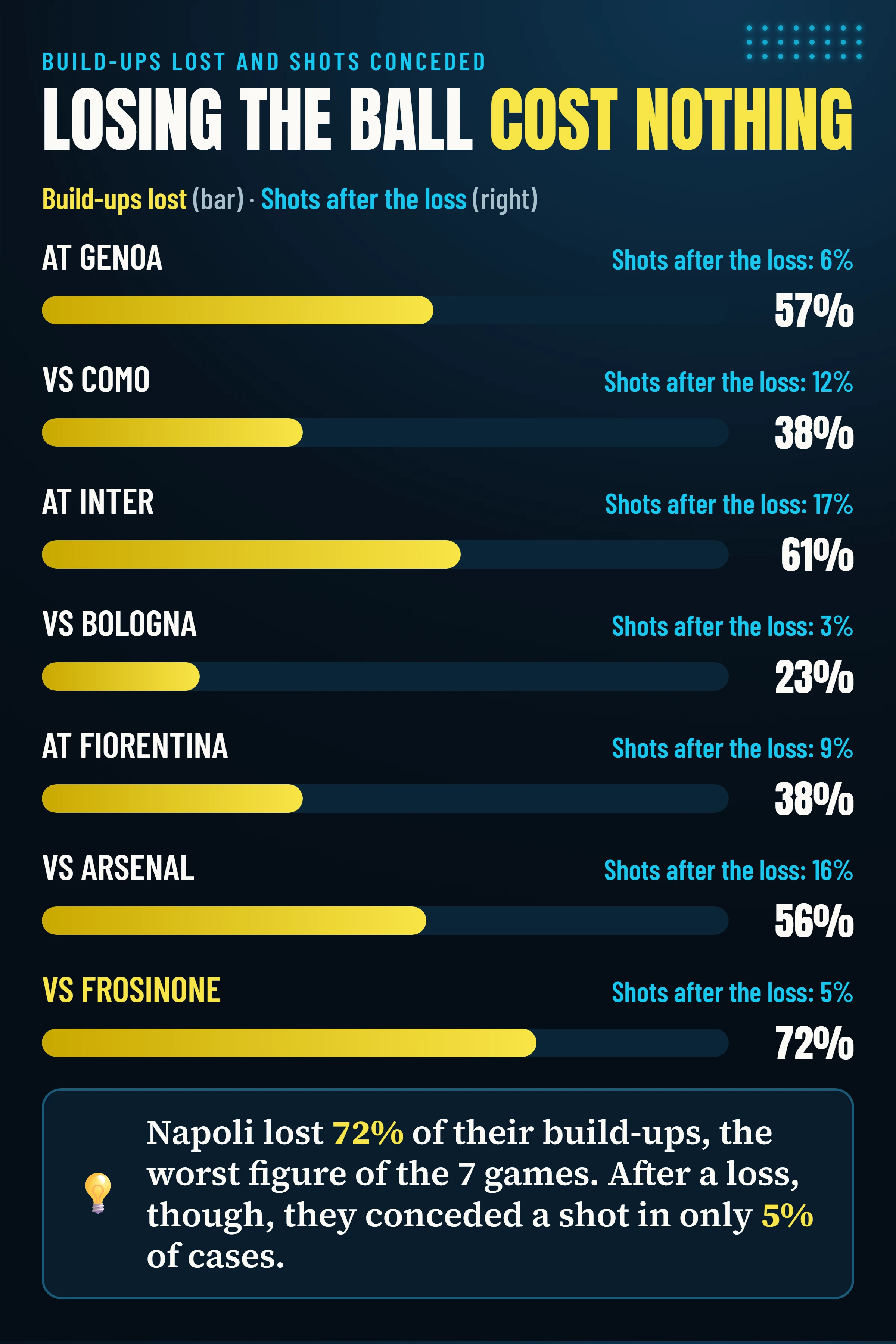
And yet those counter-attacks were worth little. Frosinone had 105 of them and turned them into six shots, no goals. After a turnover, Napoli conceded a shot in only 5% of cases, against 16–17% for Inter and Arsenal.
Two elements help explain it. After 56 of the 103 losses, that is 54%, Napoli won the ball back straight away. Frosinone managed to consolidate possession in only 33% of cases.
The second is a hypothesis, not a fact: with three centre-backs and two wing-backs dropping back, there were more players behind the ball than in a back four.
Napoli also pressed much less than expected. Their PPDA was 16.7: in the pre-match we had indicated 10–11 against teams that don’t dominate possession. PPDA measures how many passes you allow the opponent before stepping in: the higher it is, the less aggressive the press.
That is why Frosinone were able to build. They lost only a third of their build-ups (5 out of 15), against 55–75% in previous games. It confirms the doubt we raised in the pre-match: pressing Frosinone high produces less chaos than expected.
Losing the ball is not always a mistake
That 72% needs careful reading, because not every lost build-up is a mistake in the way out.
Almost half of Napoli’s build-ups (15 out of 32) started with a long ball, and 12 of these ended with a lost ball. Meret hit 13 of 19 goal kicks long and attempted 24 forward passes, completing only 7. It can be read as a way to push the game up the pitch and play for the second ball: when it goes wrong, the numbers count it as a loss.
There is a second element. Of the 23 lost build-ups, 9 started in midfield, for example from a throw-in or a free kick, and not from the box. In the other six games it was between zero and two. A ball lost far from your own goal hurts much less than one lost coming out of the box, and may help explain why the bill was so light.
Frosinone crossed more. It wasn’t enough
Frosinone attacked mostly from the right, but much less than usual: 21 final-third entries from the right against 17 from the left. In previous games the difference was much bigger.
What grew instead was the cross: 26, more than in any previous game (the maximum was 23). The most used route was the one we expected, from the right towards the centre of the box (8 crosses), and Calò was the main crosser with 9.
But those crosses produced seven shots and just one shot on target, saved. On Napoli’s left played Spinazzola, back from injury, as left wing-back, with Badiashile behind him in the back three. The problem we had flagged, with Olivera out, was probably softened by the shape: there were more players in the box ready to deal with crosses.
Calò did everything, but alone it wasn’t enough
Calò was once again Frosinone’s most involved player: 119 passes played or received, close to his maximum in the sample (124 at Genoa).
He delivered 9 crosses and tried two shots, both off target. He was not isolated: he did what he always does. The problem is that no one around him managed to turn his work into shots on target.
The script was right. The lead belonged to the other team
In the pre-match we described what happens if Frosinone go ahead: they drop deep and give up on the second goal. We did not see it, because it was Napoli who went ahead.
From the 28th minute the Ciociari had to chase for 65 minutes. It had already happened against Juventus, the only defeat in the last 22 games. In this kind of game Alvini’s team has never found a way to hurt.
Of its 17 shots, 13 came with Napoli ahead. Only one was on target. Napoli shot 13 times in the first half and 6 in the second, when they also lowered the rhythm of their press: PPDA went from 15.2 to 18.4.
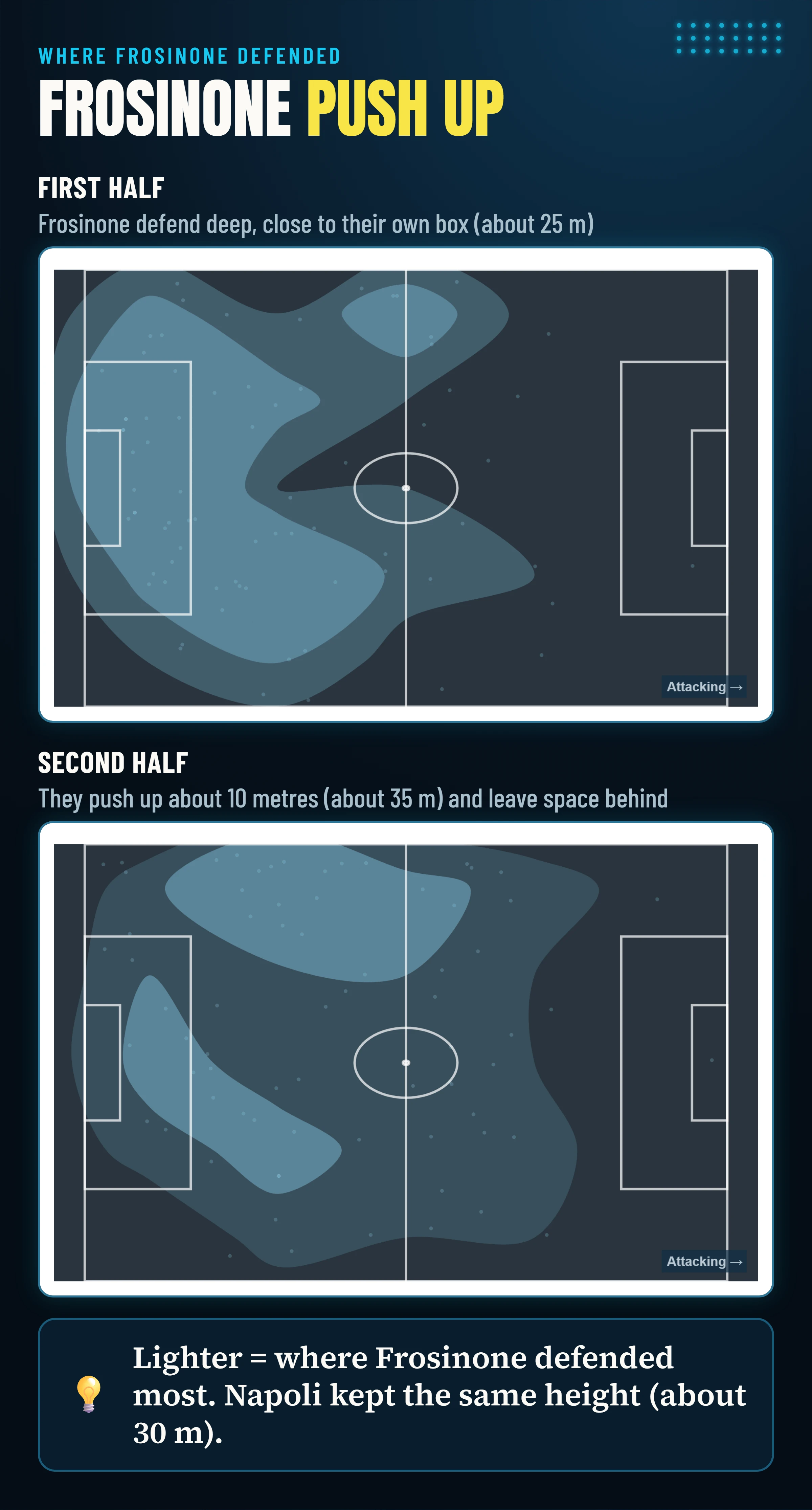
When forced to chase, Frosinone also changed height. I measured where they defend (the average height of their defensive actions): in the first half it was low, about 25 metres from their own goal; in the second it rose to about 35. Napoli, over the same period, stayed around 30 metres.
Moving up means leaving more space behind the line, and more risk when the ball is lost. It is exactly the situation in which the third goal came, at 93′.
The substitutions brought the third goal
Allegri changed five players, and almost all of them gave something. At 60′ McTominay and Lucca came on for Neres and Højlund, at 70′ Gilmour for Lobotka, at 71′ Giovane for Lang, at 80′ Politano for Spinazzola.
Of Napoli’s six shots in the second half, three came from substitutes: McTominay at 73′, Gilmour at 86′, Politano at 87′. And the assist for the 3-0 is Giovane’s, on the pitch for twenty-two minutes.
Alvini responded with five changes: Terzić for Masini at half-time, then Bobček for Raimondo and Fini for Ghedjemis at 62′, Cichella for Bracaglia at 75′ and Zerbin for Schmid at 82′. In the second half Frosinone shot more than in the first (10 shots against 7), but without finding the target. Bobček tried three times, at 63′, 70′ and 84′, and always missed the target.
The right predictions and the wrong ones
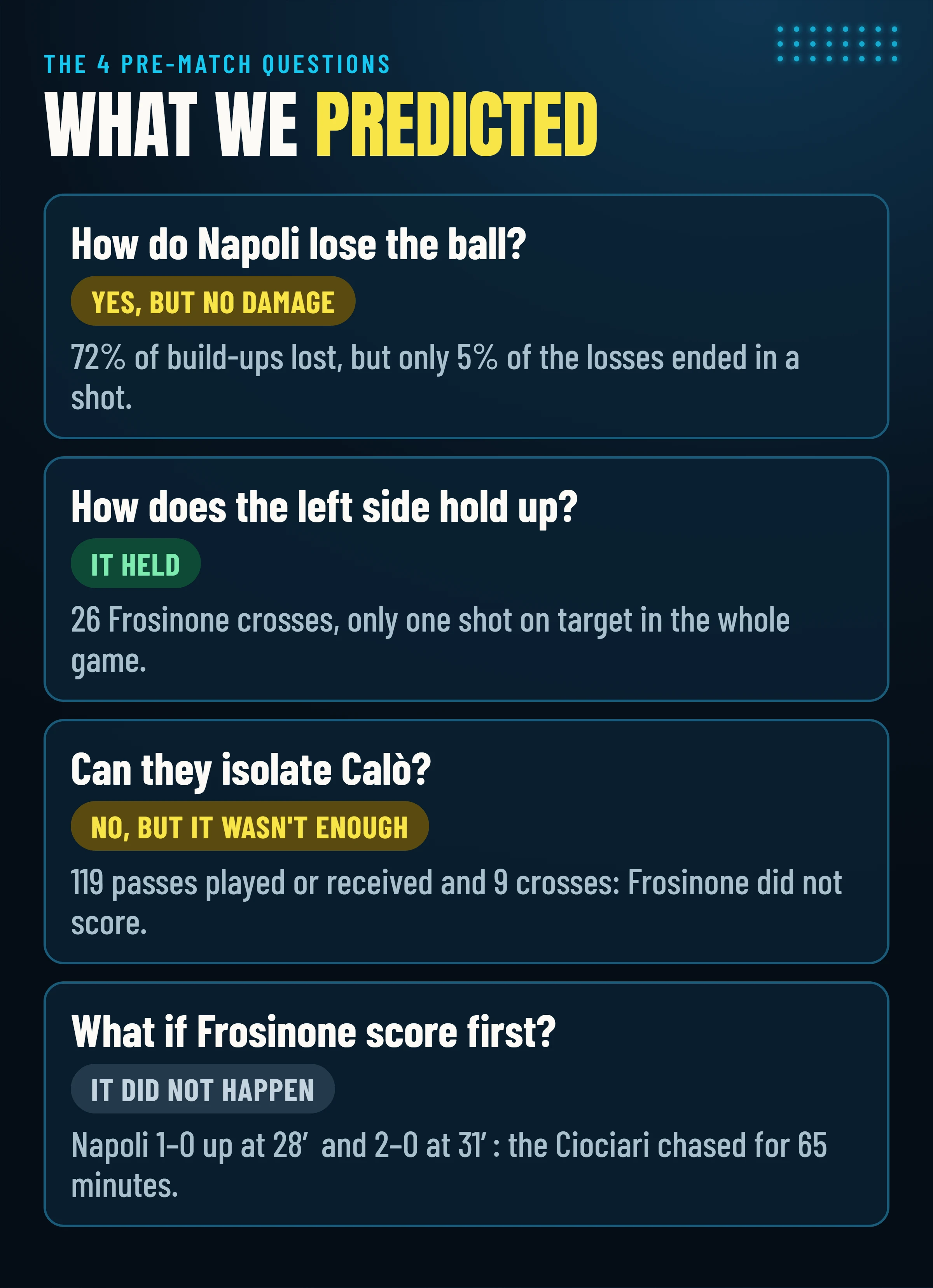
Some things we read well. Spinazzola returned and started, Cittadini played in place of Monterisi and McTominay came on for about half an hour, at 60′. The misplaced pass was the first cause of turnovers and Calò remained Frosinone’s reference point.
Others not. We had indicated the 4-2-3-1 as the likely shape and the 3-4-2-1 as plan B: Allegri started straight away with the back three. We had indicated Bobček up front: Raimondo played from the start, Bobček came on at 62′. And we expected a more aggressive Napoli in the press.
Above all, Frosinone had more of the ball than usual: 48% of the passes, against 35–40% in previous games. When the lead belongs to the opponent, the model changes.
The real test comes on Tuesday
The most useful question this game leaves is not about the result. Napoli lost 72% of their build-ups and paid little, because Frosinone turned only 6% of their counter-attacks into a shot.
On Tuesday in the Champions League, at Villarreal, the opponent is different. In the five games we analysed, Iñigo Pérez’s side press with more continuity (PPDA between 10.9 and 12.2) and at La Cerámica opponents lost between 48% and 68% of their build-ups from the back.
We come back to it in the Villarreal–Napoli pre-match.
Frosinone did much of what we had predicted, but it was not enough: Napoli scored twice between the 28th and the 31st minute, and from there the game changed script.