
Napoli–Roma, on Saturday 24 October at 18:00 at the Maradona, is the eighth matchday of Serie A. Napoli have three wins, one draw and three defeats in the league, and on Tuesday they beat Bodø/Glimt 4-3 in the Champions League. Roma have five wins and two draws in seven games, sixteen goals scored and three conceded, and on Tuesday they beat Slovan Bratislava 4-0. Both teams played on Tuesday night.
Gasperini’s Roma almost always play a 3-4-2-1 and press high. The question for Napoli is not whether they will do it, but where: a team that presses can do it on the goalkeeper and the centre-backs, or on midfield. Roma’s eight games say they choose midfield. Here we try to work out what they leave free and where Napoli can find space, and how to recognise it while the game is being played.
The news, two days before the match
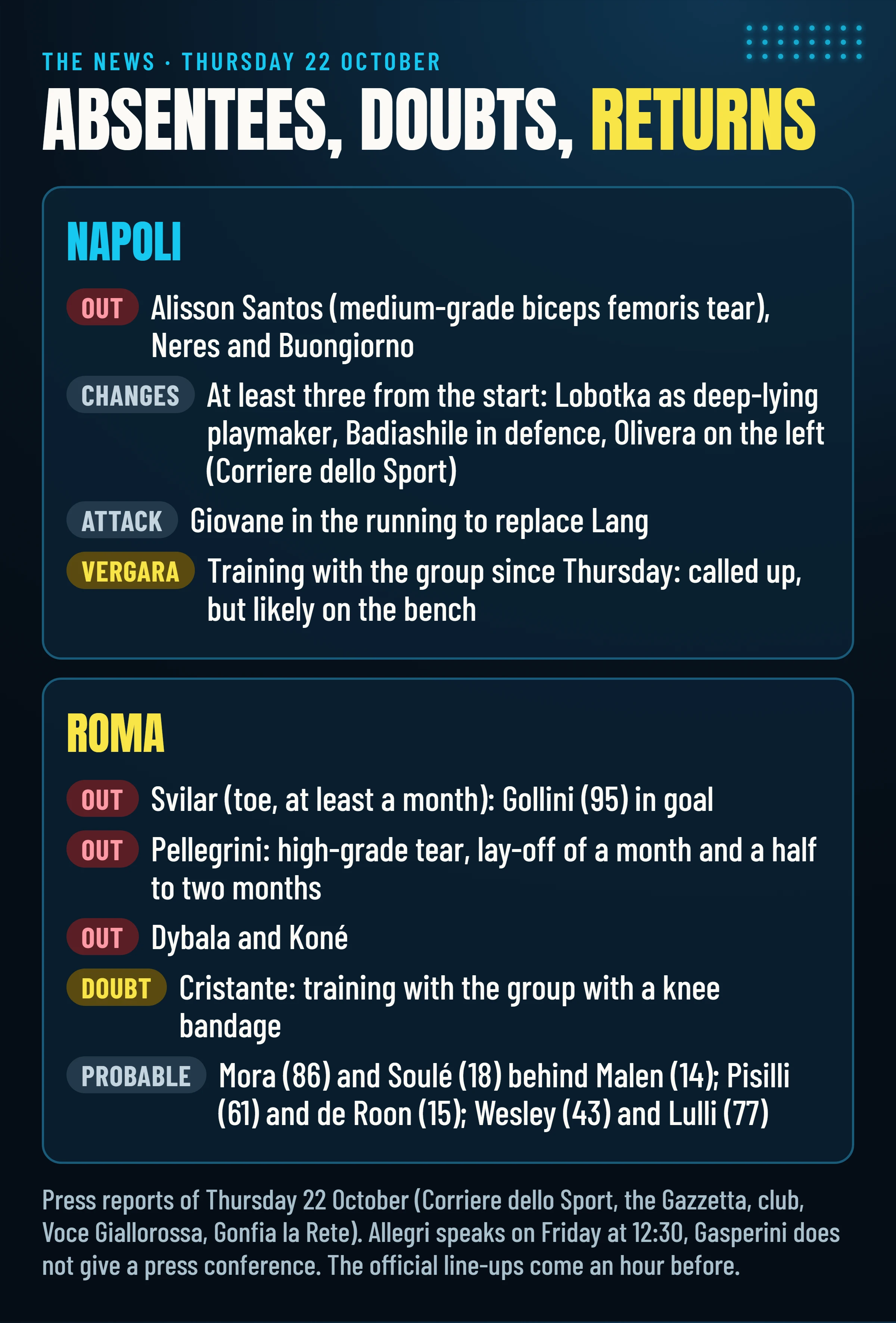
The news comes from the press and is updated to Thursday 22 October. Allegri speaks on Friday at 12:30; Gasperini will not hold a press conference, as last year after European games, so for Roma the choices will only be known with the official line-ups, about an hour before the match.
Roma have four absentees and one doubt. Svilar, who injured a toe, is out for at least a month: Gollini (95), who played against Genoa and Slovan, is in goal. Pellegrini (7), who went off against Slovan, has a high-grade tear of the semitendinosus in the right thigh: the club announced the test results on Thursday and the lay-off should last between a month and a half and two months. Koné (17) is also missing, as is Dybala (21), whose return has been postponed. The doubt is Cristante (4), back training with the group with a knee bandage on the left knee. According to Gonfia la Rete, up front Mora (86) and Soulé (18) will play behind Malen (14), with Pisilli (61) and de Roon (15) in midfield and Wesley (43) and Lulli (77) as wing-backs; Corriere dello Sport instead writes Mora on the left, Soulé on the right, Malen in the centre and Castro (9) behind them.
Napoli are missing Alisson Santos (medium-grade tear of the biceps femoris), Neres and Buongiorno. Vergara (26) trained with the group on Thursday: he will be called up but, according to Corriere dello Sport, will start on the bench. Allegri is considering at least three changes from Tuesday: Lobotka (68) as the deep-lying playmaker, Badiashile (5) in defence, Olivera (17) on the left; up front, according to AreaNapoli, Giovane (23) is ahead of Lang (70). After Roma, Napoli play at Monza on Wednesday 28, then Juventus, Porto and Lazio up to 8 November: hence the rotations.
The formation remains a question mark. Against Bodø De Bruyne (11) played in front of the defence and, the Gazzetta writes, often dropped between the defenders to receive; now Corriere dello Sport has Lobotka as the deep-lying playmaker, and it remains to be seen where De Bruyne will play. That is why this article’s tactics board is a reading, not a measurement.
Data sample. The analysis uses Roma’s eight games (seven in Serie A and Tuesday’s against Slovan, against very different opponents) and Napoli’s ten (seven in Serie A and three in Champions League). Roma’s Champions League game against Real Madrid is missing. It is little data: it shows a behaviour, not a rule.
A pressing that does not change over time
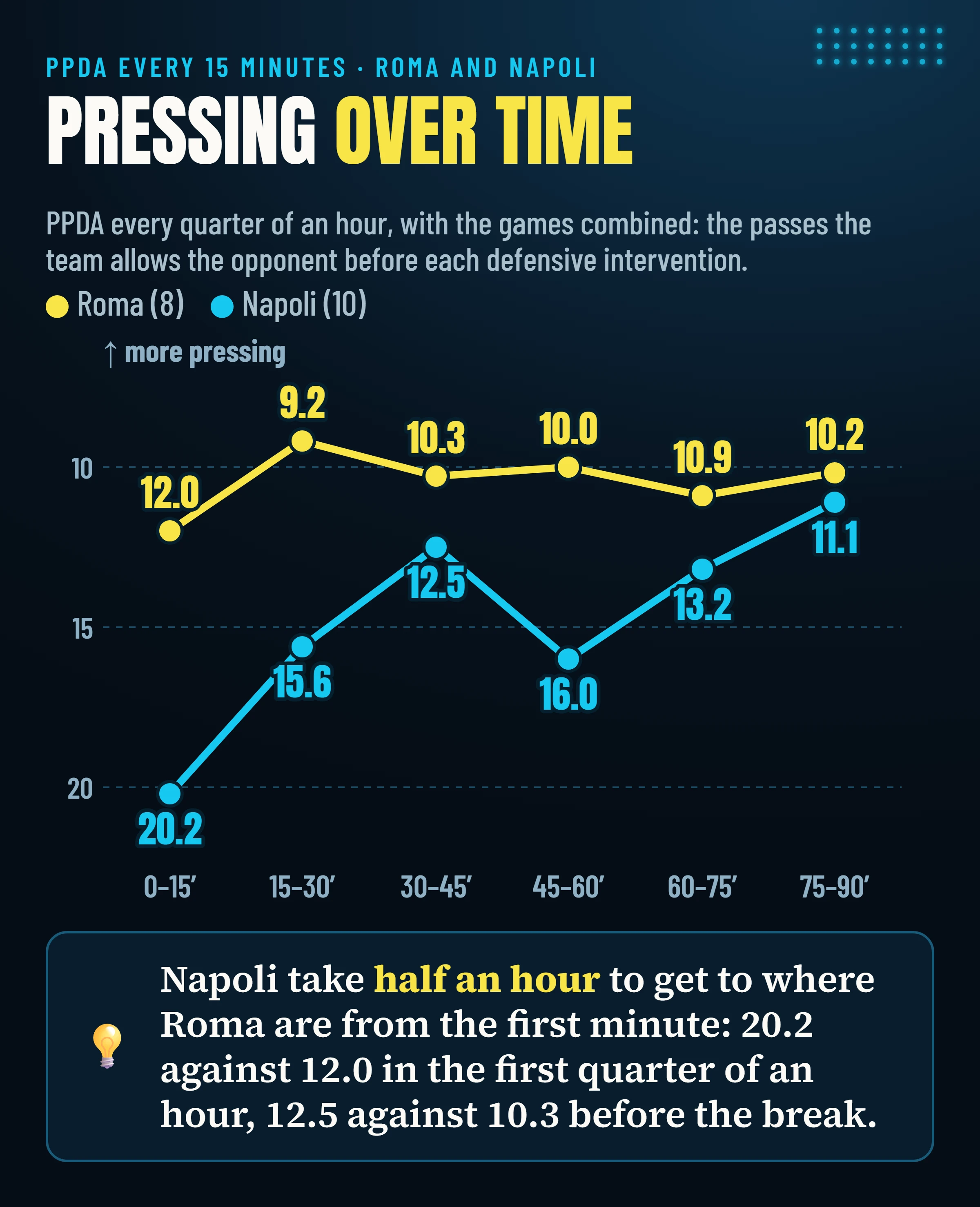
Pressing is measured with PPDA, how many passes you let the opponent make before intervening: the lower the number, the more aggressively the team presses. Roma are between 7.0 and 12.0 in seven games out of eight, even against Atalanta (9.2) and Inter (9.5); Como, 17.0, is the exception. Napoli, in ten games, are between 10.4 and 21.1.
The difference also shows over time. With the games combined, Roma stay between 9.2 and 12.0 in every quarter of an hour, from the first to the last. Napoli start at 20.2, drop to 15.6, then to 12.5 before the break and finish at 11.1: it takes them half an hour to get to where Roma are from the first minute.
Live, this means watching the first quarter of an hour: if Napoli do not push up straight away, Roma control midfield; if instead they start pressing as they do in the last minutes of their games, the match starts on equal terms.
They press in midfield, not on the goalkeeper
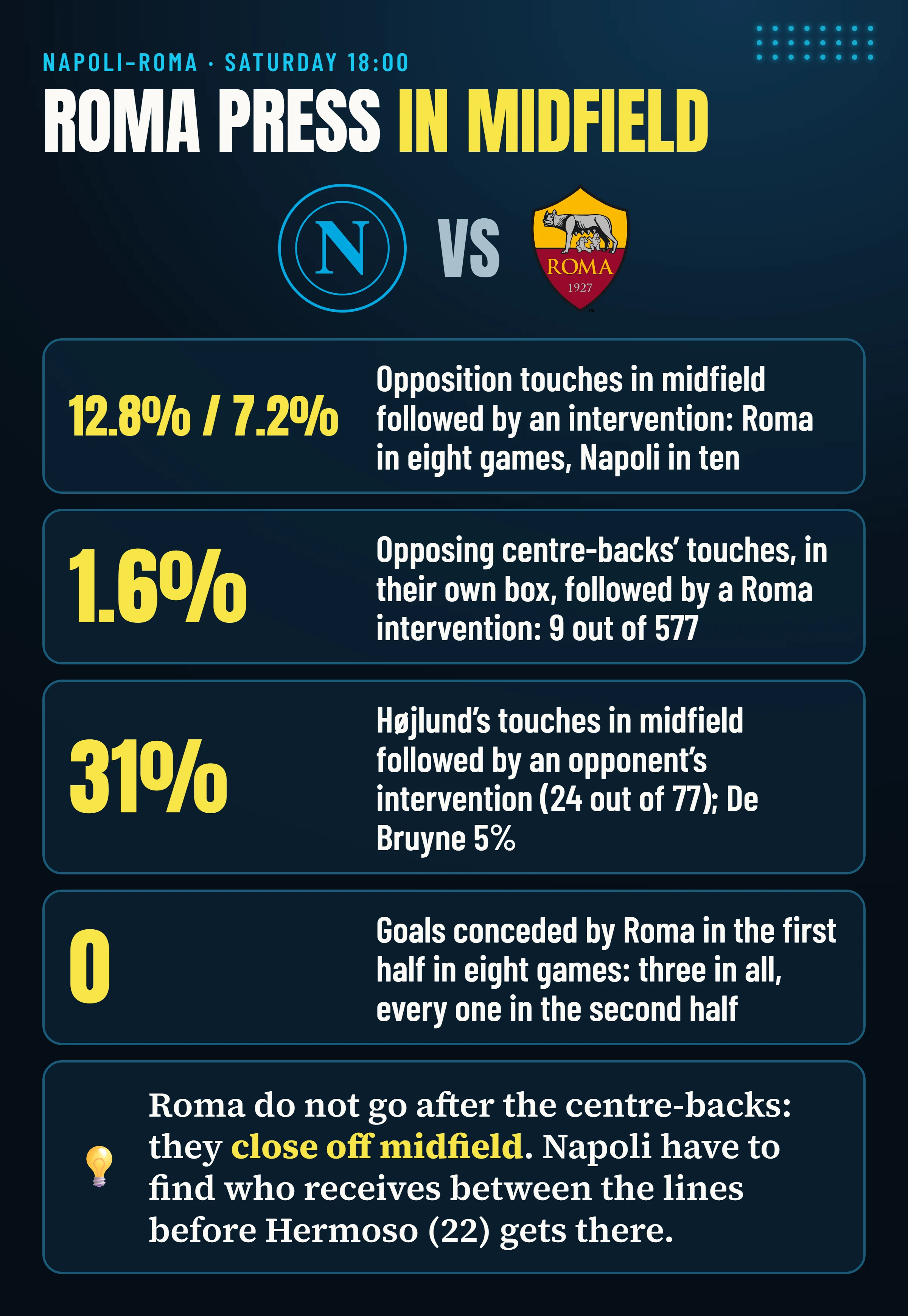
PPDA says how much, not where. To find out where, we measured the opposition touches followed by an intervention within 6 seconds and 10 metres, in each third of the pitch. In the opponent’s defensive third, that is the build-up from the back, Roma intervene on 6.0% of touches, almost like Napoli (5.2%). In the centre of that third, where the centre-backs play, 9 touches out of 577: 1.6%. Roma do not go after the centre-backs or the goalkeeper. Indeed, in six of the seven games for which we have the data, the opposing goalkeeper went long on between 54% and 76% of passes; the exception is Como, 19%. It is the area in which, against Bodø, De Bruyne (11) often dropped to receive, the Gazzetta writes: judging by Roma’s habits, he would be left free there.
In midfield it changes: Roma intervene on 12.8% of opposition touches, Napoli on 7.2%. In the final third, 22.4% against 15.1%.
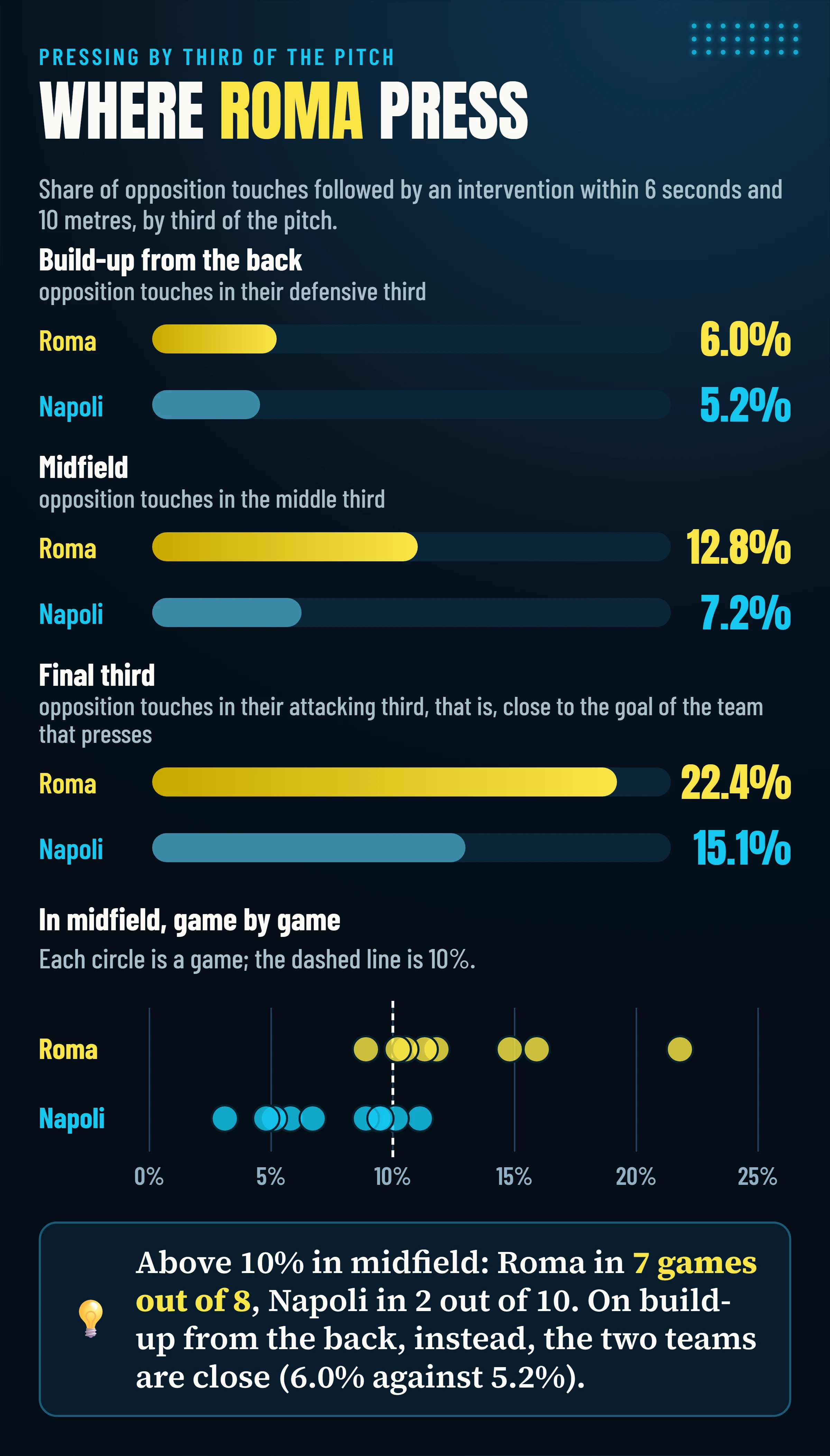
The comparison has a limit: the opponents are different. But the figure holds game by game: in midfield Roma exceed 10% in seven games out of eight, Napoli in two out of ten. And it holds against strong opponents: 14.8% against Atalanta, 10.5% against Inter.
The exception is Como, and it shows where Roma suffer. At Como, 0-0, Roma had 35% of the passes, defended at 26 metres and had 9 shots to Como’s 19; in midfield they pressed 8.9% of touches, the lowest value. Against Inter, ahead 2-0 at the break, they conceded 16 shots over the whole match and two goals in the second half. The two games in which they suffered most are those against opponents who build out along the ground or press them in turn: Napoli, depending on the day, are both.
Who receives, who presses
In midfield Roma do not press everyone in the same way. Of the touches Napoli’s players have had in the middle third, those followed by an opponent’s intervention are 31% for Højlund (19), 24 out of 77, 16% for Politano (21), 12% for McTominay (8) and Lang (70), 5% for De Bruyne (11) and 4% for Lobotka (68). Whoever receives with his back to goal is the one closed down first; whoever receives turned, between the lines, much less so. These are averages against ten different opponents: with a Roma who intervene almost twice as often, a higher percentage is to be expected for everyone.
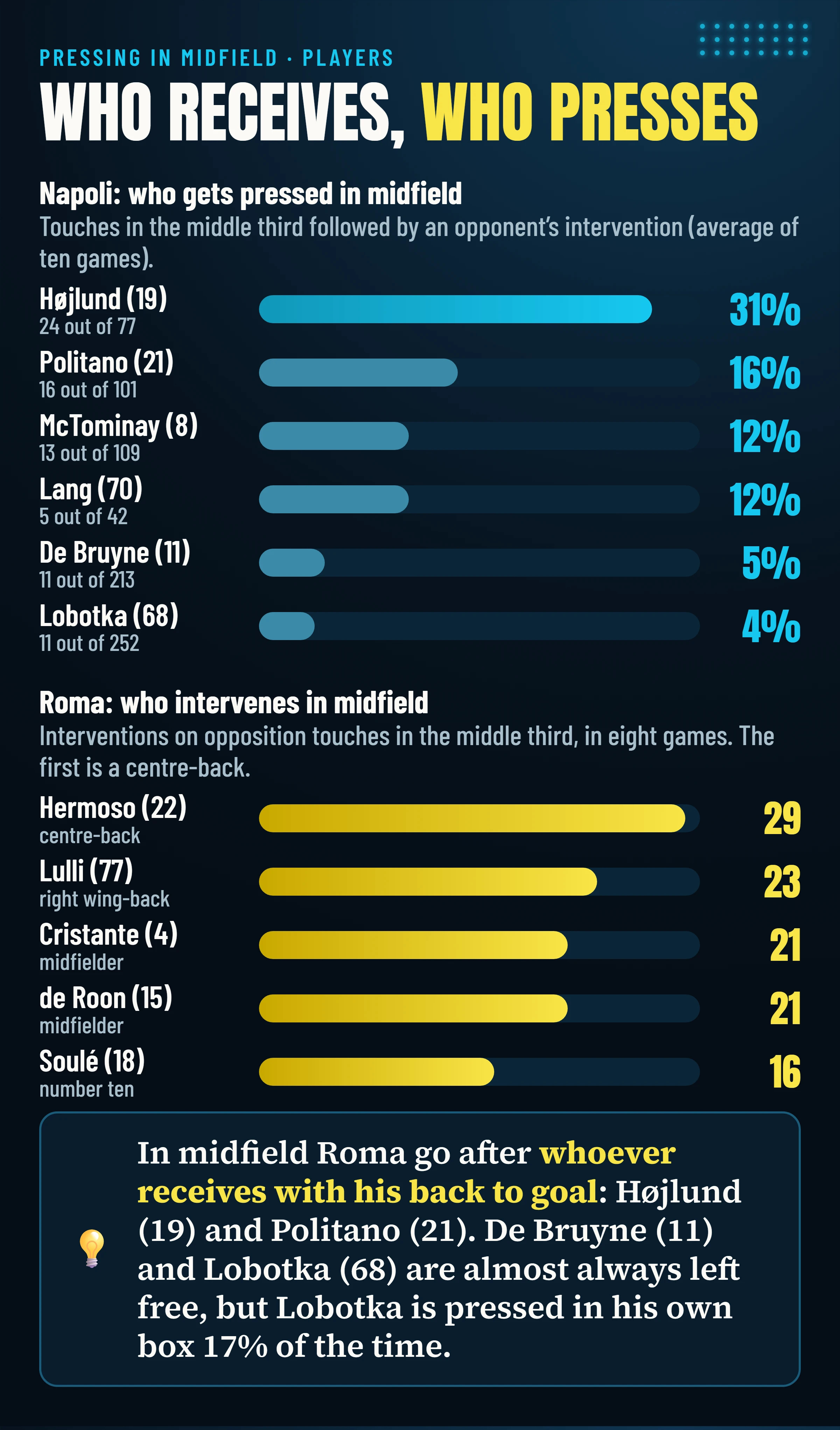
On the other side, whoever intervenes in midfield for Roma is first and foremost a defender: Hermoso (22), 29 interventions in eight games, more than Lulli (77), 23, and Cristante (4) and de Roon (15), 21 each. In a back three it is common for a centre-back to step out and follow whoever receives. The data say who intervenes, not who follows whom: that it is man-marking is a hypothesis, to be checked live.
The price of the lost ball
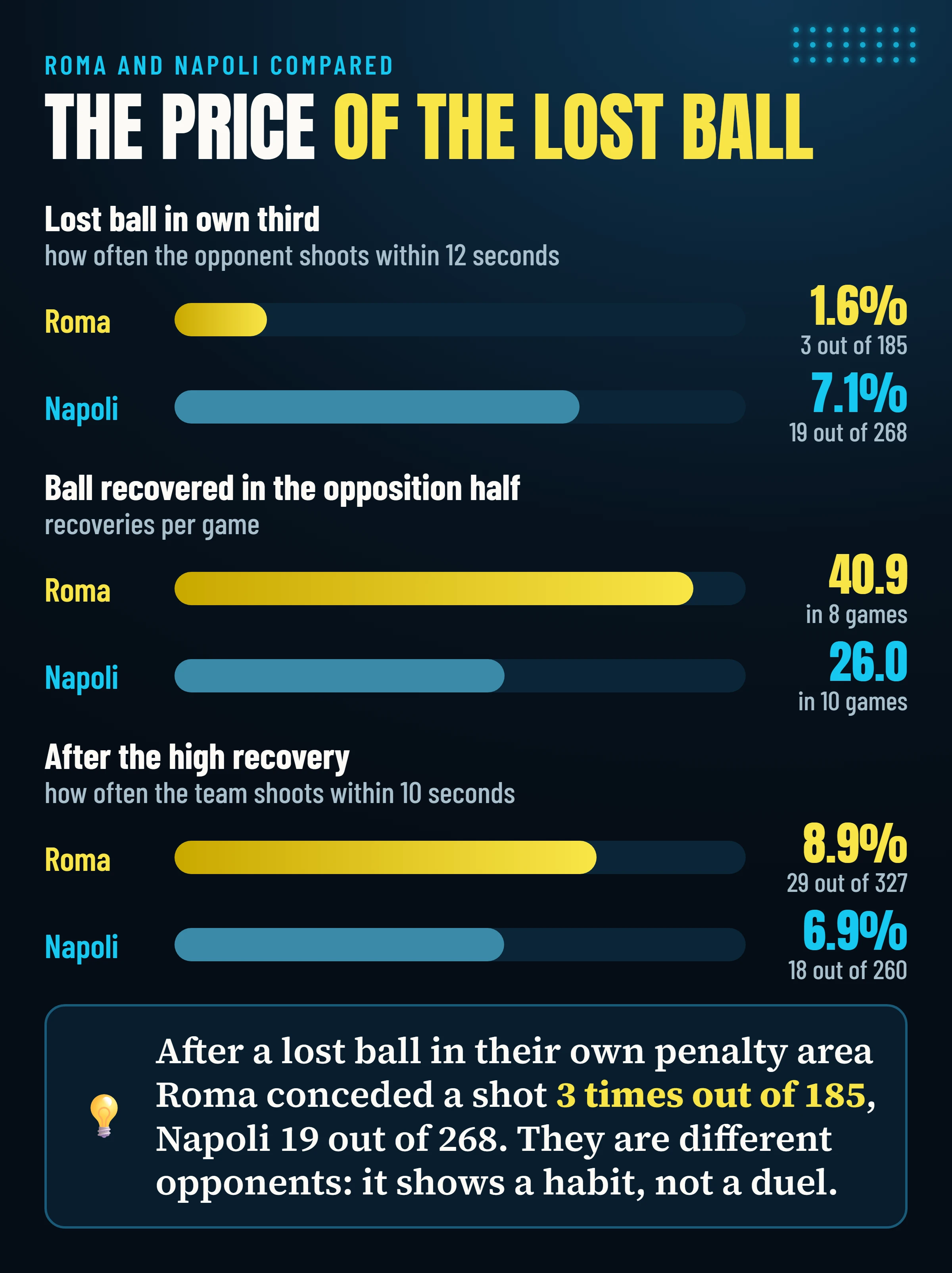
If Roma press in midfield and Napoli lose the ball there, the recovery happens close to Napoli’s goal. Roma recover 40.9 balls per game in the opposition half, Napoli 26.0; after a high recovery Roma shoot within 10 seconds 29 times out of 327 (one in eleven), Napoli 18 out of 260 (one in fourteen).
The cost of one’s own mistake is lower for Roma. After a lost ball in their own third of the pitch, in eight games, they have conceded a shot 3 times out of 185; Napoli, in ten, 19 times out of 268. It is not a direct duel: they are different opponents. But it is a habit, and in midfield, against this Roma, Napoli’s first mistake costs more than Roma’s.
Where the line-ups fit together
On the tactics board we drew Roma’s 3-4-2-1 and Napoli with the back four and Tuesday’s 4-3-3, with De Bruyne in front of the defence. A warning: for Bodø we drew the back three and Napoli played with four. If this time too Allegri chooses the back three, the two line-ups mirror each other: three against three at the back, wing-back against wing-back, number ten against central midfielder. At that point every player has a direct reference and the match is decided in the duels, or by whoever frees himself with a movement off the ball.
With the back four there are three points of contact, and they come from this article’s data.
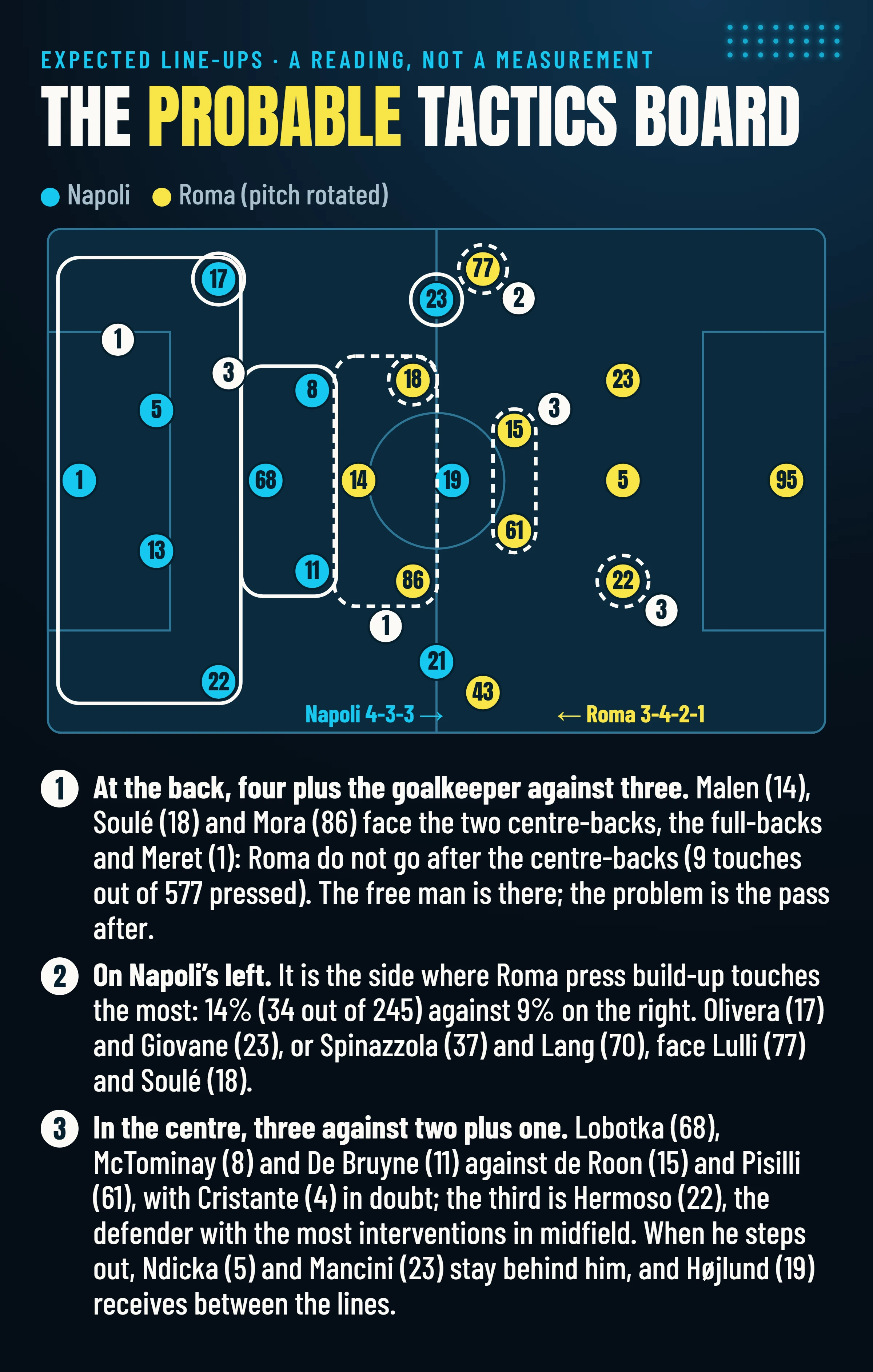
Note. This is a reading of the probable line-ups, not a measured figure: the official line-ups may change it.
Six players to watch
Three players per team tell where the match can go. The numbers are per 90 minutes, or per number of touches, and come from all the games analysed.
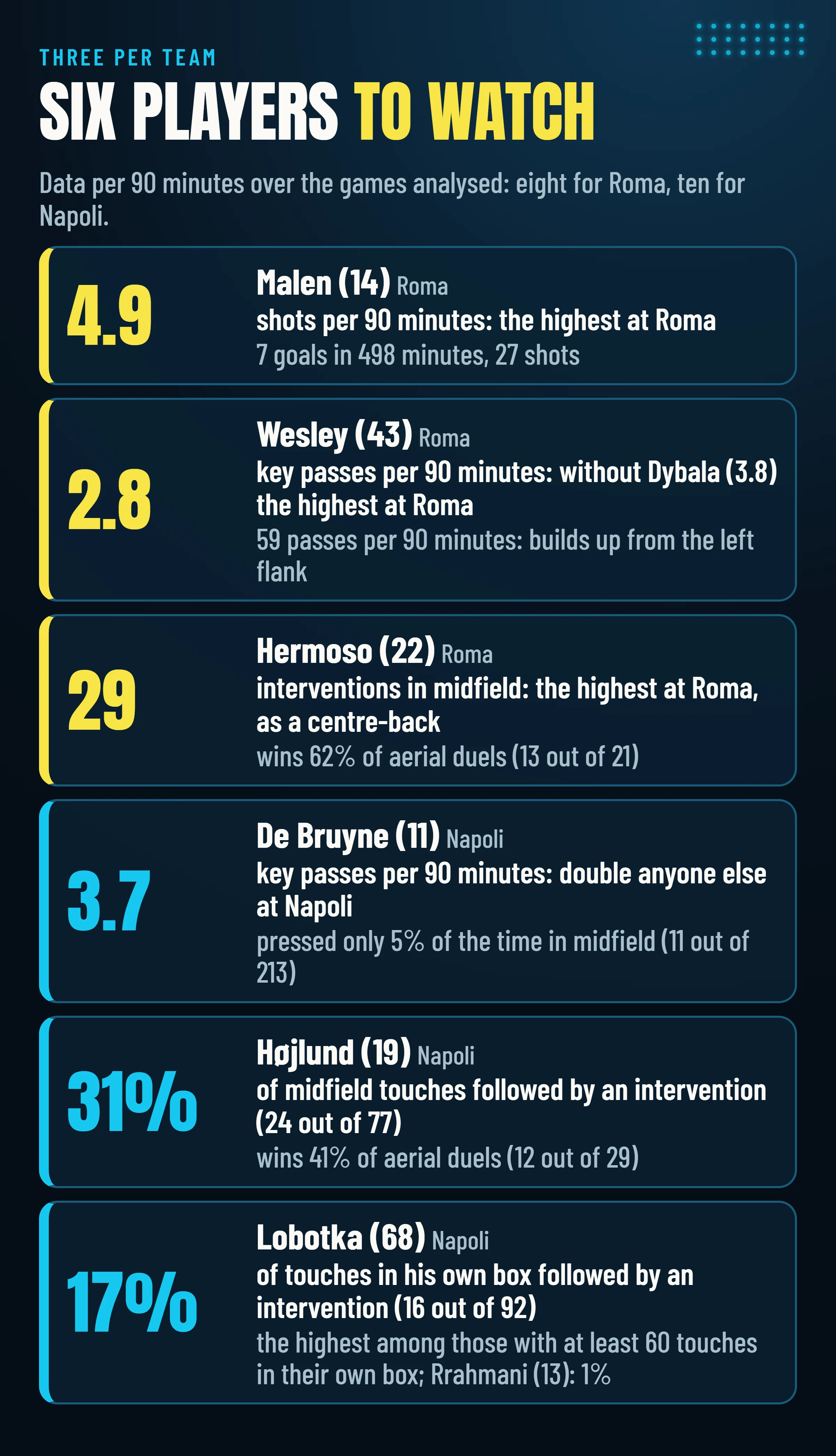
Malen (14) has scored 7 of Roma’s 20 goals, three against Fiorentina, two against Lecce, one against Torino and one against Slovan, with 4.9 shots per 90 minutes (27 in 498 minutes). He has few touches, 16 passes per 90 minutes: with Dybala out, he is the reference point up front, and Napoli have to control the depth behind their line.
Wesley (43) is Roma’s left wing-back, so on the side of Di Lorenzo (22) and Politano (21). He makes 2.8 key passes per 90 minutes (16 in 511 minutes): without Dybala (3.8) he is the highest at Roma.
Hermoso (22) is the centre-back with the most interventions in midfield, 29: he is the player to watch when Højlund (19) drops to receive. He wins 62% of aerial duels (13 out of 21). He has scored two goals, against Atalanta at 89′ and against Slovan.
De Bruyne (11) makes 3.7 key passes per 90 minutes (29 in 703), double anyone else at Napoli among those who have played at least 300 minutes. In midfield he is pressed 5% of the time (11 out of 213), in his own penalty area 12.5% (6 out of 48): against Bodø he played in front of the defence and often dropped between the centre-backs, where Roma do not go; as soon as he receives in midfield, though, the pressing he meets would be almost double the usual (12.8% against 7.0%).
Højlund (19) has scored two goals in 721 minutes and has few touches, 13 passes per 90 minutes. In midfield 31% of his touches are followed by an intervention (24 out of 77), the highest among those with at least 75. He wins 41% of aerial duels (12 out of 29): the long ball is not his terrain.
Lobotka (68) is the player who opens up the play, and in his own penalty area he is pressed 17% of the time (16 out of 92), the highest among those with at least 60 touches: Rrahmani (13) 1%. Corriere dello Sport has him as the deep-lying playmaker: he is Roma’s first possible target on touches during build-up.
Where the game can be decided
Four places, and one where the data say not to look.
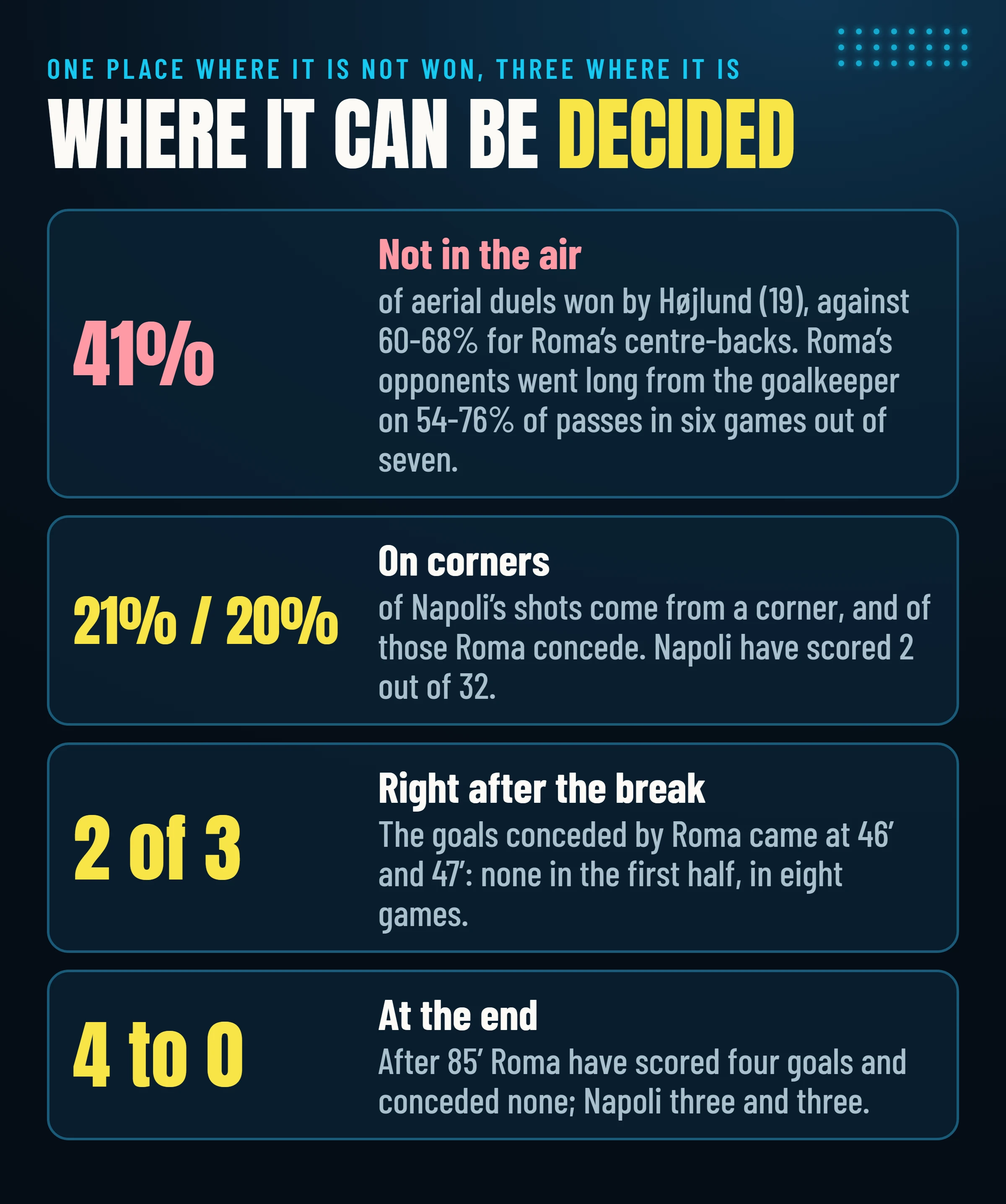
Not in the air. Højlund wins 41% of aerial duels; Roma’s centre-backs between 60% and 68% (Ndicka 68%, Balerdi 67%, Hermoso 62%, Mancini 60%). If Napoli, under pressure, go long from the goalkeeper, the ball almost always ends up with them.
On corners. 21% of Napoli’s shots (32 out of 151) come from a corner, and 20% of those conceded by Roma (15 out of 75). Napoli have converted two, Roma have conceded one.
Right after the break. No goal conceded by Roma in the first half, in eight games; two of the three conceded came at 46′ (Lautaro Martínez, against Inter) and at 47′ (Éderson, against Atalanta). The third is Lautaro’s second, at 79′. They are few cases, but they are the minutes in which Roma, ahead or level, come back onto the pitch.
At the end. After 85′ Roma have scored four goals (Pisilli 86′ and 93′, Hermoso 89′, Soulé 93′) and conceded none; Napoli have scored three (Vergara at Genoa, De Bruyne against Frosinone, an own goal by Bodø) and conceded three (Inter, Villarreal, Bodø).
If the game changes: personnel and set-up
The first goal and the substitutions: there are precedents for both teams. Roma scored first in six games out of seven in which a goal was scored; Napoli in seven out of ten.
If Napoli score, they tend to give up the ball: in the same game, between level score and lead, they lost 10 points of touch share on average, and between 10 and 19 in five games out of seven (Inter -19, Villarreal -18, Fiorentina -13, Genoa -11, Bodø -10). Roma also drop, but less: 3 points on average, in four games out of five (by 10 against Inter); they rise only against Genoa. When they were behind, only 43 minutes against Atalanta, they had 69% of touches and 3.8 shots every ten minutes, and went from 0-1 to 2-1 after 89′.
If Roma score, Napoli attack in waves: in 222 minutes behind on the scoreboard they had 53% of touches, at Venezia 74% with twenty shots in 46 minutes, without scoring.
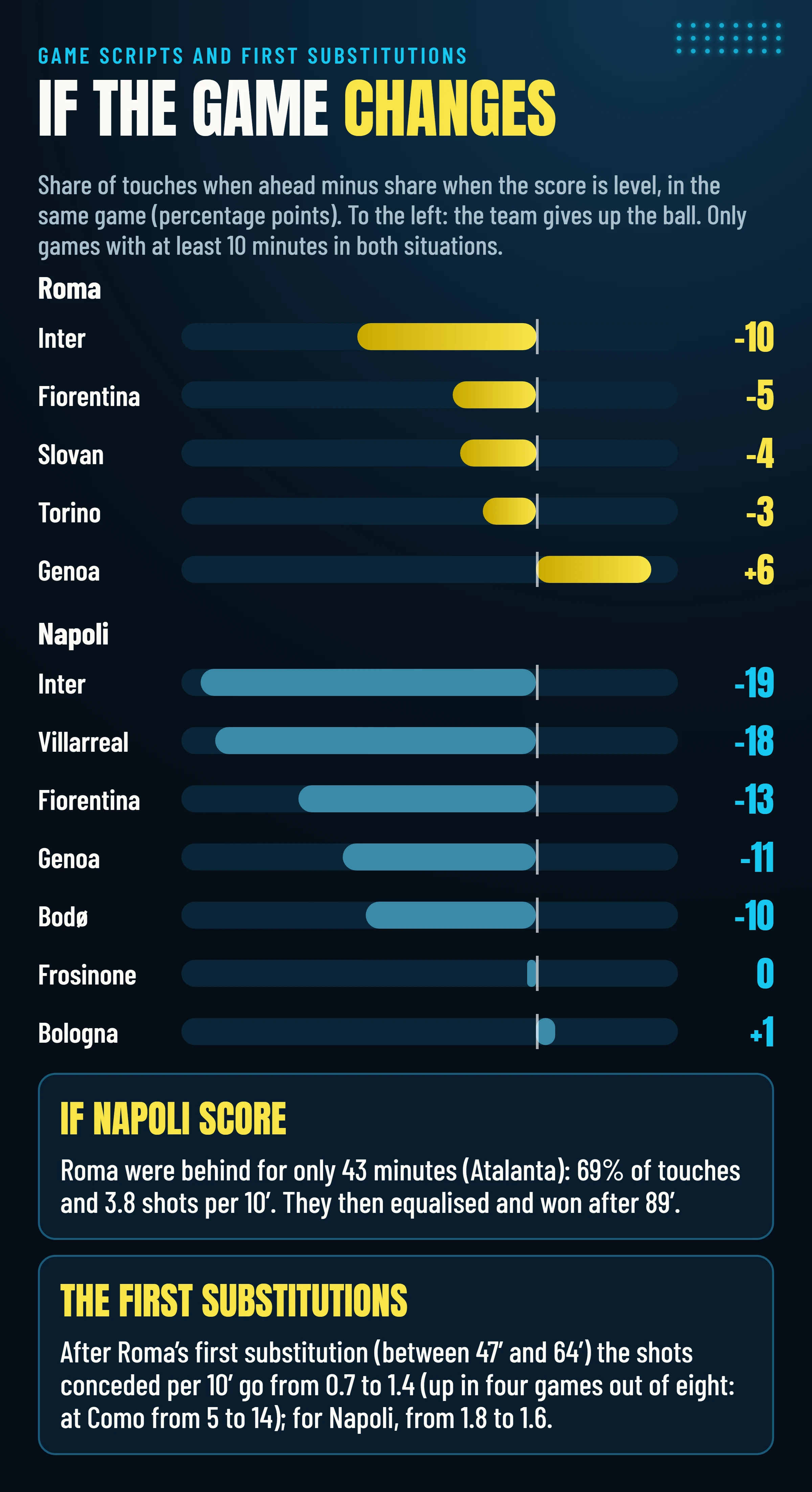
As for substitutions, Roma make the first between 47′ and 64′. After that, on average, they concede twice as many shots: from 0.7 to 1.4 every ten minutes. It does not happen every time: shots increased in four games out of eight, at Como from five to fourteen. Napoli make their first change between 47′ and 67′ and, after that, concede fewer shots than before (from 1.8 to 1.6). The window from 47′ to 64′ is the one in which Napoli can find more space, if they get there with fresh legs, and that is why Allegri rotates: after Roma come Monza, Juventus, Porto and Lazio up to 8 November. At Roma, Gollini (95), Balerdi (26) and Pisilli (61) played almost every minute of the Genoa and Slovan games.
The five signals to watch on Saturday
In midfield, not on the goalkeeper
Roma press from the first minute to the last, but not on the goalkeeper or the centre-backs: they close off midfield, and go after whoever receives with his back to goal. Napoli have already paid similar bills: against teams that press, the goalkeeper goes long and a lost ball in their own penalty area costs shots. The routes are few: not aerial play, but the centre between the lines, corners and the closing minutes.
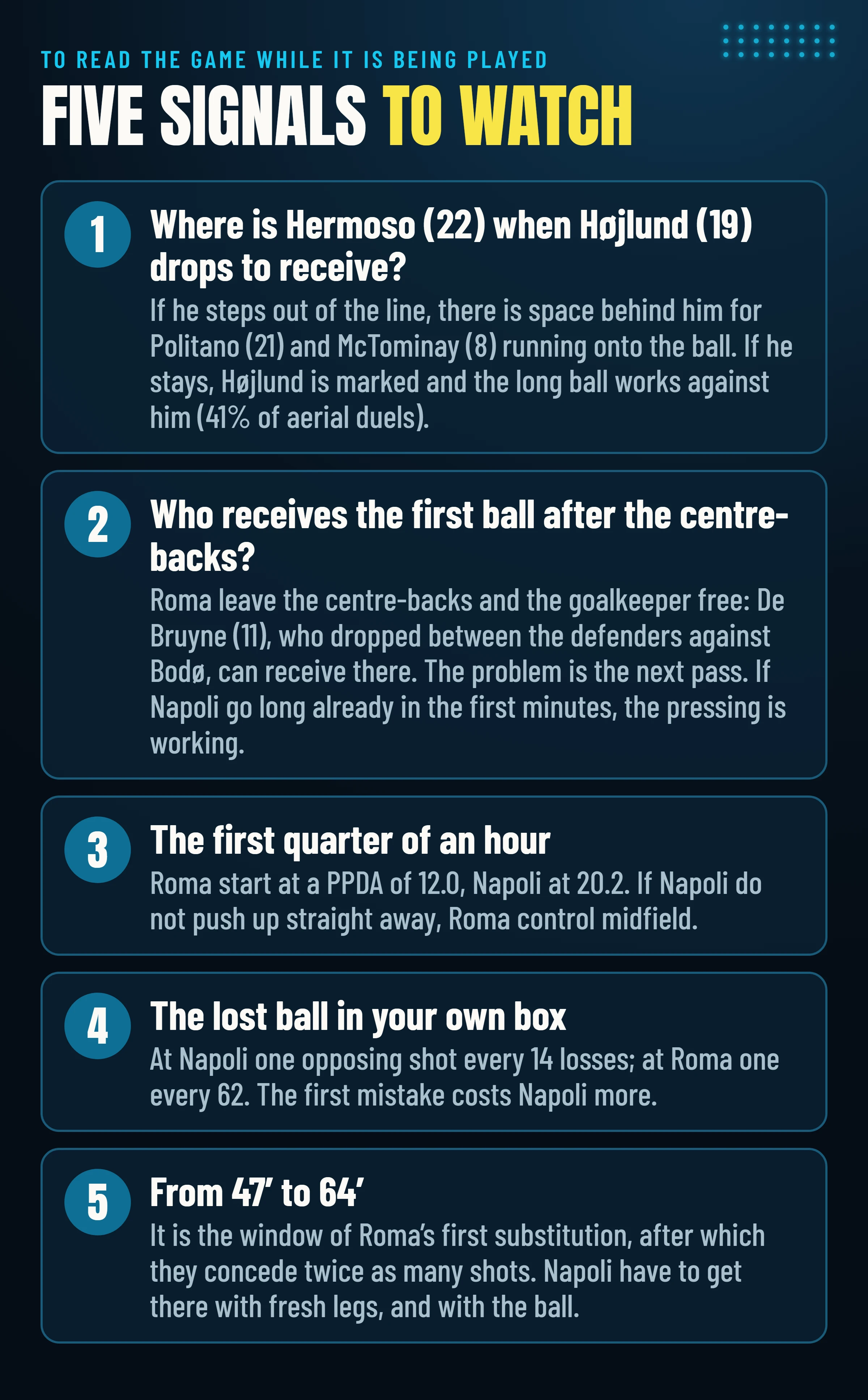
The signal of the first ten minutes: watch where Hermoso (22) is when Højlund (19) drops to receive, and who receives the first ball after the centre-backs.