
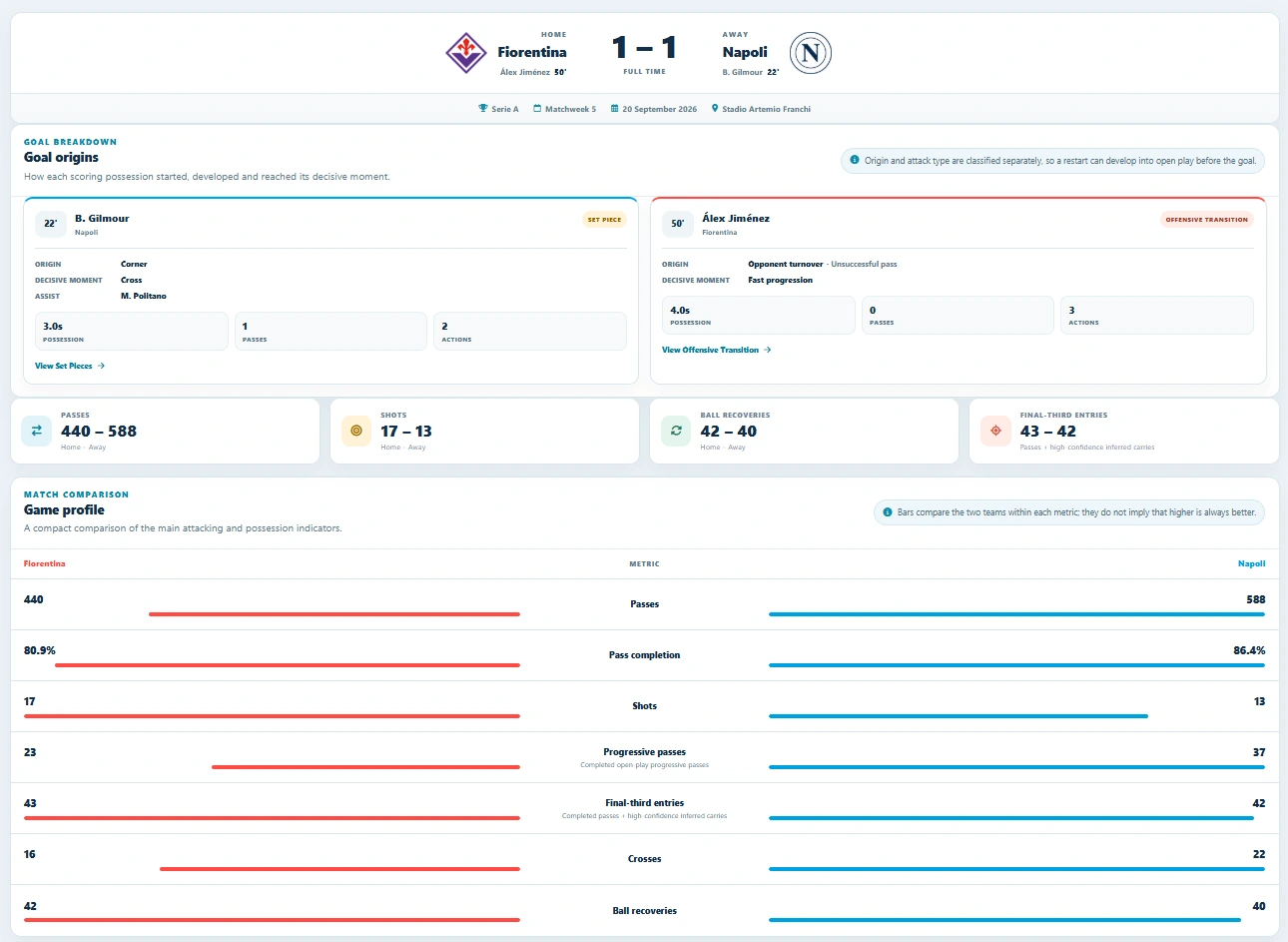
Napoli had more of the ball.
They completed more passes, produced more progression and found the route into the opposition half more consistently.
Fiorentina needed less build-up.
When they regained the ball, they more often turned that change of possession into metres, final-third access and shots.
That is where Fiorentina–Napoli becomes more interesting than the simple 1-1 scoreline.
Because the result is not a perfect picture of what the two teams produced.
Atta’s effort off the bar comes from a fortunate ricochet while Napoli try to clear the box. Jiménez’s equaliser, instead, arrives within a well-built transition, but becomes a goal only when Rafa Marín’s deflection completely changes the path of a shot that had looked manageable.
Structure and episode coexist.
The structure explains how the situation is created. The episode decides how much that situation weighs on the result.
Napoli build. Fiorentina convert.
The overall picture initially looks like a match controlled by Napoli.
The Azzurri complete 588 passes to 440, with 86.4% accuracy against 80.9%.
When progression through passing is measured, the gap is also clear: 37 completed progressive passes to 23, for 720 metres gained against 518.
Napoli move the ball better. They move it forward more often.
But when the action reaches the zone where it should turn into danger, the gap between the teams almost disappears.
Final-third entries are 42 for Napoli and 43 for Fiorentina. Shots actually swing the other way: 17 for Fiorentina, 13 for Napoli.
This is where transitions explain something that possession volume alone cannot show.
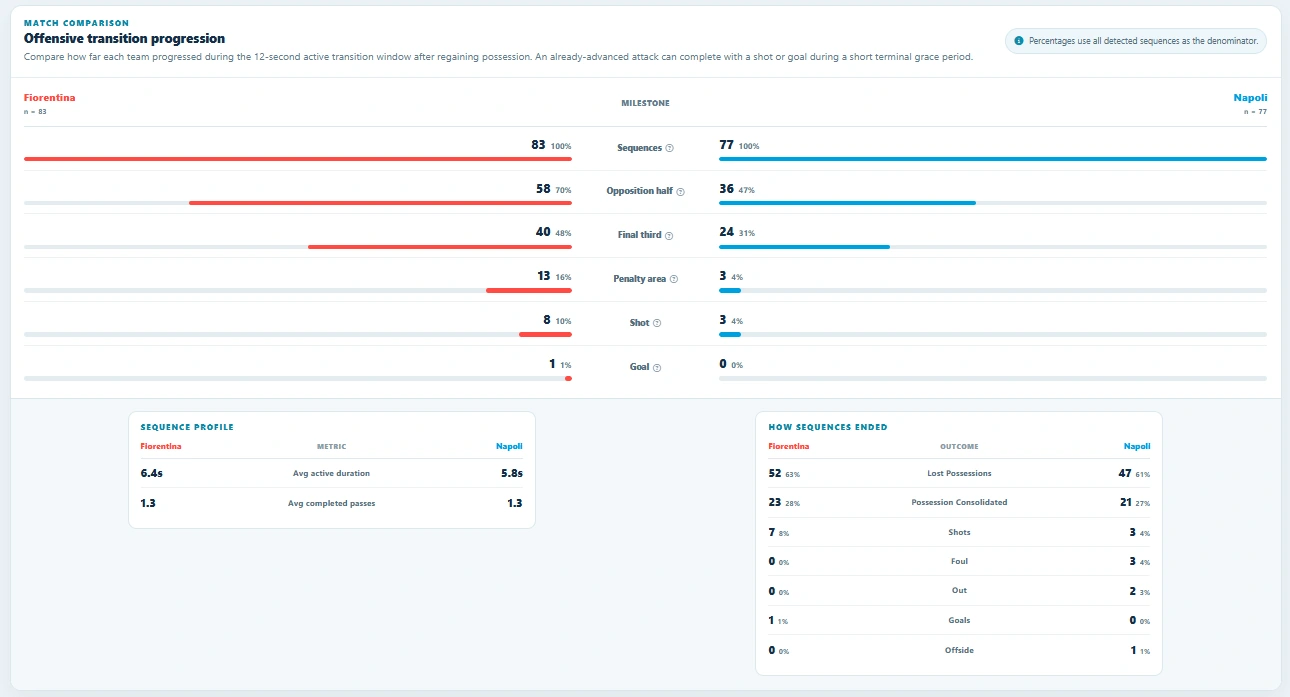
Fiorentina produce 83 offensive transitions. 70% cross halfway, 48% reach the final third and 16% get into the box.
Napoli produce 77. Only 47% cross halfway, 31% reach the final third and just 4% enter the box.
The number of changes of possession is similar. Their return is not.
Napoli need to build the advantage through circulation. Fiorentina more often find it already inside the change of possession.
The equaliser is born exactly there
The 1-1 is perhaps the sequence that best represents this difference.
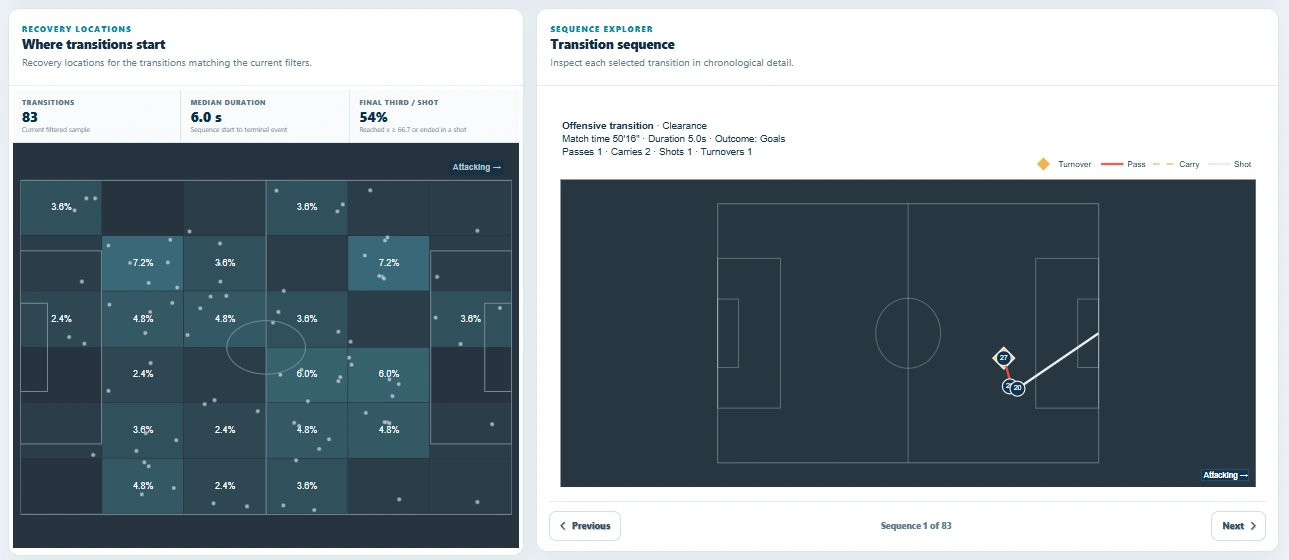
Fiorentina have just attacked. Mastantuono shoots, Milinković-Savić saves and Napoli appear to have survived the most dangerous moment.
But they do not really get out. The ball changes hands again.
Fiorentina regain it and immediately attack again, before Napoli can restore their distances.
The new sequence is classified as an offensive transition originating from an opposition turnover and unfolds in only four seconds.
Tactically, the value of the move is all here: Fiorentina regain the ball and attack a structure that is still open.
But the goal also tells us something else.
Jiménez shoots from outside the box with an effort that looks manageable. Rafa Marín tries to intervene and his deflection completely changes the trajectory, taking Milinković-Savić out of the play.
The same caution is needed when reading Atta’s first-half effort off the bar: it comes from a fortunate ricochet as Napoli try to clear the box.
Fiorentina’s 17 shots are real. They do not all describe the same quality of attack.
Napoli build on the right to free the opposite side
If transitions are the territory in which Fiorentina find advantage most easily, organised possession still belongs to Napoli.
And the direction of Napoli’s build-up is very clear.
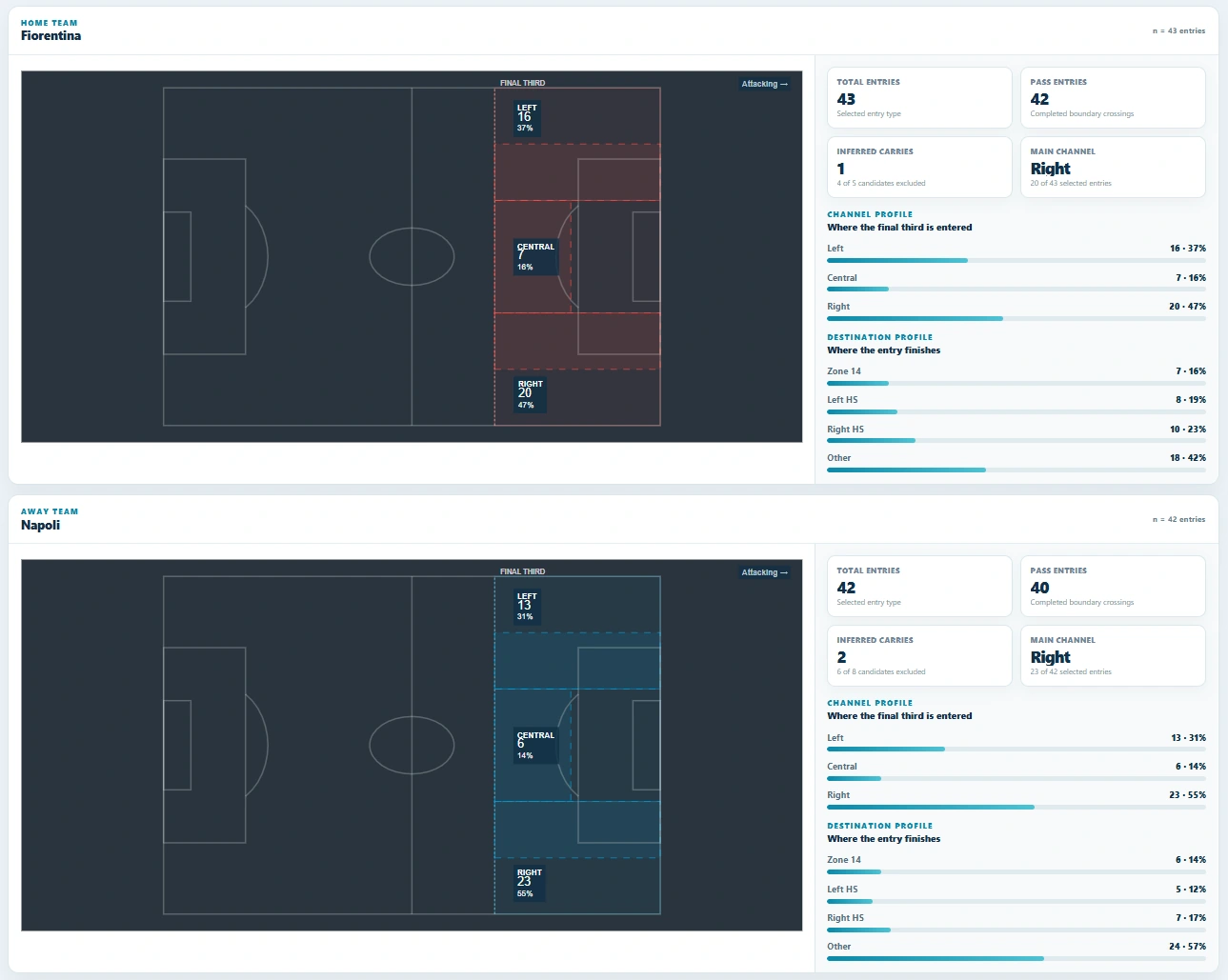
Of their 42 final-third entries, 23 come through the right channel: 55% of the total.
Only 13 come from the left and 6 centrally.
The first-half pass network follows the same logic: the most frequent connection is Di Lorenzo–Politano, with 20 combinations.
Behind them, Gilmour and Lobotka continuously provide another passing lane and allow Napoli to restart without losing control.
Building mainly on the right does not necessarily mean wanting to finish the move there.
That side also serves to attract Fiorentina. When Napoli move the Viola structure enough and then transfer the ball to the opposite side, they find some of their best situations of the match.
Olivera becomes the player who arrives later
It is in this context that Olivera’s match takes on a different meaning.
Not as a more cautious version of what Spinazzola might have offered, but as the player arriving onto an advantage created elsewhere.
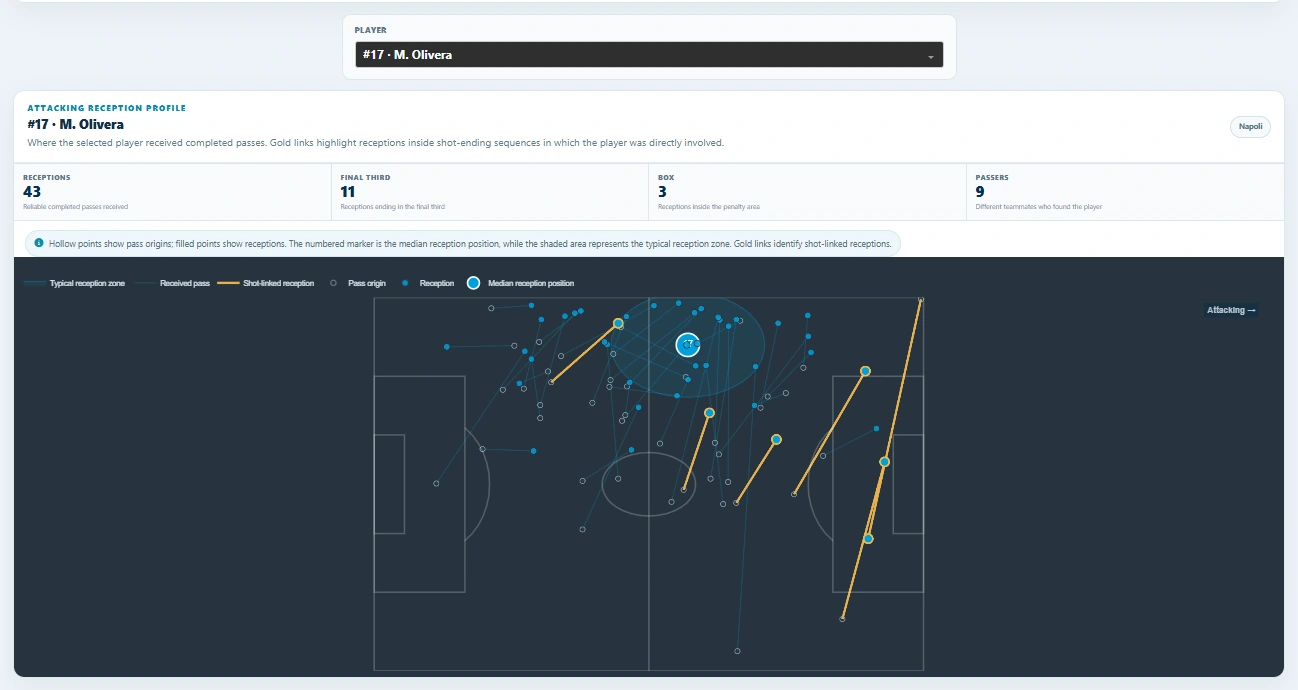
Olivera receives 43 times. Eleven of those receptions come in the final third and three inside the box.
He is also involved in seven shot-ending sequences: four as the shooter, twice by directly assisting the shot and once in the previous action.
Only Mastantuono, with nine, is involved in more shot sequences across the whole match.
The big double chance in the first half makes the mechanism clear: Napoli build on the right, move Fiorentina, then find Olivera on the weak side. First the woodwork, then De Gea.
Napoli’s 22 crosses tell a similar story: Politano delivers nine from the strong side, but Napoli can become more dangerous when they complete the transfer to the opposite flank.
Mastantuono: outside the box, inside the game
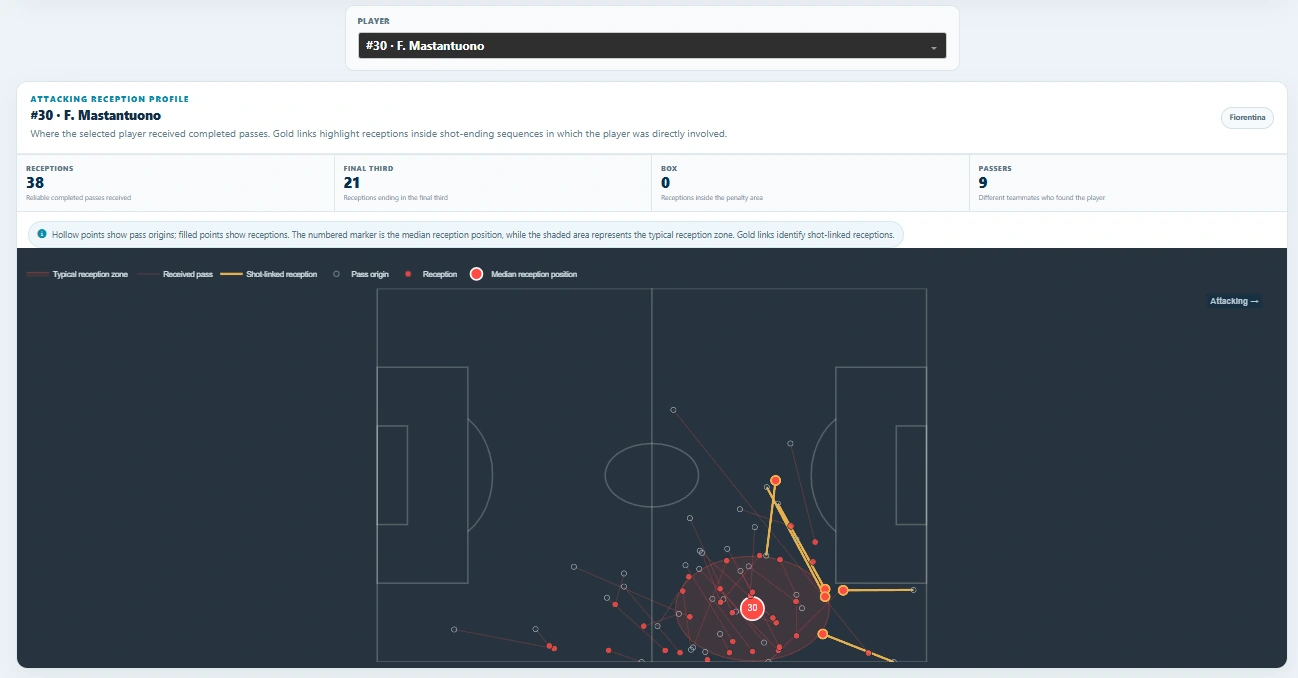
Mastantuono confirms one of the main pre-match themes, but in a slightly different form.
Against Venezia he had received 30 times: 15 in the final third and four inside the box.
Against Napoli the volume rises: 38 receptions, 21 in the final third, zero inside the box.
That is probably the clearest picture of his match.
Napoli take away the zone closest to goal. They do not take him out of the game.
Mastantuono finishes with four shots and four passes leading directly to a shot. He is involved in nine shot-ending sequences. No player from either side records more.
His position remains the one anticipated: right half-space, the possibility of receiving inside and a constant connection with Jiménez.
In the first half Mastantuono–Jiménez combine 14 times, while Ndour–Mastantuono reach 15.

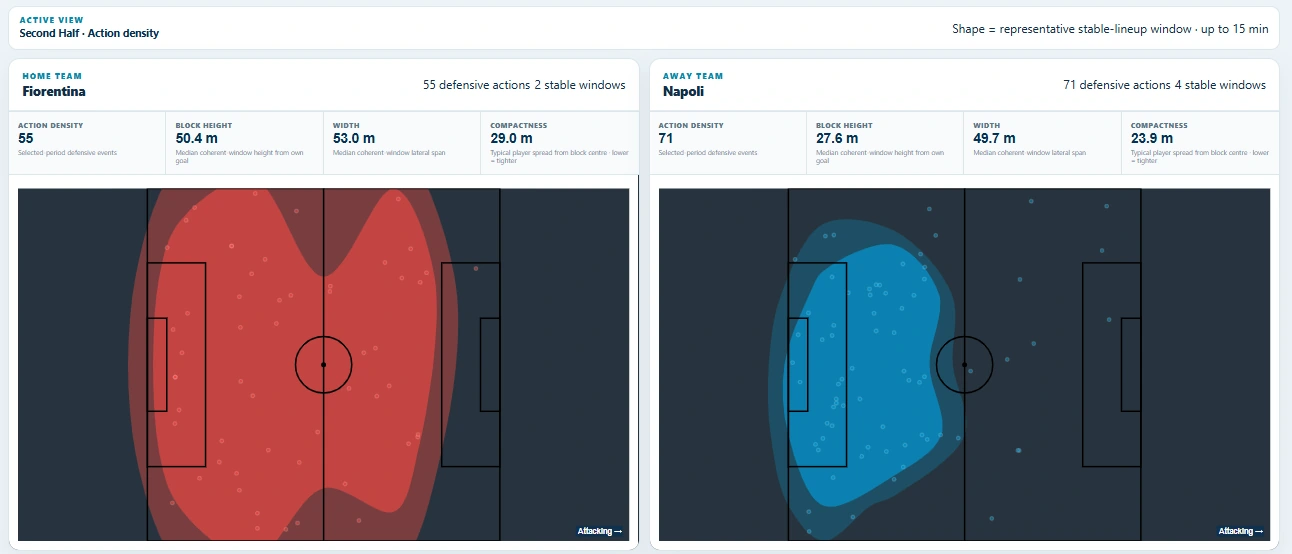
Vanoli does not press more. He moves it twelve metres higher
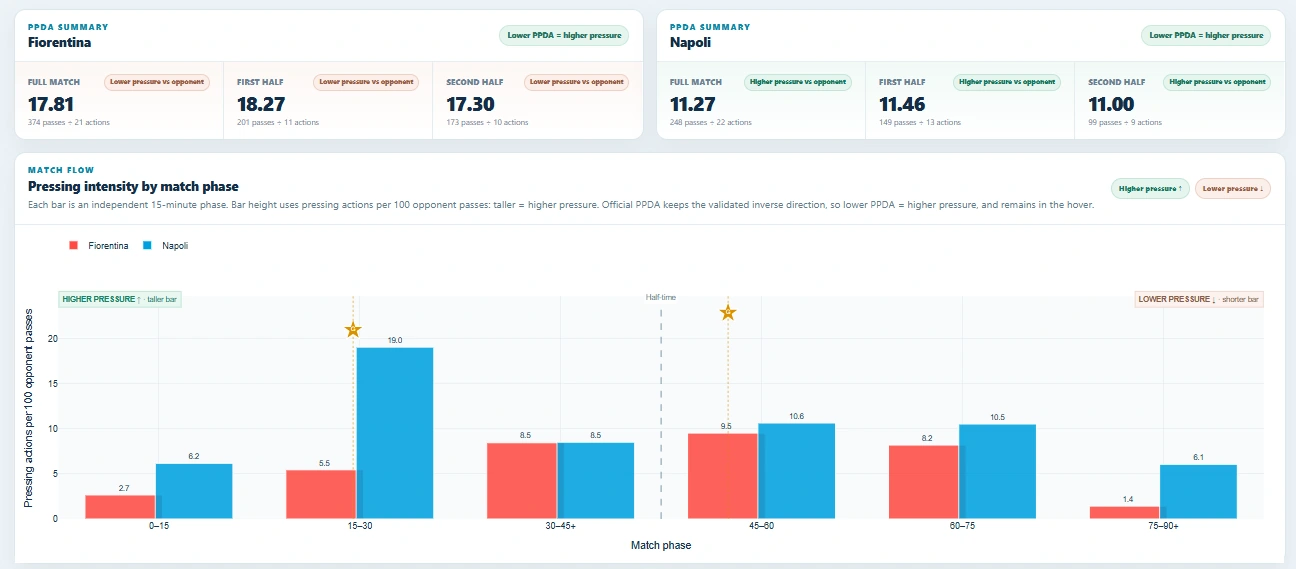
Fiorentina change after half-time. But looking only at PPDA risks hiding the most interesting part.
In the first half their value is 18.27. In the second, 17.30. A minimal difference.
There is no Fiorentina side that suddenly decides to press at a completely different frequency.
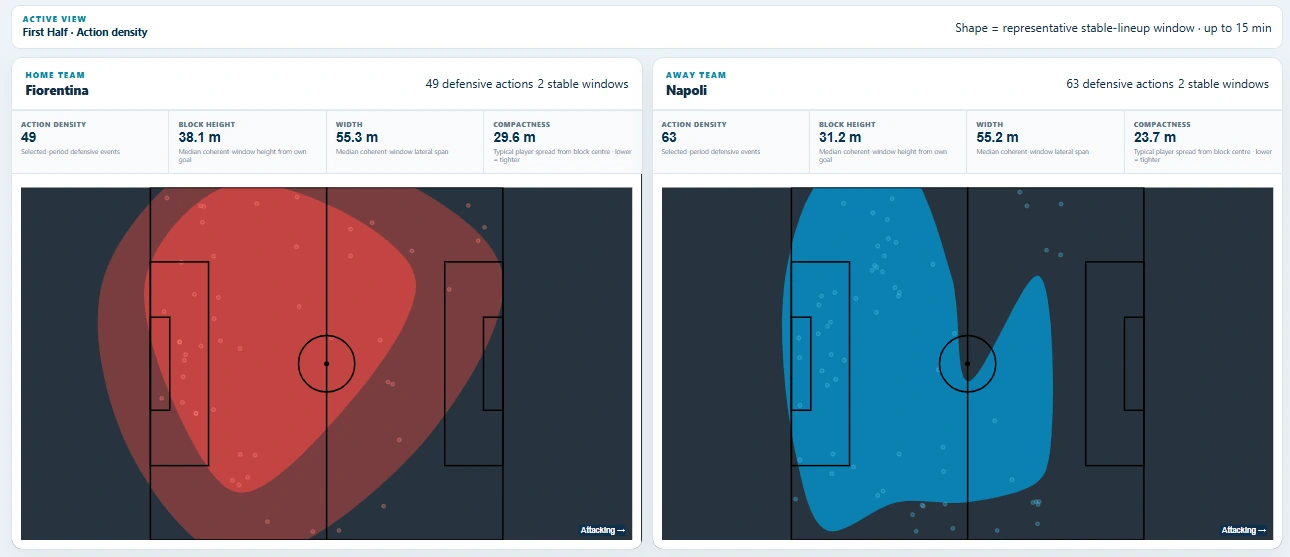
What changes most is where they try to defend.
The average height of their defensive actions moves from 38.1 metres in the first half to 50.4 after the break.
More than twelve metres higher.
The Viery–Valdepeñas change at half-time accompanies this transformation, and the equaliser arrives only six minutes after the restart.
The link with transitions is direct: regaining the ball twelve metres higher means having twelve fewer metres to cover before the action can become dangerous.
Napoli regain control. This time they also get close to scoring
The equaliser does not permanently change the direction of the match.
After Fiorentina’s best spell, Napoli progressively return to controlling the ball.
Between 65’ and 80’, circulation becomes clearly Napoli’s: more than one hundred passes against just over twenty for Fiorentina.
Allegri had already changed the attacking line. In the 58th minute Neres and Lucca replace Lang and Højlund. Favasuli replaces Politano shortly afterwards.
Neres in particular changes the quality of the final action.
In the 76th minute he gets in front of De Gea and is denied by the goalkeeper. Three minutes later, he again creates the move that allows Favasuli to shoot from close range.
De Gea again.
For much of the match Napoli had tried to move Fiorentina enough to find the free player.
In the closing stages they finally do it more cleanly.
Does all this build-up still lack a recipient?
The numbers make it difficult to argue that Napoli struggled to move the ball forward.
588 passes. 37 completed progressive passes. 42 final-third entries.
Gilmour and Lobotka constantly provide another passing lane and allow the structure to retain possession when the first option is closed.
The contrast appears further forward.
Højlund leaves in the 58th minute with 7 passes attempted, 3 completed and 1 shot.
Those numbers need caution.
A centre-forward can be useful without receiving much: he can pin centre-backs, attack depth, create space and help team-mates receive better.
One match is therefore not enough to turn these figures into a verdict on the player.
Within this particular performance, however, the gap between the team’s collective build-up and the number nine’s involvement remains evident.
Many of Napoli’s most dangerous situations come from other players: Olivera on the weak side, Gilmour attacking the corner, Neres entering the box, Favasuli on Neres’s pass.
For now, the answers mainly come from the flanks and from runs into the box. The central reference remains less involved.
It is a theme to follow. Not yet a definitive conclusion.
Two goals, two opposite ways of getting there
The two goals also tell the story of the same match.
Napoli’s opener comes from a set piece.
Politano corner. Gilmour’s run. Volleyed finish.
A prepared situation: Gilmour explained after the match that the routine had been worked on in training, which is why the celebration immediately heads towards Marco Landucci and the bench.
The equaliser belongs to the opposite world.
Change of possession. Regain. Immediate acceleration. Shot before Napoli can restore order.
Then the episode intervenes: Rafa Marín’s deflection turns an apparently manageable shot into the 1-1.
Value changes when possession changes
Fiorentina–Napoli was not balanced because the two sides did the same things with the same efficiency.
It was balanced because they created advantage in different ways.
Napoli controlled organised possession better.
They completed more passes, progressed more often through circulation and built mainly on the right before trying to find the free player on the opposite side.
Fiorentina needed less build-up.
When the ball changed hands, they progressed faster and turned a much higher share of their transitions into final-third and box entries.
The equaliser is born exactly there. From a turnover.
Then the less controllable part of football enters the picture: Rafa Marín’s deflection.
In the closing stages Napoli still create some of their cleanest situations, but De Gea denies Neres and Favasuli.
The 1-1 therefore remains suspended between what the structures created and what the episodes decided.
For Fiorentina, one indication is clear: they do not need to control the ball to control danger. Sometimes it is enough to recognise the moment when possession changes hands.
Napoli are left with a different question.
Not how to get forward. They do.