
Two matches are still too few to define Paolo Vanoli's Fiorentina completely.
They are enough, however, to test a first hypothesis.
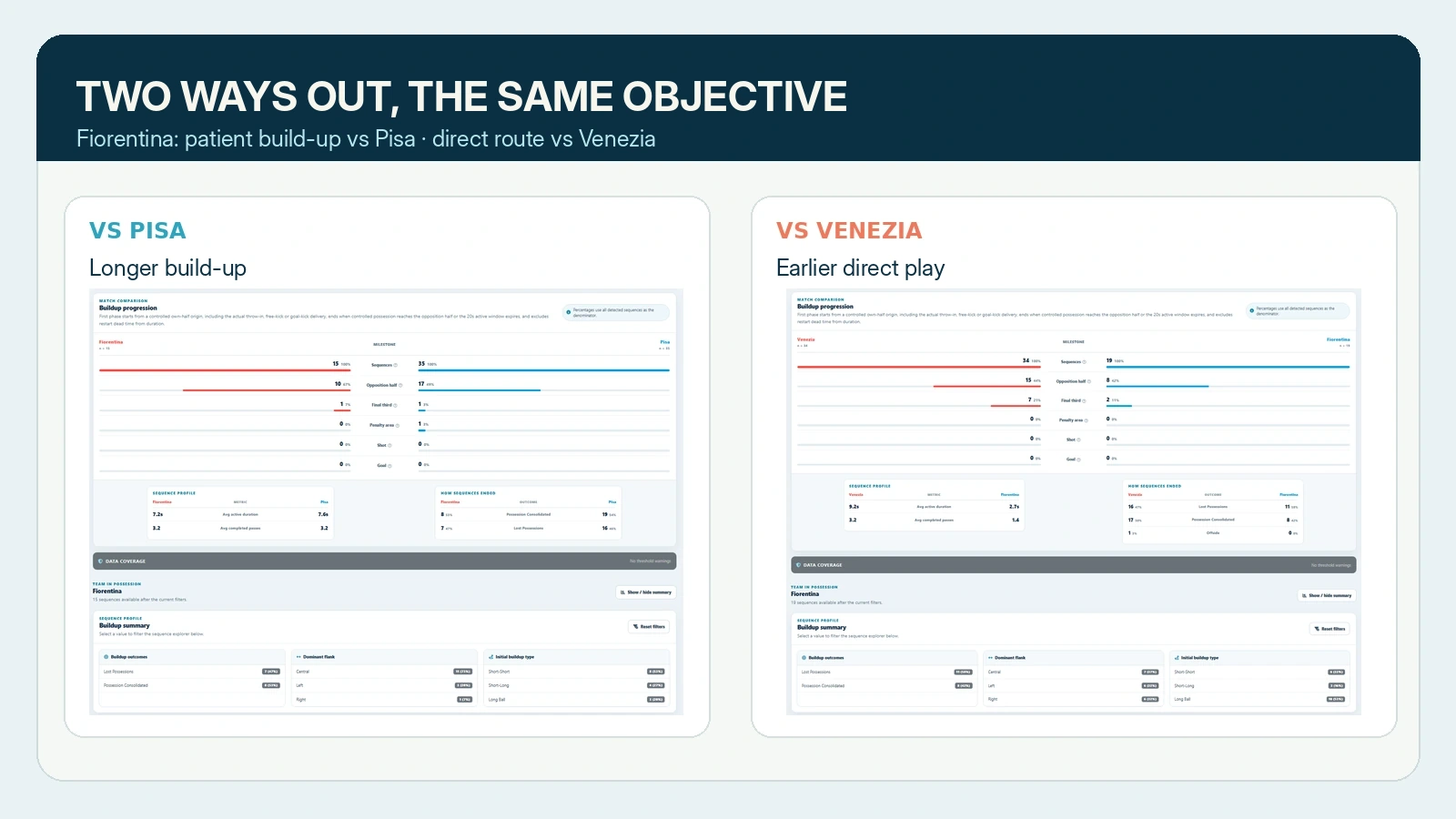
Against Venezia, Fiorentina often accepted going beyond the first press with a direct solution. Four days later, against Pisa, they did almost the opposite: prolonged possession, patient build-up, more than six hundred passes.
Two matches, two very different routes into the opposition half.
This may be the first important indication ahead of Napoli.
Vanoli does not seem to be looking for a single way to build. He looks for the most convenient way to carry the ball beyond the first obstacle.
And that is exactly where Fiorentina's game starts to become interesting.
Sample analysed. The reading uses Fiorentina's first four Serie A matchdays, the two matches of the new Vanoli cycle against Venezia and Pisa, and selected references from the Fiorentina coached by the same manager in 2025/26, including the previous meeting with Napoli. For Allegri's side, Napoli–Bologna is the most recent reference. Numbers attached to individual figures are match-specific rather than seasonal averages.
Two ways out, the same objective
The difference between Venezia and Pisa can already be seen in the first possession sequences.
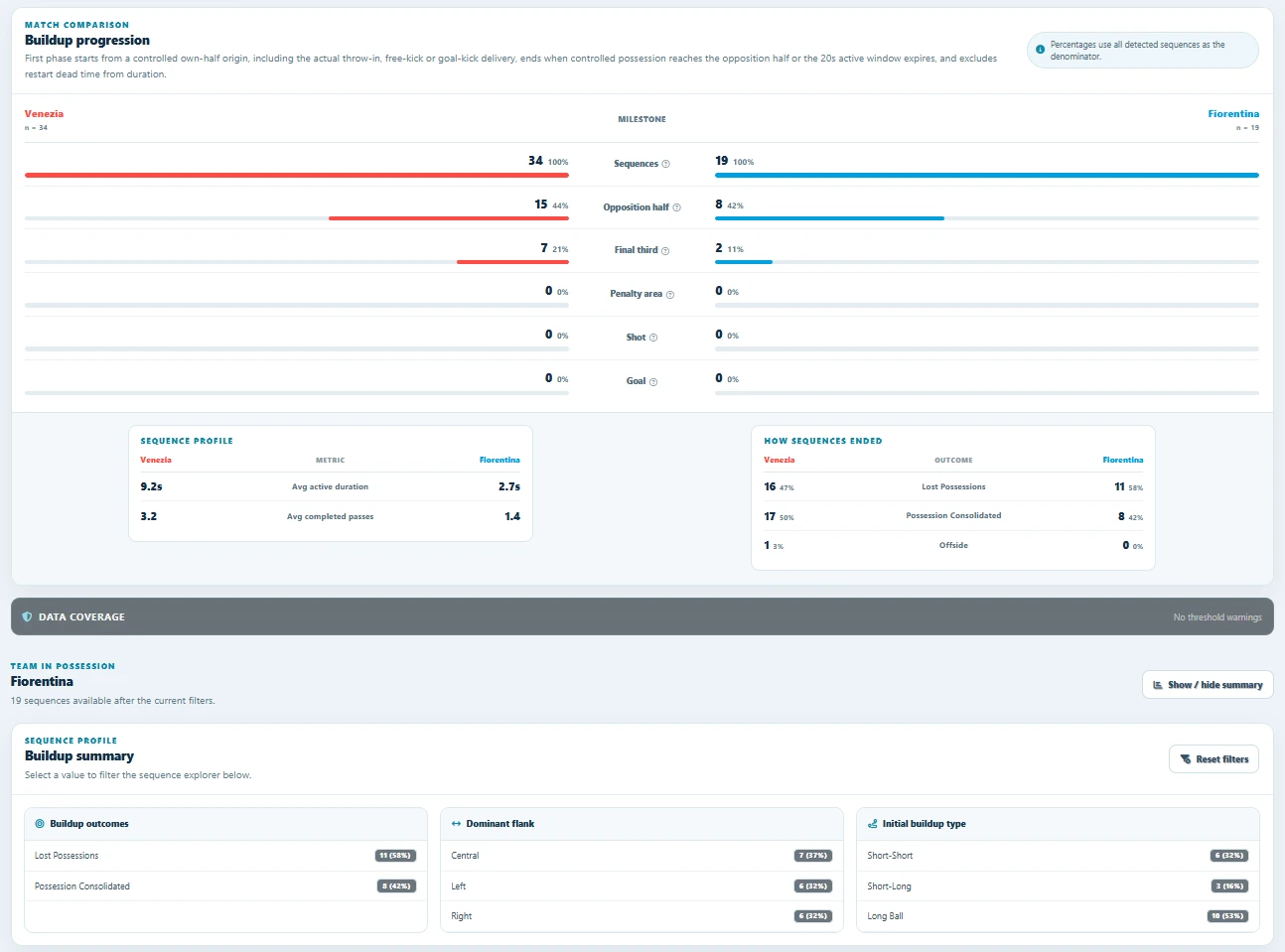
Against Venezia, Fiorentina build 19 times from their own low zone.
Only 8 sequences, 42%, reach the opposition half. Two go directly into the final third.
But another number tells the story better.
Those sequences last only 2.7 seconds on average, contain 1.4 completed passes, and in 10 of 19 cases, 53%, begin immediately with a long solution.
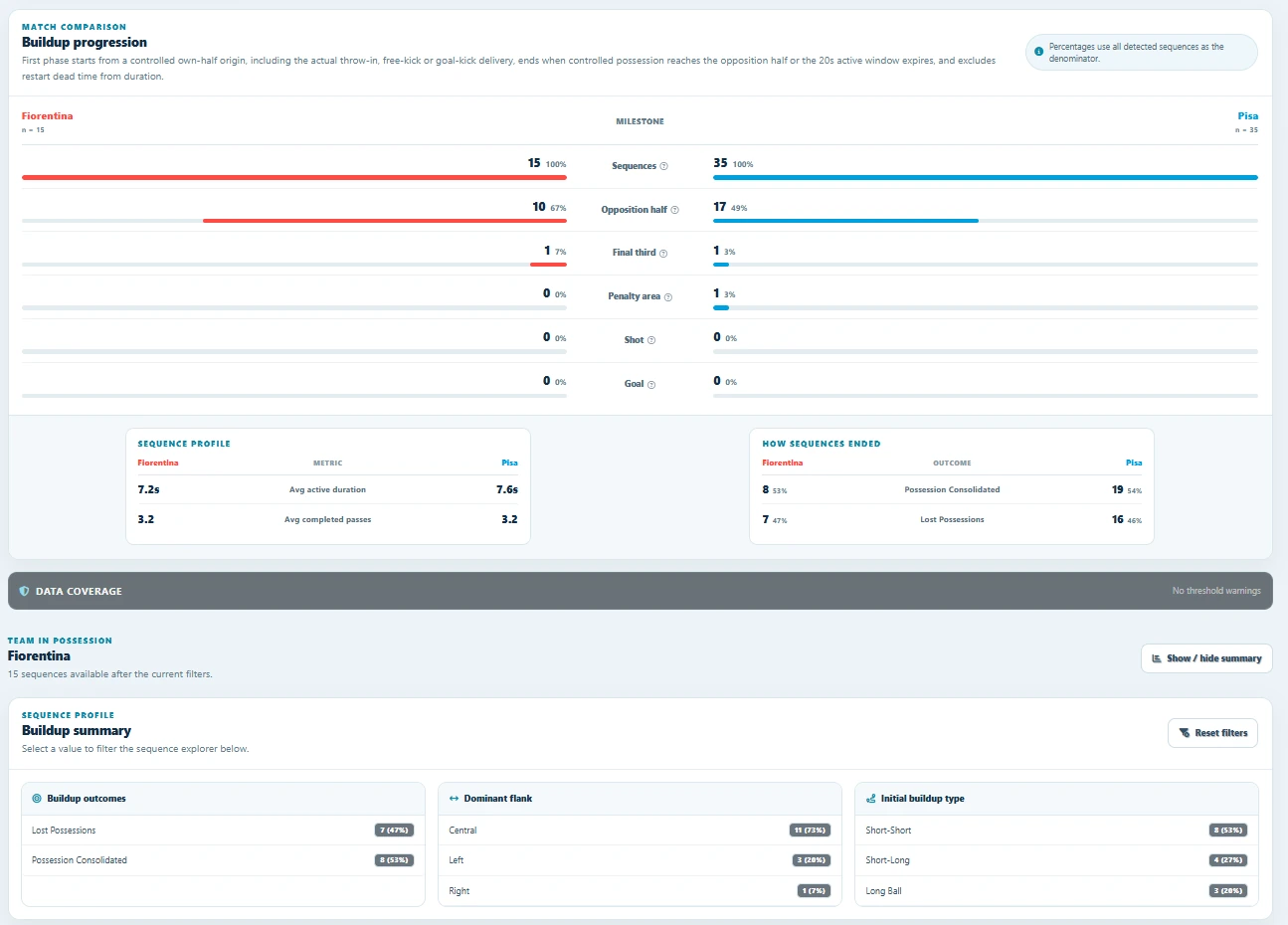
Against Pisa, the picture changes almost completely.
There are 15 build-up sequences. Ten, 67%, reach the opposition half.
Average duration rises to 7.2 seconds, completed passes to 3.2 per sequence, and only 13% of starts go long immediately.
This time Fiorentina can build.
And they do.
That is why asking whether Vanoli's Fiorentina are a short-build-up or direct team can be misleading.
They can be both.
The choice depends on what they find in front of them.
And this distinction matters for Napoli, because a high press does not necessarily prevent Fiorentina from advancing.
It may simply convince them to choose a different route.
The Venezia match shows how extreme that alternative can be.
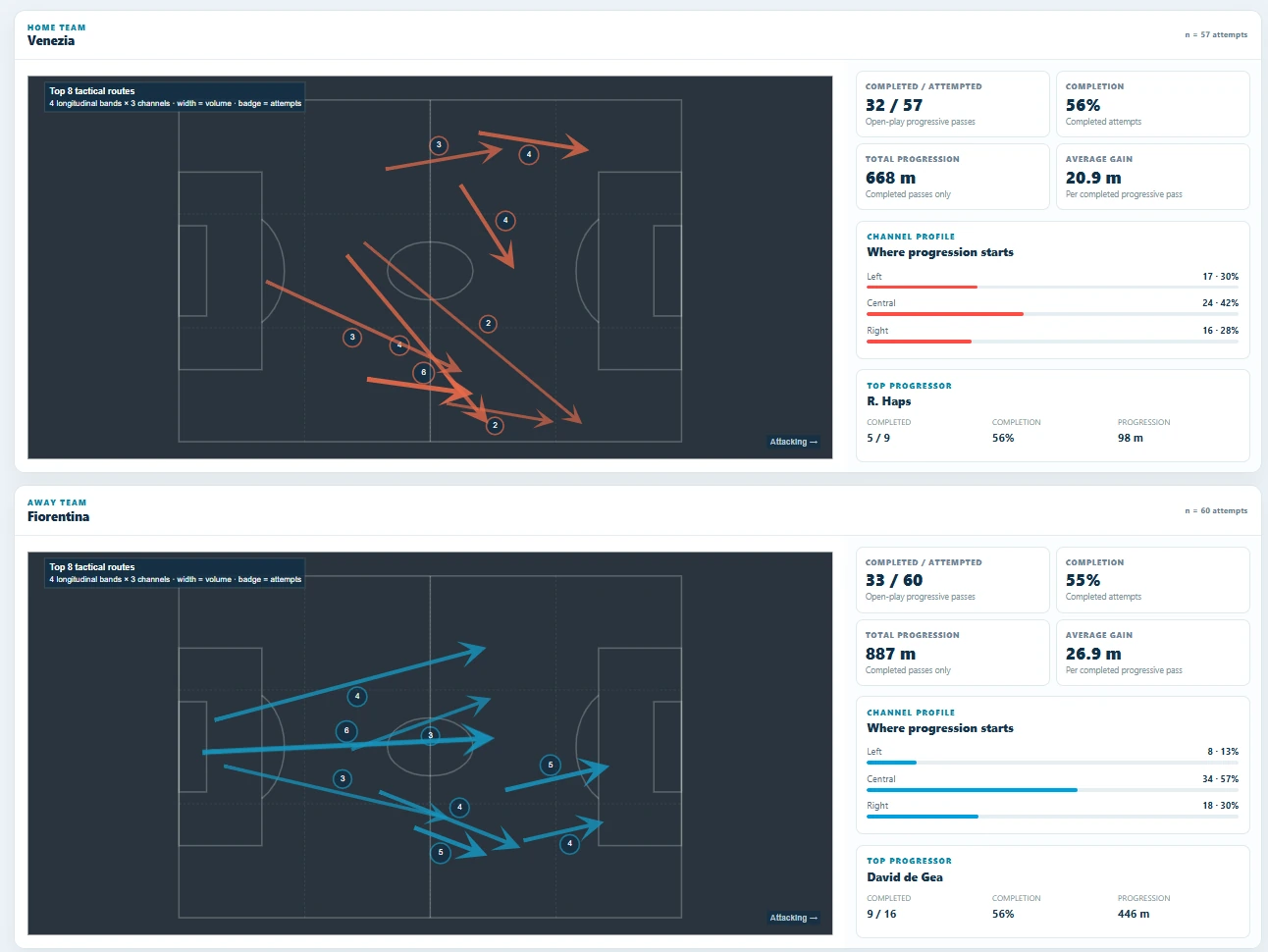
Fiorentina complete 33 of 60 progressive passes, gaining 887 metres in total.
The player who gains the most metres is not Fagioli.
It is David de Gea.
The goalkeeper completes 9 of 16 progressive passes, for 446 metres.
This does not turn De Gea into the team's playmaker.
It tells us something more useful: Fiorentina do not have to solve every press through midfield.
Fagioli remains important once possession is consolidated. Against Venezia he attempts 60 passes and is one of the references through which the team can reorganise after advancing.
But against Pisa he does not start, and Fiorentina still exceed 600 passes, building through Pongračić, Ndour and Inao Oulaï.
Isolating Fagioli, therefore, does not automatically stop the build-up.
The real problem comes immediately afterwards.
The game changes when the ball reaches Mastantuono
Against Venezia, the answer is above all Franco Mastantuono.
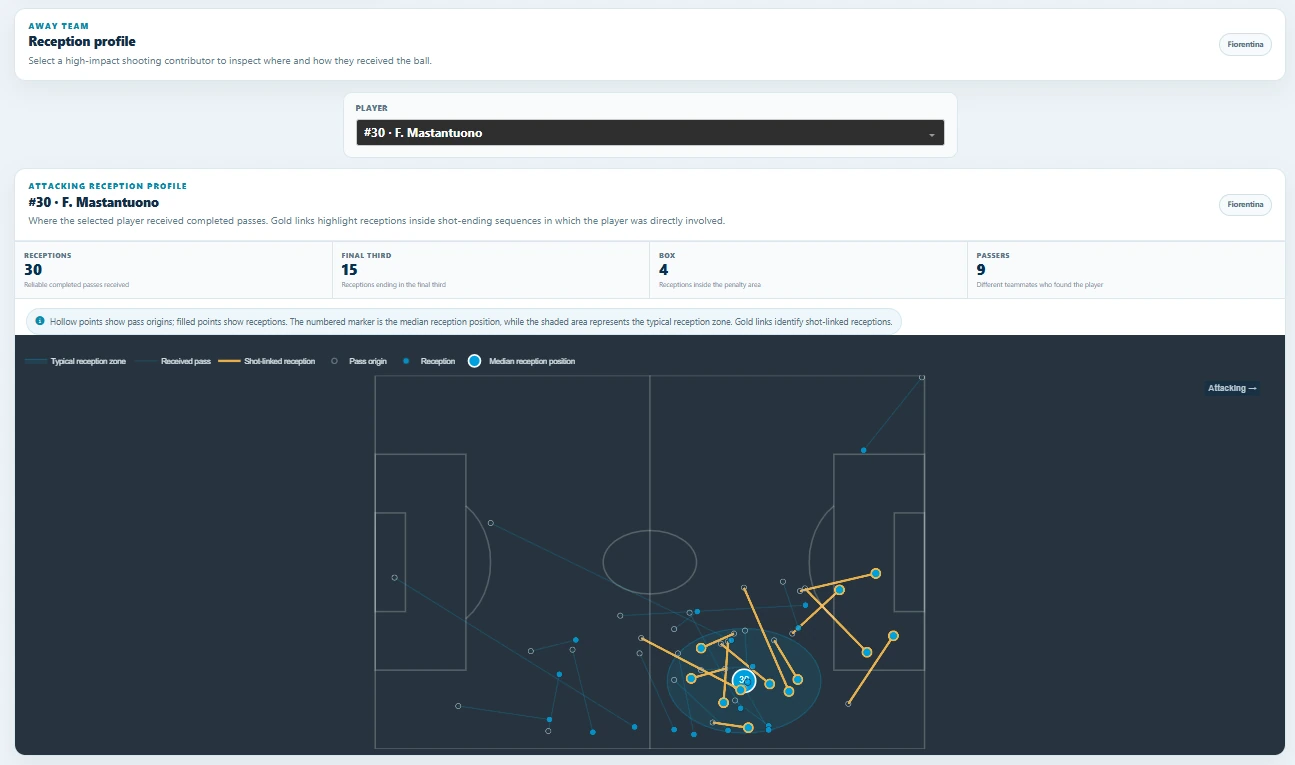
He receives the ball 30 times.
Fifteen receptions come in the final third. Four directly inside the box.
Nine different team-mates find him.
But his position, even more than the volume, makes the number interesting.
Mastantuono does not simply live on the touchline. He often looks for the inside lane, in the right half-space, high enough to receive already facing goal.
The possible structure against Napoli may favour this movement even more.
Mastantuono and Njie are expected behind the striker, with Beto favoured over Pellegrino. Rather than two wingers forced to stay wide, they are two players who can move around the central reference.
For Mastantuono, that means returning precisely to the lane he found against Venezia.
And when he receives there, his contribution is not limited to shooting.
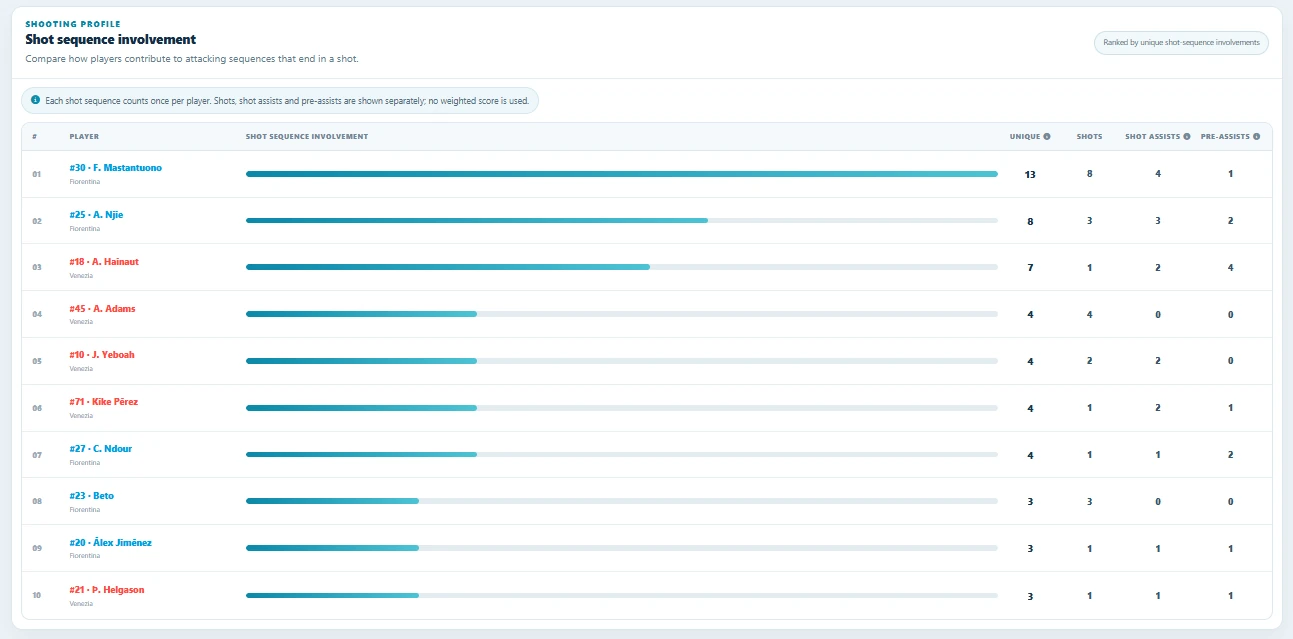
In the same match he is involved in 13 sequences that end with a shot.
Eight times he takes the shot himself. Four times he directly finds the shooter. In another action he is involved in the pass before the assist.
The hat-trick may be episodic.
The function much less so.
Napoli's priority therefore should not simply be stopping him when he enters a one-v-one.
By then, Fiorentina may already have created the advantage.
This is where the first press changes meaning.
If Napoli step up and Fiorentina still manage to carry the ball beyond that line, Mastantuono can receive with more space ahead of him.
If Napoli protect that area first, Vanoli may be forced to find value elsewhere.
So the question is not only whether Napoli will press well.
It is what they leave free while pressing.
Two games meet on Napoli's left side
Mastantuono's preferred zone leads directly to Napoli's left side.
And it is a side where the line-up may still change.
Spinazzola has suffered a minor muscle issue and Olivera is a possible alternative. Higher up, the choice between Vergara and Lang also remains open.
That is why the point should not be built around one individual player.
The tactical problem remains recognisable regardless.
On that side Napoli must simultaneously attack and protect the zone in which Mastantuono wants to receive.
With a more aggressive full-back, the risk behind him can increase. With Olivera, the balance may be more cautious, but the dilemma does not disappear.
Because the same flank can also become an opportunity for Allegri.
If Napoli can force Mastantuono to track deeper, Fiorentina lose starting metres for the player who has produced the most attacking connections in the matches analysed.
If Napoli lose the ball when that side is already open, they may offer him exactly the reception he wants.
For Napoli too, beating the press is only the first step
Napoli–Bologna showed something that connects well with the same theme.
In the first half Napoli move the ball a lot, but shoot only four times.
After the break, the number rises to eleven.
It is not simply the amount of possession that changes.
What changes is what the team manages to do after reaching the high zone.
Lobotka's goal tells the story well.
The move begins from consolidated possession, not a transition. Napoli move Bologna to one side, combine on the right, reach the byline and find the cut-back.
Lobotka attacks from the second line.
The first entry does not immediately produce the shot.
It moves the defence. Forces it to react. Creates the next situation.
It is an important principle against Fiorentina as well.
If Vanoli chooses to defend deeper in some phases, entering the final third will not necessarily be enough for Napoli to consider the attack successful.
They will have to continue the possession. Switch sides. Move the block. Find a player beyond the next pressure.
That is also why the possible presence of Gilmour and Lobotka together, with De Bruyne freer ahead of them, would be interesting.
Not because it defines one line-up as better than another.
But because it would provide different functions within the same sequence.
Gilmour can help the first possession.
Lobotka can move to maintain continuity once the first line has been beaten.
De Bruyne can look for the action that changes the speed of the move.
In other words, Napoli could try to build the same sequence that the match will ask them to defend at the other end:
Vanoli does not have to press all the time to press hard
Last January's meeting adds another layer.
Napoli had already faced a Fiorentina coached by Vanoli.
It finished 2–1 to Napoli.
But the interesting point today is above all how Fiorentina changed their behaviour without the ball during the match.
In the first half their PPDA was 28.86.
After the break it dropped to 14.90.
The lower the value, the fewer passes the opponent is allowed before a defensive intervention.
Fiorentina therefore became significantly more aggressive after half-time.
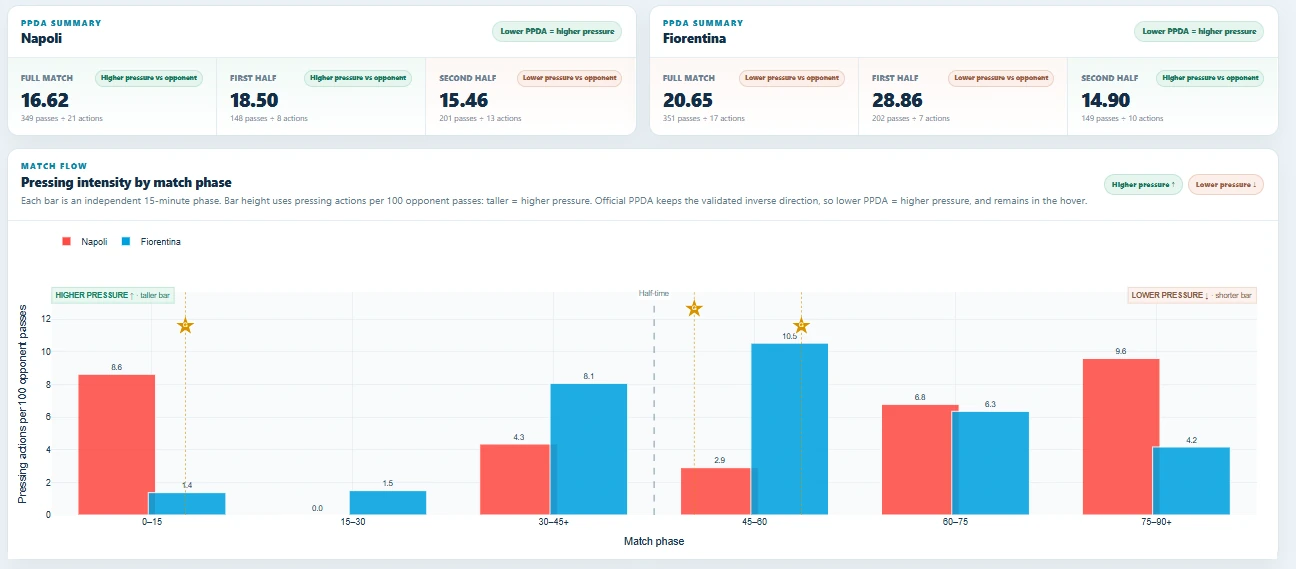
The height of their defensive actions also moved forward.
This does not mean Vanoli will repeat the same plan on Sunday.
It does mean Fiorentina's pressure can be situational.
They can wait.
They can allow the first pass.
They can let the ball reach a specific zone and choose that moment to jump.
And they can change their aggression within the same match.
For Napoli, this is an important detail.
The first build-up may look free without actually being free.
The problem can arrive on the next pass.
But here too, the risk contains an opportunity.
When Fiorentina decide to jump out, they inevitably leave something behind them.
That is why beating their pressure cannot simply mean keeping the ball.
It must mean using immediately the space that pressure has opened.
Once again, beating the first line is only the first step: the value comes from how the space that opens up is used.
A clearance does not necessarily end the attack
Fiorentina–Pisa adds the final piece.
The 3–0 comes after a match in which Fiorentina accumulate a lot of possession but, for long stretches, struggle to turn it into genuinely clean chances.
The jump comes above all when they manage to give continuity to the first action.
For the first goal, a shot is blocked and Pellegrino attacks the next ball.
For the second, Pisa seem able to escape, but Njie immediately wins possession back and finds Gnonto.
The third again comes from renewed access to the ball in the attacking zone and a short combination.
So this is not only about high pressing.
It is above all about counterpressing.
Fiorentina do not need to win the ball back thirty metres from goal throughout the match.
They only need to do it in the moments when they have already committed many players into the opposition half.
When they lose consolidated possession, they try to stop the opponent from truly escaping.
And it is often the second action that finds a defence less organised than the first.
For Napoli, that means something very concrete.
A clearance does not necessarily end the attack.
Defending the first cross or intercepting the first pass may be only half the job.
Then they have to get out. Protect the loose ball. Find the first clean pass.
Prevent Fiorentina from turning an apparently finished attack into a new possession while Napoli are still pinned back.
This may become especially important on Mastantuono's side.
Because a successful counterpress does not simply give Fiorentina the ball back.
It can give it back before Napoli have rebuilt the distances needed to stop him receiving inside.
The line-ups can change. The tactical problem much less
Pre-match indications point to Fiorentina with Jiménez and Viery at full-back, Drăgușin recovered in central defence, Fagioli available again and Mastantuono and Njie behind the striker. Beto is favoured over Pellegrino, with a possible rotation during the game.
Napoli, meanwhile, still have some doubts, especially around Anguissa and Spinazzola.
One possibility is Gilmour and Lobotka together, with De Bruyne freer ahead, Olivera on the left and Højlund as the central reference. Politano should start on the right, while the left-sided choice between Vergara and Lang remains open.
They are indications.
Not certainties.
And that is another reason why the reading of the game should not depend too heavily on names.
The players may change. The questions remain.
The advantage begins beyond the first line
Fiorentina–Napoli could easily be described as a meeting between two teams who want the ball.
The more interesting point will probably be another one.
Vanoli's Fiorentina have already shown they can beat the first press in two almost opposite ways.
They can build.
They can bypass it.
De Gea can turn a high press into a long ball that removes a line directly.
Fagioli can give order to consolidated possession.
Mastantuono can turn that progression into something genuinely dangerous.
Napoli, on the other hand, have just shown against Bologna that their own possession also changes value when they survive the first entry and build the next situation.
And this may be the point where the two teams meet.
Fiorentina want to beat the first line in order to find a reception that truly moves the attack forward.
Napoli have to decide how high to step without conceding that reception.
At the other end, Vanoli must decide how much and when to increase aggression without giving Lobotka, De Bruyne and the wide players space to play immediately behind the press.
Then come the second balls.
The clearances.
The counterpresses.
The actions that seem over and then begin again.
That is why the final possession figure may tell only part of the match.
The more interesting question is another:
That is probably where Fiorentina–Napoli will really begin.
Four things to watch
- How Napoli direct Fiorentina's first build-up.
Will they try to force De Gea into the long solution, or accept a more cautious press to protect the next ball better? - Where Mastantuono receives.
Quantity will matter less than position: touchline or half-space, back to goal or already facing forward. - How Napoli's left side works.
A more cautious interpretation can protect Mastantuono's zone better; more aggression can force him to start farther from goal. The choice of wide player will further change the balance. - Who controls the second action.
Clearances, loose balls and immediate regains may matter more than the first final-third entry.