
Monza–Napoli is played on Wednesday 28 October at 20:45 at the Brianteo, the ninth matchday of Serie A. Napoli come from the 3-3 against Roma: eleven points in eight games and, on the bench, Landucci, because Allegri is suspended. Jurić’s Monza have seven points, with two wins, a draw and five defeats; the last at Torino, 3-2, with an own goal at 94′.
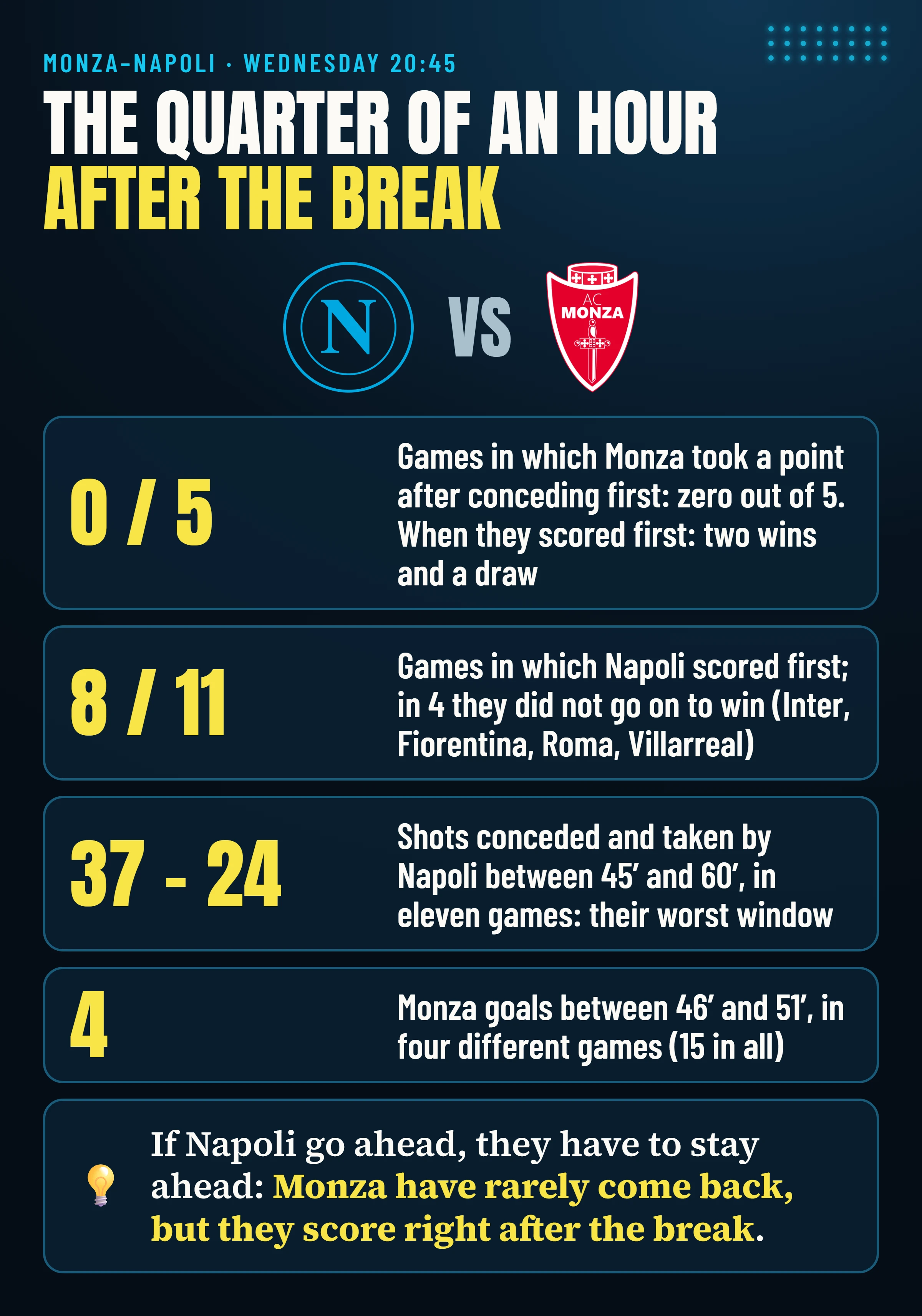
To read this match you need a simple question: who scores first? Monza have never taken a point after conceding first, in five games out of five. Napoli scored first eight times out of eleven, but once ahead they have often stopped having the ball: in four of those eight games they did not win. These are two scripts that cross, and the point where they cross is the quarter of an hour after the break.
Without Allegri and with a depleted defence
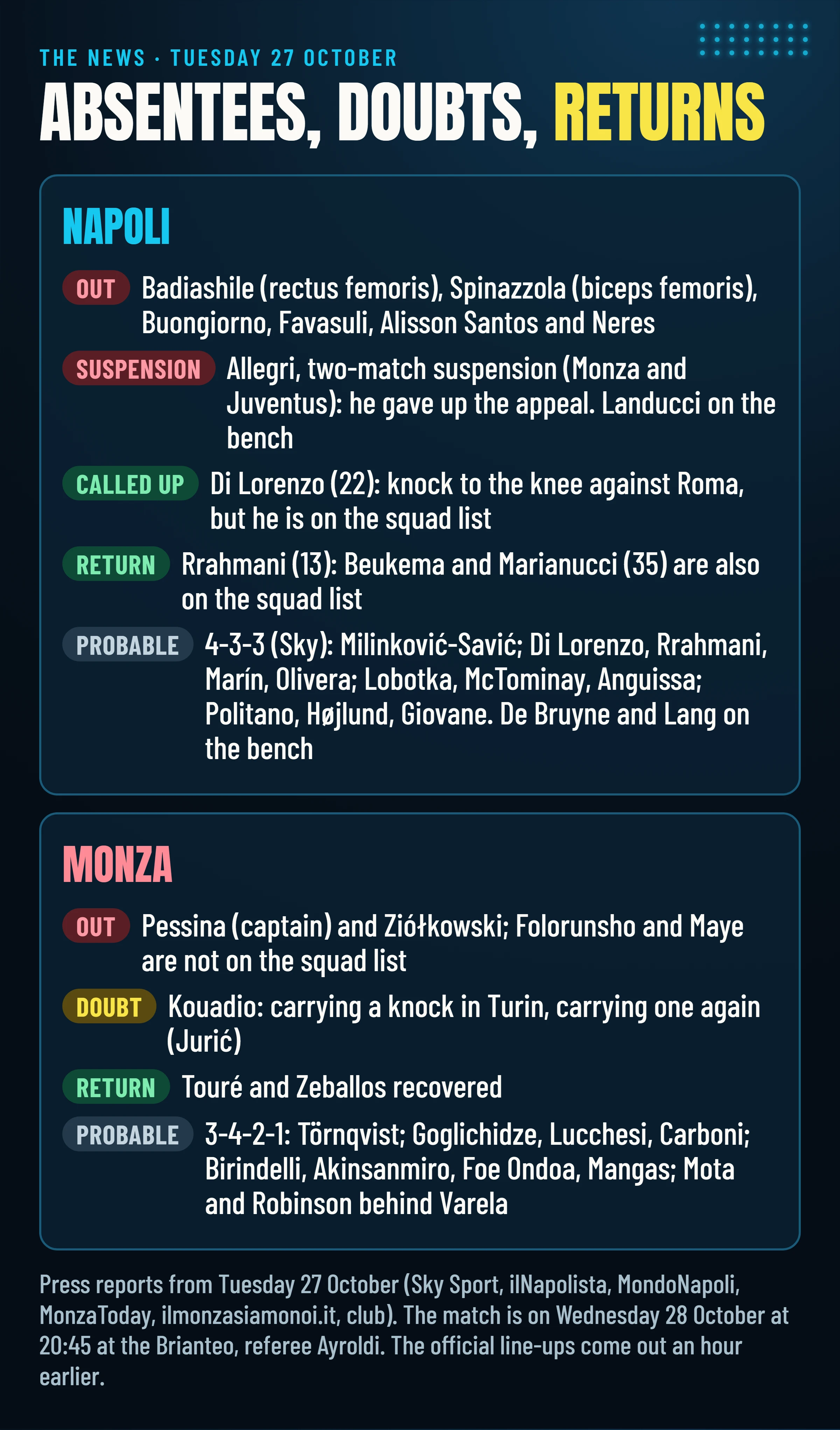
Napoli have lost two more defenders. Badiashile, who went off at 51′ against Roma, has a medium-grade tear of the right rectus femoris; Spinazzola, who came on at 79′, stopped in the final minutes and has a low-grade tear of the right biceps femoris. Buongiorno, Favasuli, Alisson Santos and Neres are also missing. Rrahmani (13) returns at the back, and Beukema (31) and Marianucci (35), who has not yet played in the league, are also on the squad list. Di Lorenzo (22) took a knock to the knee against Roma, but he is among the called-up players.
Allegri will not be on the bench: the Serie A disciplinary judge has suspended him for two matches after Saturday’s sending-off, and he misses Monza and Juventus. Today he said he had given up the appeal: “This morning I decided to give up the appeal.” Landucci will be on the bench. For the line-up, Sky points to a 4-3-3 with Milinković-Savić (32) in goal in place of Meret: Di Lorenzo, Rrahmani, Marín, Olivera; Lobotka as deep-lying playmaker with McTominay and Anguissa; Politano, Højlund and Giovane. De Bruyne and Lang would go to the bench: after Monza come Juventus and, on 4 November, Porto, and Allegri said that De Bruyne “can’t play every match”.
Monza are without Pessina, the captain, and Ziółkowski, and neither Folorunsho nor Maye is on the squad list. Touré and Zeballos have recovered; Kouadio, who played 30 minutes in Turin while carrying a knock, is carrying one again: “We are already few back there.” Jurić should confirm the 3-4-2-1: Törnqvist; Goglichidze, Lucchesi and Carboni; Birindelli and Mangas on the flanks, Akinsanmiro and Foe Ondoa in midfield; Mota and Robinson behind Varela. “Varela is untouchable,” he said, and “I don’t have a fixed eleven.”
Data sample. The analysis uses Monza’s eight Serie A games, up to and including Torino-Monza on 23 October, and Napoli’s eleven, eight in Serie A and three in Champions League. The opponents are very different and the sample is small: they are clues, not rules.
Jurić’s Monza, in eight games
Monza began with a 1-4 defeat at San Siro against Inter, with three forwards and a back three, and from there Jurić moved to the 3-4-2-1 that he has used for seven games. Then came two comebacks that almost worked: against Udinese, behind 1-3 at the break, they finished 2-3; against Lecce, behind 1-3 after twenty-one minutes, they had 19 shots to 7, scored the 2-3 at 89′ and lost all the same.
There are two wins: 2-1 against Sassuolo, with two goals from Varela in the second half, and 4-0 against Cagliari, where Monza scored first and never let up. There are five defeats, and the most instructive is the last one, on Friday at Torino. Jurić, formerly of Torino, said that “Toro were better than us”, recalled a first half in which “for long stretches we also dominated and created” and explained the second half with energy: “We lost a lot of tackles”. He does not think it is a fitness problem. Patterson’s own goal at 94′ only made the scoreline less heavy.
How do they play? Without big extremes. When the score is level their defensive block sits 36 metres from their own goal and they have 45% of possession; they do not press aggressively, allowing 15.7 passes before each intervention; they concede as many shots as they take: 109 against 107 in eight games. They are an average team that concedes early and scores often, as the goals say: fifteen scored, eighteen conceded.
Who scores first
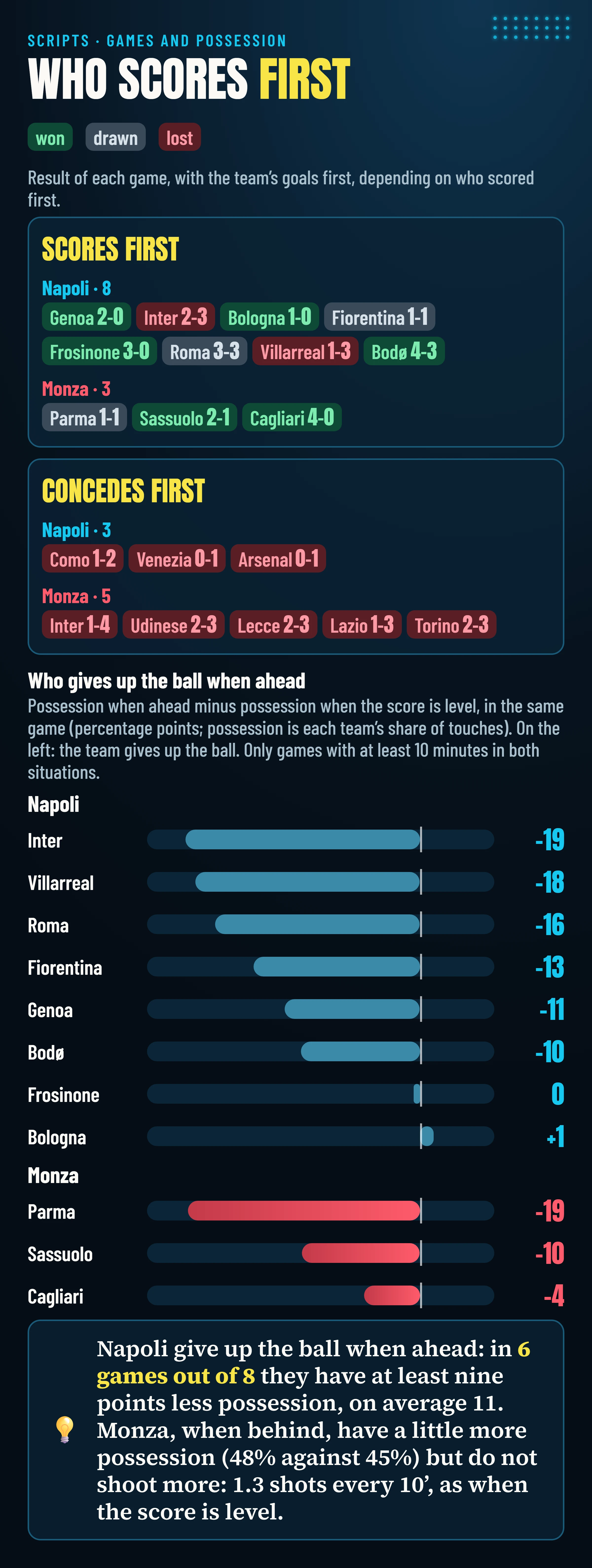
Monza are a team that chases. They have been behind for almost half of the minutes played, 357 out of 770, and ahead for a sixth. They conceded first five times, against Inter, Udinese, Lecce, Lazio and Torino, and lost them all. When they scored first, against Parma, Sassuolo and Cagliari, they took seven points out of nine.
They often start badly: four of the 18 goals conceded came in the first fifteen minutes, in three different games. Against Inter at 6′, against Lecce at 3′ and 11′, against Lazio at 3′.
Napoli are the opposite: they scored first eight times out of eleven. But going ahead was not enough for them four times: against Inter from 2-0 to 2-3, against Fiorentina from 1-0 to 1-1, against Villarreal from 1-0 to 1-3 and against Roma from 2-0 to 3-3. The common thread is the ball: when ahead Napoli give it up. Here possession is each team’s share of touches, and in the eight games in which Napoli had minutes both ahead and with the score level, when they were ahead they had on average eleven points less possession; against Inter almost twenty, against Villarreal eighteen, against Roma sixteen.
Monza too give up the ball when ahead: nineteen points less against Parma, ten against Sassuolo, four against Cagliari. And when they are behind they do not speed up: they have a little more possession (48% against 45%) but shoot at the same rate, one and a third shots every ten minutes.
The quarter of an hour after the break
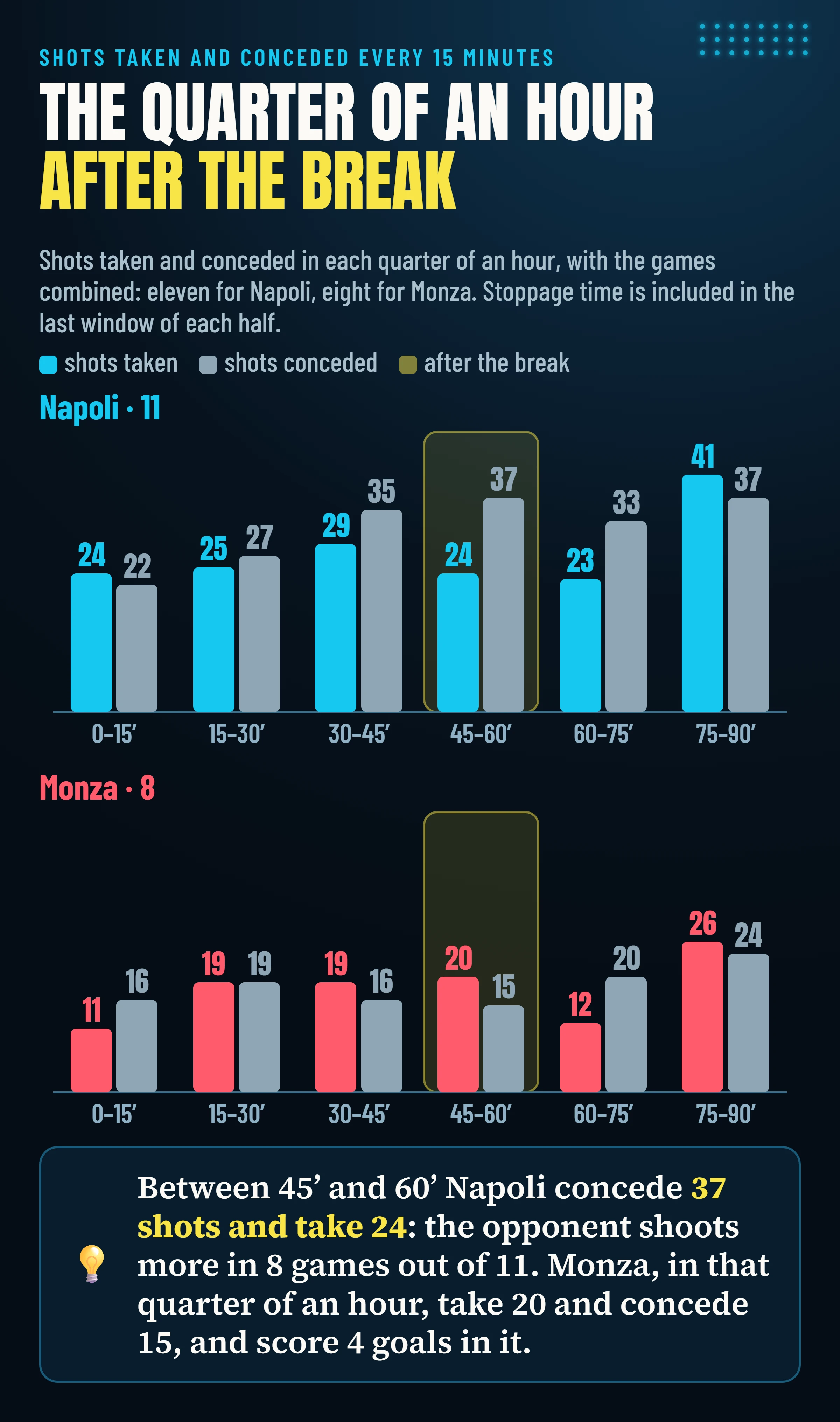
If you count shots in each quarter of an hour, the window in which Napoli are worst off is the one after the break: between 45′ and 60′ they concede 37 and take 24, and the opponent shoots more in eight games out of eleven. It is not the only window in which they concede more than they take, but it is the clearest: a difference of thirteen shots, against ten between 60′ and 75′ and six between 30′ and 45′.
The scoreline alone does not explain it. It happens in all four games in which Napoli were ahead at the break, against Fiorentina, Frosinone, Roma and Bodø: against Fiorentina the shots were six to one. But it also happens in three of the five games that were level at the break, against Genoa, Inter and Arsenal.
There is a precedent from Saturday. Against Roma, Napoli were ahead 2-0; at 58′ Gasperini made three substitutions and for eleven minutes Napoli touched the ball 24 times against Roma’s 118, until the 2-1. We told the story in the post-match: it is not an isolated case, it is Napoli’s most frequent script when they go ahead.
Allegri said it too, on the eve of the match: “Against Roma we forced it when we could have managed possession; at 2-0 we should have distributed the ball better.” And he cited the numbers: “In the first halves we have conceded only two goals, in the second halves eight: these are figures to improve on.” That is how it is in the league: two goals conceded in first halves, against Como at 17′ and 34′, and eight in second halves, three against Inter, three against Roma, one against Fiorentina and one against Venezia. Jurić, from the opposite side, saw the same match: “Against Roma, for 60 minutes I saw a fabulous Napoli.”
For Monza it is the best window: in that quarter of an hour they take 20 shots and concede 15, and score four of their fifteen goals there: Goglichidze at 46′ against Lazio, Varela at 47′ against Cagliari, Varela at 47′ against Torino and Varela at 51′ against Sassuolo. Not every game confirms it: against Inter, Udinese, Parma and Lecce, after the break, they had fewer shots than their opponents.
And the first quarter of an hour? Monza concede more than they take, sixteen shots to eleven, and have conceded four goals. Napoli take 24 shots and concede 22, and have scored twice: against Bodø at 1′ and against Villarreal at 8′.
How Monza score
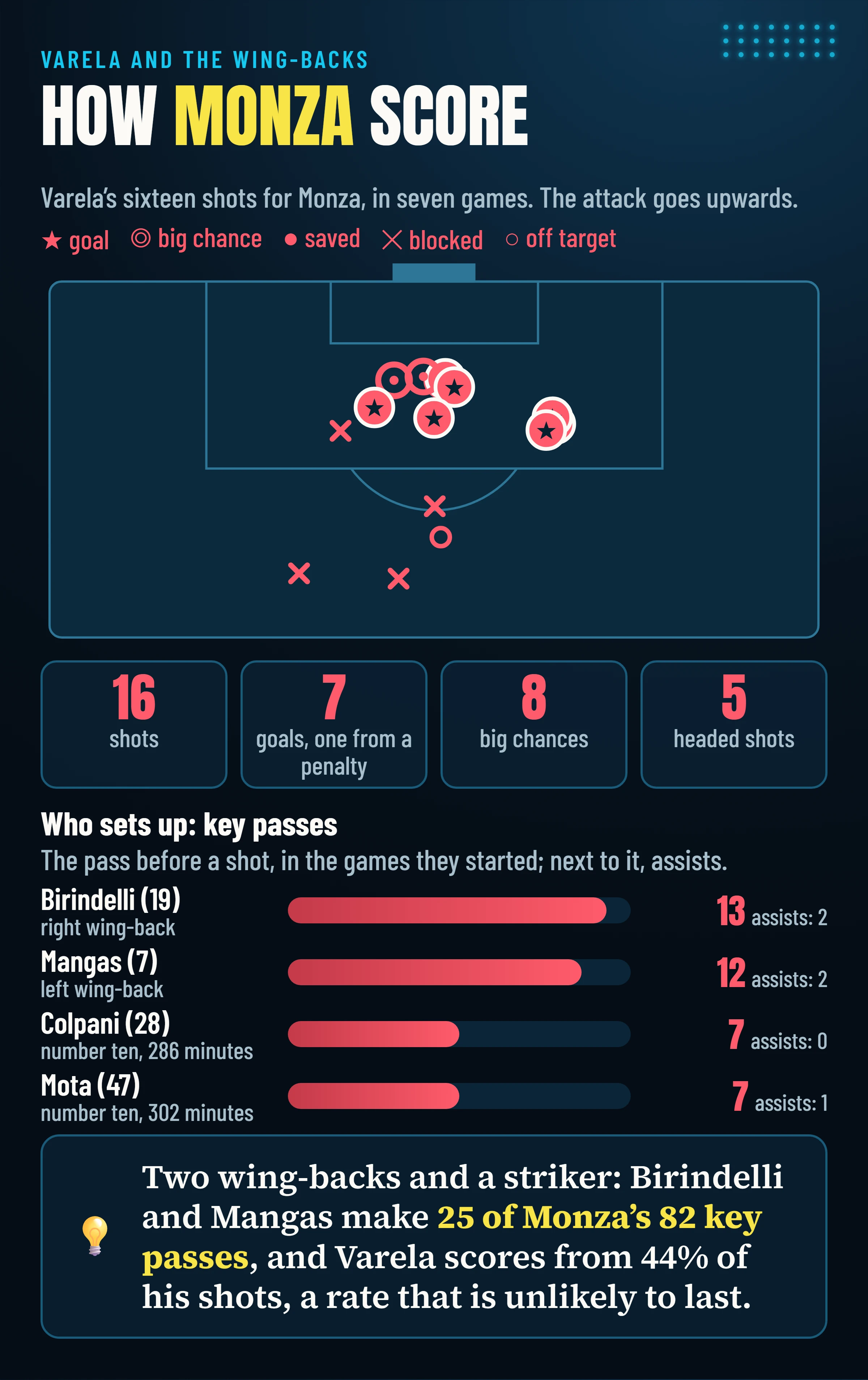
Monza score through Varela. Seven of their fifteen goals are his, in seven games played, from sixteen shots: 44%, a rate that is unlikely to hold. Eight of his shots are big chances and five are headers, even though he wins only 29% of aerial duels (9 out of 31). Together with Raimondo of Frosinone he leads the list of scorers.
The ball comes to him from the flanks. Birindelli (19) and Mangas (7) make 25 of Monza’s 82 key passes, about one in three, and make the last pass before five of the fifteen goals: Birindelli before three, including the two from corners, Mangas before two. They are the two that Napoli have to control without losing track of Varela.
Mota, Colpani, Cutrone and Robinson rotate behind Varela; they shoot a lot but score little: Mota has 13 shots in 302 minutes and no goals, Robinson 10 shots and two goals. And Monza do score, but concede more: fifteen scored and eighteen conceded in eight games.
Corners and aerial duels
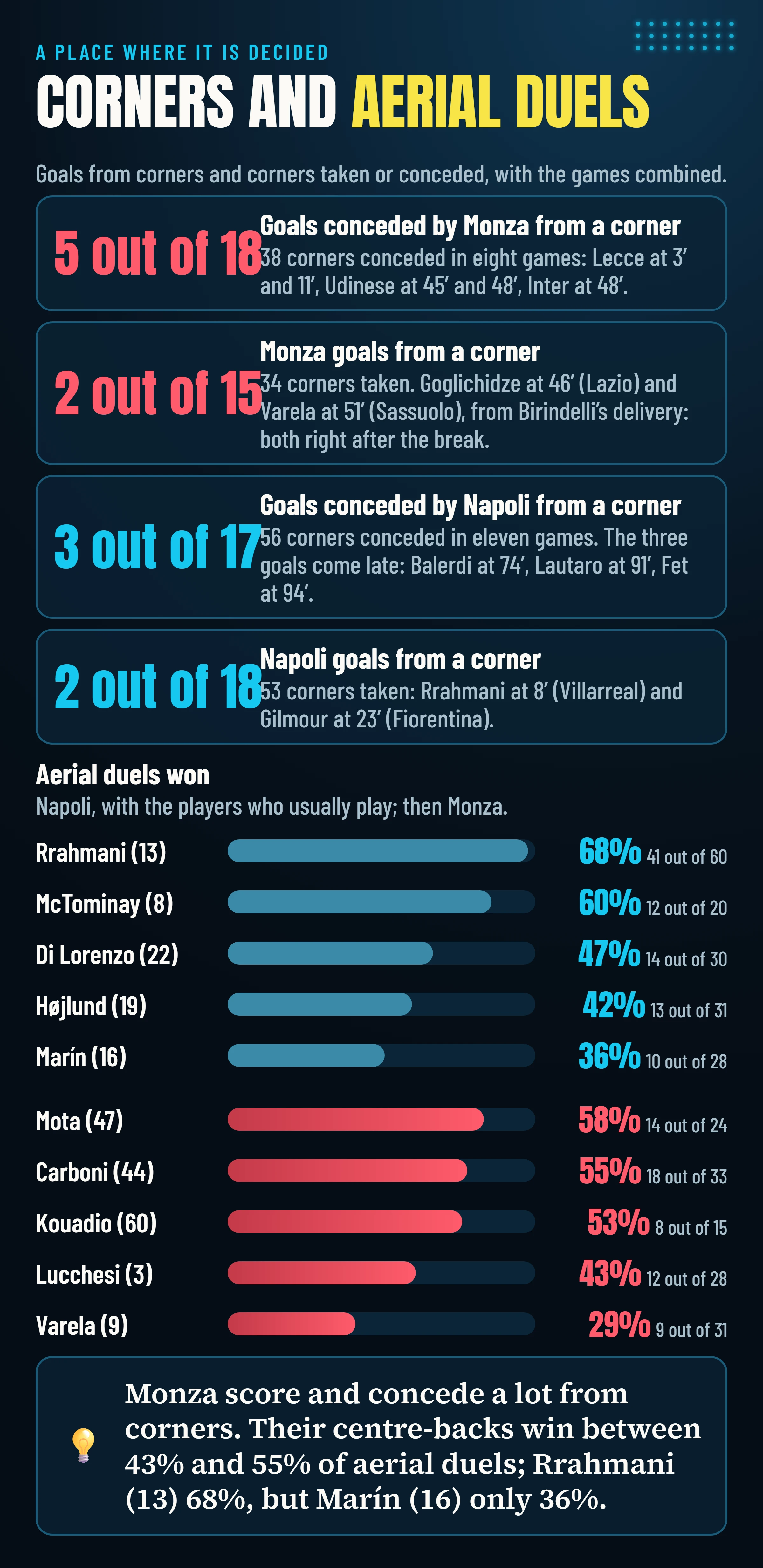
Monza concede a lot from corners. Five of the 18 goals conceded come from them: two against Lecce, at 3′ and 11′, two against Udinese, at 45′ and 48′, one against Inter at 48′. They give away almost five a game, 38 in eight. They have scored two, both right after the break and from Birindelli’s delivery: Goglichidze at 46′ against Lazio, Varela at 51′ against Sassuolo.
Napoli concede more of them, 56 in eleven games, but have conceded three goals from them, all late: Balerdi against Roma at 74′, Lautaro against Inter at 91′, Fet against Bodø at 94′. They take almost five a game, 53 in eleven, and have scored two: Rrahmani against Villarreal at 8′ and Gilmour against Fiorentina at 23′.
In aerial duels Napoli have an advantage and a problem. Rrahmani wins 68% of duels (41 out of 60) and McTominay 60% (12 out of 20), but Marín only 36% (10 out of 28). Monza’s centre-backs win between 43% (Lucchesi) and 55% (Carboni). With Badiashile out, Monza’s corners come against a reshuffled defence.
Where the line-ups fit together
Napoli should play with the 4-3-3 and Monza with the 3-4-2-1. At the back, four plus the goalkeeper against three: Varela and the two attacking midfielders. Monza are not Gasperini’s Roma and do not go after the defenders: they allow on average 15.7 passes before each intervention, against the 10.4 of Roma in their game with Napoli. Rrahmani, Marín and Lobotka should have more time to build out.
On the flanks Monza build through Birindelli and Mangas; Napoli have Olivera (17) and Giovane (23) on the left, Di Lorenzo (22) and Politano (21) on the right. If Di Lorenzo does not play, the alternative is Marianucci (35): a full-back who has not yet played in the league, against a side that builds from the flanks. In the centre, Lobotka (68), McTominay (8) and Anguissa (99) face Akinsanmiro (14) and Foe Ondoa (8); between the lines Mota (47) and Robinson (46) receive the ball, and Napoli must not leave them free.
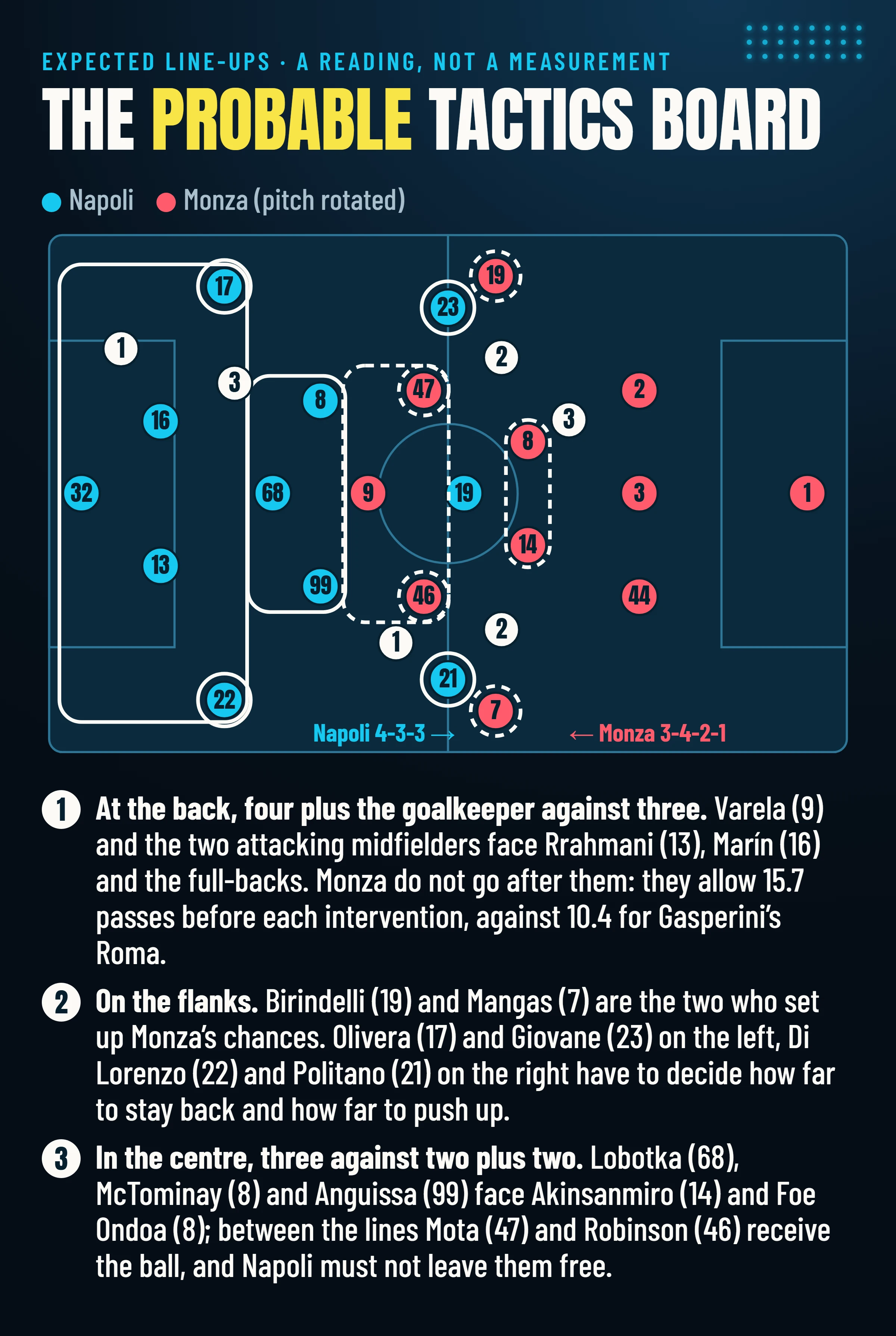
Note. This is a reading of the probable line-ups, not a measured figure: the official line-ups may change it.
Six players to watch
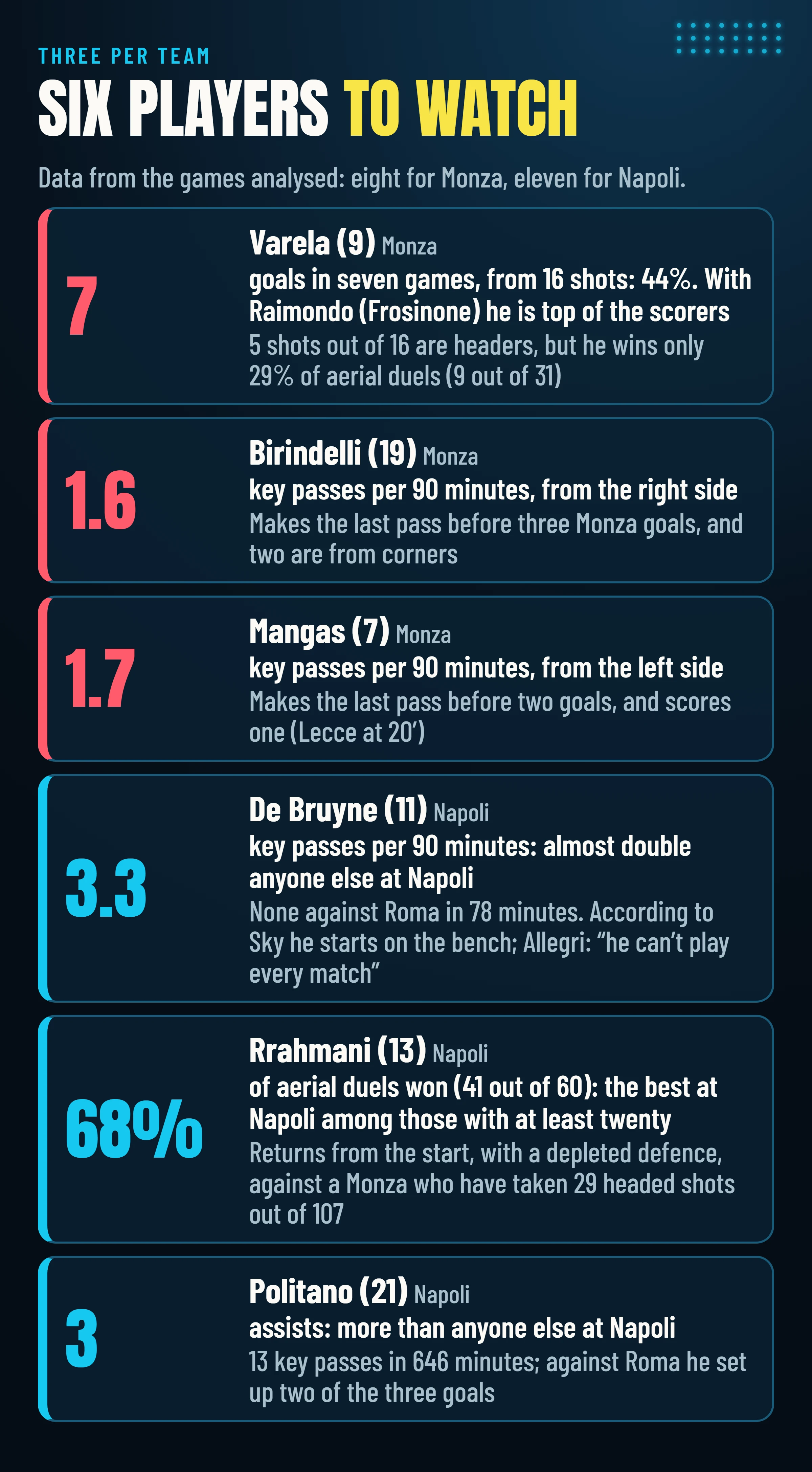
Varela (9) has scored seven goals from sixteen shots. For Monza he is the end of the attack; for Napoli he is the biggest question, with a depleted defence.
Birindelli (19) makes 1.6 key passes per 90 minutes and the last pass before three Monza goals, two of them from corners. He plays on Monza’s right side, that is, on Napoli’s left.
Mangas (7) is the left wing-back: 1.7 key passes per 90 minutes, the last pass before two goals and a goal of his own, at Lecce at 20′.
De Bruyne (11) is the player who creates the most at Napoli: 3.3 key passes per 90 minutes, almost double anyone else. Against Roma he made none in 78 minutes, and according to Sky he would start on the bench. Allegri explained it like this: “with De Bruyne it is more vertical, he switches the play in an instant”, but “he can’t play every match” and “substitutions become fundamental”.
Rrahmani (13) returns to the defence and wins 68% of aerial duels, the best at Napoli among those with at least twenty: against a Monza who have taken 29 headed shots out of 107 it is a figure that matters.
Politano (21) has three assists, more than anyone else at Napoli, and against Roma he set up two of the three goals.
The five signals to watch on Wednesday
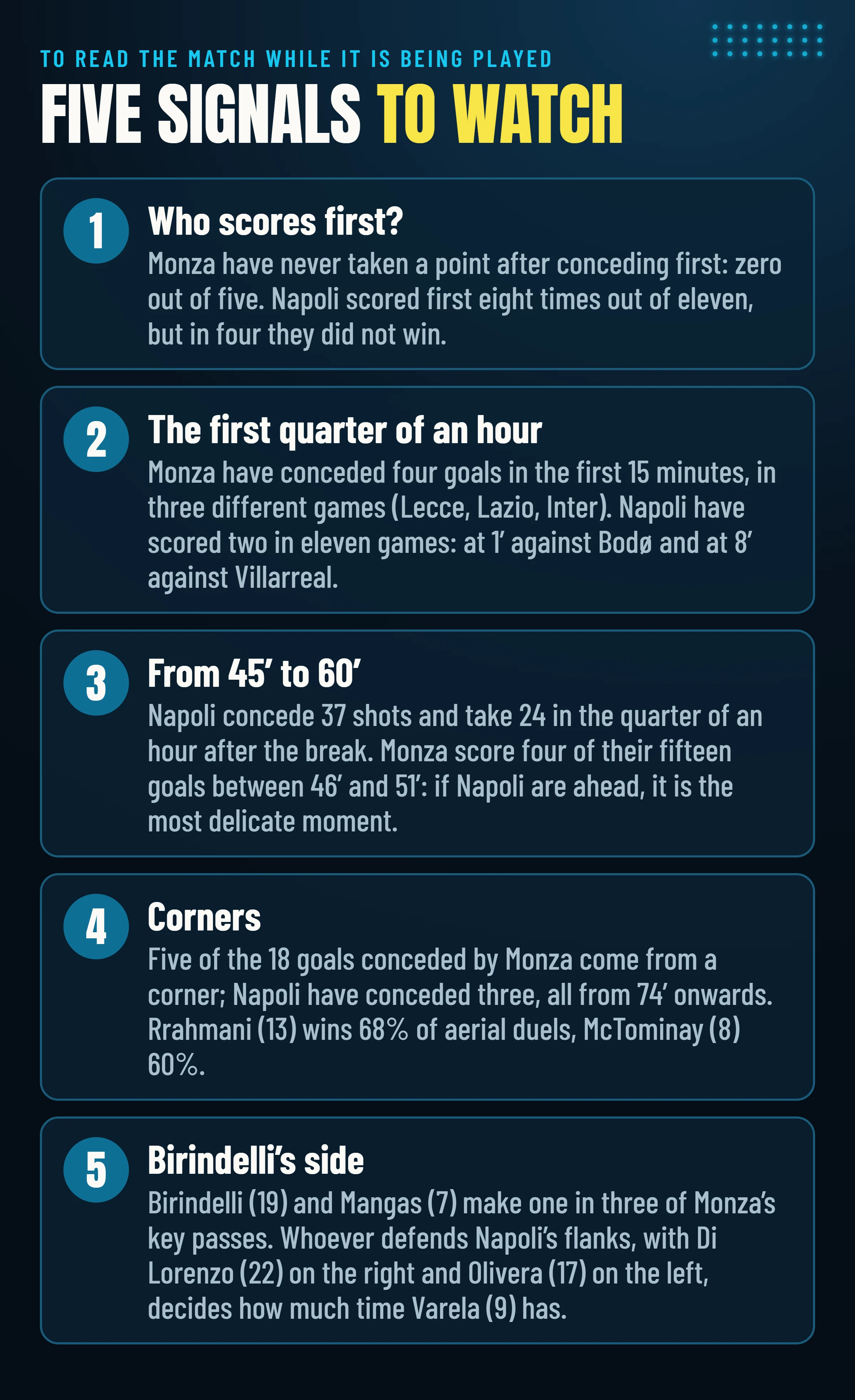
Five signals to read the match while it is being played, in chronological order: who goes ahead, how Monza start, what happens after the break, corners, Birindelli’s side.
The quarter of an hour after the break
Monza are a team that chases and rarely catches up: they have never won a match in which they conceded first. If Napoli score first, and they have done it eight times out of eleven, the match is on their side for one half. Then the second half begins, and the Napoli who give up the ball meet a Monza who score right after the break, with a cross from Birindelli or a corner, against a reshuffled defence.
The signal to watch: what Napoli do, if they are ahead, between 45′ and 60′.