
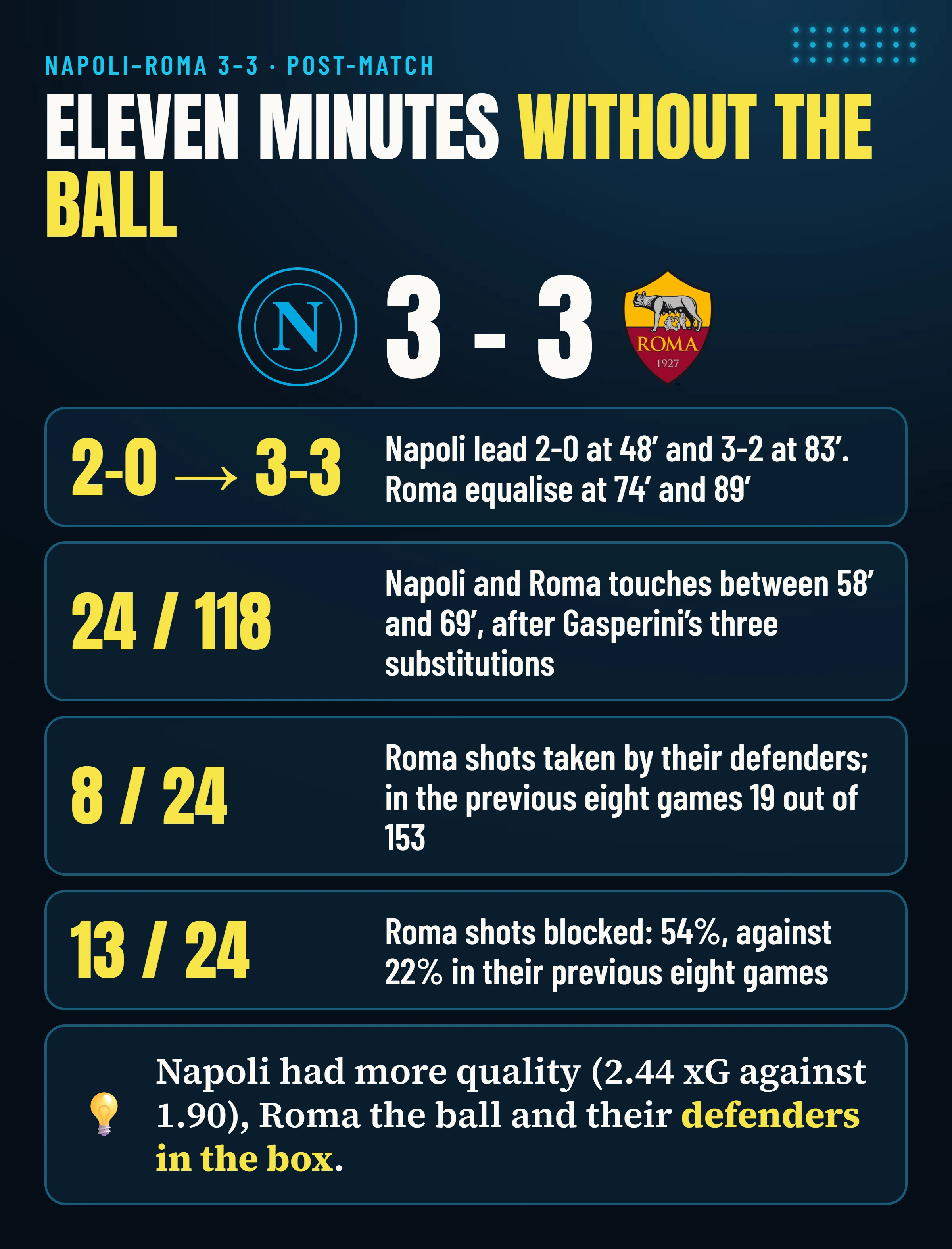
Napoli–Roma ended 3-3 at the Maradona on Saturday 24 October, and had everything: Napoli 2-0 up, Roma coming back with three substitutions and a defender, Napoli ahead again at 83′ and Roma equalising at 89′, after a minute and a half of VAR. At the end of the game Allegri was sent off. Roma remain unbeaten. Beppe Bergomi, on Sky, said that for sixty-five minutes Napoli had impressed him and that “Roma hardly knew what was going on”; the Gazzetta wrote that it was perhaps the best game of the first eight matchdays.
The pre-match said that Roma press in midfield, not on the goalkeeper or the centre-backs, and that Napoli had to find whoever receives between the lines. Here we look at the game again with those questions. What comes out is a game in two parts, divided by a substitution: for an hour Napoli controlled it, then for eleven minutes they almost stopped touching the ball.
The game, phase by phase
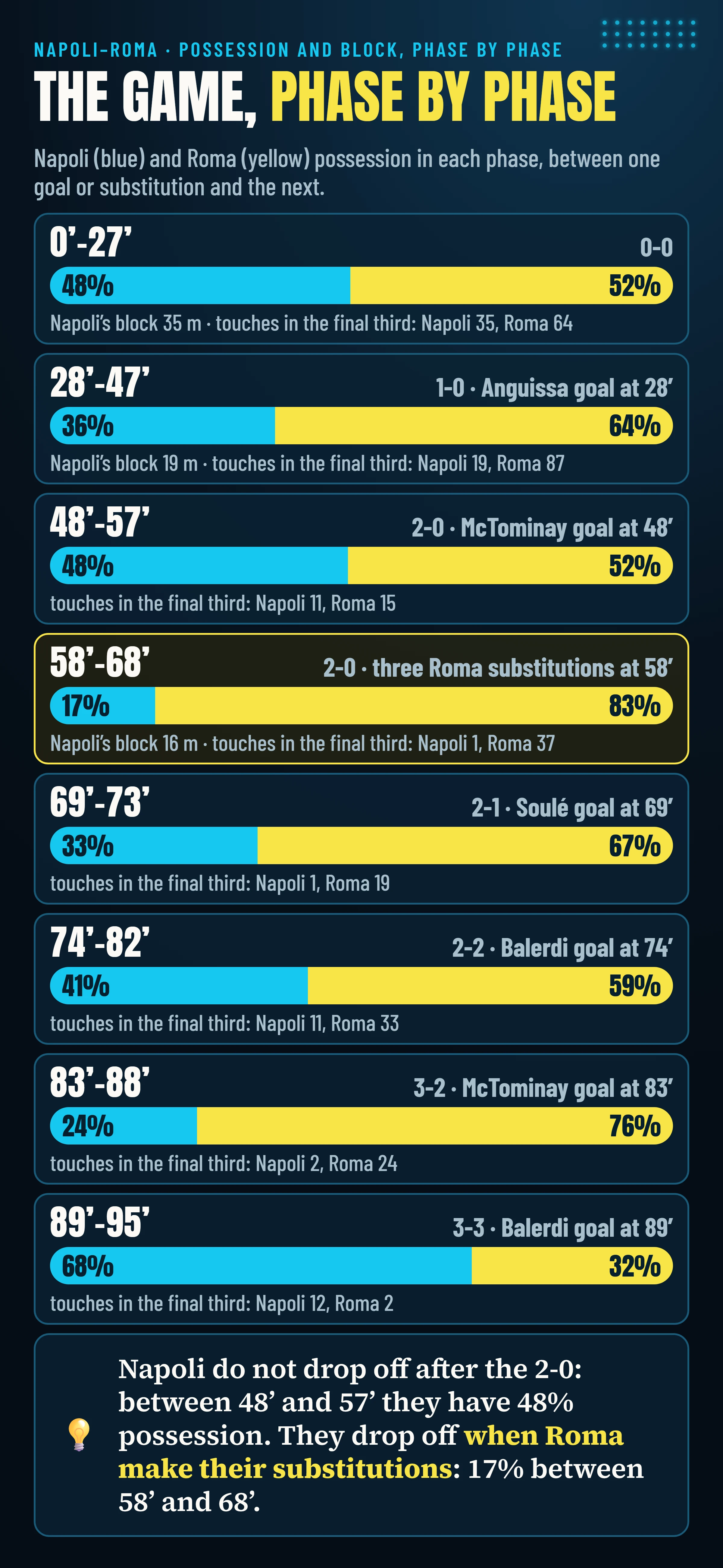
The simplest way to read it is to split it between one goal or substitution and the next, and look at possession. Here possession is each team’s share of touches: over the whole match Napoli are at 40%, against Sofascore’s 39%. Napoli start on equal terms, drop after the 1-0, recover for ten minutes after the 2-0 and then disappear when Roma make their substitutions: at their worst they have 17% of possession. They pick up again after the 2-2 and in the last minutes, at 3-3, have the ball again: they try to win it.
It is not the story “Napoli scored and dropped deeper”. It is a little more complicated, and to understand it you have to take it in order.
Up to the 2-0: a bicycle kick and Napoli dropping deeper
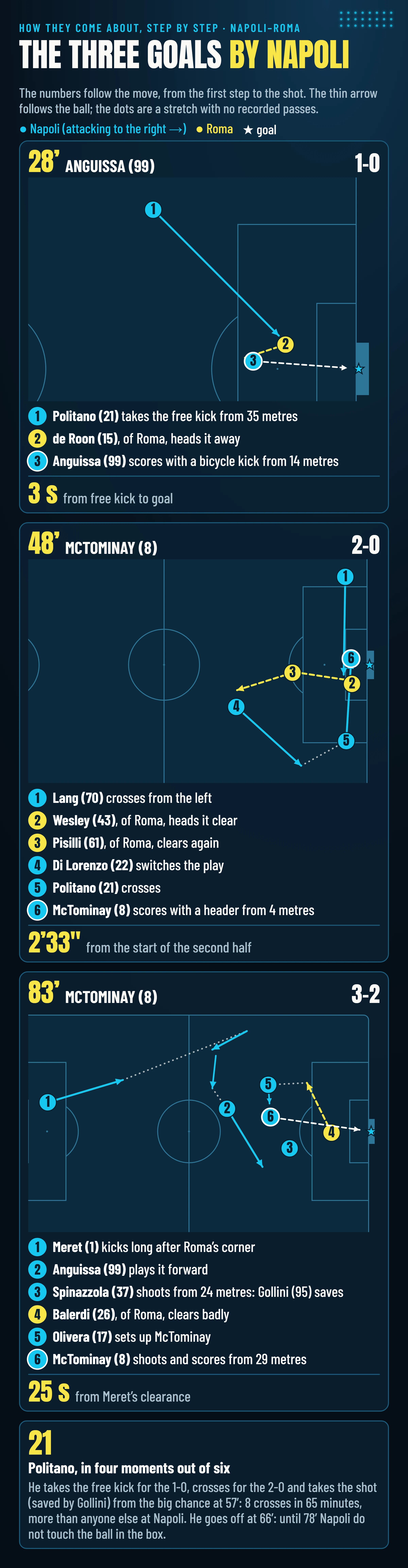
Until 28′ the game is level. Then Cristante (4) stops De Bruyne (11) with a foul, Politano (21) takes the free kick from 35 metres, de Roon (15) heads it away badly and the ball goes back to Anguissa (99), who scores with a bicycle kick from 14 metres: 3 seconds from the free kick to the goal. Two of Napoli’s three goals come from a free kick or a cross, not from a move built through the centre.
After the 1-0 Napoli do what the pre-match said they do: they give up the ball. They drop almost back to their own box and leave the ball, and the pitch, to Roma. Roma do the opposite: when behind, they push up with the whole team, defenders included. In the first half they shoot eleven times, but eight shots are blocked, three of them by Hermoso (22) from inside the box.
Napoli, meanwhile, counter-attack and create two big chances. At 41′ Politano finds Højlund (19), who heads off target from nine metres. At 44′ Meret (1) clears the ball and, ten seconds later, Højlund gets past Rensch (2) in the box and sets up Olivera (17): his shot from five metres is stopped on the line. Meret goes long on one pass in two, much more than usual: it is one of the pre-match signals, the goalkeeper one, and here it becomes a weapon for counter-attacks.
The second goal comes two and a half minutes after the start of the second half: Wesley (43) and Pisilli (61) clear twice, Di Lorenzo (22) switches play, Politano crosses and McTominay (8) scores with a header. It is also the pre-match signal about “right after the break”: with this one, three of the six goals Roma have conceded in nine games have come in the first three minutes of the second half.
And Napoli, at 2-0, do not drop deeper straight away: for ten minutes they hold the ball almost as much as Roma. At 52′ Badiashile goes off with a muscle problem and Beukema (31) comes on. At 57′ Wesley miscontrols the ball and Politano shoots from twelve metres, saved by Gollini (95): it is Napoli’s fourth big chance, and it would have made it 3-0.
At 58′: three substitutions and eleven minutes without the ball
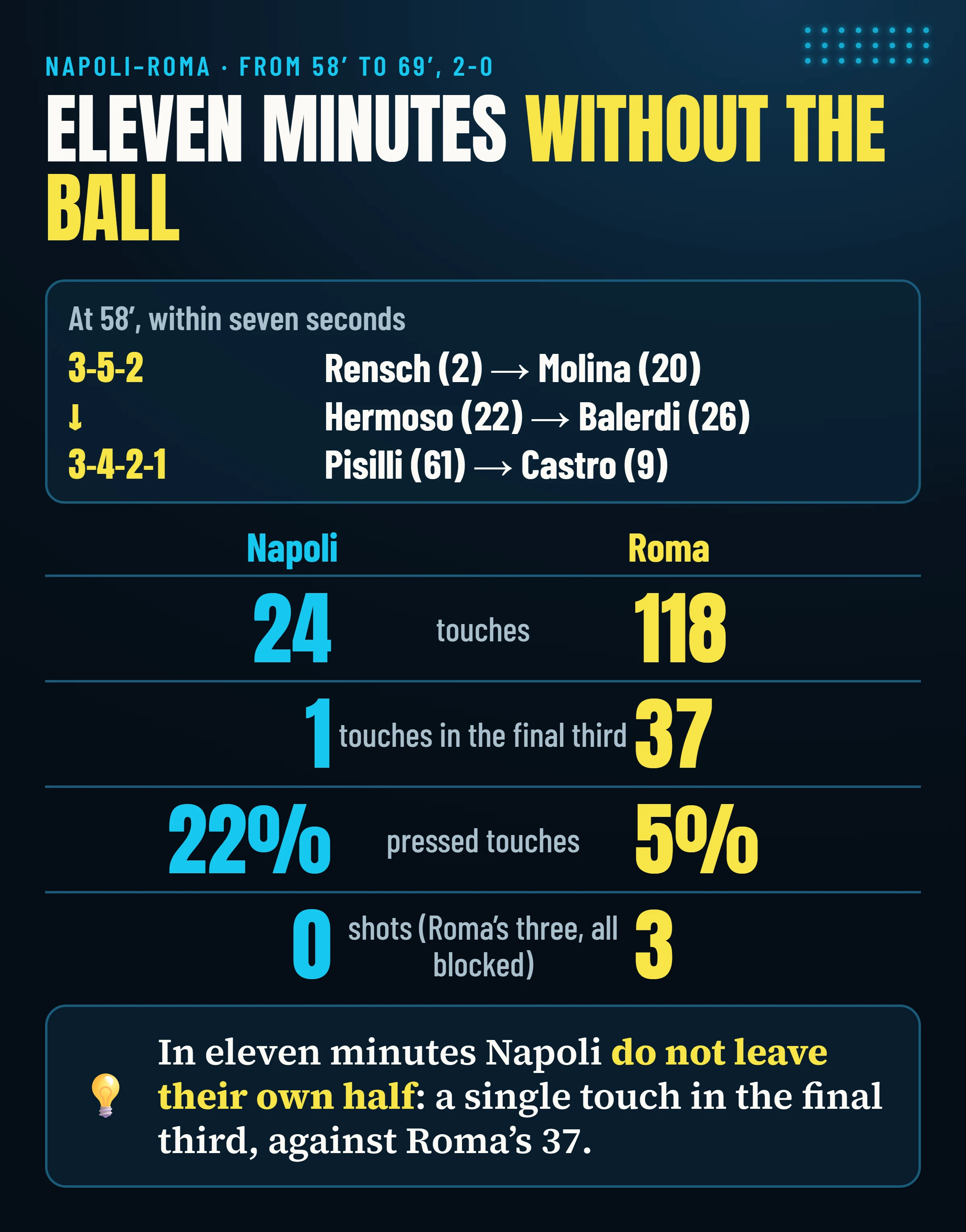
At 58′, in seven seconds, Gasperini changes three players: Molina (20) for Rensch (2), Balerdi (26) for Hermoso (22), Castro (9) for Pisilli (61). The data show the switch from a 3-5-2 to a 3-4-2-1. From that moment to the 2-1, eleven minutes go by.
In those eleven minutes Napoli touch the ball 24 times, Roma 118. They do not leave their own half: a single touch in the final third, against Roma’s 37. And when they have the ball they lose it quickly: one in five of their touches is followed by an intervention by Roma, one in twenty the other way round. It is the moment when Roma do what the pre-match said: they press forward, and do not drop deeper even two goals down. In the second half Roma’s pressing grows and Napoli’s collapses.
Roma shoot three times in those eleven minutes, and all three shots are blocked: Napoli are not breached, they are pinned back. At 66′ Allegri takes off Politano, who was the one keeping the team highest up the pitch, and brings on Giovane (23). From Politano’s shot at 57′ until 78′ Napoli do not touch the ball in the box, while Roma shoot ten times.
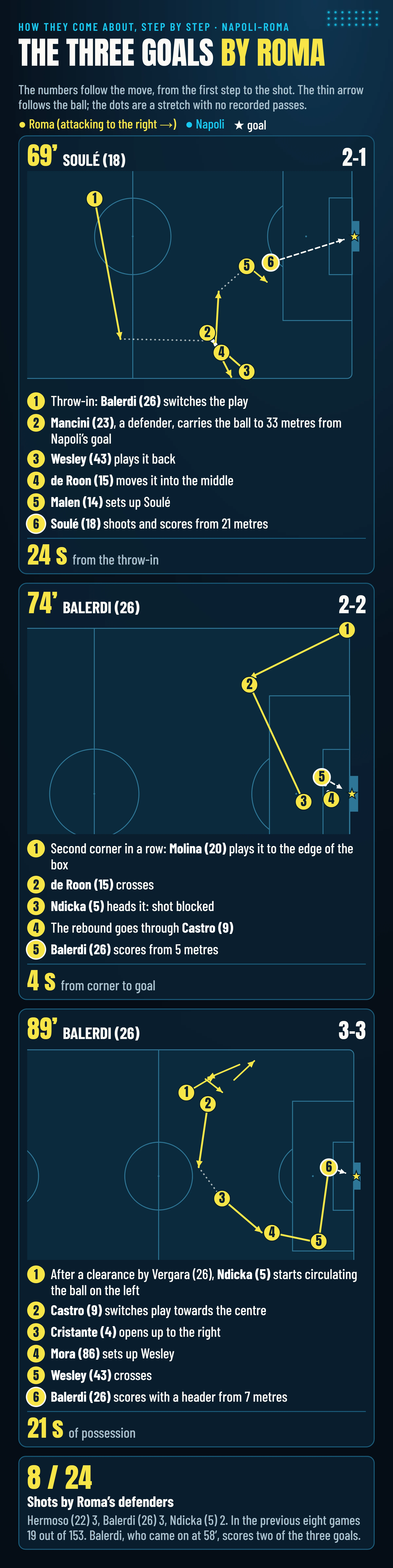
The 2-1, at 69′, comes from a throw-in for Roma, about forty metres from Gollini’s goal. Then twenty-four seconds of possession: Mancini (23), a defender, carries the ball up to about thirty metres from Napoli’s goal; Wesley (43) and de Roon (15) circulate it and Malen (14) sets up Soulé (18), who scores from about twenty metres.
The pre-match predicted the opposite: after the first substitution Roma, on average, conceded twice as many shots. At 58′ Gasperini makes his changes and Roma concede fewer: it is their best moment. On why Napoli ground to a halt, opinions differ: Condò, on Sky, spoke of “a question of age”; Sabatini said that saying Allegri dropped too deep “means not having seen the game”. The data do not say why. They say when: after Roma’s substitutions, not after the 2-0.
Gasperini’s defenders
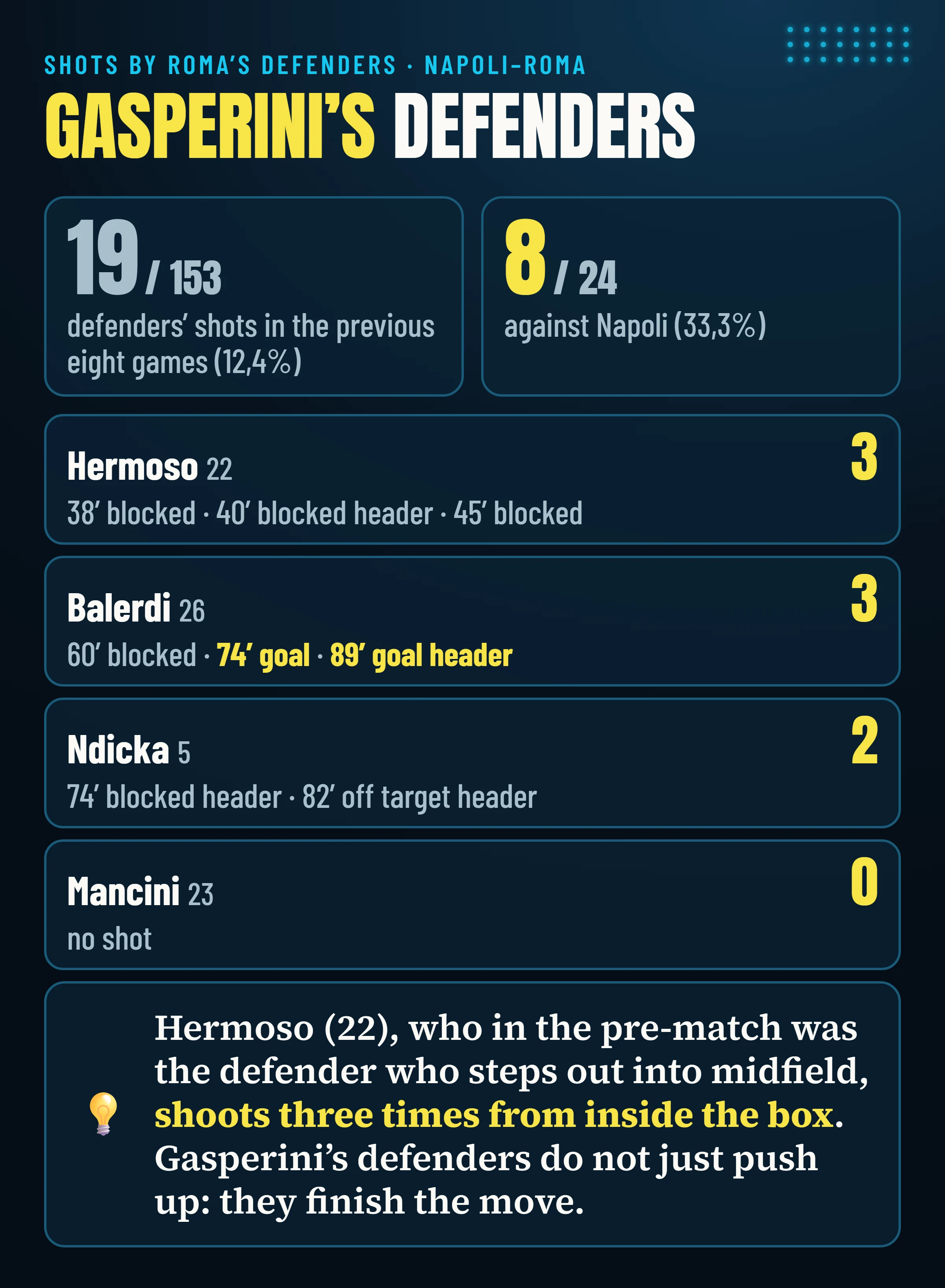
Roma scored three goals in three different ways: a counter-attack (Soulé), a corner (Balerdi), a cross (Balerdi). The second and the third are by a defender who came on at 58′, and it is not only Balerdi: eight of Roma’s 24 shots are by their defenders, one in three, against one in eight in the previous games. Hermoso (22) takes three, all in the first half and all blocked. Balerdi three, two goals. Ndicka (5) two, headers. Only Mancini does not shoot.
The 2-2 goal, at 74′, comes from the second corner in a row: Molina (20) plays it short, de Roon crosses, Ndicka heads it, the rebound passes through Castro and Balerdi scores from five metres, four seconds after the corner. Roma take eleven corners, seven of them after the substitutions; Napoli two. In the pre-match the corner was one of the places where the game could be decided, and so it was.
The 3-3, at 89′, is a cross: eight passes in twenty-one seconds after a clearance by Vergara (26), the last one Wesley’s, for Balerdi to head in. It is the fifth goal Roma have scored after 85′ in nine games, and Roma have not yet conceded any.
Roma also shot very badly: 13 of the 24 shots were blocked, more than half, against a little more than one in five in their previous eight games. Only four shots out of 24 were on target, and three are goals. Napoli’s low block worked like a wall; it gave way on three plays: a transition, a corner, a cross.
The last fifteen minutes
After the 2-2 the game opens up. Napoli get a little of the ball back and at 79′ Allegri changes three players in twenty-five seconds: Lobotka (68) for De Bruyne, Vergara (26) for Lang (70), Spinazzola (37) for Di Lorenzo. In the last quarter of an hour Roma take another corner, at 82′.
The 83′ goal comes from exactly that: Ndicka misses the header on Molina’s corner, Meret gathers it and launches it long. In twenty-five seconds Napoli get to a shot: Spinazzola (37) shoots, Gollini saves, Balerdi clears badly, Olivera (17) sets up McTominay (8) and McTominay scores from 29 metres. Napoli are ahead again. But straight afterwards the ball goes to Roma: Napoli have a quarter of it, Roma, without shooting, the rest, and six minutes later Balerdi scores.
The goal is checked by the VAR for a minute and a half, between 88′ and 90′. Beukema, who came on at 52′, had stayed down after a contact with Balerdi before Wesley’s cross; Allegri was asking for a foul. According to the Gazzetta’s replay analysis and Calvarese’s comment there was no foul. A few seconds after play restarted Allegri was sent off.
In the last seven minutes, at 3-3, Napoli try to win it: they have the ball, get into the final third several times and shoot twice, one by Olivera off target and one by Beukema saved. Roma hardly shoot any more.
The tactics board, with the real positions
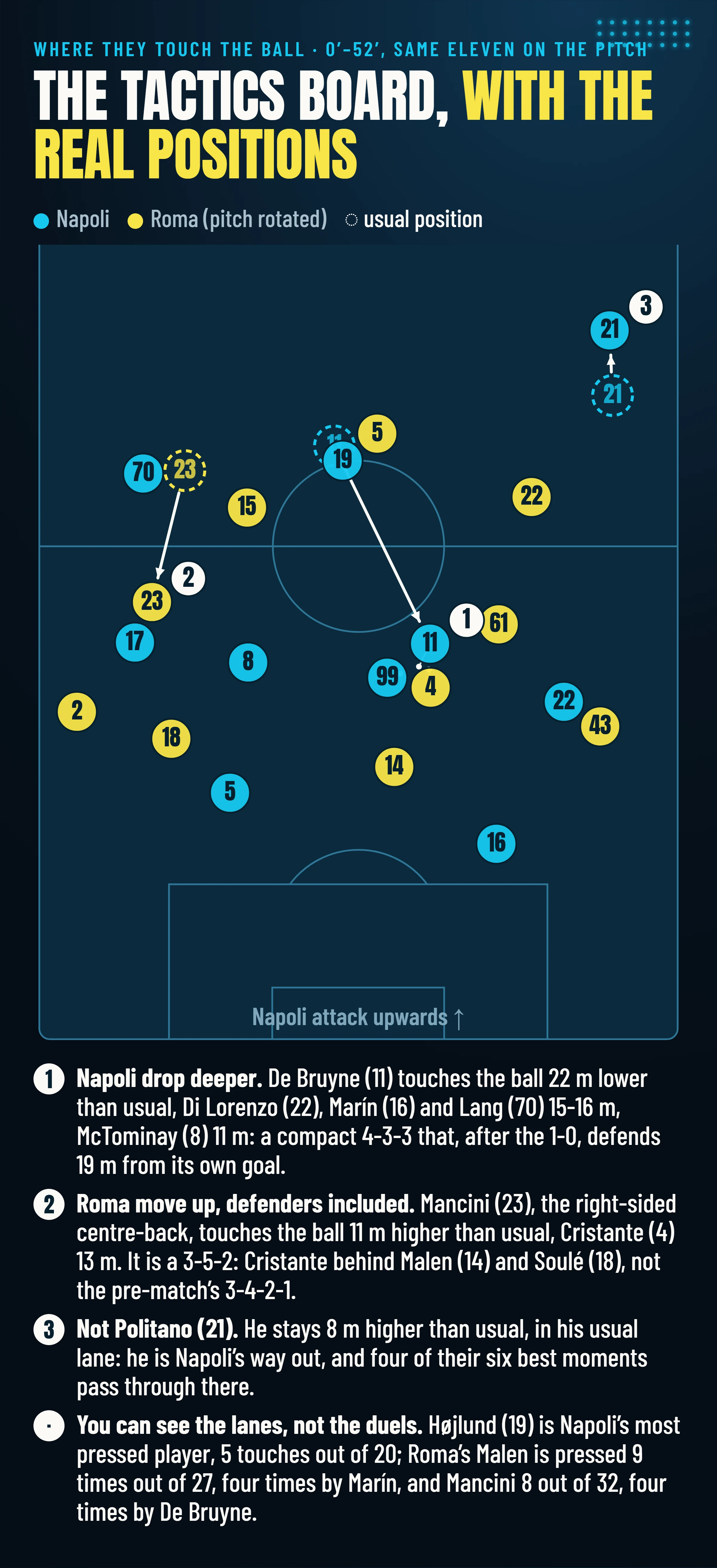
In the pre-match we had drawn Roma with a 3-4-2-1 and Napoli with a 4-3-3 and Lobotka. Napoli played with a back four and three midfielders, but with Anguissa (99) and not with Lobotka; Roma played a 3-5-2, with Cristante (4) behind Malen and Soulé, and switched to a 3-4-2-1 only at 58′. On the line-ups, the pre-match tactics board was wrong. The real positions, though, say something different, and more interesting.
The figure shows where the same eleven touched the ball, in the first 52 minutes, compared with where they usually touch it. Napoli drop deeper: De Bruyne (11) touches the ball 22 metres lower than usual, and Di Lorenzo (22), Marín (16) and Lang (70) also play deeper. Roma move up: Mancini (23), the right-sided centre-back, touches the ball 11 metres higher than usual, Cristante (4) even more. Politano is the only Napoli player who stays high, in his lane.
You can see the lanes, not the duels. Højlund (19) is Napoli’s most pressed player; Roma’s Malen is pressed four times by Marín (16) and Mancini four times by De Bruyne. In midfield Napoli are pressed more than usual, in their own box little, and Meret never. As we said, Roma do not go after the goalkeeper.
Few shots, good chances
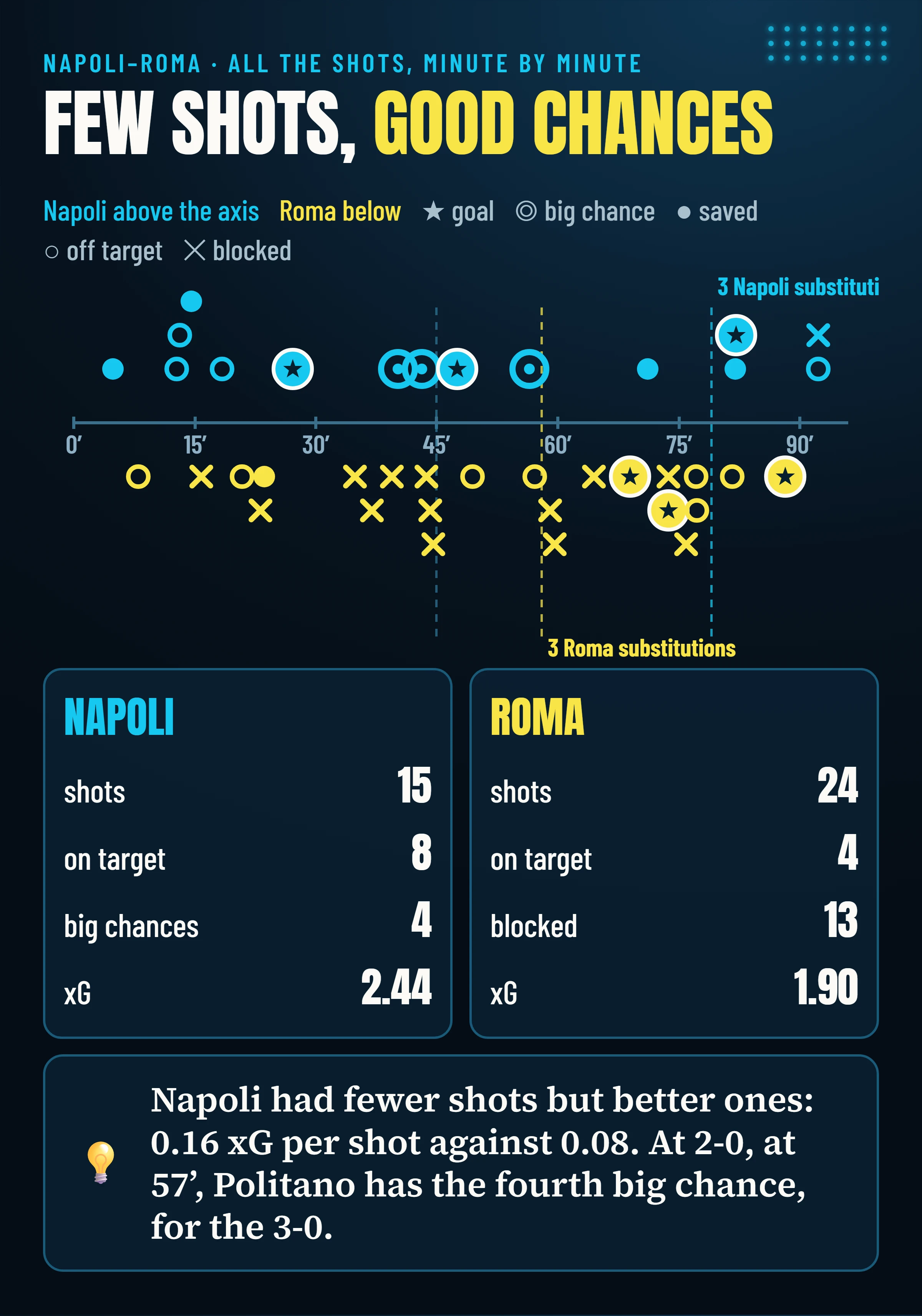
On Sofascore’s numbers Napoli did better: 2.44 xG against 1.90, four big chances against two. They took fewer shots, 15 against 24, but put more of them on target, and each of their shots is worth twice as much as one of Roma’s. The four big chances all come between 41′ and 57′: Højlund, Olivera, McTominay (the goal), Politano. Then nothing more.
The ball, on the other hand, is Roma’s: 61% according to Sofascore, almost 600 passes against fewer than 400 and eleven corners against two. Napoli shot better, Roma had more of the ball and more ways to get there. The 3-3 sits in between: neither a robbery nor a gift.
Six players, what happened
In the pre-match we had pointed to six players to watch. Here they are, with two others who decided the game.
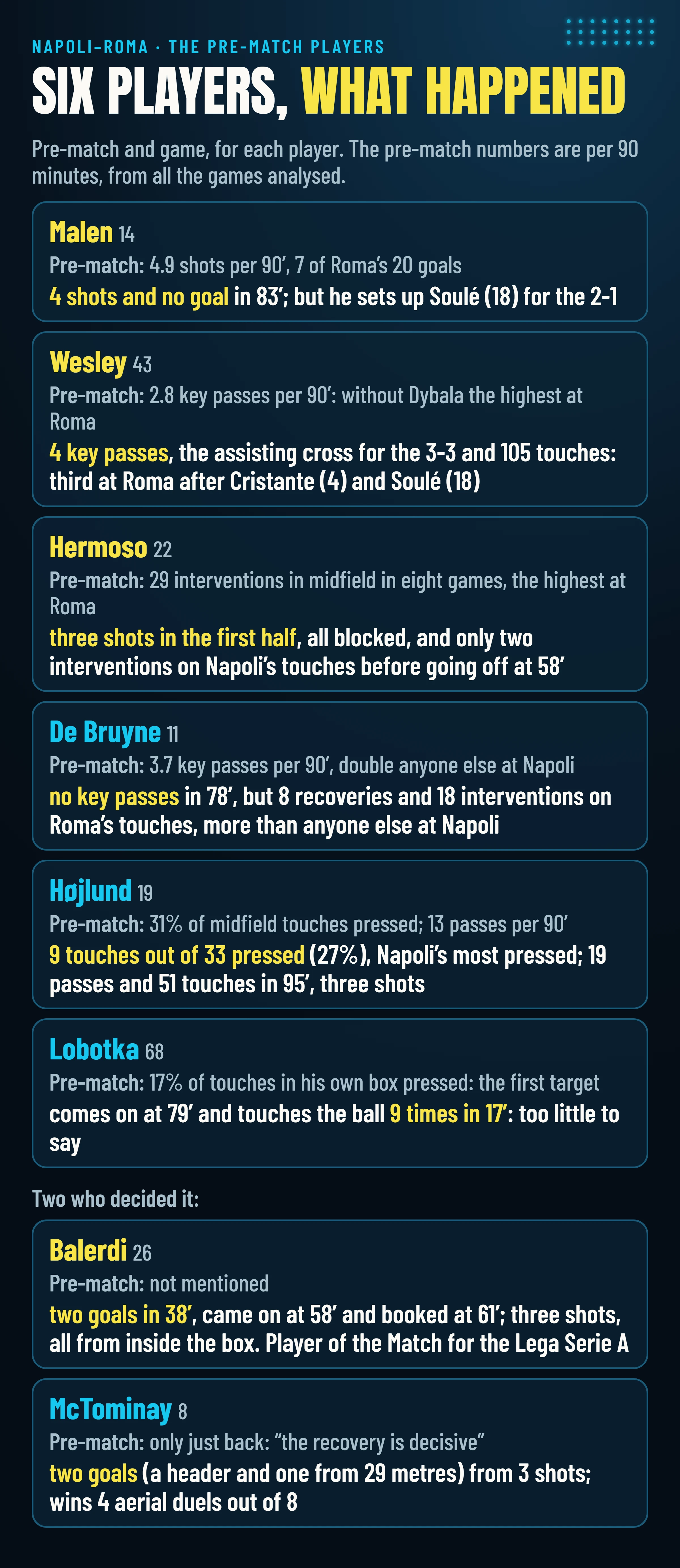
Malen (14) was the striker Roma’s goals went through: seven of the twenty. Here he shoots four times, no goal, and sets up Soulé for the 2-1.
Wesley (43) was, without Dybala, the player who created the most chances at Roma. Here he makes four key passes and the cross for the 3-3, and miscontrols the ball from which Politano’s big chance at 57′ comes.
Hermoso (22) was the defender who stepped out into midfield the most. Here he shoots three times from inside the box, all blocked, and makes only two interventions on Napoli’s touches. He goes off at 58′.
De Bruyne (11) was the one who created the most at Napoli, twice as much as anyone else. Here he makes no key passes in 78 minutes, but eight recoveries and 18 interventions on Roma’s touches, more than anyone else at Napoli, and he plays 22 metres lower than usual. It is a different De Bruyne from the pre-match one: deeper, more defensive.
Højlund (19) was Napoli’s most pressed player in midfield, and still is: more than one touch in four followed by an intervention, against one in eleven for the rest of the team. He has few touches, shoots three times and does not score; the chance at 41′ is his.
Lobotka (68) was Roma’s first target in build-up. He comes on at 79′ and has very few touches in seventeen minutes: too little to say.
Balerdi (26) was not in the pre-match. He comes on at 58′, is booked at 61′ and scores two goals, with three shots in 38 minutes. The Lega Serie A named him Player of the Match.
McTominay (8) had only just returned: Ivano Trotta had said that his recovery was “decisive”. He scores two goals, a header and one from outside the box, and wins half of his aerial duels.
What we said
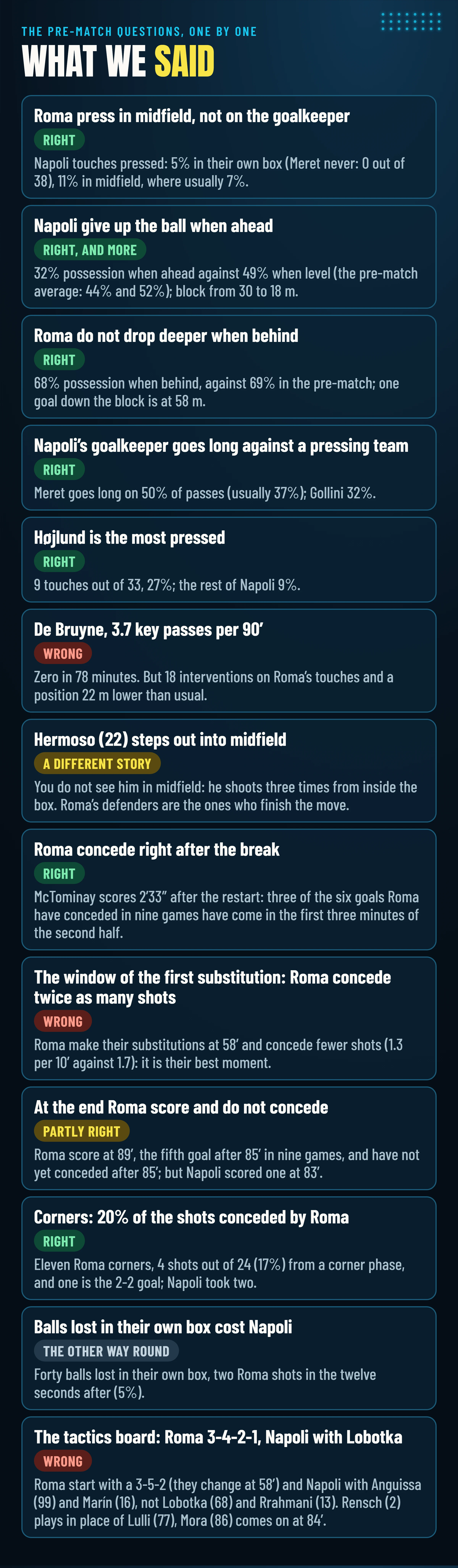
Thirteen pre-match questions, one by one. Seven right: the pressing in midfield and not on the goalkeeper, Napoli ahead giving up the ball (and more so: 32% possession when ahead, against 49% when level), Roma behind not dropping deeper, the goalkeeper going long, Højlund the most pressed, the second half, the corners. Two partly right: the ending, and Hermoso, who does not step out into midfield but shoots from inside the box. Three wrong: the tactics board, the De Bruyne of 3.7 key passes and the window of the first substitution. One the other way round: the lost balls in their own box, 40 in all, but only two Roma shots in the twelve seconds after.
After the whistle
Allegri was sent off at 90′ and the Serie A disciplinary judge gave him a two-match ban (he misses Monza and Juventus) and a fine of 10,000 euros, for an insulting expression towards the match officials at the end of the game, a gravely disrespectful one in the dressing room and aggressive behaviour towards a Roma official; Napoli have announced an appeal. Beukema apologised on social media. Napoli also lose Badiashile (muscle problem) and Spinazzola (biceps femoris tear: he misses Monza). Gasperini, at the press conference, called Allegri’s remark “unfortunate”.
Eleven minutes without the ball
Napoli had the game in hand for an hour, with a 2-0 built on a free kick and a cross, and let it go in eleven minutes: from the moment Roma changed three men and kept pushing up, even two goals down. Roma, as the pre-match says, do not drop deeper. They scored three goals in three ways and two of them through a defender, and won the battle for the ball without winning the battle for the goals.
The signal to take to Monza and Turin: when a team changes three men and keeps pushing up, the ball has to be able to leave its own half.