
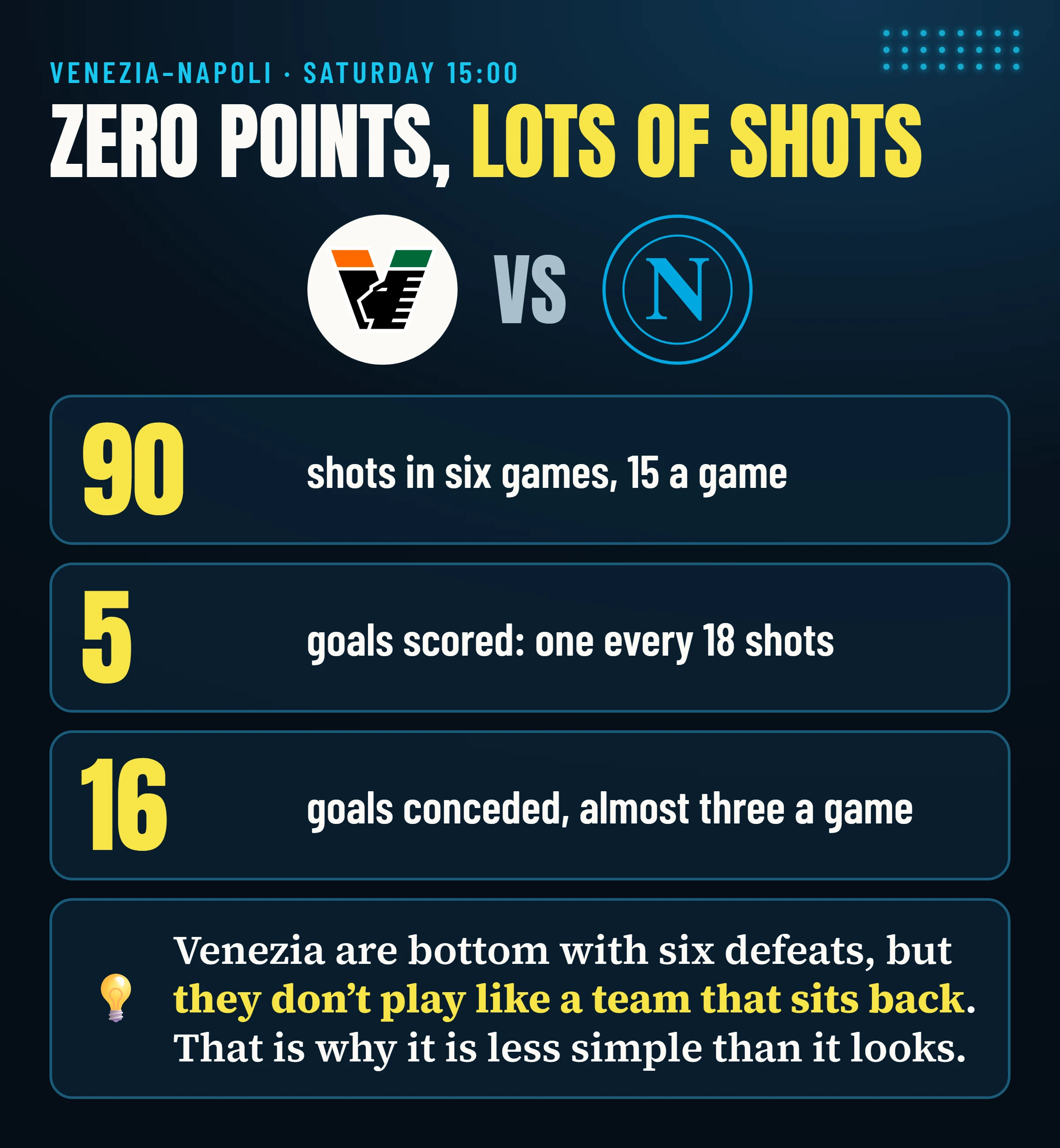
Venezia–Napoli, on Saturday at 15:00 at the Penzo stadium, is matchday 7 of Serie A. Venezia are bottom on zero points, with six defeats in six games, and changed coach a few days ago: Stroppa out, Davide Nicola in, making his debut against Napoli.
Napoli come from the defeat at Villarreal. Allegri said in his press conference that they need to “manage the ball better at certain moments of the game”.
On paper there is an obvious favourite. But Venezia’s six games and Napoli’s eight suggest this game can change at one precise moment: after the first goal. Venezia, when they fall behind, change the way they defend. Napoli, when they go ahead, tend to change the way they play. Here we try to understand what changes and how to recognise it while the game is on.
A new Venezia, for one game
The news comes from the press and is updated to Friday 16 October. The official line-ups arrive an hour before the game.
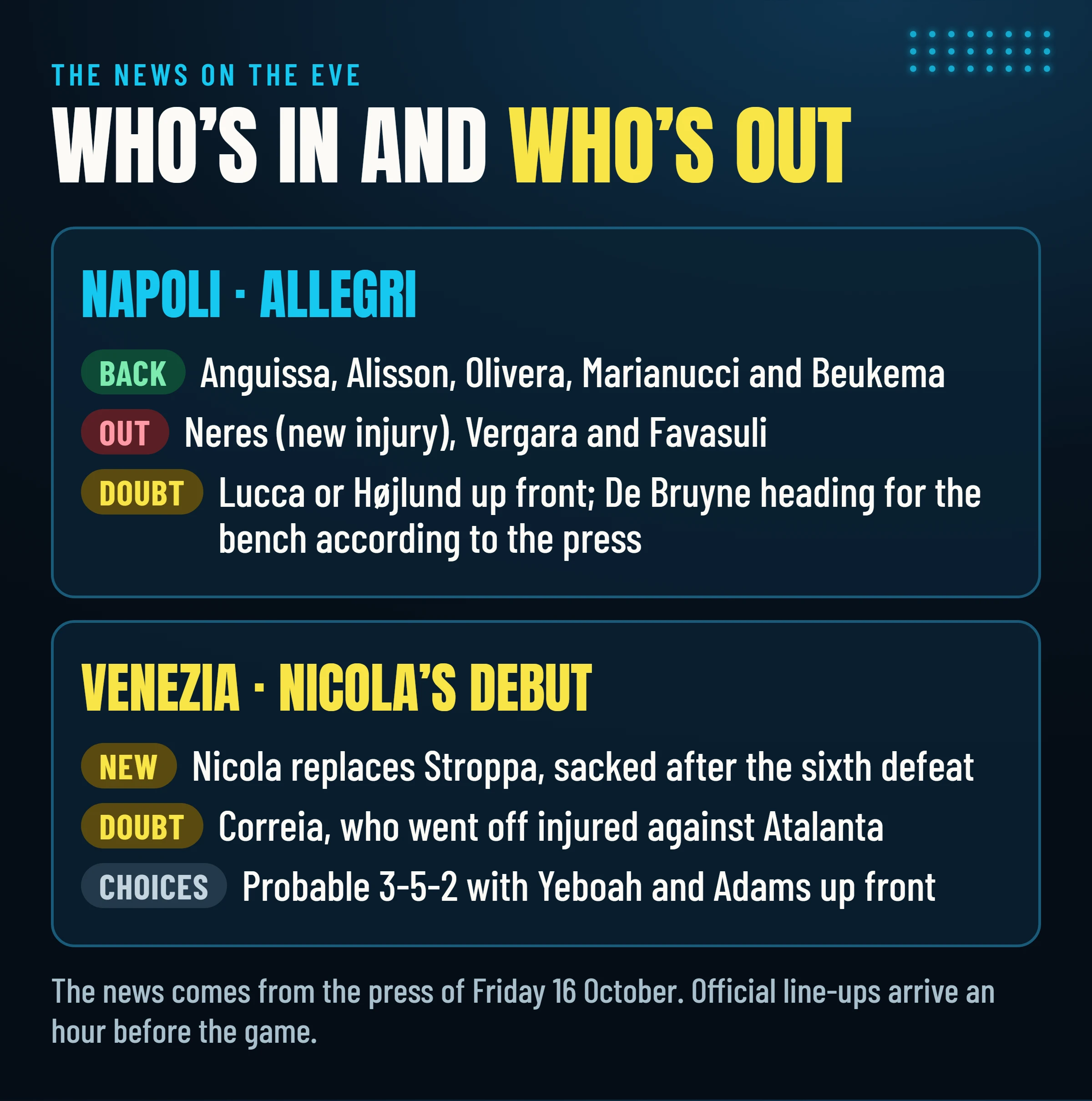
Venezia sacked Stroppa after the 3-1 at Bergamo, the sixth defeat in six, with two goals conceded in the first six minutes. Nicola, a specialist in rescue jobs, has had very little training time: it is hard to change everything in two days. According to the Gazzetta he should keep Stroppa’s set-up, the 3-5-2 with Yeboah and Adams up front and two selection dilemmas on the wings; Sky speaks of a few changes. Correia, who went off injured at Bergamo, is to be assessed.
In Napoli Anguissa, Alisson and Olivera are back, and Marianucci and Beukema have recovered. Neres is missing, injured again. Allegri has to choose between Lucca and Højlund, and said the double centre-forward “can be a solution”. According to the press De Bruyne could start on the bench.
Data sample. The analysis uses Venezia’s six games (Lecce, Frosinone, Fiorentina, Milan, Lazio and Atalanta) and the eight Napoli games already analysed. These are few games, and all with Stroppa on the bench: the numbers show trends, not certainties.
A Venezia that doesn’t sit back
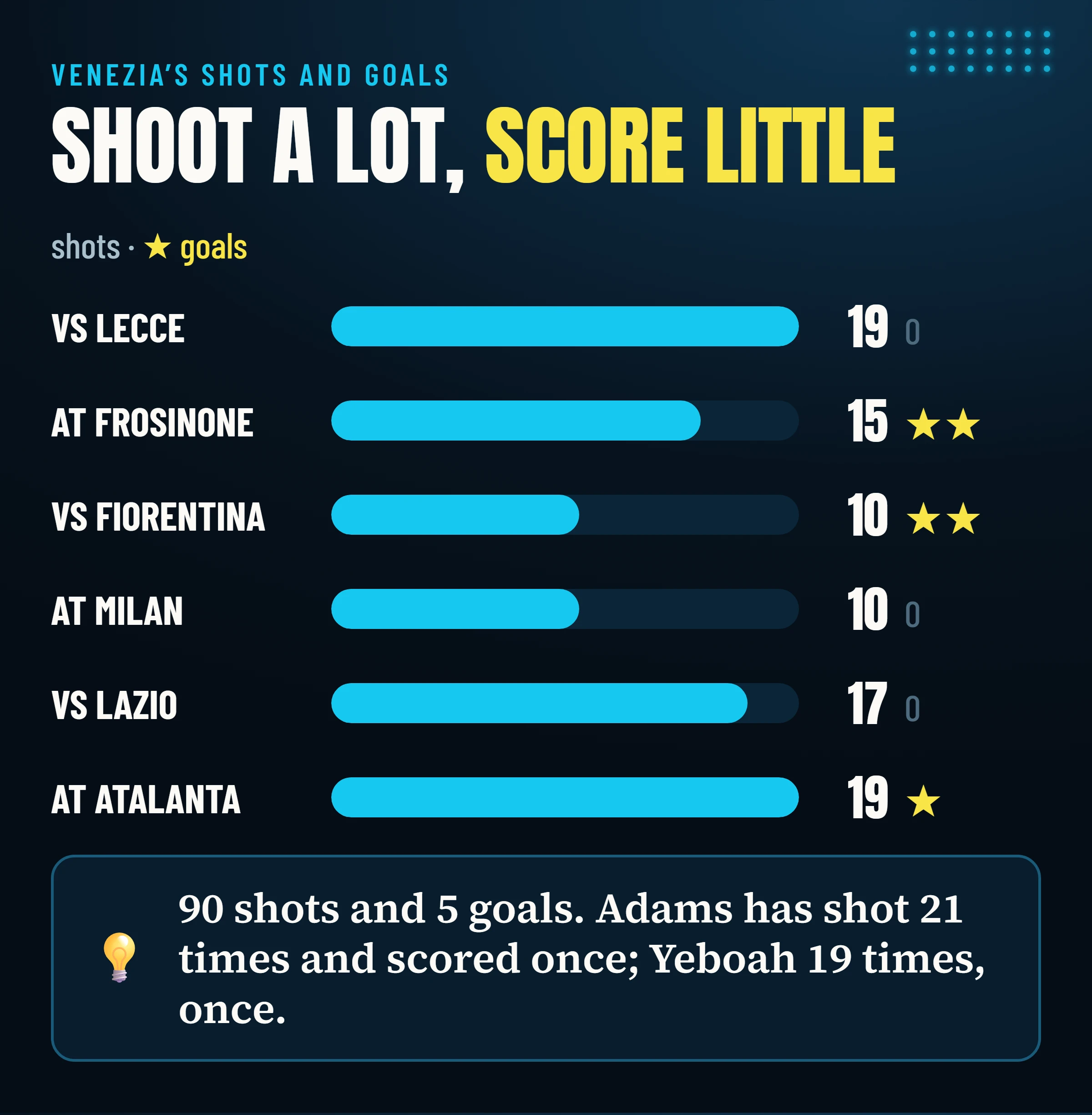
Venezia play a 3-5-2: three centre-backs, two wing-backs who push up to the edge of the box and two strikers. They are not the team that waits and counters, as you might expect from a bottom side: they keep the ball (between 60 and 71% of the passes in four games out of six) and have taken 90 shots in six games. Playing like this has a cost, which we will see later.
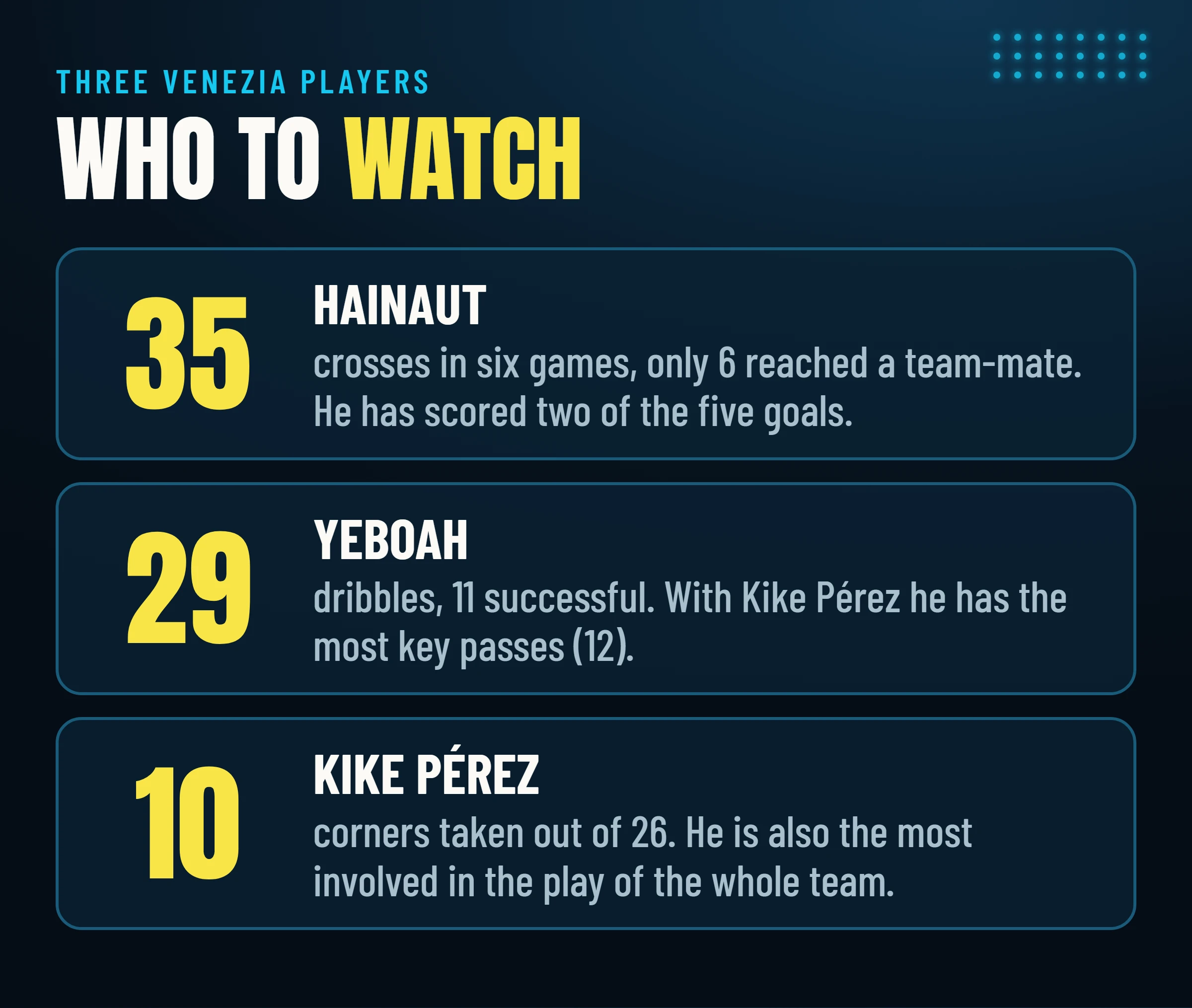
Three players explain how it works. Hainaut, the right wing-back, is the one who has crossed the most: 35 crosses, but only 6 reached a team-mate. Venezia look for the wing and use it badly: for Napoli, who will probably field Spinazzola on that side, the risk is not the cross itself but what is left afterwards, the ball bouncing around the box.
Yeboah is the striker who invents: 29 dribbles, 11 successful, and 12 key passes, as many as Kike Pérez. He is the one who tries to beat the first man; if a Napoli centre-back steps out to take him, he leaves space for Adams, who touches the ball little (81 passes in six games) but shoots almost always from inside the box: 16 shots out of 21, one goal. Kike Pérez, a central midfielder, is the player everything goes through: the most involved in the team and the one who takes the most corners (10 out of 26).
The surprising fact is the other one: 90 shots and 5 goals. They are not desperate shots: 53 out of 90 come from inside the box. They are wasted chances rather than missed ones. That is why Venezia are less harmless than they look, and for Napoli the first signal to watch is simple: if Venezia shoot a lot in the first thirty minutes, Napoli are not controlling the game, even when they have the ball.
Which Venezia will show up?
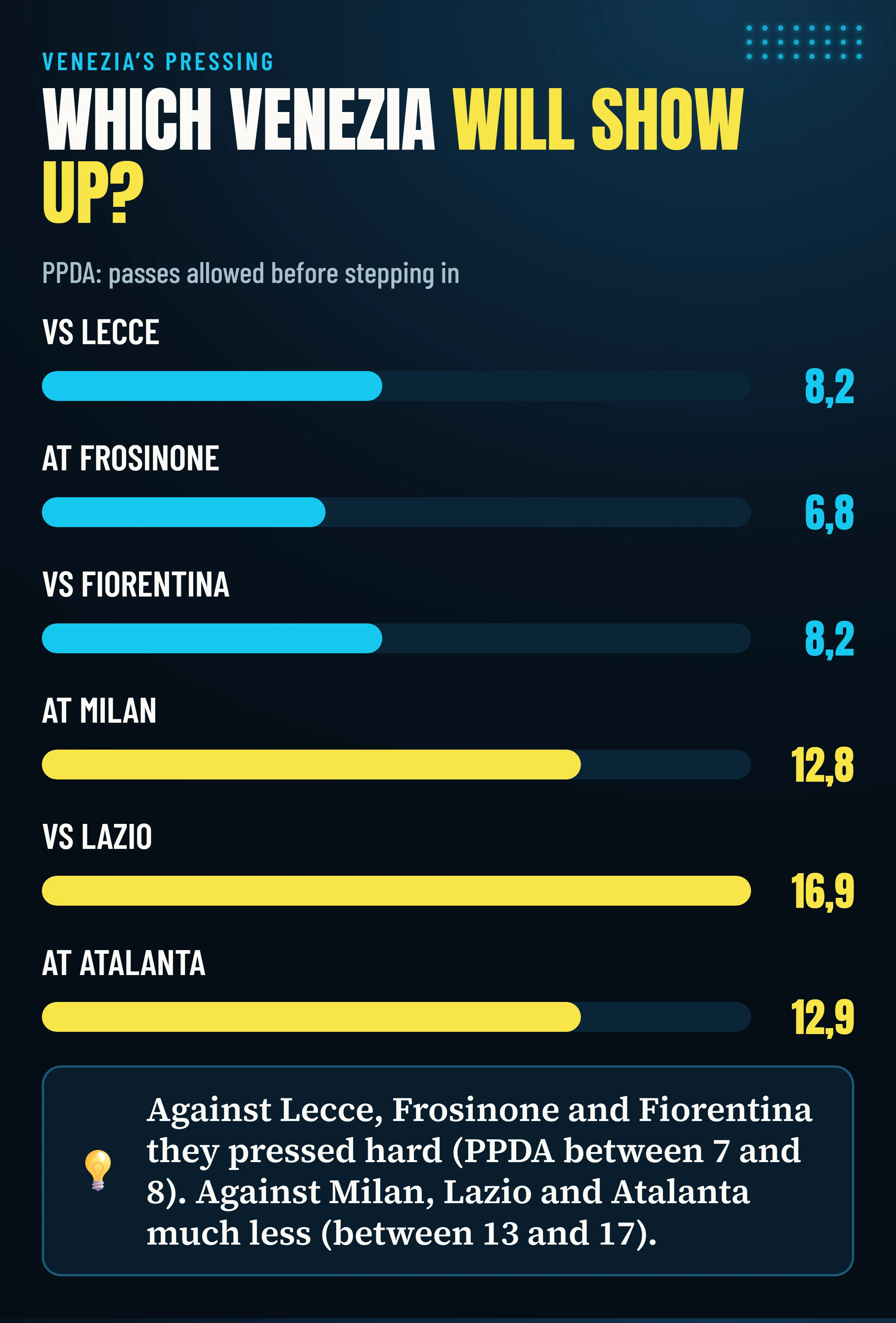
Pressing is measured with PPDA: how many passes you let the opponent make before stepping in. The lower the number, the more the team presses. Against Lecce, Frosinone and Fiorentina Venezia pressed hard (between 7 and 8). Against Milan, Lazio and Atalanta much less (between 13 and 17).
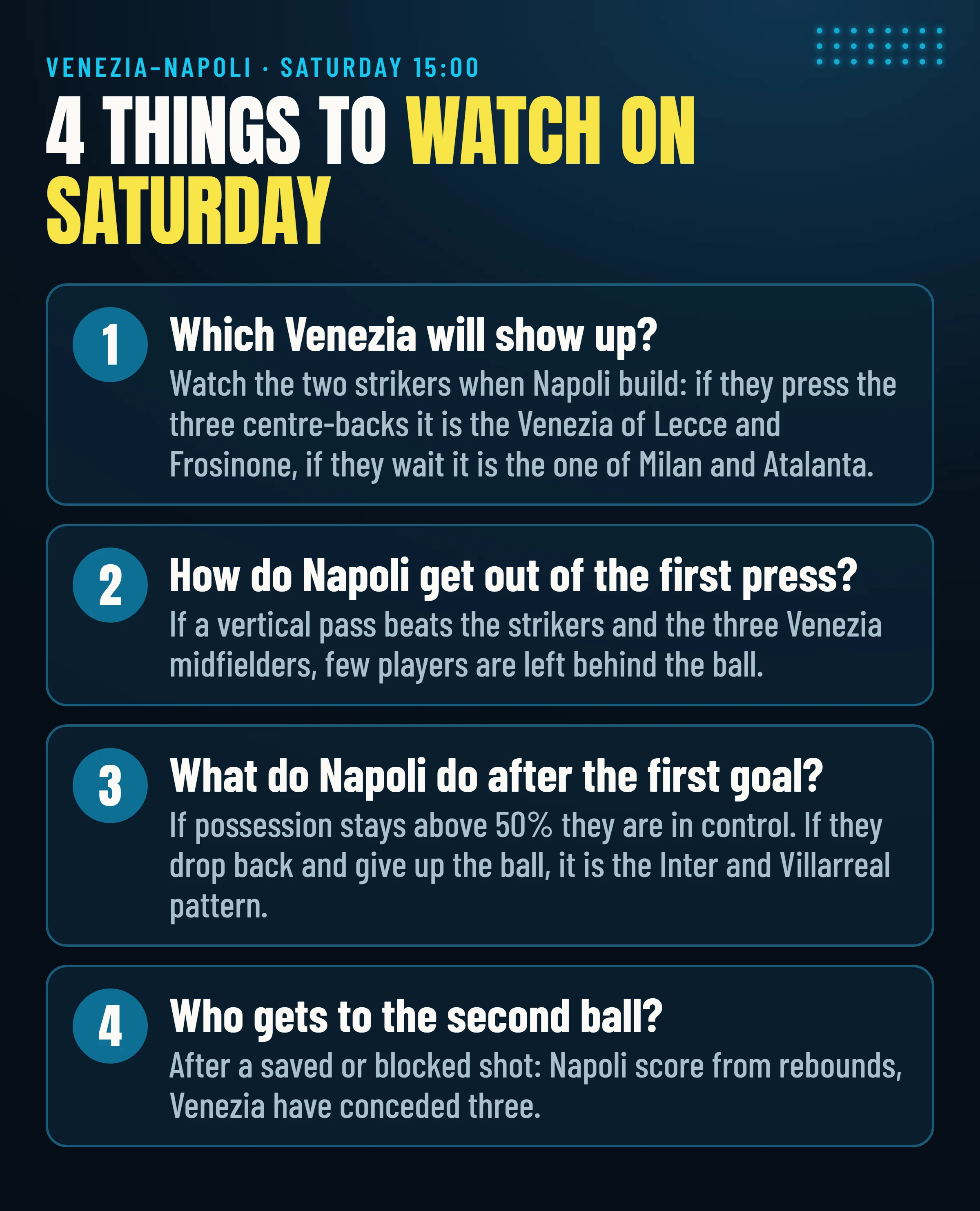
For Venezia, Napoli are an opponent closer to the second group, but Nicola is not Stroppa: the Gazzetta describes him as a coach with no preconceived ideas about the set-up. No data can say which Venezia we will see. You can tell quickly, though, by watching the two strikers when Napoli build from the back: if they press the three Napoli centre-backs, it is the Venezia of Lecce and Frosinone; if they wait in midfield, it is the one of Milan and Atalanta.
If Napoli press, Venezia struggle
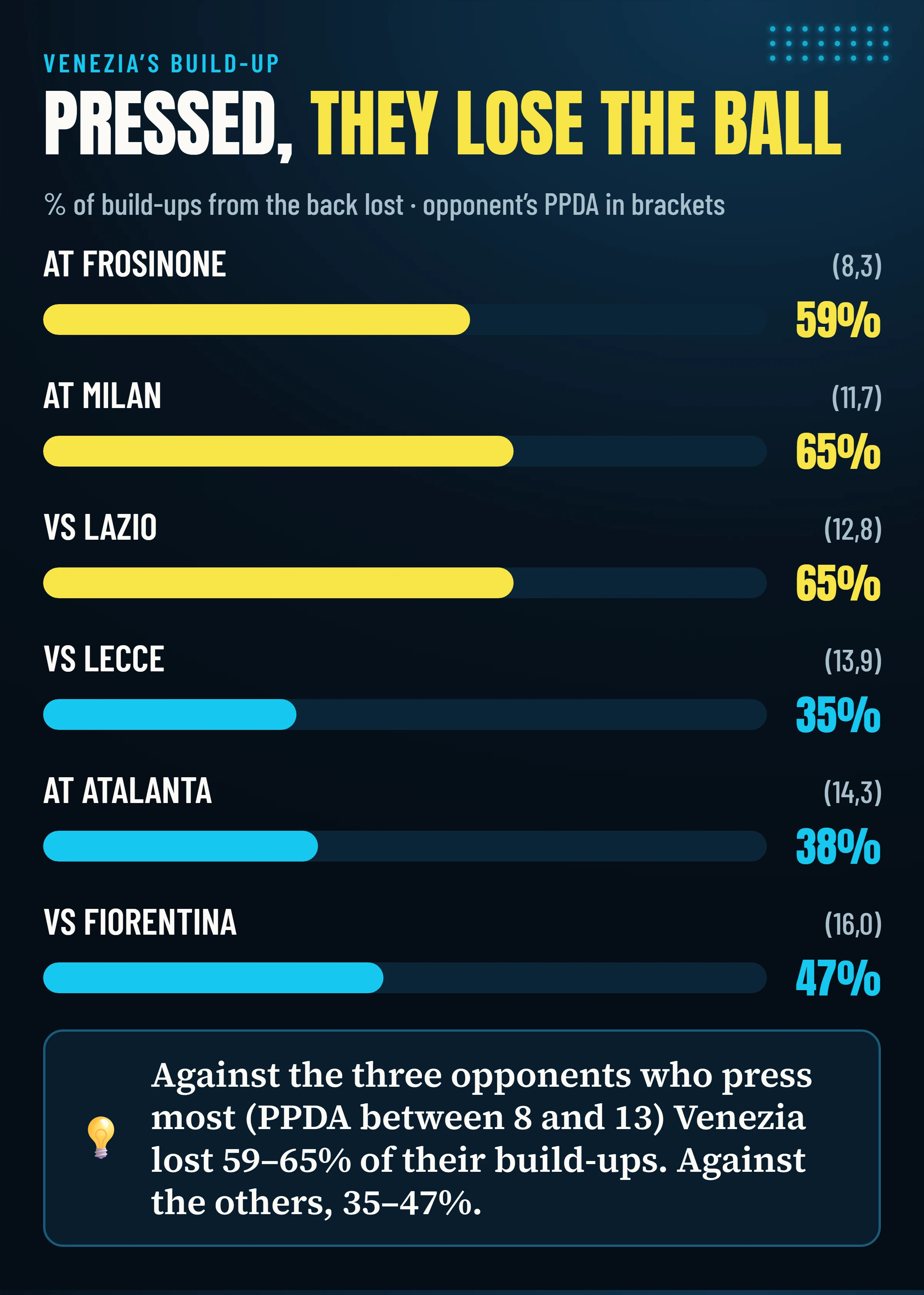
There is a figure that speaks to a choice Allegri will have to make, press or not. Venezia build from the back: goalkeeper Stanković is the third most involved player in the team and, with Kike Pérez, the one with the most forward passes (31). When pressed, they struggle. Against the three opponents who press most (PPDA between 8 and 13: Frosinone, Milan and Lazio) they lost 59–65% of their build-ups from the back; against the other three, 35–47%.
Napoli pressed a lot (PPDA between 10 and 11) against Genoa, Bologna and Fiorentina, little (between 17 and 21) against Como, Inter, Arsenal and Frosinone, and about 12.6 at Villarreal. Knowing that Venezia make mistakes when pressed, they have a reason to push up. But pushing up is a choice, not a rule: pressing high also means accepting to leave space if the first press is bypassed.
Live, just watch what Stanković does when he has the ball. If Napoli’s number tens go up onto the three centre-backs and he has to kick long, Venezia lose the first ball; if he finds a free centre-back, the press has been beaten.
Where the two line-ups fit together
The rest is told by the line-ups. Napoli have played their recent games with a back three, two wing-backs, two midfielders and two number tens behind the centre-forward; Venezia play a 3-5-2. On the board there are three points of contact.
Wing-back against wing-back. Both teams use their wing-backs as the main weapon. On one side is Hainaut, the one who has crossed the most; on the other, probably, Spinazzola. If Spinazzola goes forward, he leaves space for Hainaut; if he stays back, Napoli defend the crosses with five but give up a weapon going forward. It is the duel to watch first.
At the back, Napoli have an extra man: three centre-backs against two strikers. That means there is always a team-mate free to build, and that Meret and the centre-backs can take their time. The point is whether they find him, against a Venezia with three midfielders ready to step onto the passing line.
In midfield the count flips: three Venezia midfielders (Bašić, Kike Pérez and Sohm, according to the Gazzetta) against Napoli’s two. To even it out the number tens are needed, receiving between the lines without dropping too deep. If they drop back to help, Napoli lose threat; if they stay high, the two midfielders risk being overrun.
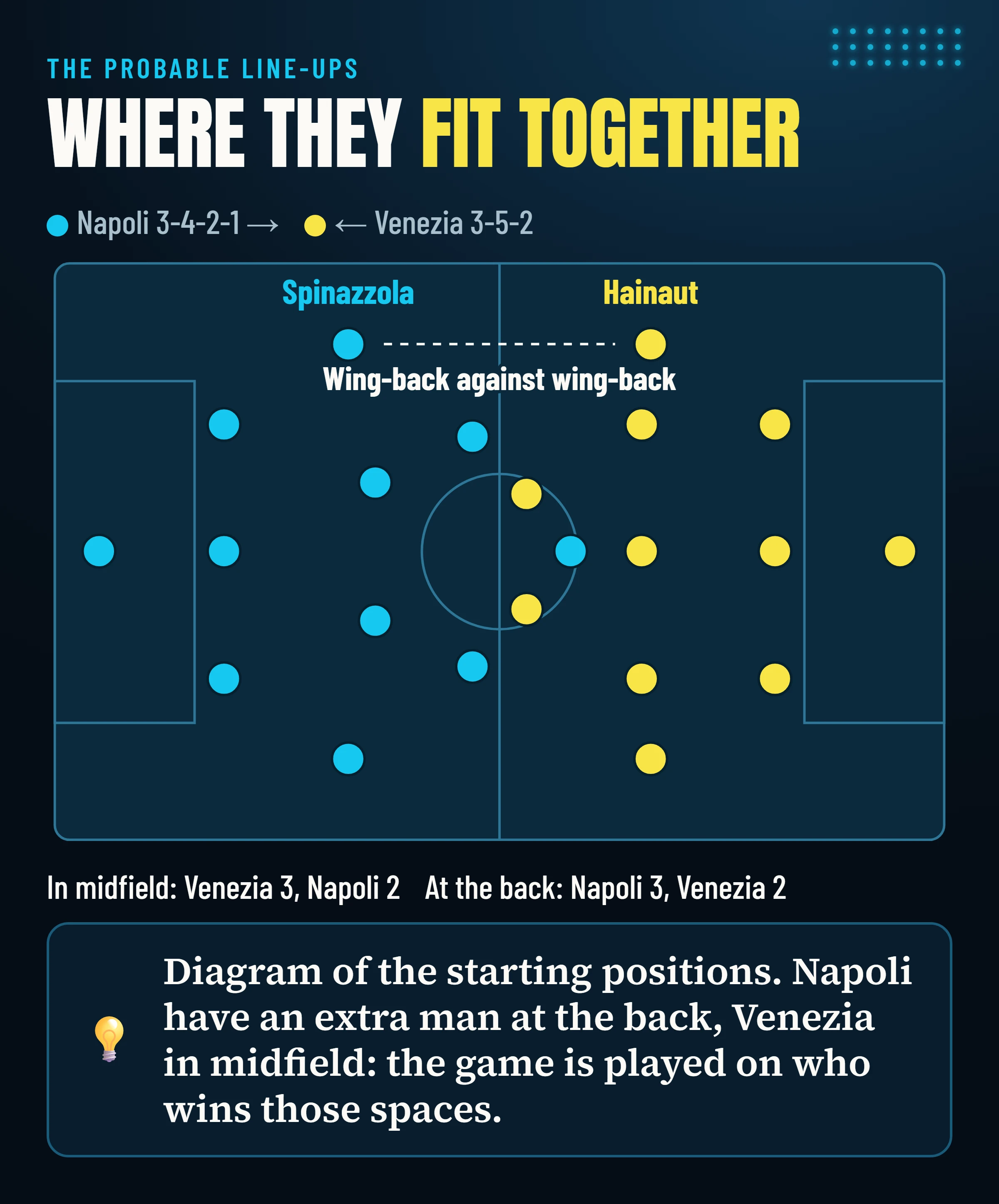
Note. This is a reading of the probable line-ups, not a measured figure: the official line-ups may change it.
What changes when Venezia fall behind
The moment Venezia start chasing comes early: in five games out of six they conceded their first goal by the 50th minute (in the 3rd against Atalanta, the 20th at Frosinone, the 28th against Fiorentina, the 45th against Lecce, the 50th against Lazio). Napoli scored first in six games, three times within 30 minutes.
At first sight Venezia defend higher in the second half (from about 31 to about 37 metres from their own goal). But it doesn’t depend on the break, it depends on the score. When level they defend at about 34 metres, when behind at about 41. It happens in all six games, and in the second half Venezia were almost always behind.
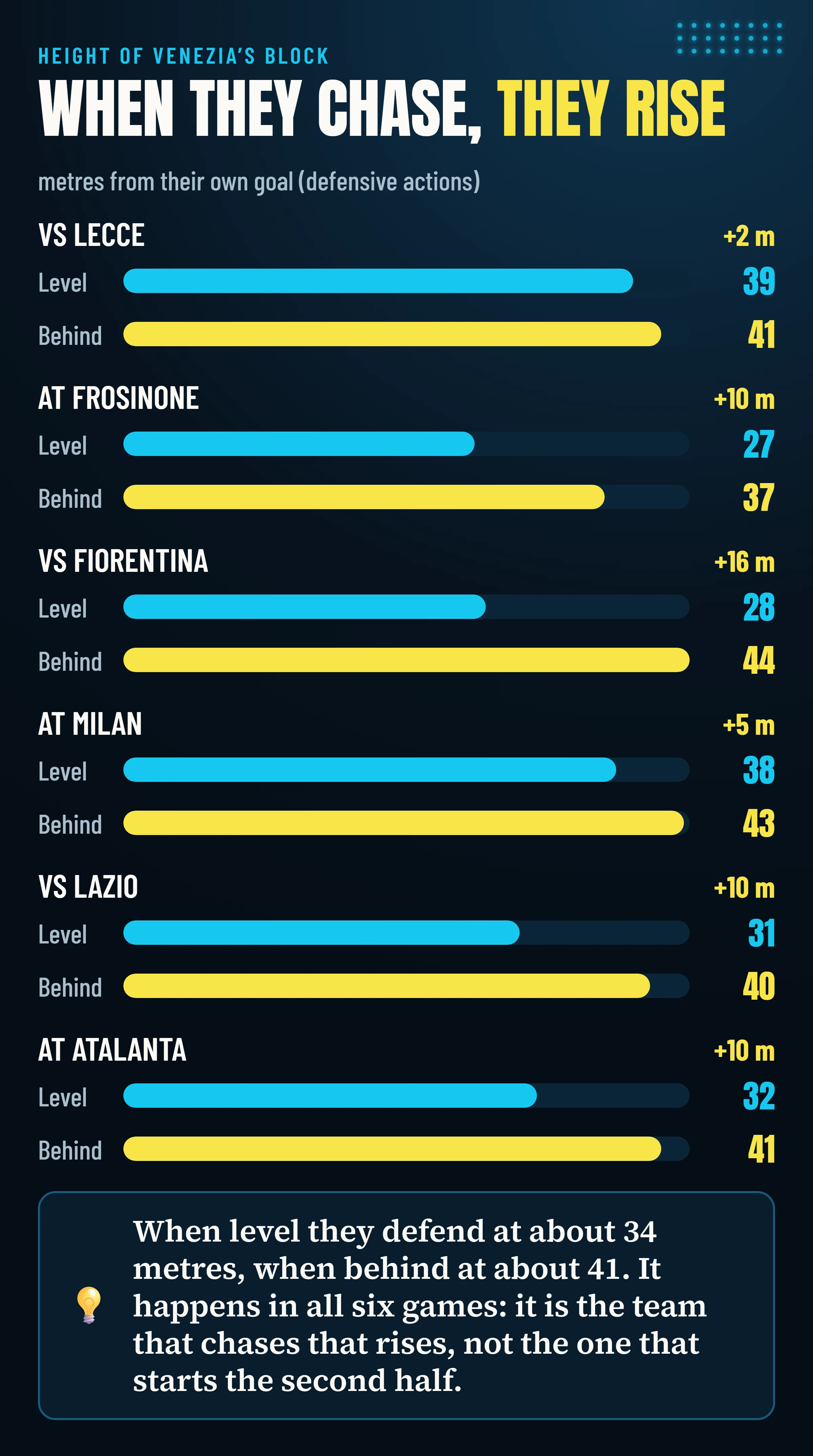
In practice, Venezia chasing the game rise by about seven metres. For Napoli it means the first goal changes the game: afterwards, there is more space behind the three centre-backs. Venezia have already paid for it: six of the sixteen goals conceded are real counter-attacks (one to nine seconds after the opponent’s ball recovery, with at most two passes), four against Milan and Atalanta. And it is no coincidence that Napoli’s two counter-attacking goals, at Genoa in the 86th minute and against Frosinone in the 93rd, came with the opponent chasing.
Live, after a possible Napoli goal, just watch the line of Venezia’s three centre-backs: if it moves close to the halfway line and the wing-backs stand on the edge of the box, space opens up in front of Meret to break forward.
Napoli after the first goal
Napoli have the mirror problem, and it concerns that very moment. They went ahead first in six games out of eight, but won three. We looked at what changes in their play after the goal, in the five games in which the lead lasted at least a quarter of an hour (at Genoa they scored in the 81st minute).
Against Inter, Napoli’s share of passes fell from 39 to 23% and they lost 3-2 after being two goals up. At Villarreal it fell from 57 to 39% and they lost. At Florence it dropped by eight points (from 56 to 48%) and they drew. Against Bologna and Frosinone, instead, it stayed steady (from 62 to 57% and from 50 to 51%) and they won.
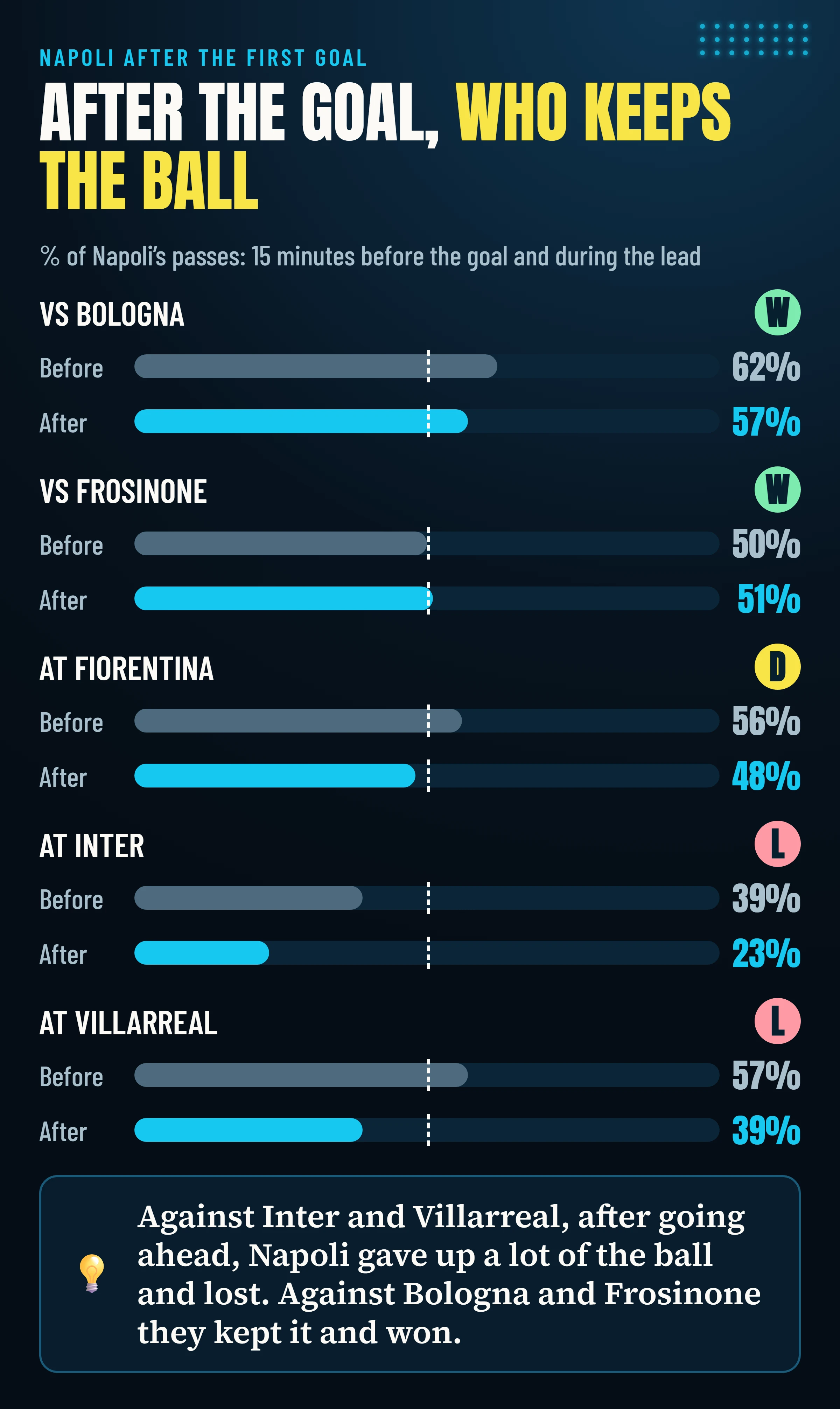
The meaning is simple: when Napoli go ahead and give up the ball, they don’t defend the lead, they hand it to whoever is attacking. That is why Corriere dello Sport suggests bringing Lobotka and Gilmour back in front of the defence, to keep possession. It fits another figure: Napoli have never lost when they had more than half of the passes.
Live, after a possible first goal, the signal is simple: do Napoli keep circulating the ball, even calmly, or do they drop back and wait? It is five games, so it is a tendency, not a rule.
Where it is decided: second balls
One last point, less visible. Three of Napoli’s eleven goals come from a rebound, after a saved or blocked shot (Inter, Frosinone, Villarreal). Three of the sixteen goals Venezia conceded came the same way, and six more from a defensive error or a cross.
This answers a question left open: Venezia don’t suffer only from counter-attacks. The decisive moment of nine goals out of sixteen is a rebound, a cross or an individual error, that is, a situation of confusion inside the box, where what matters is the position of the three centre-backs, the return of the wing-backs and alertness on the second ball. Napoli, who often score from a rebound, have an extra card.
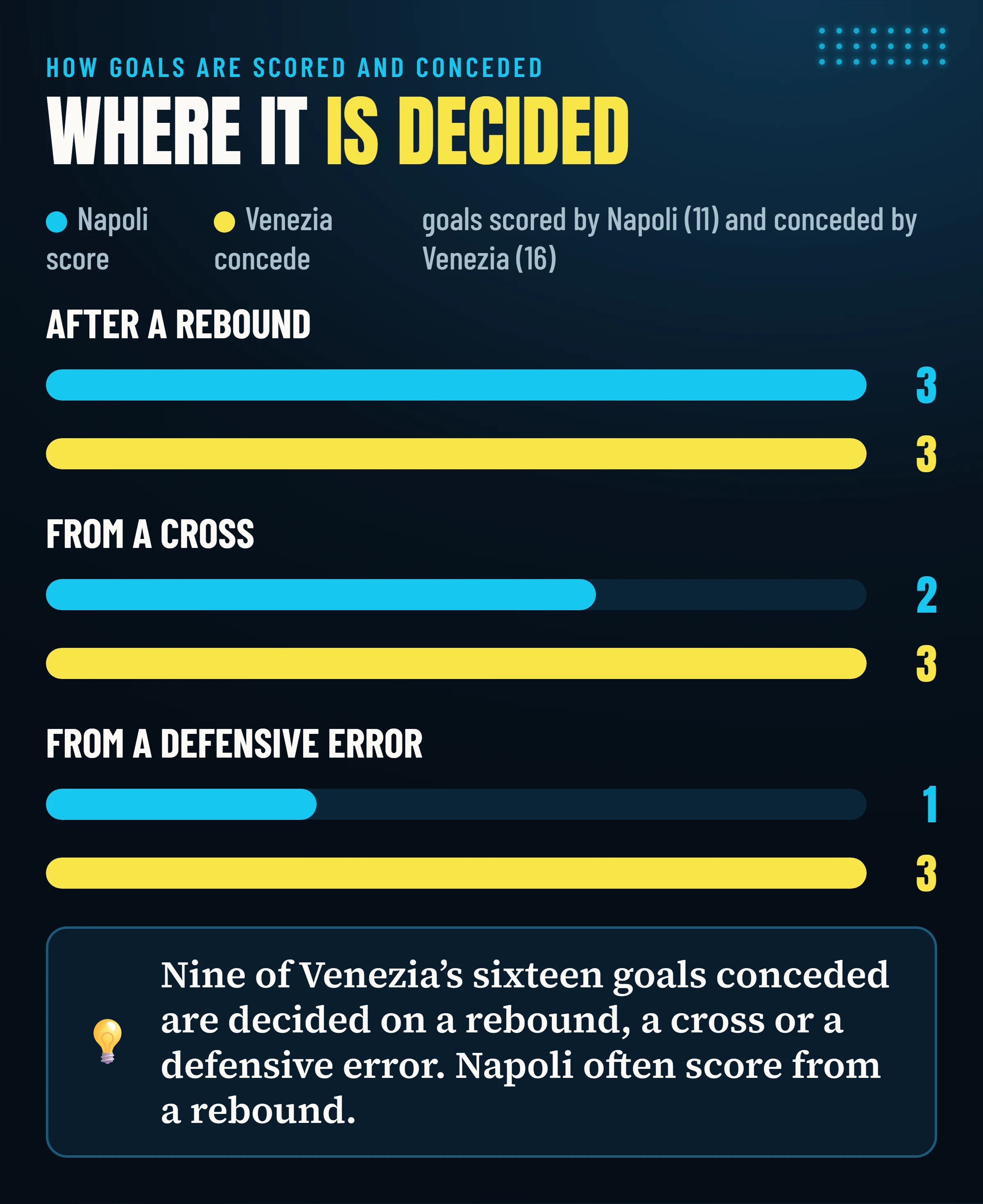
Live, after every saved or blocked shot, just watch who gets to the rebound first.
The four signals to watch on Saturday
The game after the first goal
If Napoli go ahead, Venezia rise and leave space: it will be up to Napoli to decide whether to use it, keeping the ball, or suffer it, giving the ball up as against Inter and Villarreal. If it is Venezia who go ahead, it is another story, because in six games they have never held a lead.
Venezia create but don’t score, and when they chase they leave space: the game depends on what Napoli do after the first goal.