
The game we expected never happens
The pre-match starting point was simple.
Tedesco's Bologna had collected only one point, but across the first three matchdays they had shown a team capable of building a lot: high passing volume, Ferguson constantly involved, progression toward the flanks and an increasing ability to keep the ball after beating the first line of pressure.
For Napoli, the issue therefore seemed to be mainly how much to allow.
Allowing a few passes between the centre-backs could be acceptable. Allowing Ferguson to receive freely and turn that first circulation into stable possession higher up the pitch was a different matter.
Instead, the game changes direction almost at its root.
Napoli do not simply leave the ball to Bologna and then choose where to defend.
They take the ball themselves. And they take the territory with it.
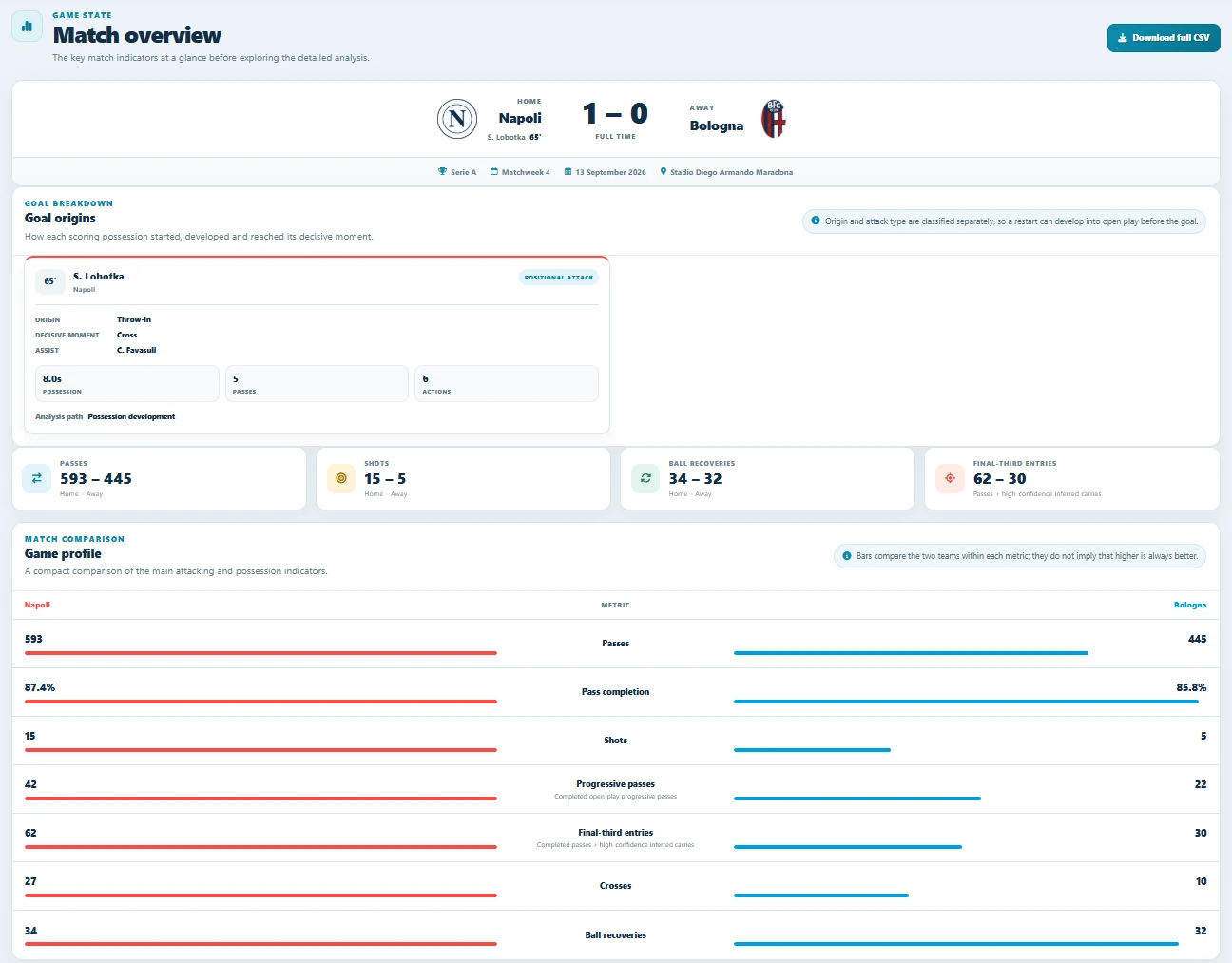
The external possession data close at 58% for Napoli and 42% for Bologna. But the real gap comes afterwards: 15 shots to 5, four big chances to none and 1.81 xG to 0.25. Napoli also produce 33 touches in the opposition box and ten corners; Bologna stop at 15 touches and do not win a single corner.
That matters because it prevents a misleading reading of the scoreline.
A 1-0 can suggest a balanced match decided by one moment.
Napoli do not just have more possession. They carry it much further forward
The Lab data point in the same direction.
In our model Napoli finish with 42 progressive passes to 22, 62 final-third entries to 30 and 27 crosses to 10.
That already reveals a fundamental difference from the Bologna seen in the previous matchdays.
Against Lazio, Atalanta and Sassuolo we had seen a team that could struggle to reach the final third directly from the first build-up, but often managed to beat a press, consolidate the ball higher up and restart from there.
In Naples, that chain breaks much earlier.
Bologna still have moments of circulation. They struggle to turn them into territory.
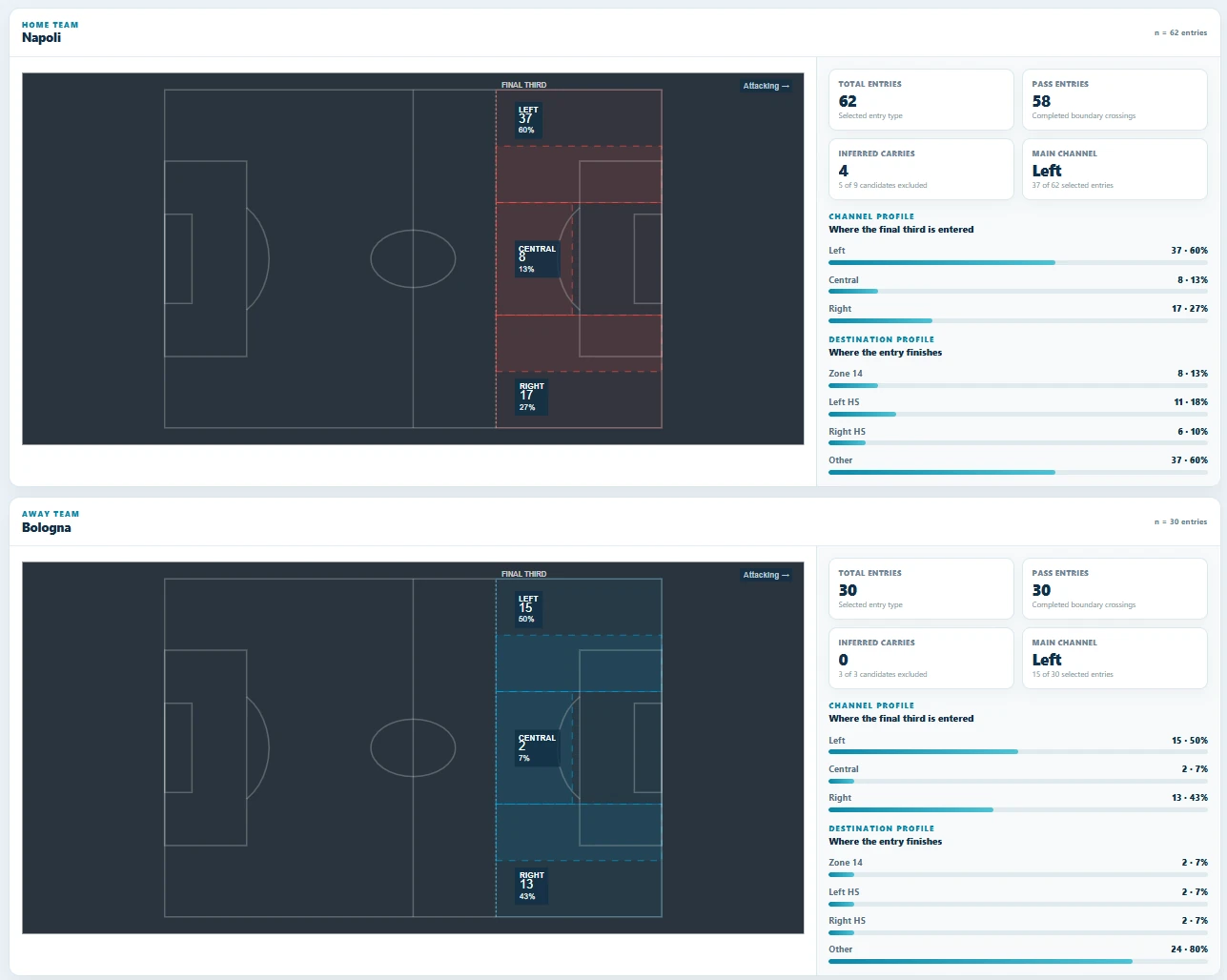
The map is particularly clear: 15 entries from the left, 13 from the right, only 2 through the centre.
Bologna can therefore reach the flanks. The heart of the pitch is almost always harder to access.
And that is precisely what reduces the value of their possession.
Moving the ball from one centre-back to the other is one thing. Receiving inside the opposition structure, turning and forcing the next line to react is another.
Napoli allow much less of the second.
Ferguson stays central. This time the possession stops there
This is perhaps the most interesting part of the comparison between pre- and post-match.
In the pre-match we built much of the analysis around Lewis Ferguson. Not because he was necessarily the player meant to play the final pass, but because he was often the player capable of changing the value of Bologna's possession.
First circulation. Ferguson. Next development.
The passing network had shown how present he was inside the main connections and how he could act as the hinge toward the strong side.
At the Maradona, Ferguson does not disappear. Quite the opposite.
He completes 61 of 65 passes, so he remains fully inside Bologna's passing volume.
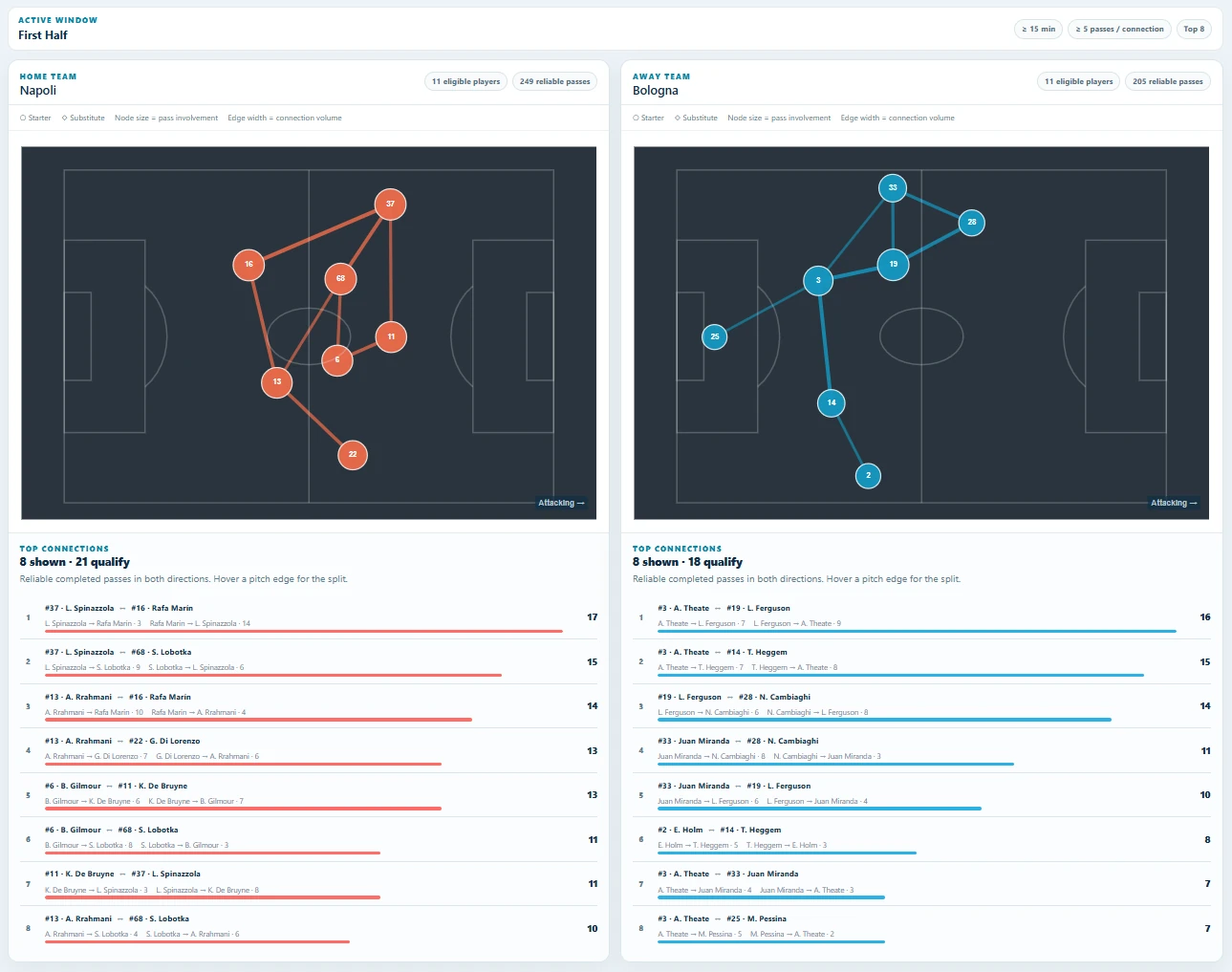
The point is that his volume produces much less.
Napoli do not necessarily need to stop Ferguson touching the ball. They need to stop him turning that reception into the pass that changes the situation.
For long stretches, they do.
Ferguson can receive. He can return the ball. He can help Bologna preserve their structure.
Far less often can he carry the possession into a phase where Napoli really have to drop and defend.
The crossing problem simply never develops
Before the game we had insisted on one idea.
The problem was not allowing one cross. It was allowing thirty.
Against Sassuolo, Bologna had produced 38.
Not all dangerous. Not all leading to a shot. Their value was in the repetition.
Cross. Clearance. Regain. New possession. New entry. Second ball. Another cross.
The longer a team can keep the opponent inside that sequence, the less it matters that the first situation was defended well.
In Naples that mechanism never really forms.
Bologna finish with 10 crosses.
From 38 to 10.
It is not only a quantitative reduction. One of the ways Bologna had shown they could turn possession into pressure almost disappears.
And this is where the week's context matters as well.
Four days earlier Napoli had faced Arsenal in the Champions League. In the pre-match we linked second actions to the clarity required by a schedule with a game every few days.
Not because a team must automatically be tired, but because repeatedly defending your own box demands successive decisions: step out or stay, follow or protect, jump onto the second ball or prepare for the next delivery.
Napoli find the best possible solution.
Managing energy also starts here. Not only by running less, but by having to defend the same situation fewer times.
When the game opens up, Napoli are much more dangerous
Napoli's control is not limited to organised possession.
One of the clearest differences appears exactly when possession changes hands and the structure temporarily breaks.
When Napoli lose the ball, Bologna take the transition into Napoli's half in 31% of cases, into the final third in 22%, into the box in 7% and as far as a shot in only 3%.

When the opposite happens and Bologna lose the ball, the numbers change completely.
Napoli reach the opposition half in 74% of situations, the final third in 55%, the penalty area in 13% and a shot in 12%.
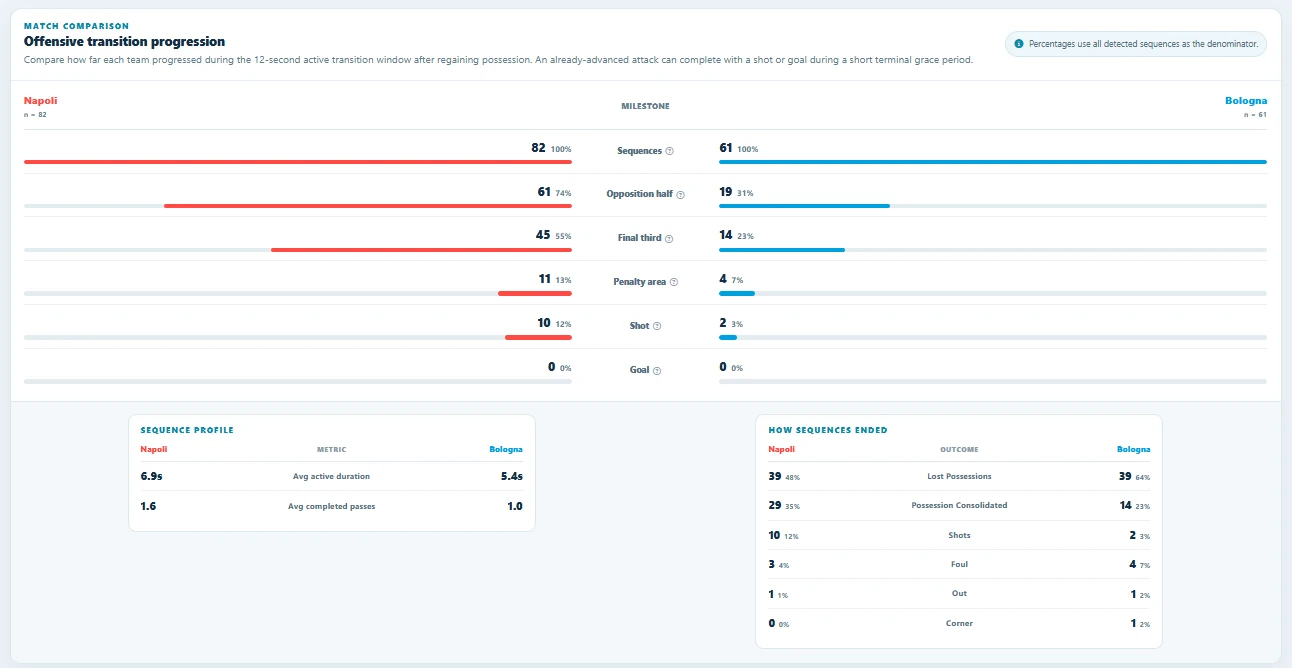
This confirms part of the pre-match idea, but not exactly in the way we expected.
We thought Napoli might accept some Bologna possession and then attack the moment Tedesco's side lost the ball with many players advanced.
That window exists. But Napoli do not need to build the entire game around it.
There is another significant figure: 66% of Napoli's defensive transitions end with a regain. Bologna fall to 47%.
The sequence therefore becomes almost the opposite of what we feared: not Bologna → cross → second ball → Bologna again, but often Bologna lose it → Napoli regain → Napoli advance.
The first half keeps the score open, not the direction
Going into half-time at 0-0 can hide some of what had already happened.
Napoli fail to turn their superiority into a lead, but they quickly push Bologna toward a game different from the one Tedesco would probably have preferred.
Højlund has two big chances before the goal and accumulates 0.63 xG on his own. De Bruyne repeatedly finds positions from which he can search for the final pass.
Bologna defend. They keep the score level. But they cannot use that resistance to progressively move the game in the other direction.
That is probably the difference between staying in the scoreline and staying in the game.
Bologna are always in the scoreline. Much less so in control of the match.
Allegri changes two players. Napoli change the tempo
At half-time Allegri intervenes without overturning the structure.
Noa Lang replaces Vergara and Costantino Favasuli replaces Politano.
It would be tempting to attribute everything that follows to the substitutions. That would be too simple.
Napoli had already set the direction of the first half.
But Lang and Favasuli add two new characteristics exactly where the game can still be pushed.
Lang gives Napoli a different reference on the left. He receives, carries the ball, forces the full-back to defend differently and gives Napoli a more natural presence in that zone.
Favasuli adds freshness on the right, but above all the ability to arrive high without breaking the team's balance.
The second-half numbers capture the change in intensity: after the break Napoli rise to 61% possession, produce 11 shots and win 8 corners.
This is not a second half in which Napoli, coming off the Champions League game, try to lower the tempo and manage.
The opposite happens.
It is after the break that the territorial superiority becomes more insistent. The goal arrives inside this phase.
The goal is not an isolated moment. It is the shape control takes
The minute is 66.
The move begins from a throw-in. Di Lorenzo and De Bruyne work the right side, the ball reaches Favasuli and his cross finds Lobotka inside the box. The midfielder attacks the space and finishes with his right foot.
The shot is worth around 0.40 xG, making it one of the highest-quality chances of the match.
In the Lab model the sequence is reconstructed as 8 seconds, 5 passes and 6 actions.
It is short. It is not sudden.
Napoli can push Favasuli that high because they are already playing consistently inside Bologna's half. They can send Lobotka into the box because the structure behind him allows the midfielder to leave his normal zone temporarily.
They can develop down the right because Bologna have already been forced deep for long enough to open the space for the next movement.
Lobotka scores, but De Bruyne is everywhere in Napoli's attacking game
The name that remains is inevitably Stanislav Lobotka.
He scores the goal and completes 57 of 62 passes, 43 in the opposition half, two key passes and one big chance created. The external source gives him an 8.8 rating, the highest of the match.
But reducing the post-match to an article about the scorer would miss too much.
In the Lab data another player keeps appearing whenever Napoli's possession begins to carry attacking meaning: Kevin De Bruyne.
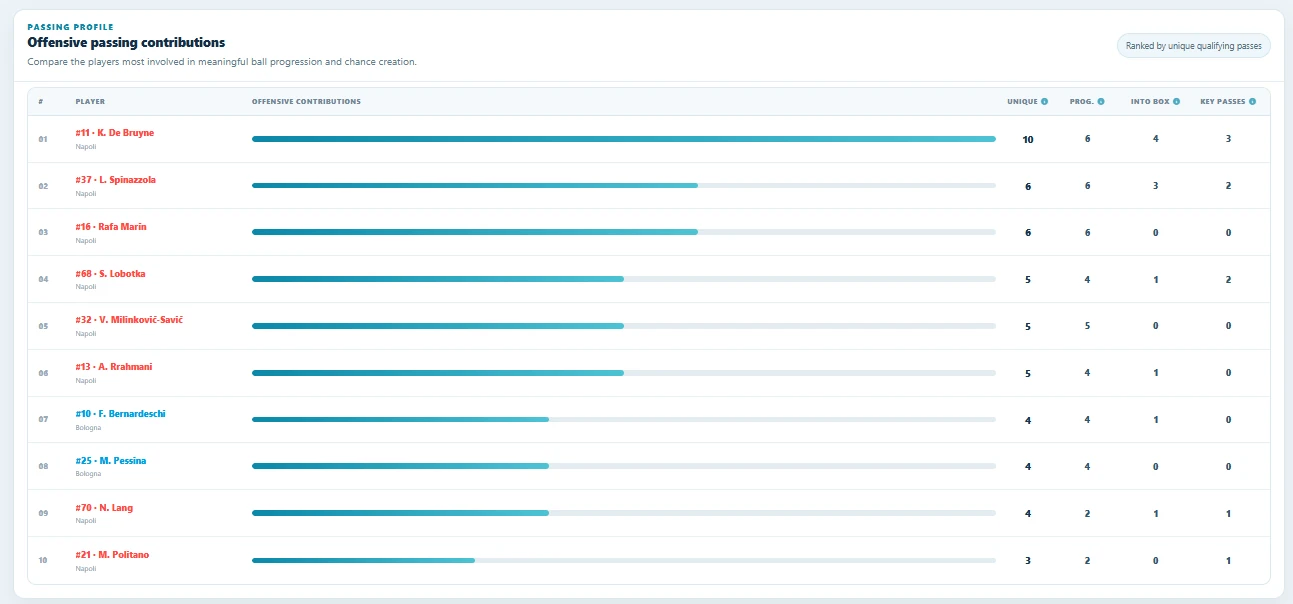
He is also the player most involved in sequences ending with a shot: 6 sequences, 3 shots and 3 passes immediately preceding a shot.
The external source adds four key passes overall, twelve crosses and 0.55 xA.
The combination of Lobotka and De Bruyne explains why Napoli's possession carries more weight.
Lobotka guarantees continuity. De Bruyne constantly tries to alter that continuity to create something.
One keeps possession alive. The other tries to make it dangerous.
On the goal, both functions end up inside the same move: De Bruyne takes part in the development, Lobotka arrives to finish.
Bologna stay in the 1-0, but cannot change the game
The scoreline inevitably creates risk.
A one-goal lead means a single incident can be enough. A deflection. A second ball. One badly defended cross. A set piece.
That is why it would make little sense to describe the ending as tension-free.
Tedesco tries to change the team, adjusts personnel and attacking occupation, and later brings on Enem and Mbangula to add fresh legs in the front line.
Bologna try to push higher. But they reach that stage after a match in which they have created very little.
Five shots. 0.25 xG. No big chances. No corners.
That is probably the right way to read the 1-0.
Napoli could have killed the game earlier. They do not, and that leaves them exposed to the natural risk of any one-goal lead.
But they do not spend the closing minutes defending against a Bologna side piling up chances.
Bologna remain alive because the score allows it, not because they manage to change the balance of the game in a lasting way.
The four questions, after the match
- Could Napoli screen Ferguson without constantly chasing the centre-backs?
Ferguson remains heavily involved and completes 61 of 65 passes, but his volume produces far less territory and chance creation than in previous matches.
Verdict: yes, in the tactical outcome. - Could Bologna turn their build-up into stable possession on the flanks?
They record 30 final-third entries to Napoli's 62 and only 2 come centrally. Crosses fall from 38 against Sassuolo to 10.
Verdict: no. - After regaining the ball, could Napoli beat the first counterpress?
Yes. Napoli's attacking transitions reach the opposition half, final third and a shot much more often than Bologna's.
Verdict: yes. - Could Bologna change the game by adding more attacking presence late on?
Tedesco changes personnel and tries to increase the attacking weight, but Bologna finish with 5 shots, 0.25 xG and no big chances.
Verdict: no.
Not all possession is worth the same
That was the title of the pre-match.
After the game, it is probably still the best way to close the loop.
Only the meaning has changed.
Before Napoli–Bologna we were looking mainly at Bologna's possession. The question was whether Allegri would accept giving it up and how dangerous it would become once it passed through Ferguson and reached the flanks.
The match gives a different answer.
Napoli do not simply allow that possession. They have more of it.
More importantly, they use it better.
They turn it into progression more often. They carry it into the final third more often. They support it with more players inside the box.
When they lose it, they regain it better. When they win Bologna's ball, they advance more easily.
And when the goal arrives, it does not come from a moment detached from the rest of the match. It comes from a Napoli side already established high up the pitch, able to move Bologna to one side, free Favasuli and send Lobotka into the decisive space.
That is probably the most important point of the 1-0.
Bologna keep Ferguson and part of their circulation. They lose almost everything that circulation had produced in the previous weeks.
Napoli, by contrast, connect possession, territory, transitions and chance creation inside the same performance.
The scoreline stays narrow.
The story of the match much less so.