
The result says little about the volume produced
Three matchdays, one point. Taken alone, that would suggest a Bologna side still searching for its identity.
The opening matches tell a more complex story.
Against Lazio, Atalanta and Sassuolo, Tedesco’s side completed 1,804 passes to their opponents’ 1,246 and produced 51 shots to 31. Even in the first two defeats they had more of the ball and more attempts than the opposition.
Yet the return remains minimal.
That contrast is the first thing to keep in mind for Napoli–Bologna: Bologna’s volume of play does not yet match their ability to turn it into results.
Building does not yet mean progressing
The first build-up data help separate two concepts that are often blended together.
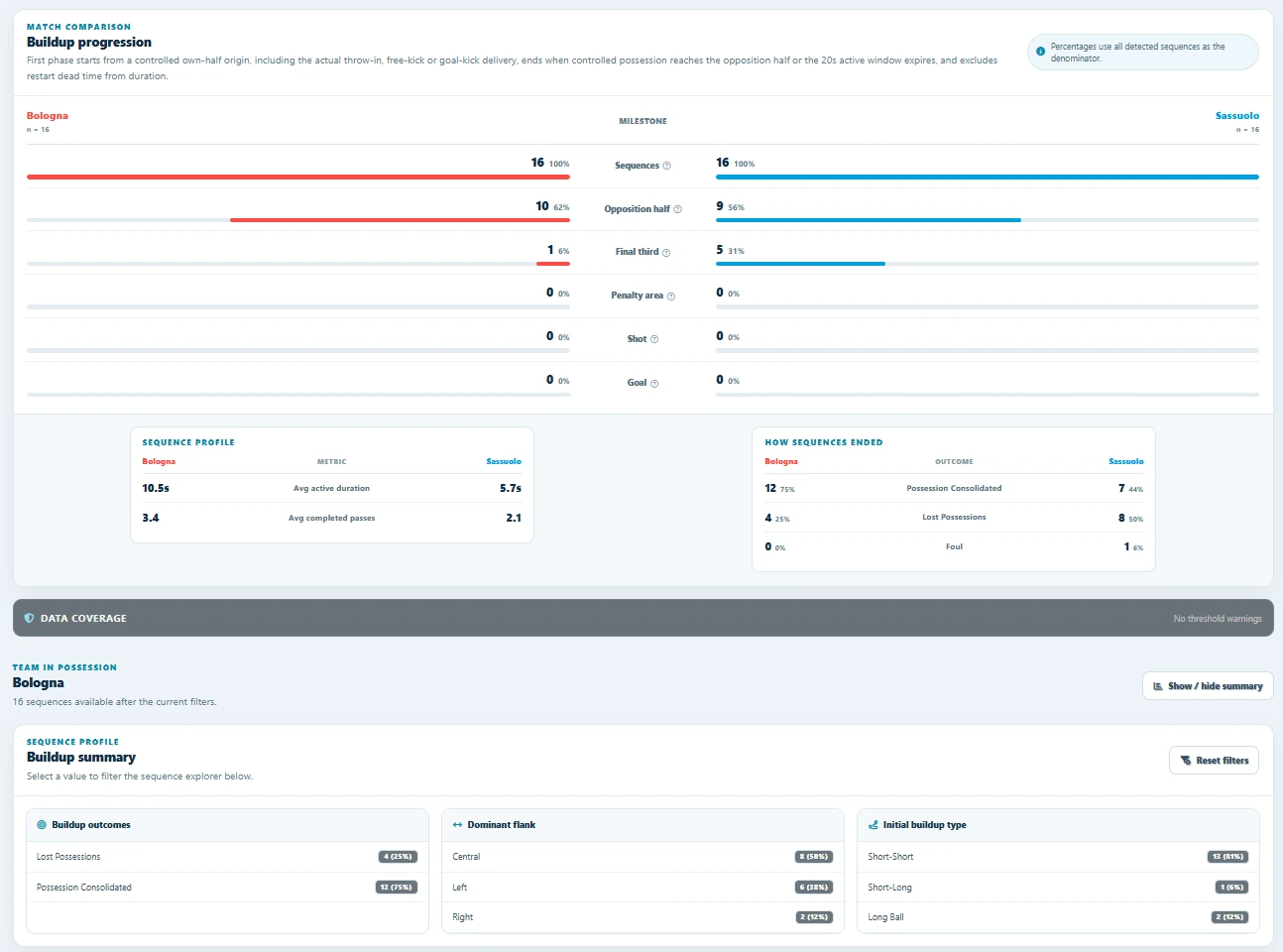
Against Lazio, Atalanta and Sassuolo, only 6% of the analysed build-up sequences reach the final third directly. The percentage is identical in all three matches.
What changes sharply is what happens before that point. Bologna end with controlled possession in 47% of the sequences against Lazio, 61% in Bergamo and 75% against Sassuolo.
The rise therefore does not describe a team going straight from its own box to the opponent’s goal. It describes a team increasingly able to beat the first pressure, stabilise the ball a few metres higher and start again from there.
The match in Bergamo is perhaps the clearest example: Bologna reach 704 passes and shoot 16 times to 6, while final-third entries remain broadly even.
Ferguson changes the value of possession
Between circulation still far from goal and an attack capable of moving the opposition block, Lewis Ferguson appears constantly.
Across the first three matchdays he attempts 332 passes, completing 307. In Bergamo he reaches 125 attempts, against Sassuolo 122.
But volume alone says little. It is mainly the position Ferguson occupies in the structure that makes him interesting.
Against Lazio he is Bologna’s best progressor with 7 progressive passes completed from 11 and 96 metres gained. Against Atalanta that rises to 10 from 12 and 186 metres.
Against Sassuolo he receives 100 times, with 20 receptions in the final third, only 2 in the box and as many as 14 different team-mates finding him.
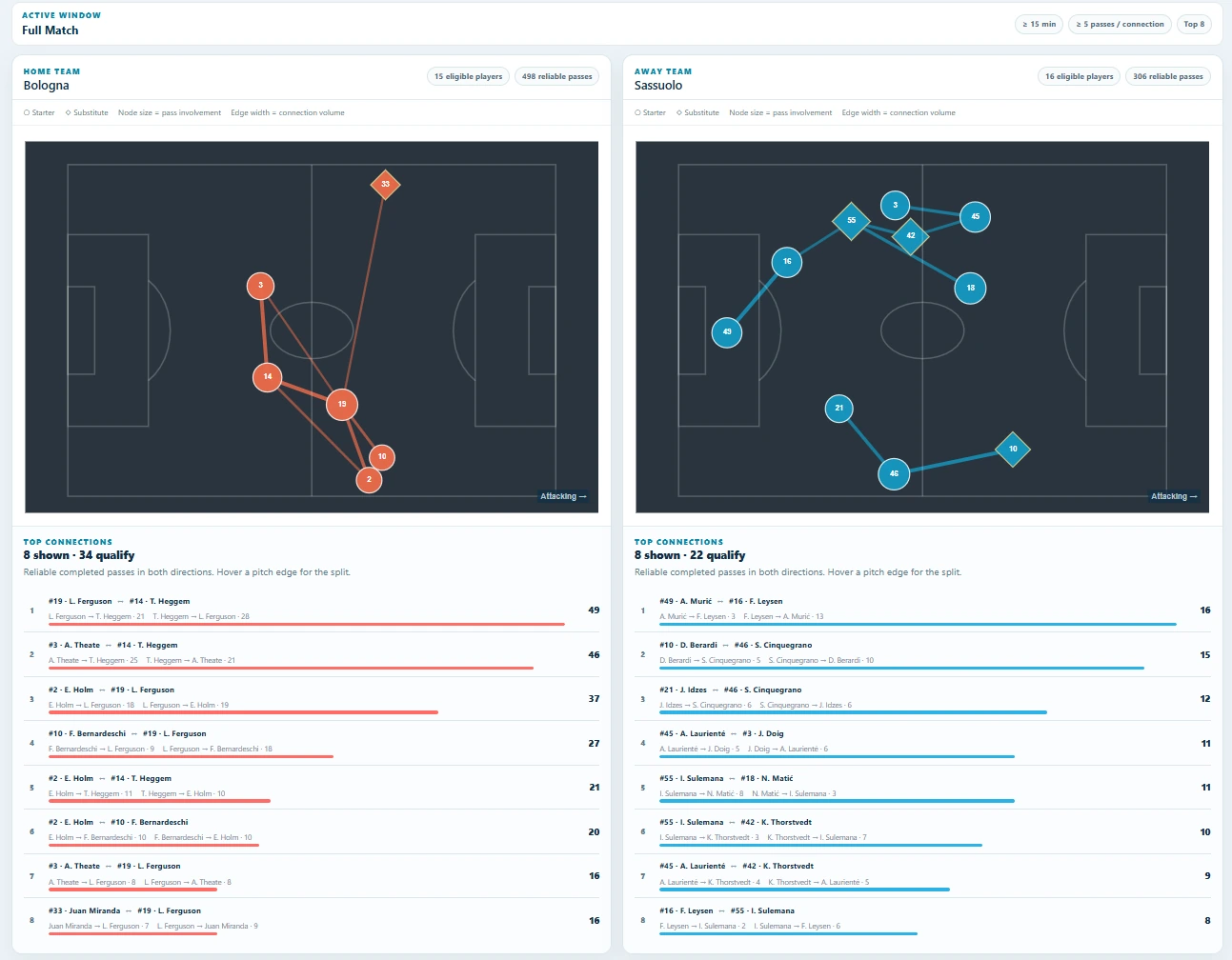
The pass network makes the principle very clear: Ferguson–Heggem 49, Holm–Ferguson 37, Bernardeschi–Ferguson 27.
Team-mates, positions and attacking directions change. Ferguson remains in the middle.
There is no need to chase the centre-backs immediately
Against a team that wants to build from the back, the intuitive solution would be to push the pressure straight onto the first defenders.
But Bologna look comfortable keeping possession on the first line, and Ferguson constantly offers a solution ahead of it.
If Napoli send a player onto a centre-back but leave the passing lane behind him free, the press can create the opposite effect: it releases precisely the player who can turn that first circulation into progression.
For Allegri it may therefore be more useful to guide rather than chase: allow some passes between the defenders, screen Ferguson, direct the ball towards a flank and choose that moment to increase the pressure.
The flank matters more than the side
Once the first build-up is beaten, another feature appears: Bologna repeatedly look for the flanks, but not always the same one.
Against Lazio they record 40 final-third entries, 21 from the left: 52%. In Bergamo there are again 40, with 24 from the left: 60%. Against Sassuolo the picture flips: 61 entries, 33 from the right, 54%.
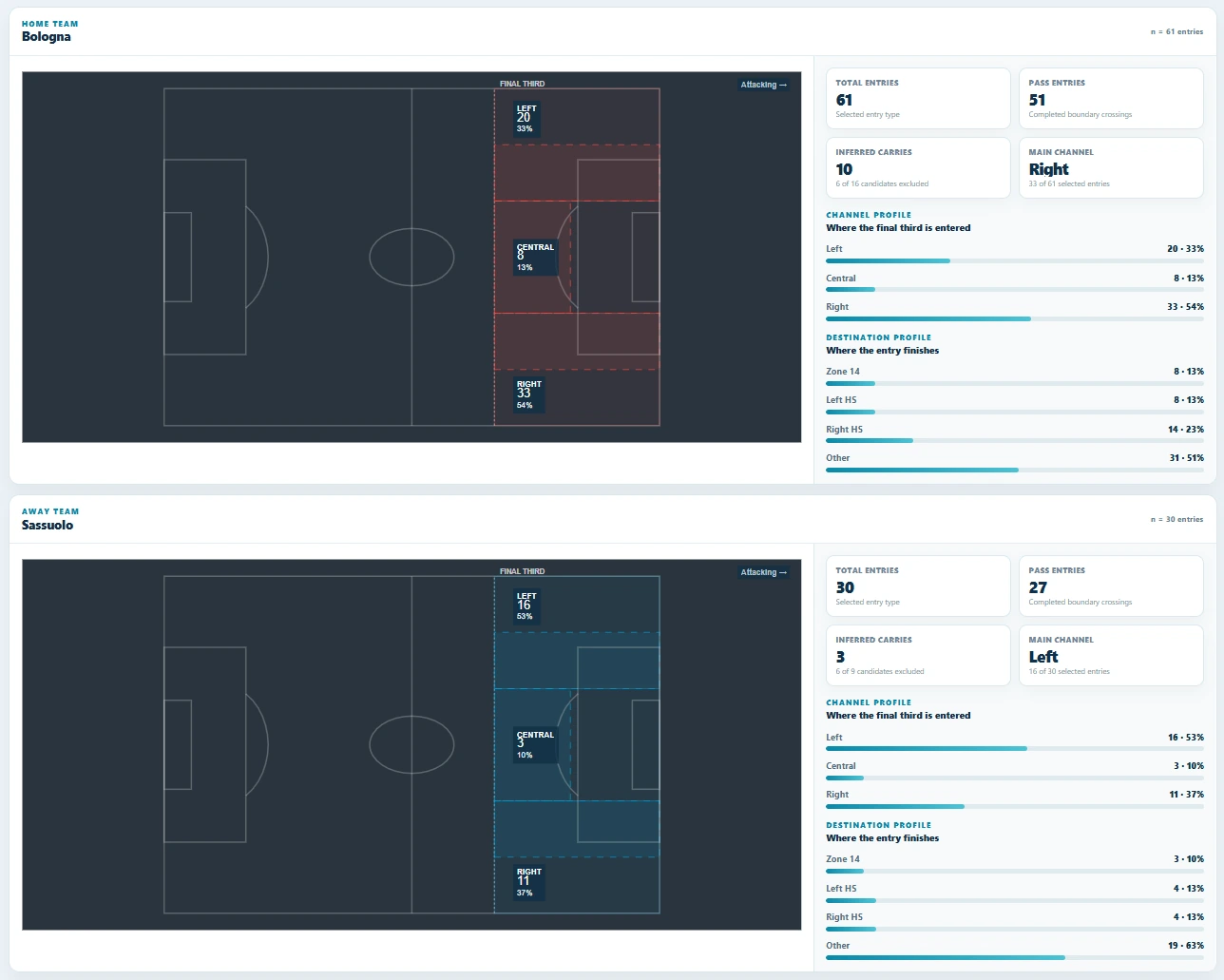
It would therefore be wrong to prepare for a Bologna side that is simply left- or right-oriented.
The constant is not which flank. It is reaching a flank after possession has been consolidated.
Against Sassuolo the progressive passes follow the same direction: 57% of the attempts start on the right, with Bernardeschi the team’s best progressor at 9 completed from 13 and 138 metres gained.
The danger grows when Bologna can stay there
This is where allowing possession can start turning into allowing control.
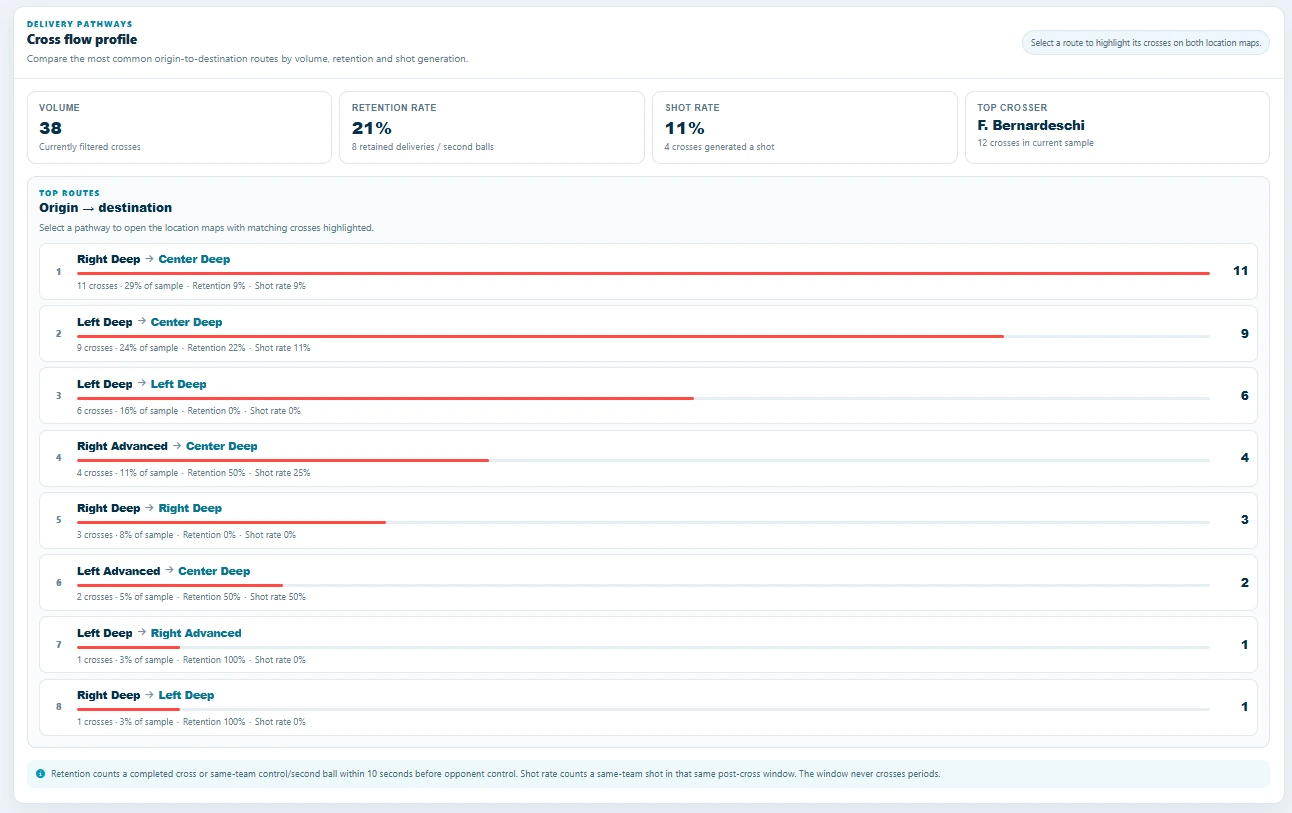
Against Sassuolo Bologna enter the final third 61 times and produce 38 crosses. Bernardeschi alone delivers 12.
The immediate return from those crosses is not devastating: 21% retention and 11% shot rate in the analysed window. So the individual cross should not automatically be treated as an emergency.
The problem can come afterwards.
Cross. Clearance. Bologna recovery. Another switch. Second entry. Another cross.
A team can defend the first ball perfectly and still find itself increasingly close to its own goal. The longer Napoli remain pinned back, the more the match stops being one defensive situation and becomes a sequence of situations to defend.
That detail may matter even more in the current context. Napoli come into this game after the Champions League match against Arsenal and return to the pitch only a few days later, in a run of closely spaced fixtures. That does not automatically mean fatigue. It means that repeatedly defending your own box also demands clarity on the second action.
Every second ball requires another decision: step out or hold, follow the man or protect the zone, squeeze up or prepare for the next cross. The longer Bologna keep Napoli inside that cycle, the greater the risk that a distance is read a fraction late or that a clearance does not really end the attack.
It is precisely when Bologna send many players forward that something can open up
Bologna should not simply be described as a team vulnerable in transition.
In the first two matchdays they regain the ball immediately in 57% of defensive sequences against Lazio and 54% against Atalanta. The first counterpress works.
Against Sassuolo, however, immediate regains fall to 45%. And when that first pressure is beaten, the picture changes: 30% of opponent transitions reach the final third, 13% enter the box and 13% end with a shot.
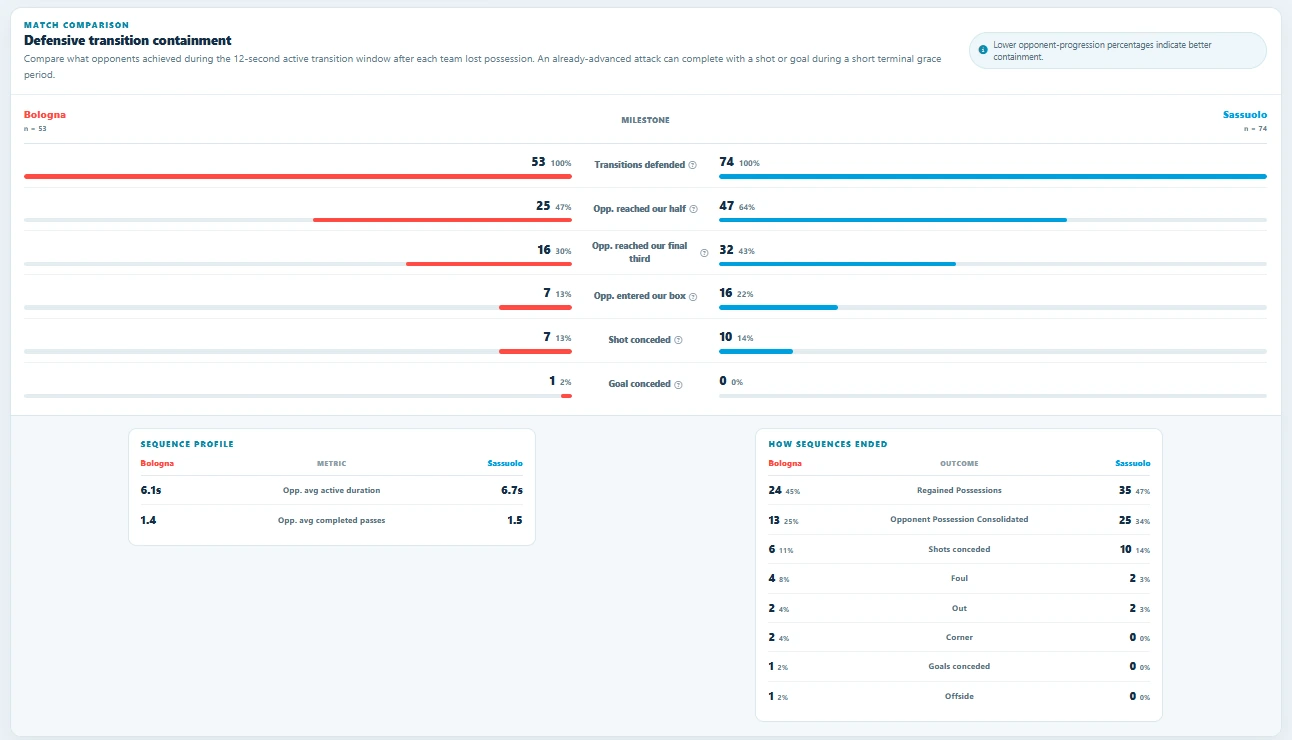
It is also the game in which Bologna reach their most aggressive territorial occupation: 61 final-third entries, 38 crosses and PPDA 7.71.
That is not enough to establish an automatic causal relationship. But the logic is coherent: the more players are sent above the ball, the greater the reward can become for the team that beats the first pressure after the regain.
For Napoli the decisive action can be very simple: regain → first pass out of pressure → free player ahead → acceleration.
Against Arsenal there was already a glimpse of this behaviour: in the 61st minute Olivera regains possession and immediately looks for Højlund in behind; seconds later the striker gets a shot away. Against Arsenal those situations were too rare to become a game plan. Against Bologna they may appear more often.
After an hour, a second match can begin
There is one final element to consider.
Against Sassuolo, in the 65th minute, Tedesco replaces Cambiaghi with Dovbyk. Bologna move into a 4-4-2 with Piccoli and Dovbyk together.
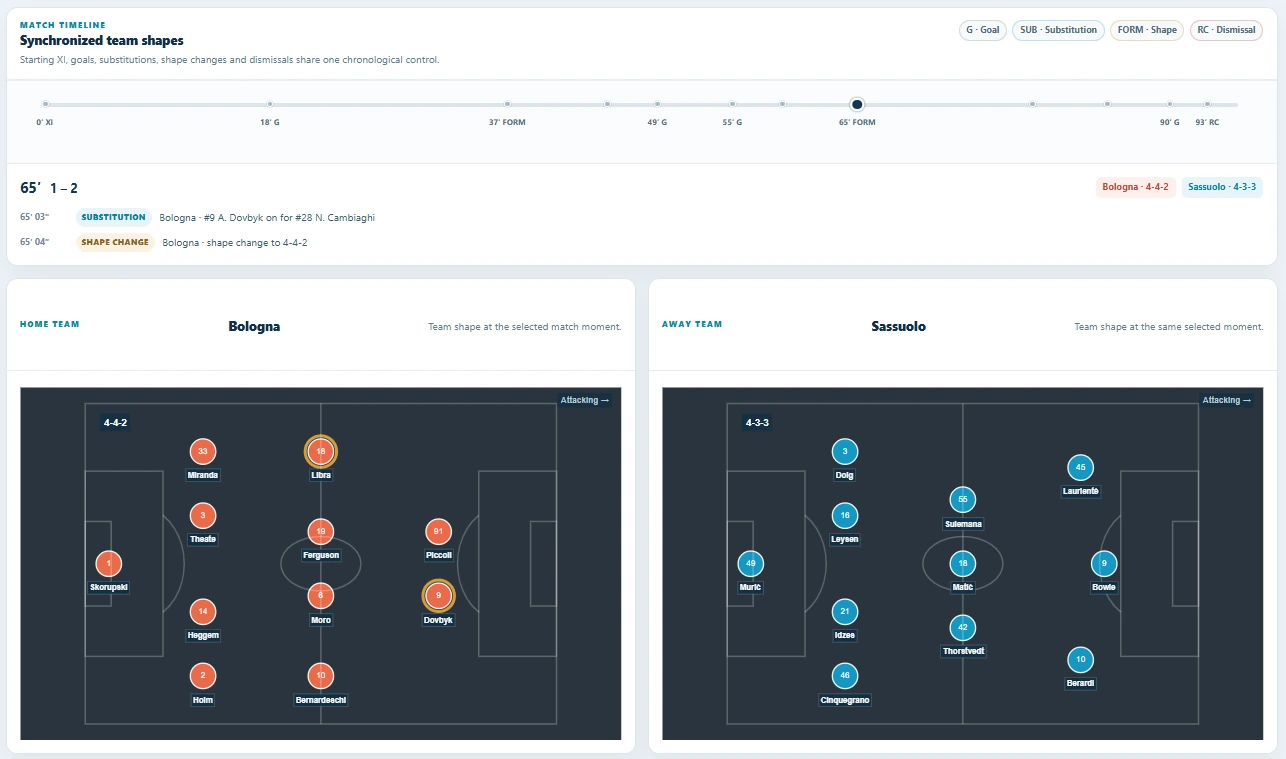
The change alters the type of threat: box occupation rises, wide deliveries gain value and clearances and second balls become even more important. Dovbyk later scores the 2-2.
For that reason, if Napoli are ahead, they cannot simply keep dropping and rely only on density in front of goal.
With two central references, allowing repeated crosses means giving Bologna exactly the kind of game they are looking for.
Not all possession is worth the same
Bologna arrive in Naples with only one point, but with enough signals to deserve much more attention than the table suggests.
Tedesco is building a team that wants the ball. But the value of that ball changes during the move.
A pass between the centre-backs is not worth the same as a free Ferguson reception. A Ferguson reception is not yet worth the same as a clean entry on the flank. A cleared cross is not worth the same as a second ball recovered by Bologna in front of the box.
It is on those differences that Allegri can build the match.
The four things to watch
- Can Napoli screen Ferguson without constantly raising the pressure onto the centre-backs?This is the first test: whether Bologna can connect the first build-up to the next phase with ease.
- Can Bologna turn the first build-up into stable possession on the flanks?Having the ball deep is not enough. The difference will be whether they can settle higher and produce entries, crosses and second actions.
- When Napoli regain the ball, can they beat the first counterpress?Bologna often win it back immediately. If that first pressure is beaten, much more interesting spaces can open.
- If Tedesco moves to two strikers, can Napoli defend without sinking permanently?Piccoli and Dovbyk together change the weight of the box and make control of crosses, clearances and second balls even more important.