
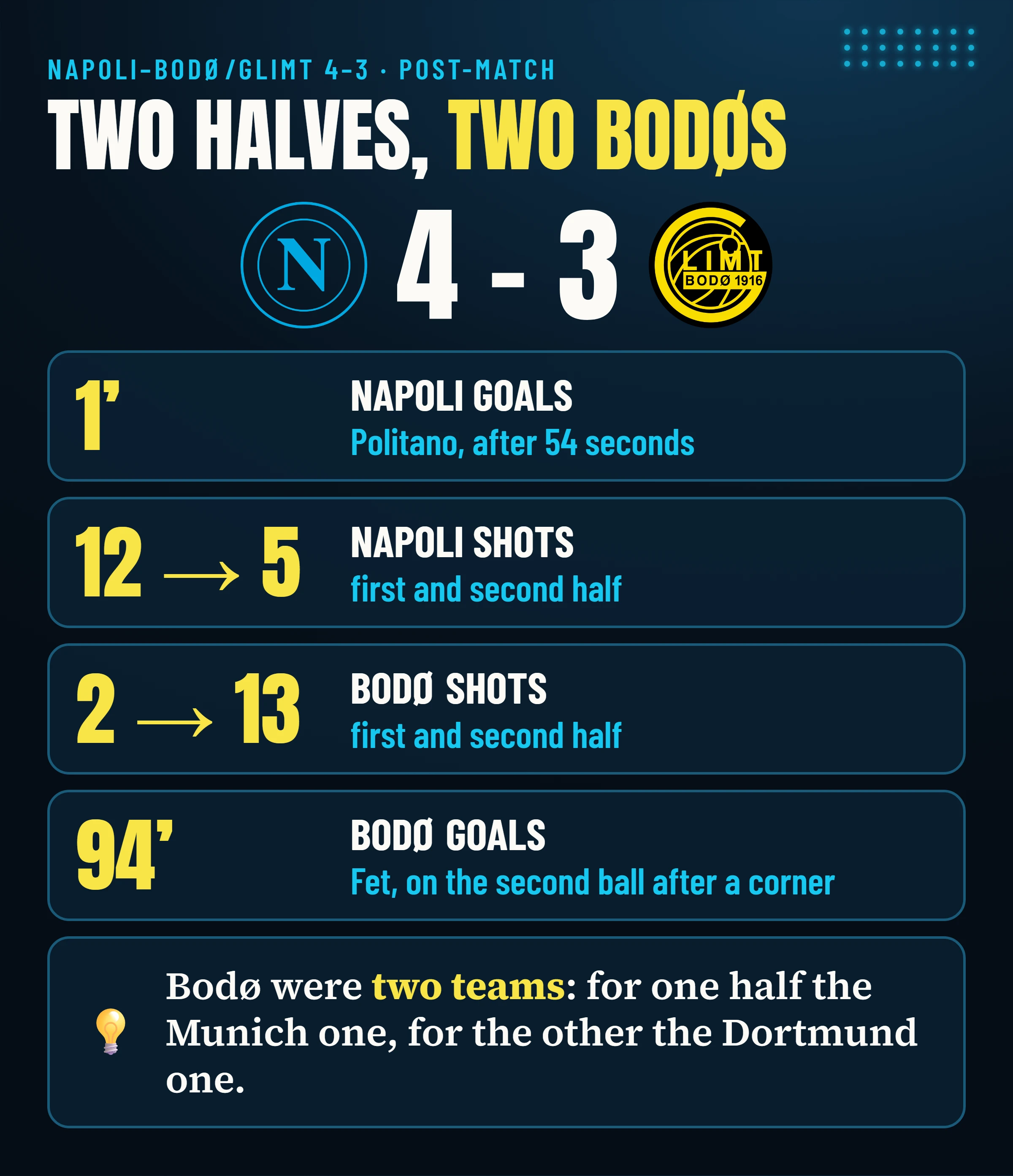
Napoli came into the third matchday of the Champions League on zero points and with five defeats in nine games. Shortly before kick-off, sporting director Giovanni Manna had said that the coach was “absolutely not in question”. In the end Napoli won 4-3, their first European win of the season: two goals from McTominay (8), one from Politano (21) and an own goal from Bjørtuft (4), with Bodø also scoring in the 94th minute.
In the pre-match we wrote that the game depended on a question no data could answer: which Bodø turns up in Naples? In the Champions League we had seen two, the Munich one, defending 24 metres from their own goal, and the Dortmund one, pushing up to 44. Both of them turned up, one per half. And, reading the numbers, it was not Knutsen who decided it but Napoli. Let us try to understand how, and re-read the pre-match predictions one by one: some were right, others not.
The 4-3-3 we had not predicted
Let us start with a mistake of our own. On the pre-match tactics board we had drawn a 3-4-2-1 Napoli, the one indicated by Sky and by recent games, and we had written that McTominay (8) could start on the bench. Allegri fielded a 4-3-3, with McTominay starting and De Bruyne (11) in front of the defence as the deep-lying playmaker, between McTominay and Anguissa (99), who was back on the pitch for the first time since 5 September. The Norwegian press called it an “unexpected” move.
Allegri explained it to Sky after the game: “De Bruyne is an extraordinary player. I told him he would enjoy playing in front of the defence a lot. He is a player who has both the short pass and the long one”.
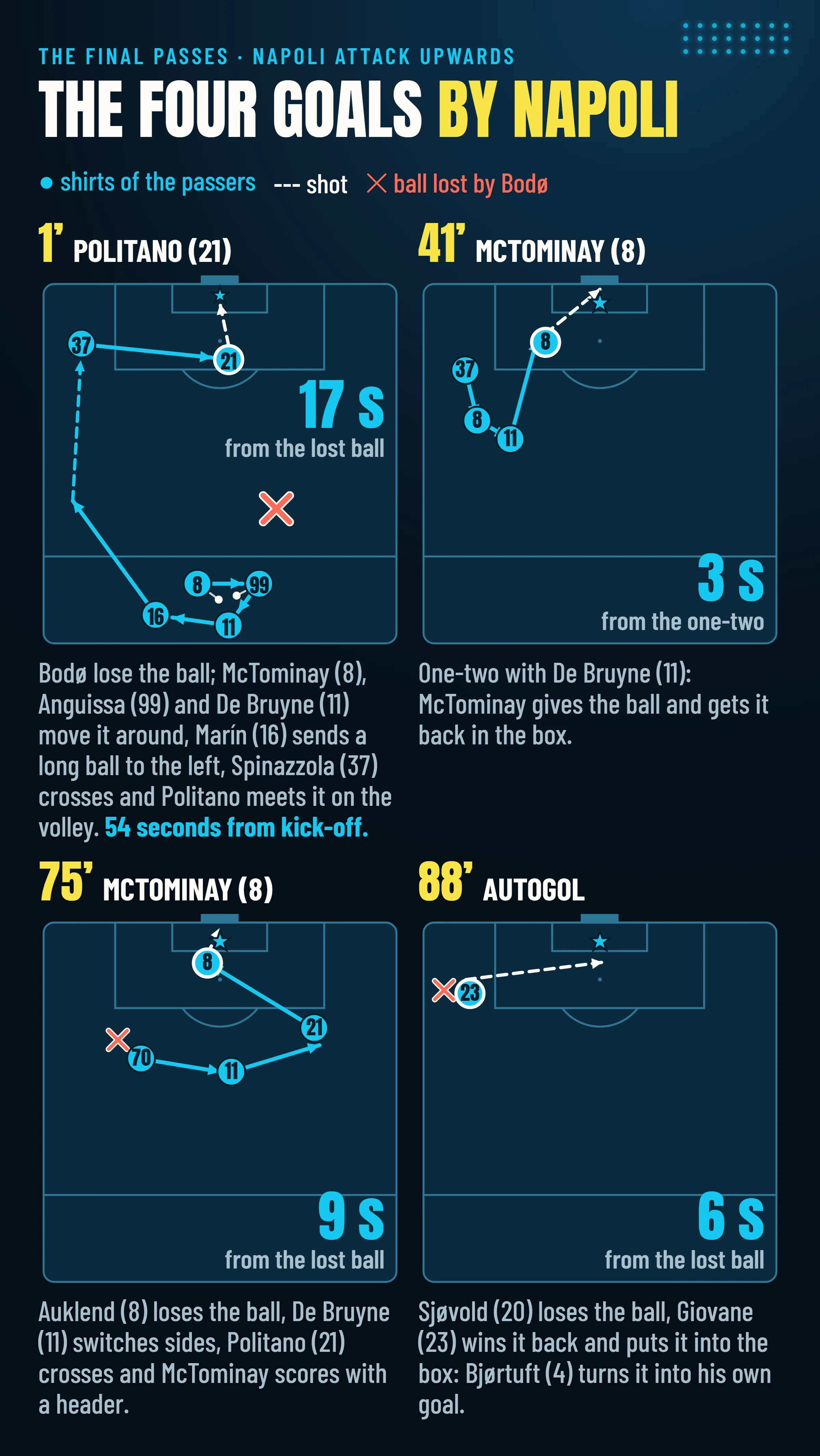
It worked straight away. After 54 seconds Napoli are already ahead: Rafa Marín (16) sends a long ball to the left, Spinazzola (37) crosses and Politano (21) meets it on the volley in the middle of the box. Seventeen seconds earlier Bodø had lost the ball in their own half. Among the games we have analysed, it was the second time, after Munich, that Bodø conceded first.
The tactics board, with the real positions
In the pre-match we had drawn a tactics board with three points of contact: three against two at the back, Napoli’s right flank and four against two in the middle. This is the same board with the real positions, for the hour in which the same eleven that started the game were on the pitch, from the 1st to the 60th minute. Each circle is a player, with his shirt number, and sits where he touched the ball or made an intervention most often. Napoli, in blue, attack upwards; Bodø, in yellow, are drawn rotated, so the two teams face each other. The three zones are the lanes: Napoli’s right, centre, Napoli’s left.
A clarification. These are average positions of touches and interventions, not where the players stand when the ball is elsewhere, and two circles close together do not prove that the two marked each other. That is why we look at the lanes and at who closed down whom: we count a ball as “pressed” when it is followed by an opposing intervention within 6 seconds and 10 metres.
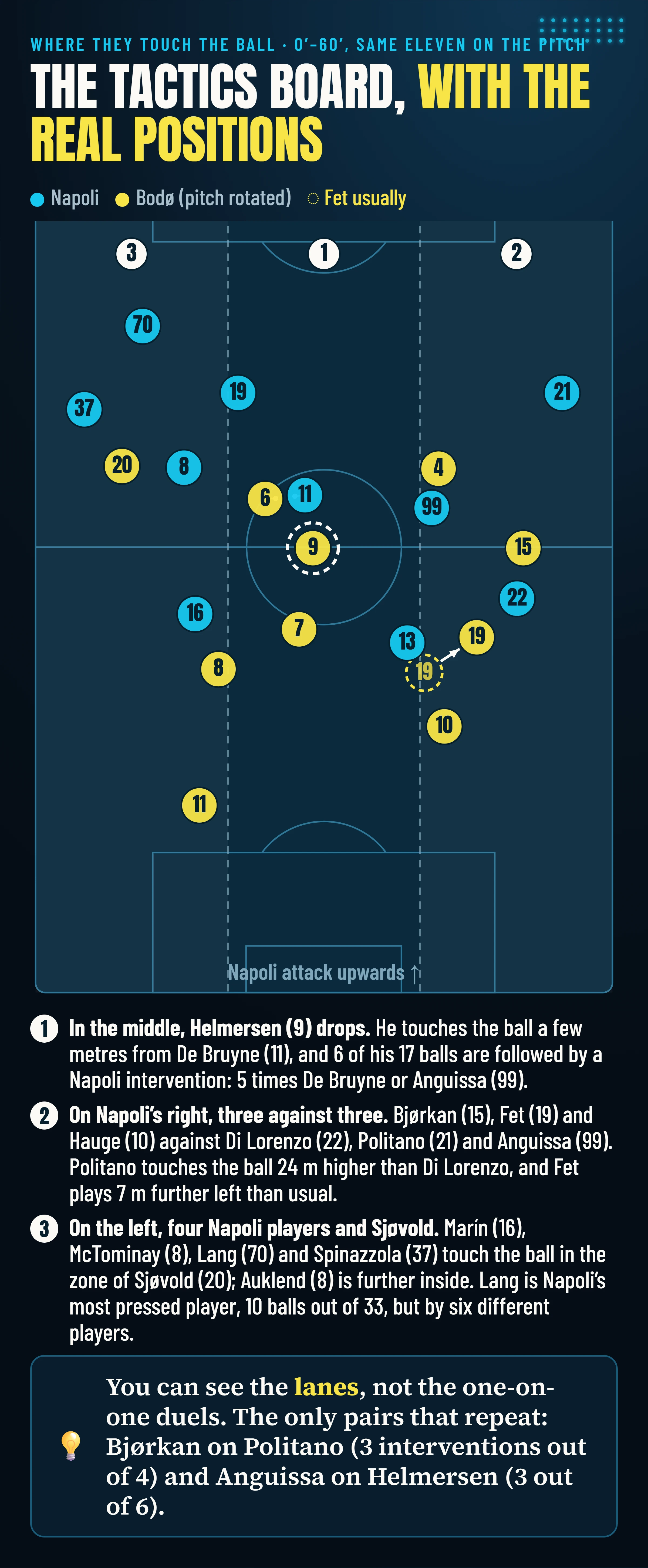
Look at it from above, one lane at a time.
In the middle, a striker who drops. Helmersen (9) touches the ball a few metres from De Bruyne (11) and Gundersen (6): it is Bodø coming to fetch the ball, not the centre-forward waiting. Napoli shut him down: 6 of his 17 balls are followed by an intervention, 35%, against 7% for his team-mates, and five times it is De Bruyne or Anguissa (99). The four against two in the middle, on the other hand, never materialised: Napoli played with three midfielders, De Bruyne in the centre and McTominay and Anguissa in the half-spaces, and Bodø had Berg (7) in the middle and Fet (19) shifted to the left.
On Napoli’s right, three against three. This is the pre-match point that held up. Di Lorenzo (22), Politano (21) and Anguissa (99) face Bjørkan (15), Fet (19) and Hauge (10), who touch the ball in the same lane. Politano plays very high, 24 metres further up the pitch than Di Lorenzo, and wide as always: 7 metres from the touchline, as in the other games. Bodø made four interventions on him, three of them by Bjørkan. Fet, on the other hand, is not where he usually is: he plays 7 metres further left than in the other games, with a normal variation of 2. It is the lane from which Bodø entered the final third most, and from which two of their three goals come.
On the left, four Napoli players and Sjøvold. Marín (16), McTominay (8), Lang (70) and Spinazzola (37) touch the ball in the zone of Bodø’s right-back, Sjøvold (20); Auklend (8) plays further inside. McTominay is 14 metres further left than usual, although the comparison is on only three games. Lang is Napoli’s most pressed player, 10 balls out of 33, but the interventions come from six different players: Fet three times, Sjøvold and Auklend twice each. It is the side from which Napoli entered the final third most, 27 times out of 40.
The verdict is partly right. The lanes can be seen: each team loaded its own left, Napoli with four players and Bodø with three, and the two left sides made the game. The one-on-one duels cannot: no player was always shut down by the same opponent. The only pairs that repeat are Bjørkan on Politano (3 interventions out of 4) and Anguissa on Helmersen (3 out of 6), small numbers.
The Munich Bodø
From there, for almost the whole first half, Bodø are the Munich side. Their first shot of the game is the equalising goal, in the 27th minute: until then twenty-seven minutes go by without a shot, with 63 touches in the final third but only 5 in the box, and in the same spell Napoli shoot 8 times. For the whole first half Bodø defend 14 metres from their own goal: even deeper than in Munich, where it was 24.
Knutsen put it like this: “In the first 25 minutes we were not able to express ourselves at our best and we lacked the necessary energy”. He added to TV 2 that in the first half the team did not have the strength it thought it had.
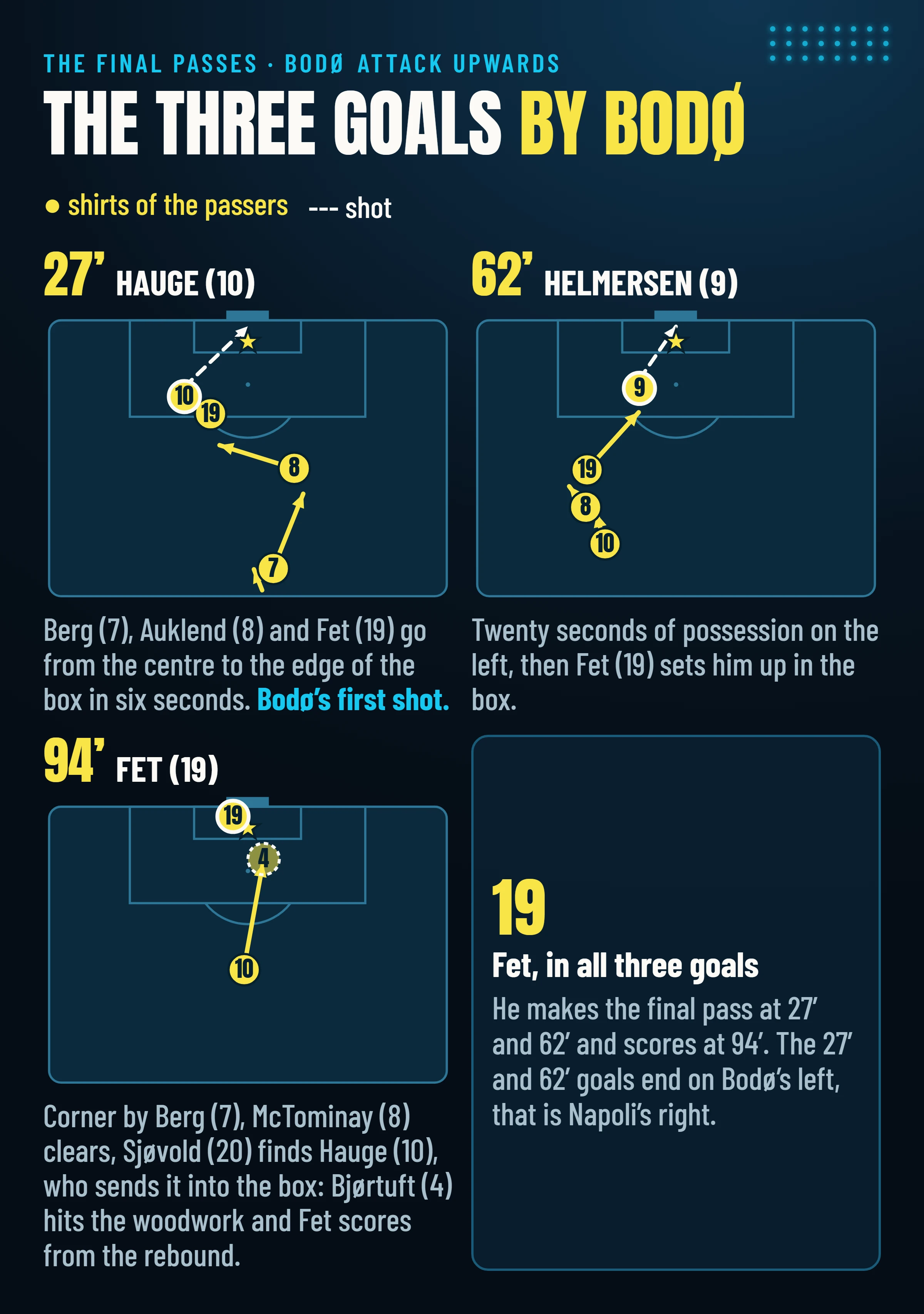
The equaliser, though, is a textbook move. Berg (7), Auklend (8) and Fet (19) pass the ball from the centre to the edge of the box in six seconds, Fet serves Hauge (10) and Hauge shoots. It is what Allegri described after the game: “When we are close to our box, we let the ball through to the inside too easily. We cannot have four of us cut out by a single pass”.
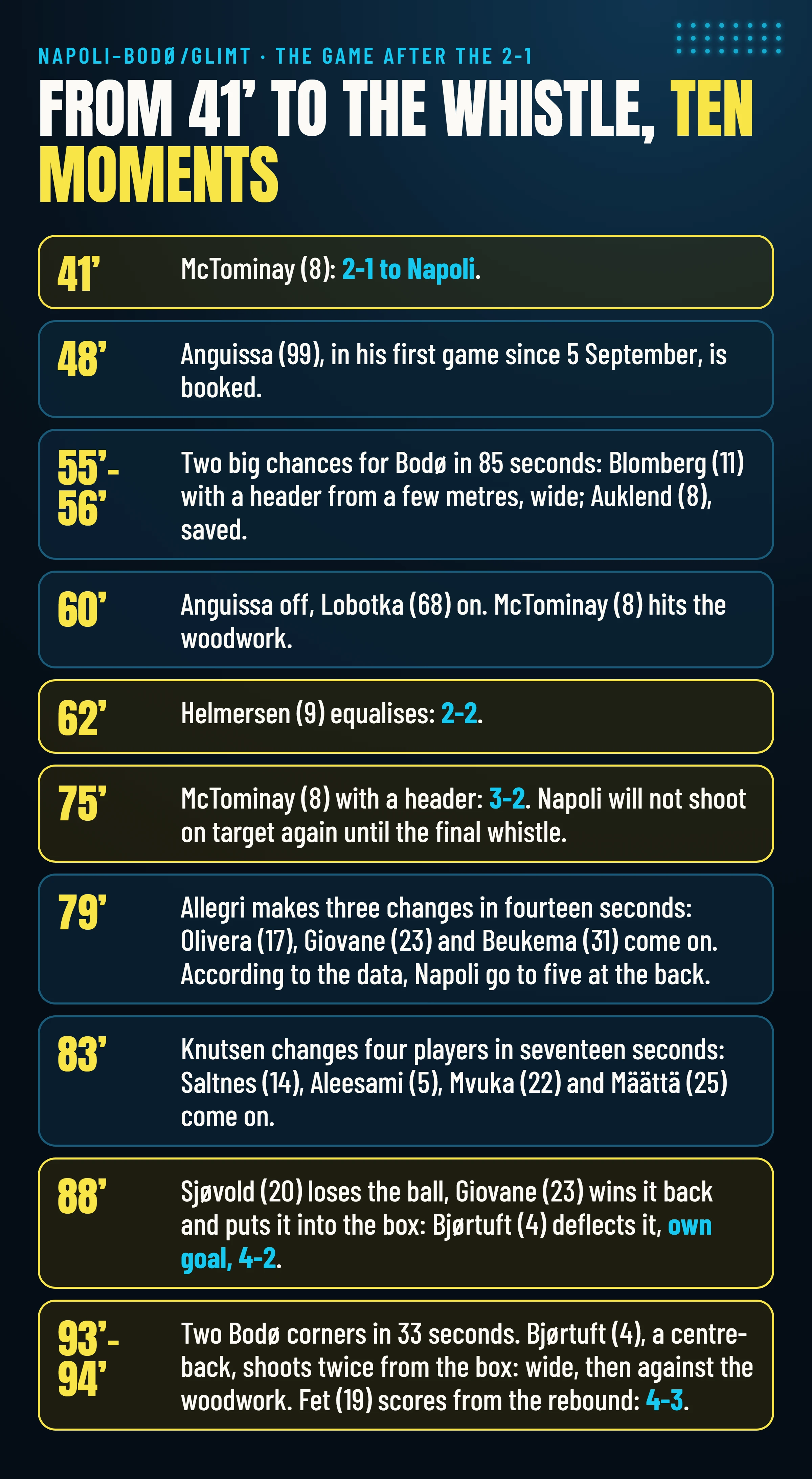
Napoli reply in the 41st minute, with a one-two: McTominay (8) gives the ball to De Bruyne (11) and gets it straight back in the box, three seconds before the shot. It is 2-1, and the first half ends with 12 Napoli shots against 2 for Bodø.
Napoli drop deeper
In the second half the opposite happens. Bodø go from 48% to 66% of touches and from 2 to 13 shots; Napoli from 52% to 34% and from 12 to 5. Bodø’s block rises from 14 to 40 metres, Napoli’s drops from 42 to 24: the two teams swap heights, as if the game had flipped.
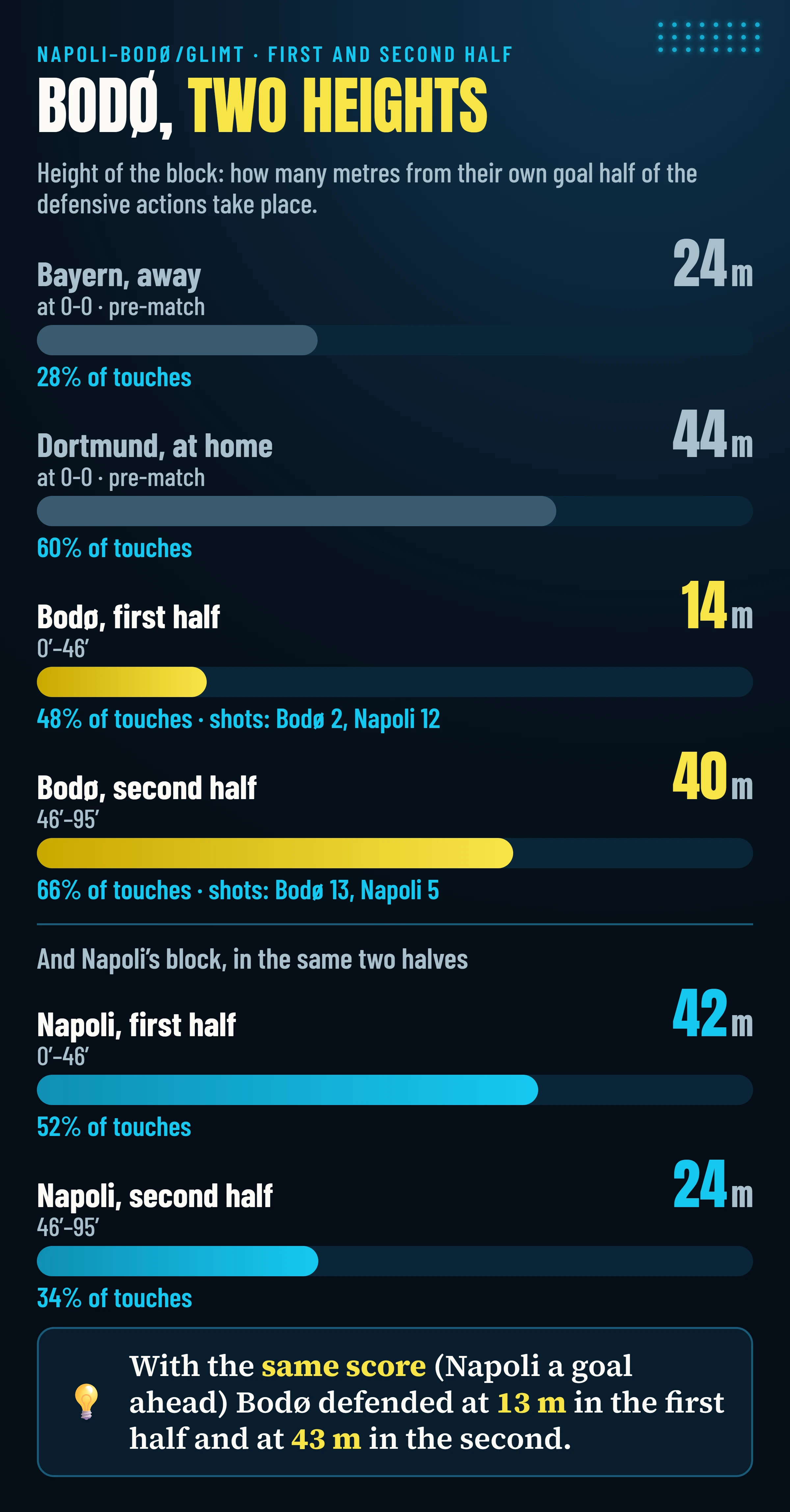
It is the Munich Bodø (24 metres) followed by the Dortmund one (44): in this game the first is even deeper and the second almost identical.
The score alone does not explain the difference. With the same result, Napoli a goal ahead, Bodø defended at 13 metres between the 1st and 27th minutes and at 43 between the 41st and 62nd. It was Napoli who changed, and with them Bodø.
Napoli admitted it. When Sky asked him why the team tends to drop deeper after taking the lead, Allegri replied: “You are absolutely right. It is a situation also linked to the condition of some players. Anguissa had not played since 5 September and did sixty minutes. McTominay scored two goals tonight, but he is not yet the real Scott. (…) In those moments, not having the legs to go and press forward and then get back, it is better to defend with the low block”.
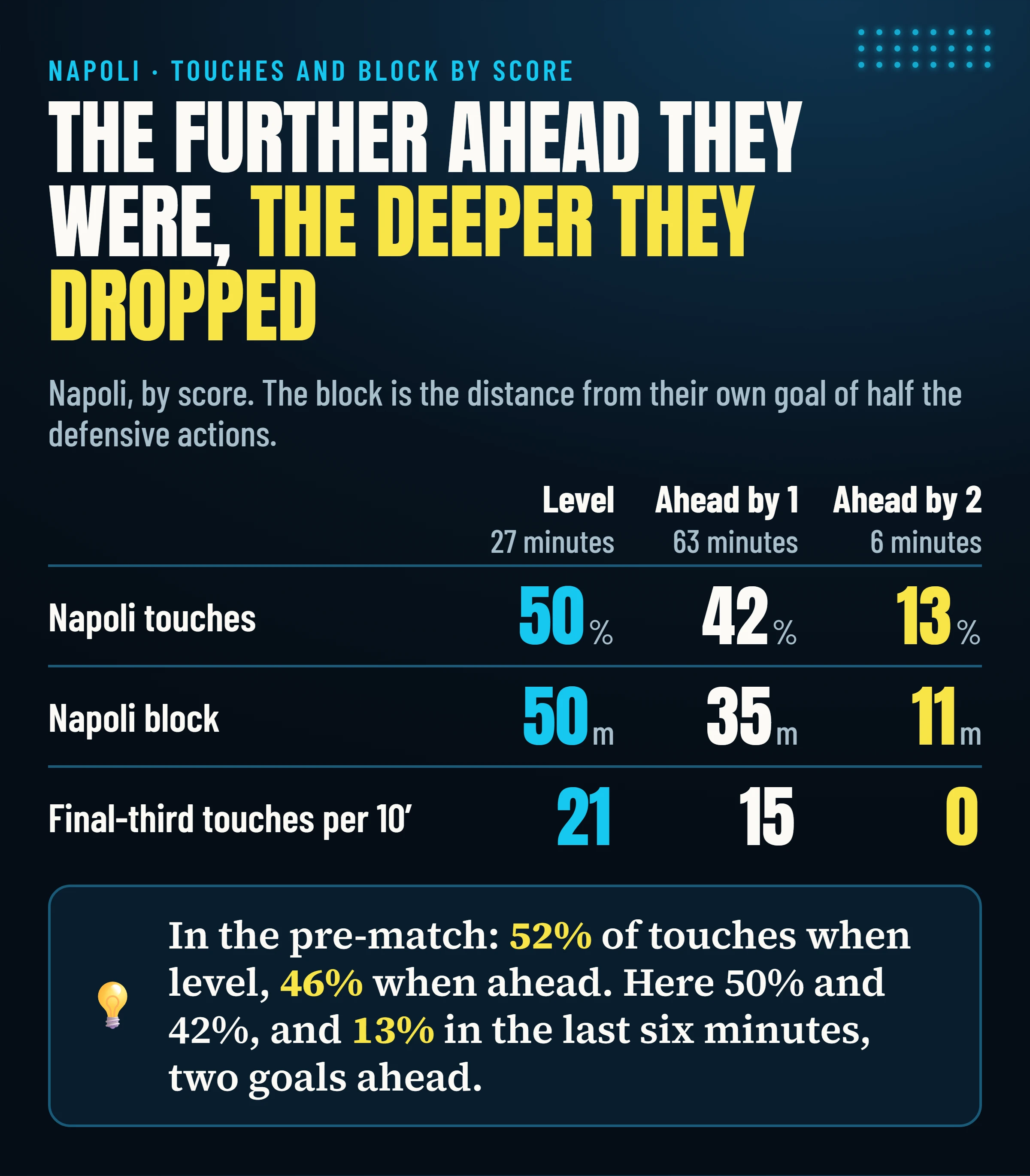
In the pre-match we wrote that Napoli, when they go ahead, tend to give up the ball: 46% of touches against 52% when the score is level. Against Bodø it happened, and by a lot more. When level Napoli had 50% of touches and defended 50 metres from their own goal; one goal ahead, 42% and 35 metres; two ahead, in the last six minutes, 13% and 11 metres.
The Dortmund Bodø
From the 41st to the 62nd minute the game belongs to Bodø. Between the 55th and 56th minutes, in 85 seconds, they have two big chances: Blomberg (11) misses with a header from a few metres, Auklend (8) is denied by a save. Meanwhile, Anguissa had been booked in the 48th minute and Lang (70) in the 58th; in the 60th Anguissa goes off and Lobotka (68) comes on, while McTominay hits the woodwork. In the 62nd minute Bodø equalise: twenty seconds of possession on the left side, which for Napoli is the right, and then Fet (19) serves Helmersen (9) in the box.
In the pre-match we had pointed to Napoli’s left as the weak side: 48% of opposition entries into the final third went through there. This time the opposite happened. Bodø entered the final third 59% of the time from their own left, that is from Napoli’s right, and 27% from the other side. In the quarter of an hour after the hour mark, eleven entries out of twelve. Napoli, on the other hand, attacked mostly from their own left: 27 entries out of 40. Two left flanks, one against the other.
The second-half Bodø, however, are not the Dortmund side that presses high. PPDA, that is, how many passes they allow before stepping in, is here 29 in the second half and 38 in the first, against 13 at Dortmund. Bodø come up with the ball, they do not go and win it. In line with this, Napoli’s goalkeeper, Meret (1), went long only 6 times out of 29, 21%, against 74% against a pressing Inter: the pre-match trend (the more the opponent presses, the more the goalkeeper goes long) held up.
Ten seconds, but the other way round
In the 75th minute Bodø have 64% of touches over the last thirteen minutes and are the most stretched team of the game: 62 metres between the deepest and the highest player, against 35 in the previous phase. The Norwegian press writes that, during Bodø’s spells of dominance, the Maradona had turned on its own team. Then Auklend (8) loses the ball about twenty metres from his own goal, Spinazzola (37) challenges him, Lang (70) wins it back, De Bruyne (11) switches play with a long ball and Politano (21) crosses: McTominay (8) scores with a header, beating Sjøvold (20) in the aerial duel. Nine seconds have passed since the lost ball.
It is signal number 3 of the pre-match, the “ten seconds after every lost ball”, but read the other way round. Napoli lost 30 balls in their own half and Bodø never shot in the twelve seconds that followed. Bodø lost 41 in theirs, and after one of those they conceded the 3-2.
The player who loses the ball most is Sjøvold (20): 10 balls in his own half, and he is involved in the 3-2 and the 4-2. In the pre-match we had pointed to him as the full-back who builds the most, 86 passes per 90 minutes. Knutsen defended him: “I don’t understand certain assessments, I chose to play him and I take the responsibility”. Sjøvold told the Norwegian press that the coach reproaches him for passing back to the goalkeeper, and that when he tried something else it went badly.
The “something else” is the 4-2. In the 88th minute Sjøvold, instead of laying it off to Haikin (12), tries to dribble and loses the ball in front of Giovane (23), who had come on nine minutes earlier. Giovane wins it back, puts it into the box and Bjørtuft (4) turns it into his own goal. Six seconds pass from the lost ball.
And the crosses? In the pre-match we had written that this was not where Napoli could win: against Bodø in Europe, only 6 out of 42 were completed, and Napoli attempt 18 a game and complete one in four. Tonight they attempted 14 and 3 were completed, in line with those numbers. But two became goals: the cross from Spinazzola (37) for Politano (21) in the 1st minute and the one from Politano for McTominay (8) in the 75th. Knutsen told TV 2 that Bodø struggle in duels in the box and at stopping crosses, and that this is Napoli’s biggest strength: “we knew it”.
Five at the back
After the 3-2 Allegri changes again. In the 79th minute he makes three substitutions in fourteen seconds: Olivera (17), Giovane (23) and Beukema (31) come on for Politano (21), Lang (70) and Spinazzola (37). According to the data Napoli switch to five at the back, a 5-4-1. It is a set-up the pre-match had not predicted: at Venezia, behind, Allegri had gone from three to four at the back; here, ahead, he adds a centre-back.
The 5-4-1 holds. From the 76th to the 88th minute Bodø have 76% of touches and never shoot. Then the 4-2 arrives and everything changes. In the last six minutes Napoli have 13% of touches and defend 11 metres from goal; Bodø 87%, with ten touches in the box per ten minutes and three shots. Knutsen changed four players in seventeen seconds, and a centre-back, Bjørtuft (4), is in the opposition box: he shoots twice, wide and against the woodwork.
In the 94th minute, after two corners in 33 seconds, Fet (19) scores from the rebound. It is 4-3, and there is about a minute left until the whistle. In the last twenty minutes Napoli never shot.
Allegri, at the press conference: “What needs to improve is when we are close to our box, where we are still a little too fragile: too many balls pass between the lines”.
Seven goals, two ways of scoring
Lining up the seven goals, a difference shows. Napoli scored quickly: their goals took between one and seven passes after a recovery, and three come from a ball Bodø lost in their own half, 17, 9 and 6 seconds before the goal. Two out of four finish off a cross.
Bodø scored by building up. Their two goals from open play came from possessions of nine and ten passes, lasting twenty seconds or more, and the third from the second ball after a corner. Fet (19) is in all three: he makes the final pass for the goals in the 27th and 62nd minutes and scores the one in the 94th.
Fewer chances, more goals
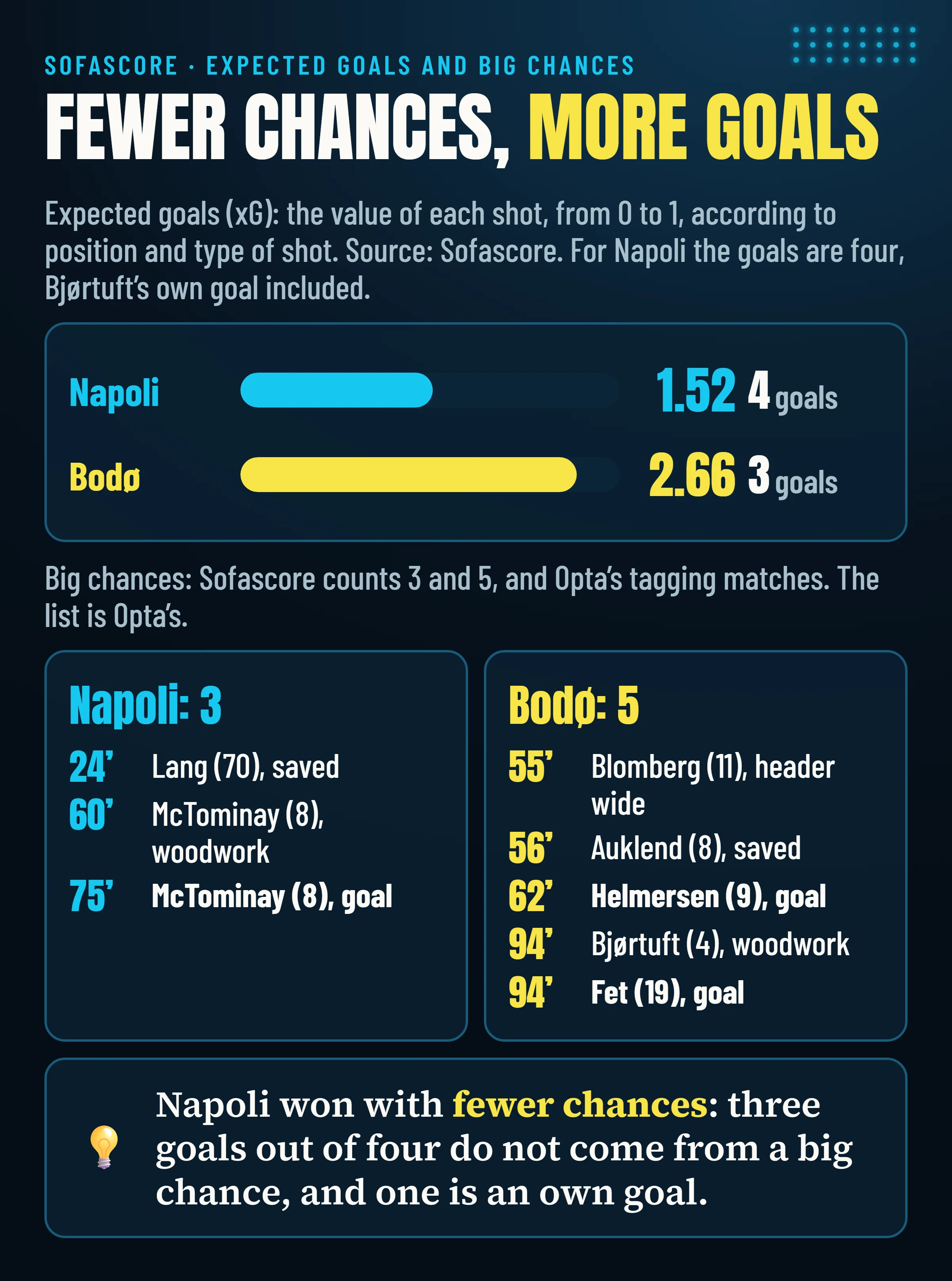
Sofascore’s numbers say Bodø created more: 2.66 expected goals against 1.52 and five big chances against three. Opta’s tagging also counts five and three. Expected goals, or xG, gives each shot a value between 0 and 1, based on position and type of shot.
Napoli won with less. Three of their four goals do not come from a big chance: Politano in the 1st minute, McTominay in the 41st and the own goal. The fourth is McTominay’s header in the 75th. Bodø scored two out of five, and the other three are Blomberg (wide) and Auklend (saved) in the 55th and 56th minutes, and Bjørtuft’s shot against the woodwork in the 94th.
Allegri, at the press conference, read the game the other way round: “Napoli are third in the table for expected goals. If tonight we had scored three goals by the end of the first half, would there have been anything to say?”. Napoli, in fact, shot 12 times in the first half. But with a single game and with the xG of a different source, it is a clue, not a verdict.
Six players, and two who were not there
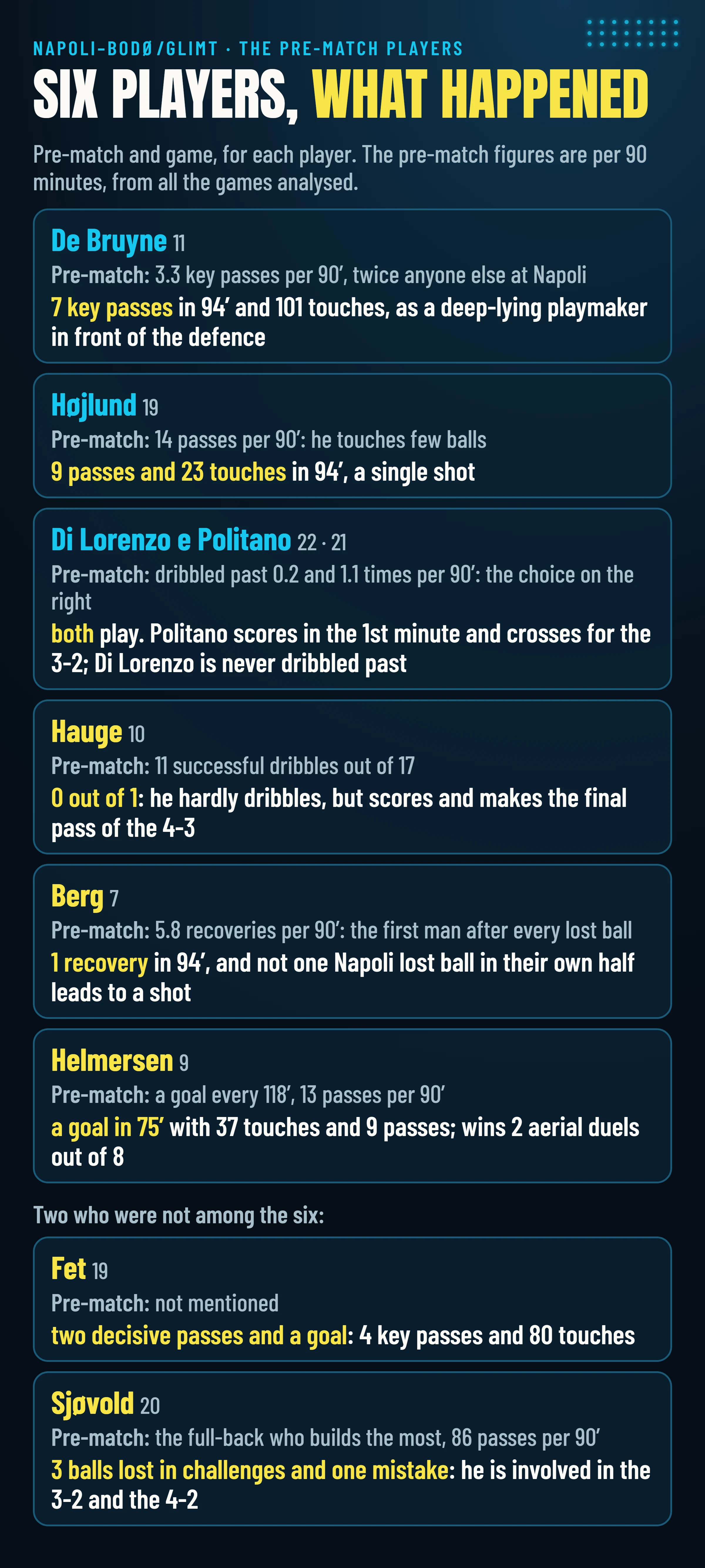
De Bruyne (11) made seven key passes in 94 minutes, twice his average (3.3 per 90), and touched the ball 101 times as a deep-lying playmaker, more than any other Napoli midfielder. Højlund (19), on the other hand, touched 23 balls and made 9 passes in 94 minutes, with a single shot: we had written that he already did very few, 14 per 90. Politano (21) scored in the 1st minute and made the cross for the 3-2; Di Lorenzo (22) was never dribbled past. Allegri, in the end, did not have to choose between the two: he fielded both of them.
Hauge (10) was Bodø’s dribbler, and tonight he attempted a single dribble, unsuccessful; but he scored and set up Bjørtuft for the shot against the woodwork in the 94th minute. The duel we had pointed to, Hauge against Napoli’s right, did take place, but without dribbles: Hauge got into the box, he did not beat anyone. Berg (7) made a single recovery: Napoli lost 30 balls in their own half and not one cost a shot. Helmersen (9) made 9 passes in 75 minutes, two shots and a goal, from his big chance: against Dortmund 38% of his touches had been followed by an opposing intervention, here 30%.
The two we had not mentioned are Fet (19), with two decisive passes and a goal, and Sjøvold (20), whom we had pointed to only as a builder and who is in the middle of the 3-2 and the 4-2.
What we said
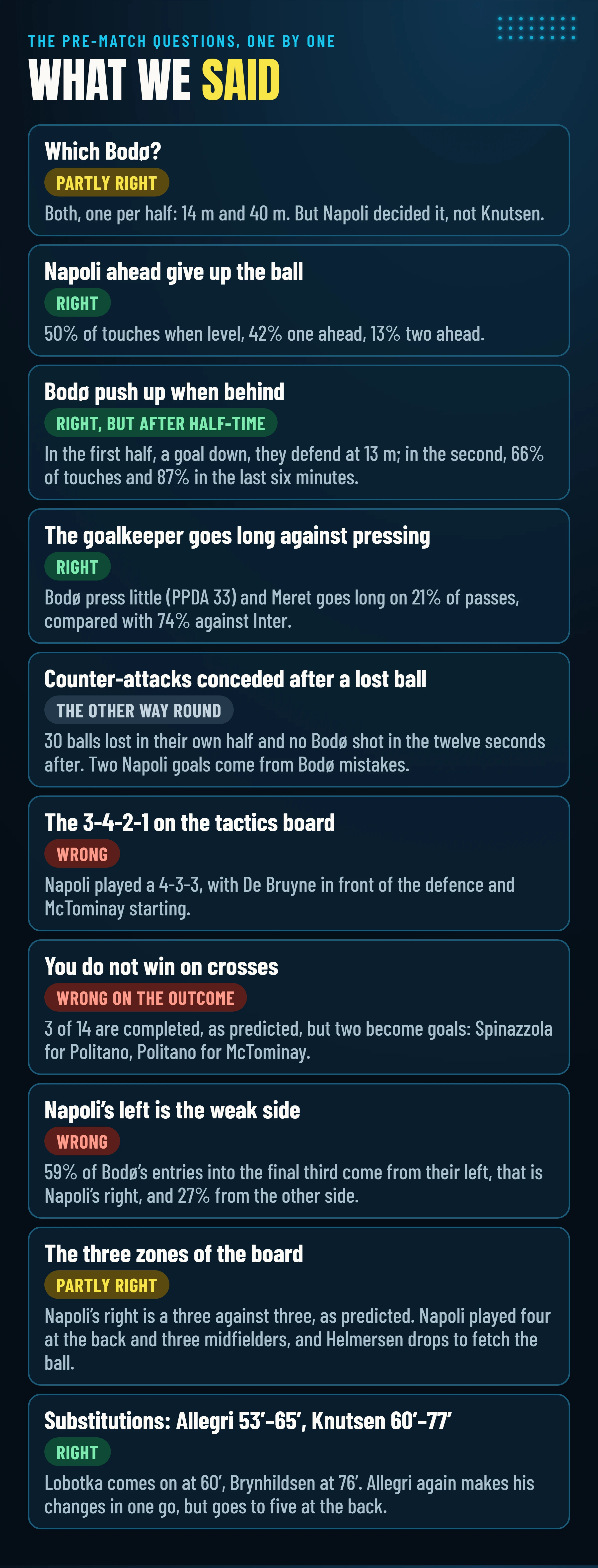
The balance is mixed: four right readings, two partly right, one reversed, three wrong.
We read the script well after the first goal, the link between pressing and the goalkeeper’s long balls, and the timing of the substitutions. We got the tactics board wrong (4-3-3, not 3-4-2-1), the weak side (Napoli’s right, not the left) and the crosses; of the three zones on the board only Napoli’s right held, three against three. And the point that seemed the most solid, the counter-attacks, did not show up against Napoli: it was Napoli’s own that counted. The opening question, which Bodø, had a simpler answer than we thought: both, one per half, and it was Napoli who chose.
High for one half, low for the other
Allegri said the fragility “is not physical”: “When we are close to the box, the ball passes too easily”. The three goals conceded come at three different moments, with Napoli high (the 27th minute) and with Napoli low (the 62nd and 94th), and always from a ball that passes between the lines or from a second ball. It is the most useful reading for Saturday, when Roma are the league opponents: the problem is not how deep Napoli drop, but how much space they leave between one line and the other when they do.
Napoli won with a team that was high for one half and low for the other, and Bodø were two teams as a result: the three goals conceded, which came in both versions, say that the problem is not the height of the block but the balls that pass between the lines.