
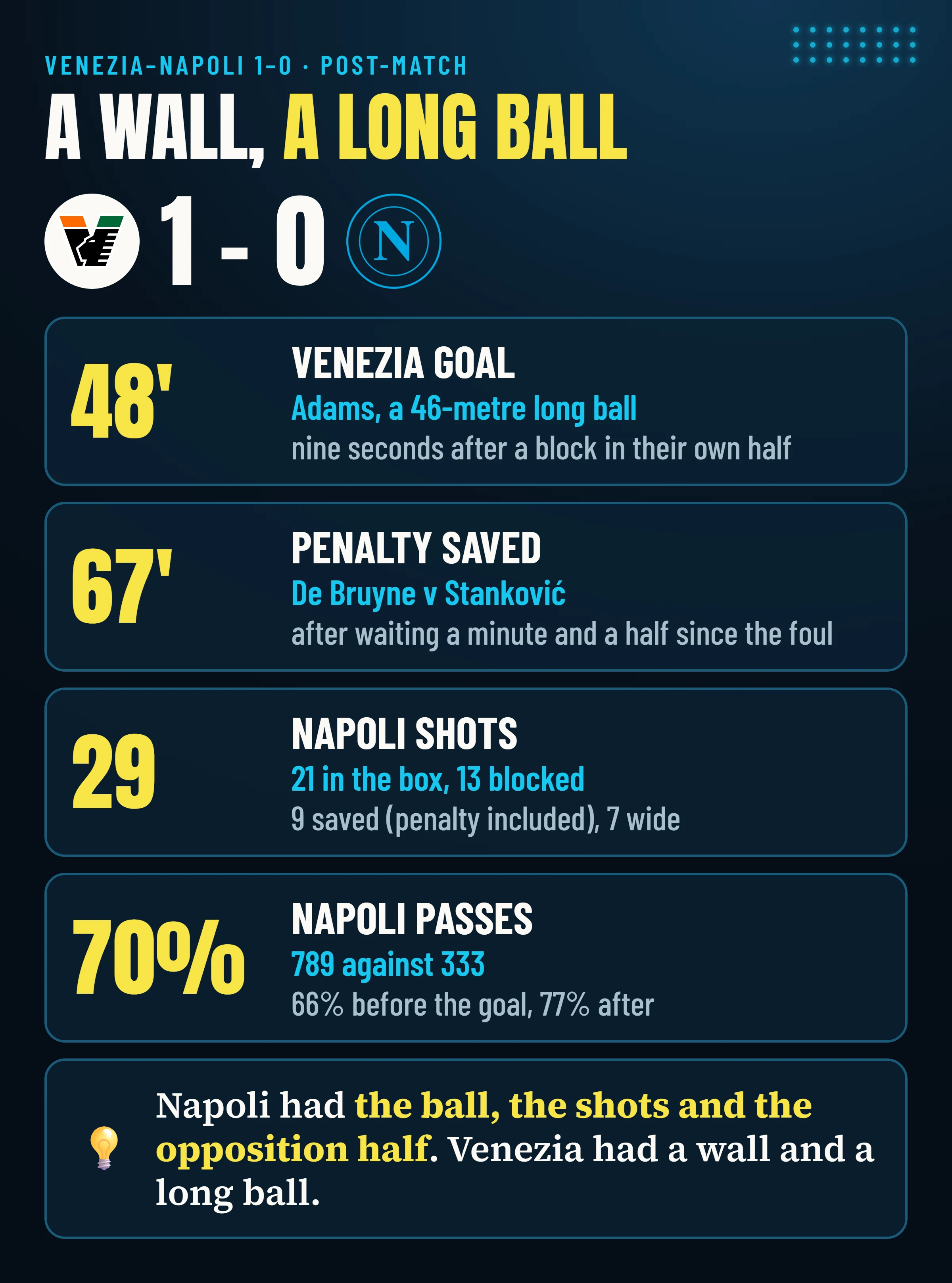
Venezia were bottom of the table, on zero points, with six defeats in six games and a coach changed a few days earlier: Stroppa out after the 3-1 at Bergamo, Davide Nicola in, who according to the pre-match press was making his debut against Napoli. Napoli came from the defeat at Villarreal and from a remark of Allegri’s that sounded like a plan: they need to “manage the ball better at certain moments of the game”.
On paper there was an obvious favourite. In the end Venezia won, 1-0, and took their first three points of the season. Adams scored the goal at 48′, from a long ball. For the whole rest of the game Napoli had the ball, the opposition box, a penalty and twenty-nine shots. They did not score.
In the pre-match we had written that the game could change at one precise moment, after the first goal, and that Venezia, in six games, had never held a lead. This time they held it, for forty-six minutes. Let us try to understand how, starting from the question the pre-match ended on: which Venezia would we see?
Which Venezia?
In the pre-match we had described two Venezias. The one of Lecce, Frosinone and Fiorentina, who press the opposition high, right from their own box. And the one of Milan, Lazio and Atalanta, who wait further back. To measure the difference we use PPDA, which counts how many passes you let the opponent make before stepping in: the lower the number, the more the team presses. The first Venezia sat between 7 and 8, the second between 13 and 17.
Against Napoli the PPDA was 35.5: more than double, even compared with the more cautious of the two. We saw neither the first Venezia nor the second. We saw a third, who left the ball to Napoli and sat in front of their own box.
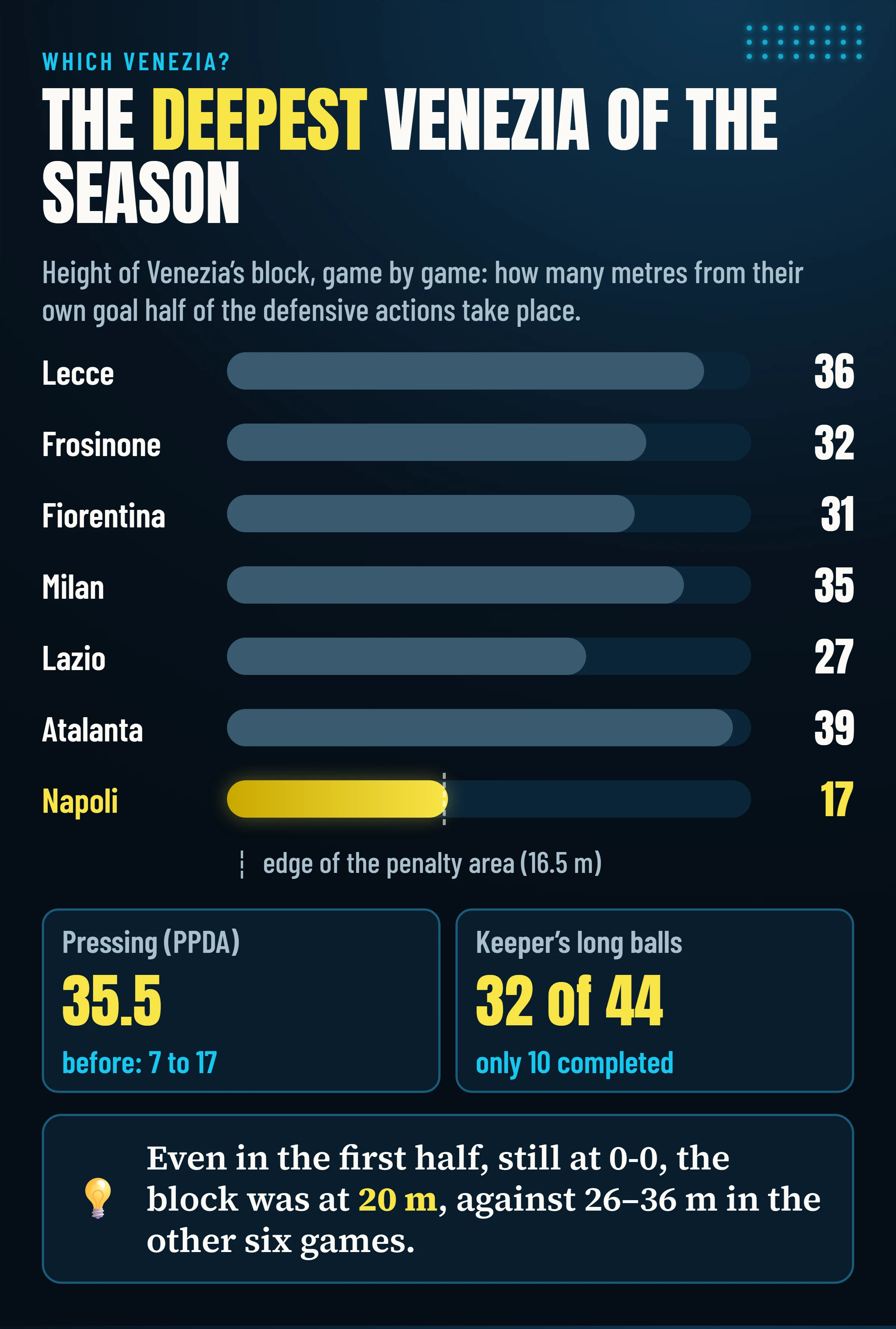
Another figure shows it too. Take half of Venezia’s defensive actions, that is tackles, interceptions, recoveries and clearances, and look at how far from their own goal they happen. In the other six games the answer was between 27 and 39 metres. Against Napoli it was 17 metres: practically on the edge of the penalty area. And it was already like that in the first half, when the score was still 0-0.
When Venezia had the ball, they did not try to play it. Goalkeeper Stanković went long 32 times out of 44, and only in 10 cases did the ball reach a team-mate.
Why? The data do not say. It may be the new coach, it may be Napoli, because with 70% of the passes almost every team drops deeper, it may be the score. The first half, at 0-0, says that the score alone is not enough; the other two explanations stay open.
Live, in the pre-match, we had written to watch Venezia’s two strikers when Napoli built up: if they press the three centre-backs it is the Venezia of Lecce, if they wait in midfield it is the one of Milan and Atalanta. Here they did neither: they stayed high, but did not step up to press.
The tactics board, with the real positions
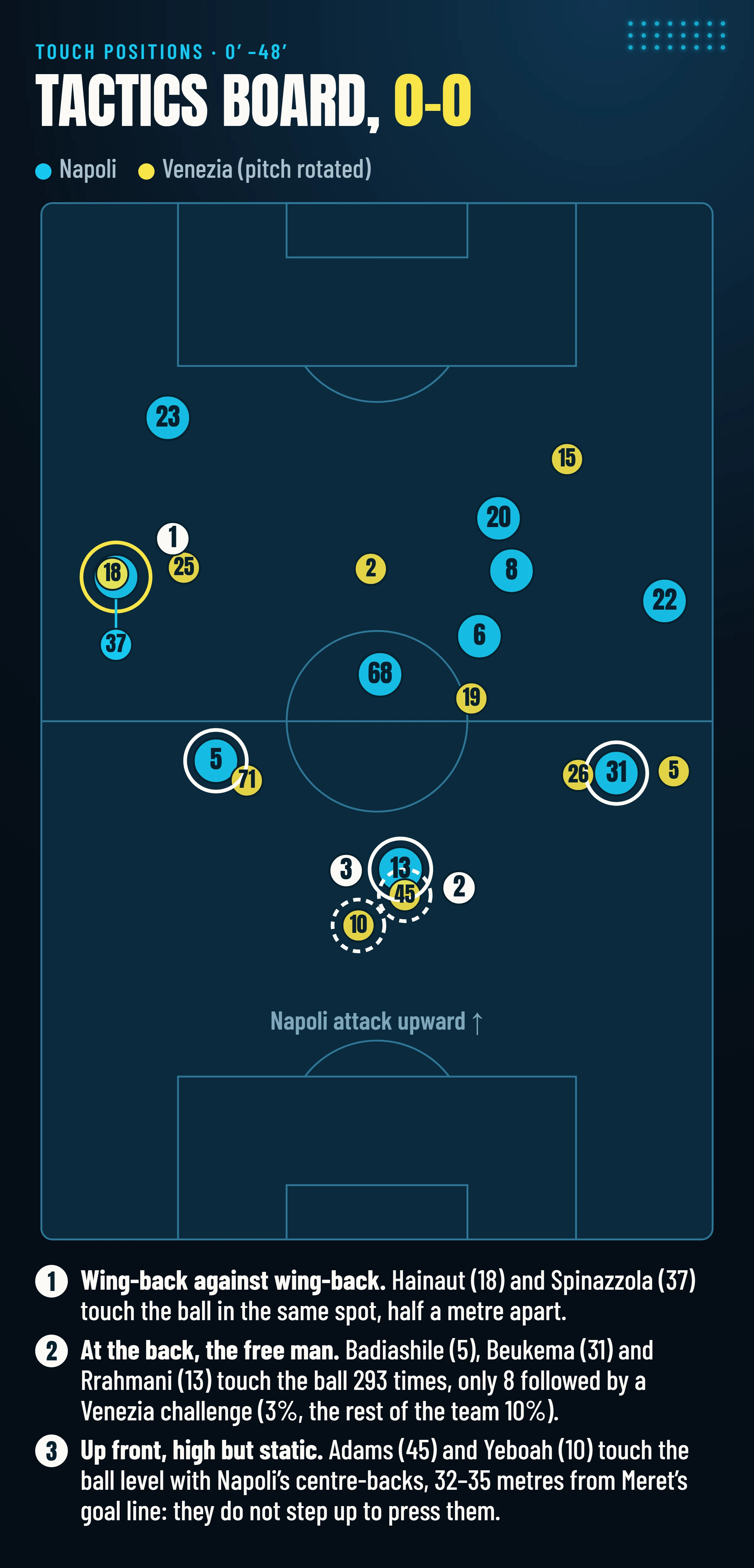
In the pre-match we had drawn a tactics board with three points of contact. This is the same board, but with the players’ real positions in the first half, when the same eleven were on the pitch and the score was 0-0. Each circle is a player, with his shirt number, and sits where he touched the ball most often or made a defensive action. Napoli, in blue, attack upward. Venezia, in yellow, are drawn rotated, so the two teams face each other.
Look at it from above, one piece at a time.
On the left, at the top, two circles one above the other. The yellow one with 18 is Hainaut, the blue one with 37 is Spinazzola: the two wing-backs, the duel we had flagged in the pre-match as the first to watch. They touched the ball in the same spot, half a metre from each other, practically shoulder to shoulder the whole time. We had written that if Spinazzola went forward he would leave space for Hainaut. The opposite happened: Spinazzola went forward, Hainaut stayed glued to him and never had that space, because he spent the game defending. He made more defensive actions than any team-mate and just three crosses, in a season in which he was making almost six a game.
In the centre, at the bottom, the three circles with the white border. They are Napoli’s three centre-backs: Badiashile (5), Beukema (31) and Rrahmani (13). They are among the players who touch the ball most: 293 times between the three. And almost nobody challenges them: in 8 cases, less than once in thirty, an opponent stepped in within a few seconds, against once in ten for their team-mates. To be clear, we count a ball as “challenged” when it is followed by a tackle, an interception, a recovery, a clearance or a foul by the opponent within 6 seconds and 10 metres. Napoli always had a free man to start the play from, as we had predicted: three against two at the back. But finding him was not enough.
Next to the centre-backs, two yellow circles with a dashed border. They are Adams (45) and Yeboah (10), Venezia’s strikers. They touch the ball level with Napoli’s defenders, but do not press them: they watch them. They are high, and static. Rather than to win the ball, they seem to be there to receive a long ball.
In the middle, the circles blend together. The yellow 19, Sohm, is a few metres from the blue 68 and 6, Lobotka and Gilmour. On paper Venezia had three men against two, with Bašić and Kike Pérez, and the pre-match board made it a strength. On the pitch it translated into nothing: the centre was the zone where Napoli were challenged least, and until the goal they had two of every three passes.
Overall Napoli were challenged on one ball in thirteen, a little over half the rate at Villarreal. It is the snapshot of a game in which one team wanted the ball and the other did not.
The minute of the wall
The first half has one minute that tells the whole game in miniature. At 28′ Gilmour takes a corner. Badiashile (5) shoots, Sohm (19) blocks it. Rrahmani (13) tries again, and this time it is Haps (5) who blocks it, a few metres from goal: second corner. Gilmour takes it, Di Lorenzo (22) shoots from ten metres and the ball goes wide. McTominay (8) shoots twice in a row, and both times Juan Jesus (15) is there to block.
Five shots in thirty-one seconds, all inside the box. Four stopped by a Venezia player, one wide. No goal.
In the pre-match we had pointed to second balls as the place where the game could be decided, because Napoli often score from a rebound. Here are five in half a minute, and it was not enough. It is also the only time, in the whole game, that Napoli managed to shoot again straight after a shot was turned away.
Where Venezia shut the ball down
Venezia pressed little, but not by chance. The exception is Giovane: seven of his thirty-one touches, almost one in four, were followed by a challenge, against about one in fifteen for his team-mates. Six of those seven came on Napoli’s left flank, in front of Spinazzola, and always by the same players: Kike Pérez (71) four times, Hainaut (18) twice, Sohm (19) once.
At 53′ Giovane goes off and Alisson Santos comes on in his place, playing in the same channel. The script does not change: again Kike Pérez and Hainaut closing him down, six challenged touches out of forty-one. The numbers are small and Alisson Santos’s case, on its own, would say nothing; but it is the same story with a different player.
Live: Napoli’s left flank, Spinazzola and Giovane against Hainaut and Kike Pérez, is where Venezia won the ball, close to their own box.
Nine seconds, a long ball
The first half ends 0-0, after three minutes of stoppage time. The second half has been under way for just over three minutes when the goal comes. Napoli are building in Venezia’s half: Lucca tries a short pass and Kike Pérez blocks it. Lucca also loses control of the next ball. Sohm launches a high ball 46 metres towards Adams, who controls it 21 metres from goal and shoots two seconds later: goal.
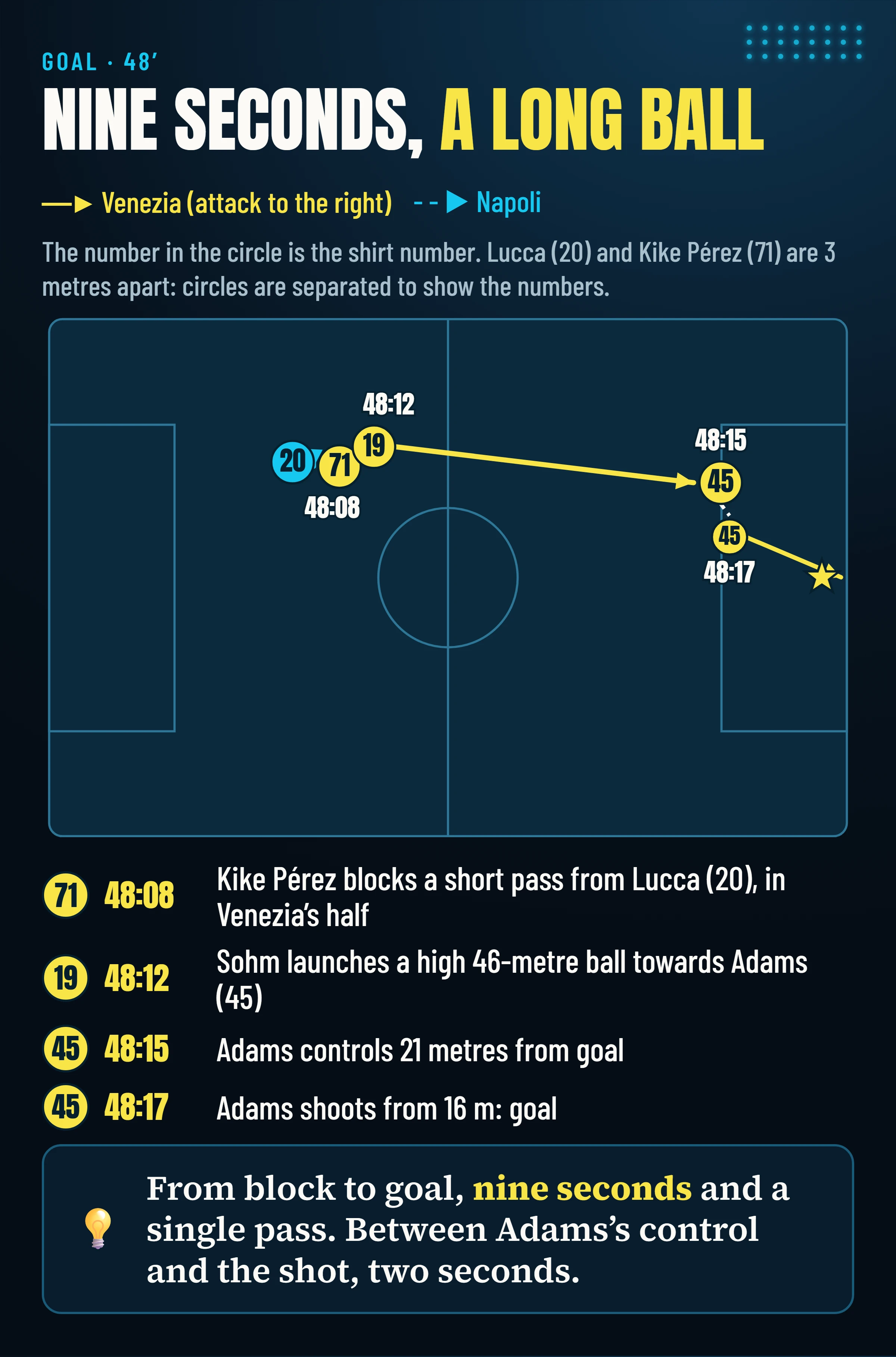
Nine seconds from the block to the goal, a single pass. In the pre-match we had written that six of the sixteen goals Venezia conceded were real opposition counter-attacks, and that Venezia, when they push up, leave space behind. Here it was Venezia who made the counter-attack, against a Napoli who were attacking. We do not know where Napoli’s defenders were in those nine seconds, because we have no tracking data: we know that Adams needed just two between control and shot.
Adams was the man to watch. In the pre-match: he touches the ball little but almost always shoots from inside the box. Against Napoli he took 6 of Venezia’s 9 shots, all from the box, and one went in.
Live: after a Venezia recovery, watch whether the first ball goes long towards Adams.
After the goal, the wall
From there the game changes, and it changes in one direction only. Venezia drop even deeper: their four defenders, the three centre-backs plus Hainaut, go from touching the ball 34 metres from their own goal to 24. Napoli keep the ball for three passes out of four and shoot 20 times after the goal, against 9 before it.
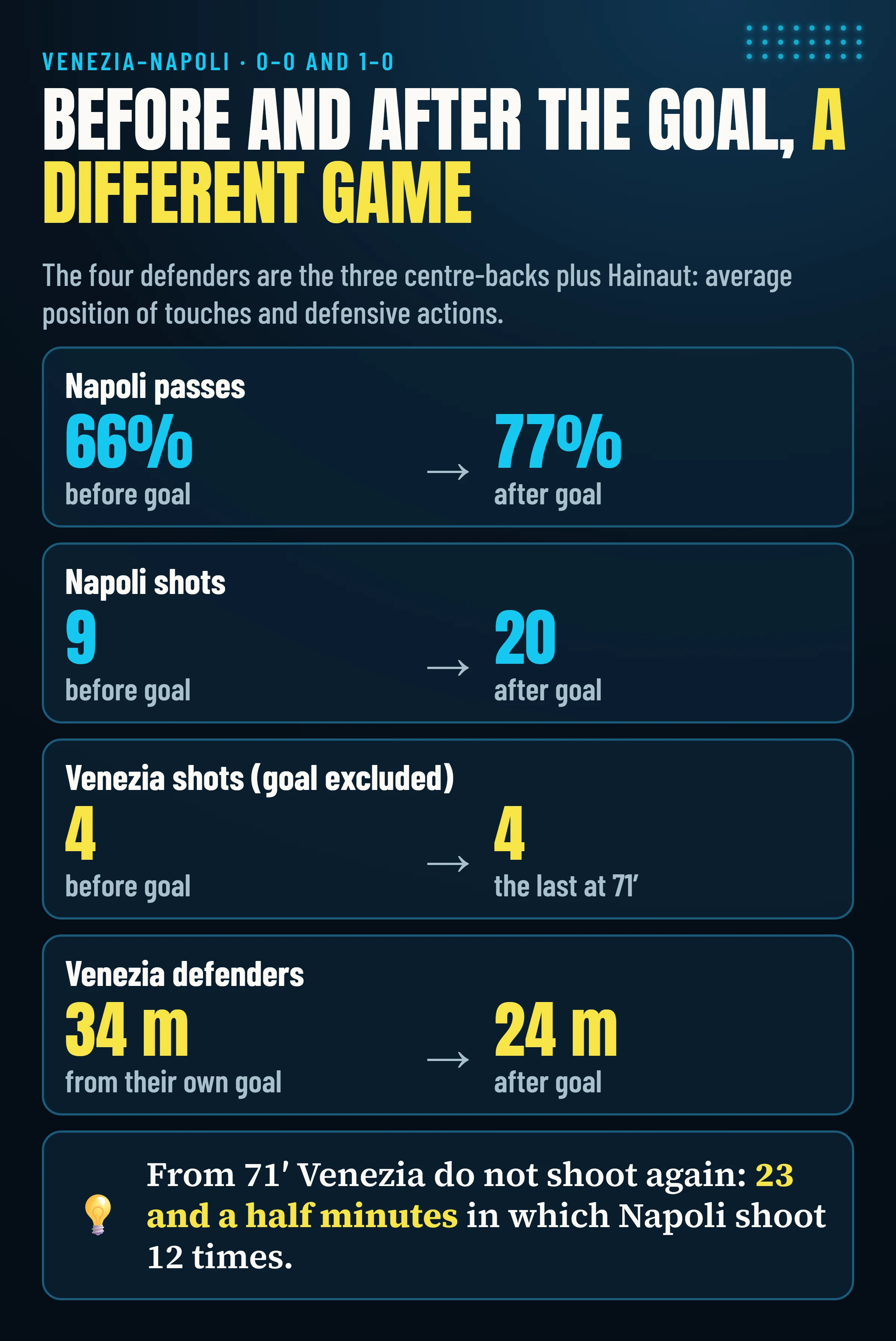
Venezia do not disappear: they shoot four more times. But the last is at 71′, and after that they do not shoot again.
Napoli’s twenty-nine shots are not desperate shots: twenty-one come from inside the box, twelve metres from goal. The problem is who is waiting for them. Almost three in four of Venezia’s defensive actions happen in their own defensive third; beyond the halfway line we count just sixteen in the whole game. The result is that almost one shot in two is blocked.
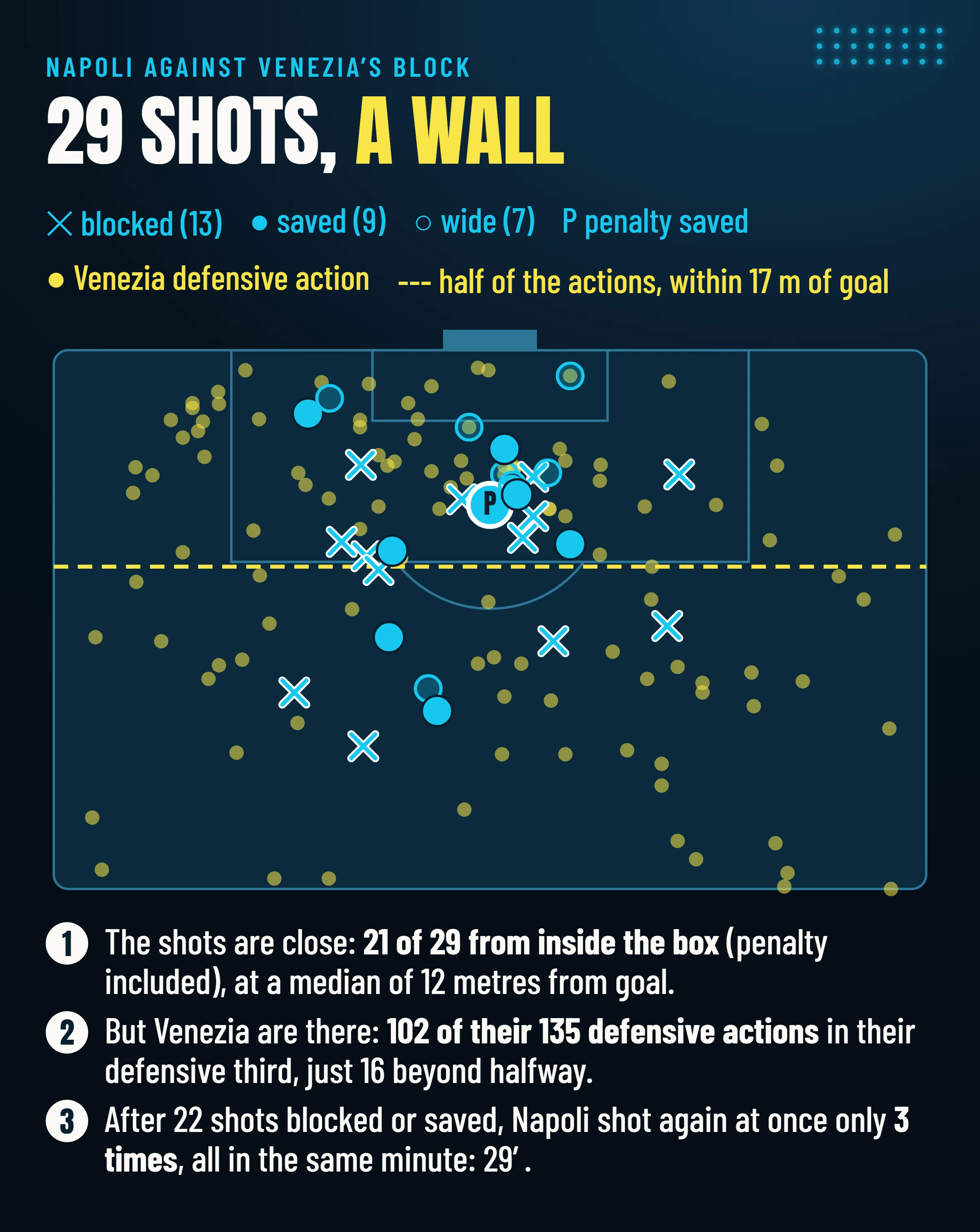
Stanković made nine saves, penalty included, Meret three. And expected goals (xG) tell the same story. xG gives each shot a value between 0 and 1, based on how hard it is to score from that position: a penalty is worth about 0.8, a shot from distance a few hundredths. According to Sofascore Napoli created 2.44 expected goals, Venezia 0.63: almost four times as many, and zero goals against one.
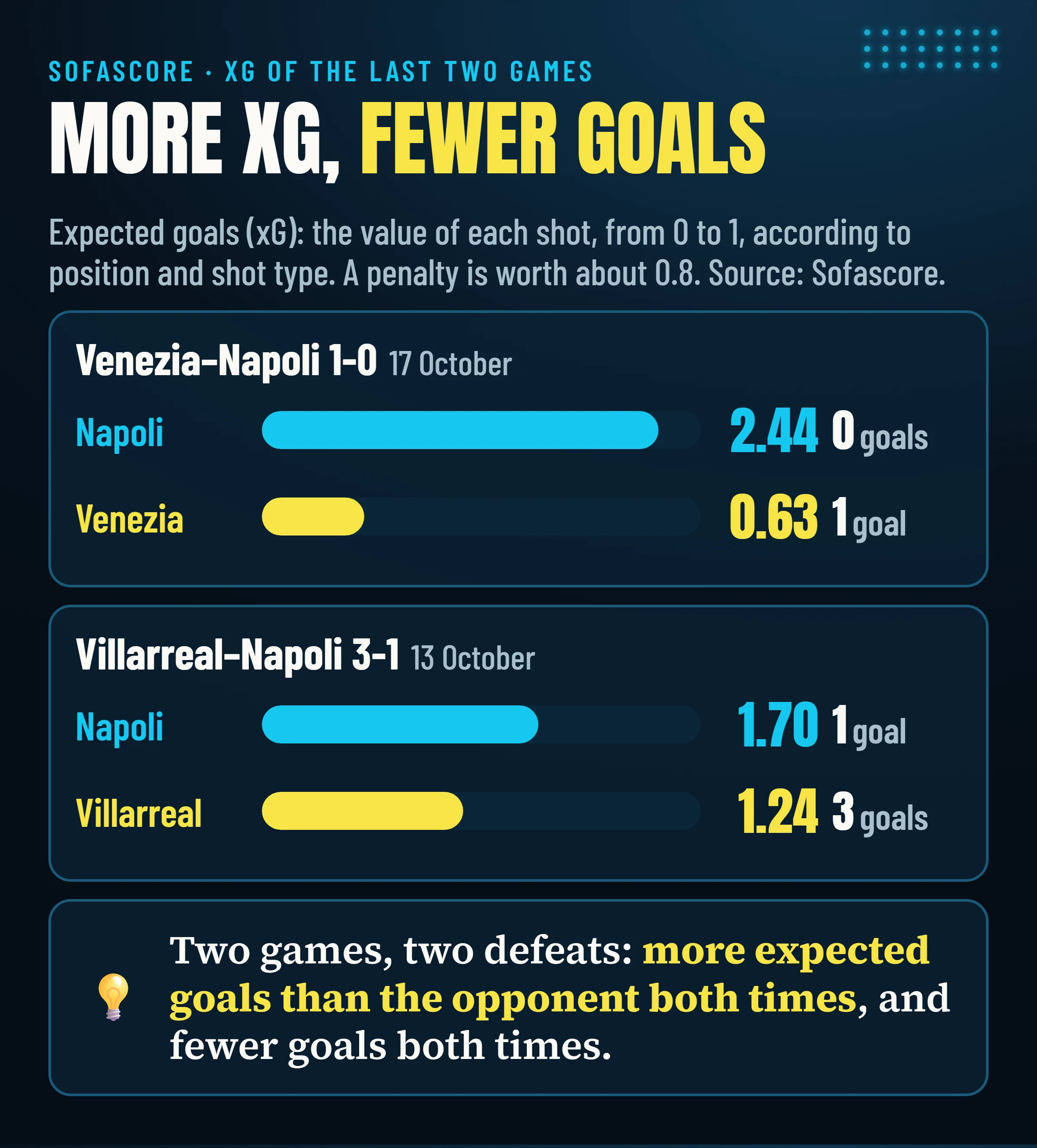
It is the second game in a row in which this happens. At Villarreal, four days earlier, Napoli had created more than the opposition (1.70 against 1.24) and lost 3-1.
Opta’s data point in the same direction too: they label only two plays in the whole game as a “big chance”, both Napoli’s, the penalty and Badiashile’s shot at 91′. Stanković saved both.
The crosses too, the most natural route against a low block, yielded little: 31 in all, and only 7 reached a team-mate.
De Bruyne’s penalty
Line up the second half and these are the moments.
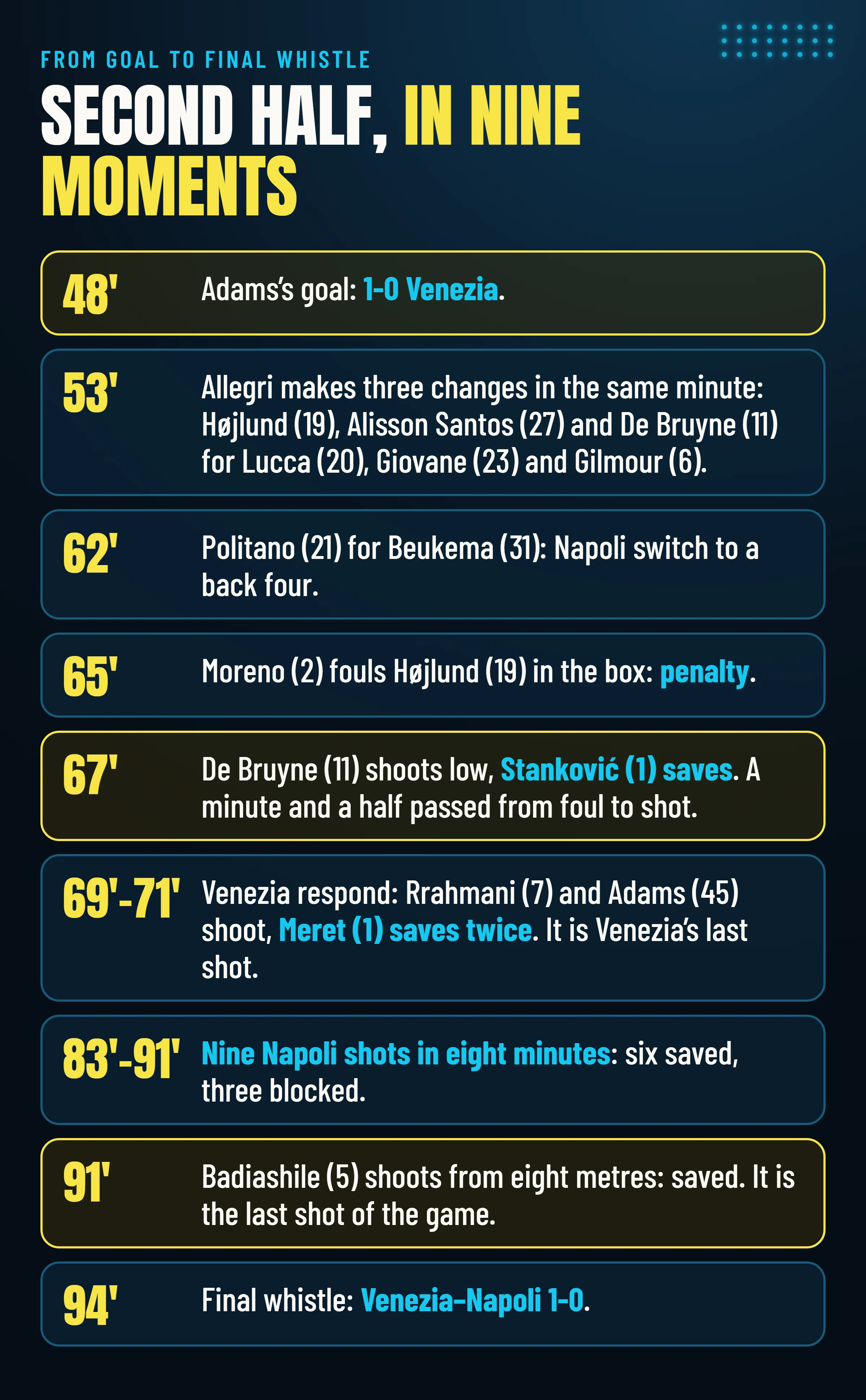
Allegri had already changed the game from the bench. At 53′ three substitutions in the same minute: Højlund, Alisson Santos and De Bruyne in place of Lucca, Giovane and Gilmour. At 62′ Politano for Beukema, with the defence moving to four. Venezia made five substitutions, between 62′ and 81′, without changing shape: they stayed in a 3-5-2.
At 65′ Moreno fouls Højlund in the box: penalty. A minute and a half goes by before the kick is taken. De Bruyne, who had started on the bench, shoots low, towards the post. Stanković gets there and saves. It is one of the two chances Opta labels as clear-cut, and Napoli miss it.
Napoli do not stop. Two minutes later, at 69′, De Bruyne tries again from outside the box and the shot is blocked. And then Venezia respond. At 69′ Rrahmani, Venezia’s number 7, who came on for Yeboah, shoots from fifteen metres: Meret saves. At 71′ Adams shoots from ten metres: Meret saves again. They are Venezia’s last two shots. In four minutes, after the saved penalty, Venezia had two shots on target to close out the game.
The final minutes
Napoli’s game comes in waves. Between 35′ and 56′, stoppage time included, they go twenty-four minutes without shooting: in that stretch they make 39 touches in the final third and only 3 in the box, and the wall holds without Venezia even having to come out. Then the final wave arrives.
From 83′ to 91′ Napoli shoot 9 times in eight minutes: Lobotka from distance, Alisson Santos three times, McTominay, Di Lorenzo, Politano twice. Six shots are saved by Stanković, three blocked. The last is the clearest. At 91′ Badiashile, from eight metres, shoots and Stanković saves. It is the same Badiashile who had opened the series of shots in the minute of the wall, at 29′: he opened one sequence and closed the game.
The whistle comes at 94′, after about four minutes of stoppage time. The stat that falls is the pre-match one: Napoli had never lost when they had more than half of the passes (three wins and a draw, in four games). Against Venezia they had 70% and lost. It was four games: it was a tendency, not a rule.
What we had predicted
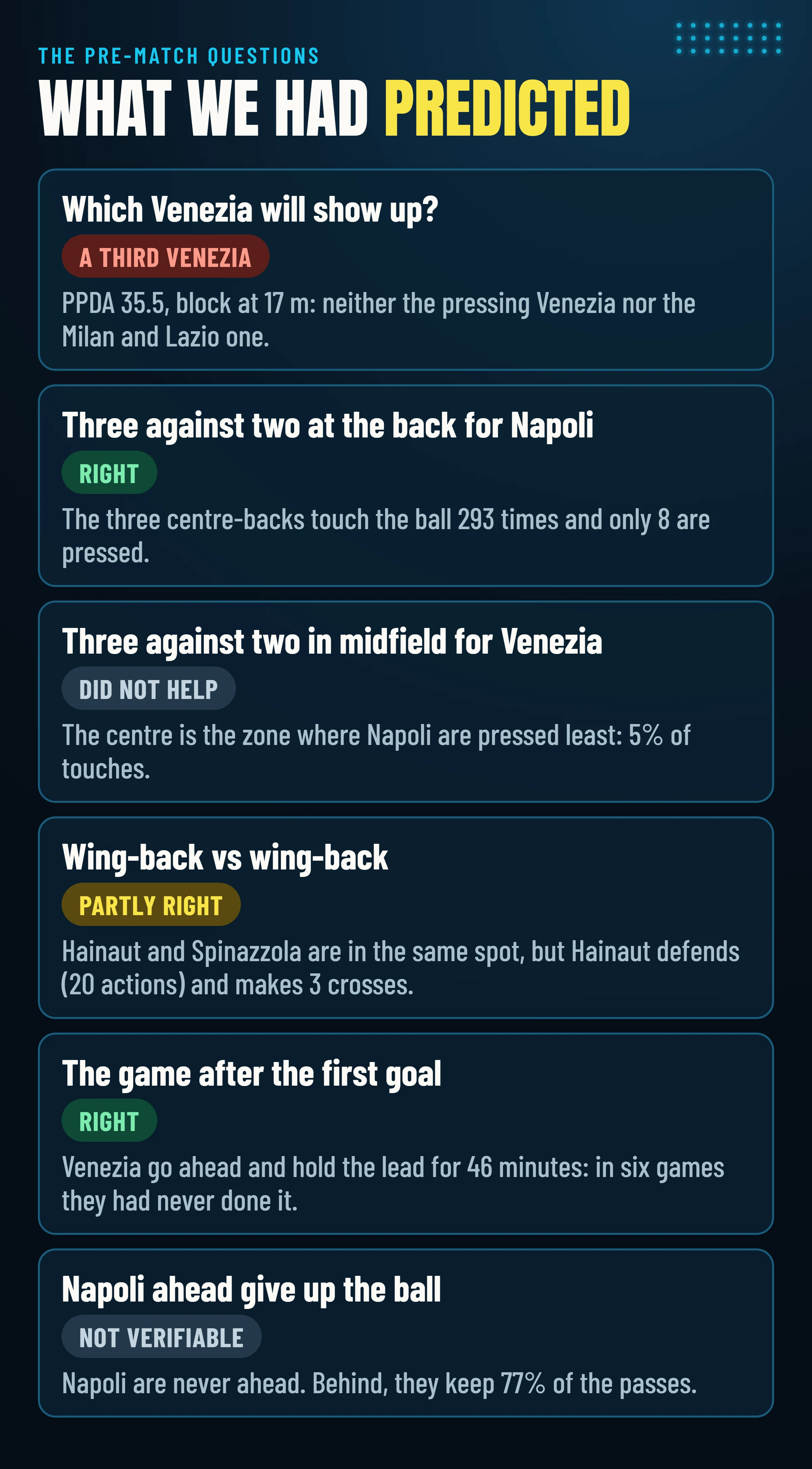
The balance is mixed: two right reads, one half-right, one wrong, one that was on the board but did not weigh on the pitch, one that the game did not allow us to check.
We read the three against two at the back well, the wing-back duel (half-right: it happened, but the opposite of how we imagined it) and the game after the first goal, including the possibility that Venezia could go ahead. We got the opening question wrong: neither the Venezia that presses nor the one that waits in midfield showed up, but one deeper than all the rest and with no pressing. And we had not imagined the penalty, which with De Bruyne in the right place seemed the simplest way to change the game.
The ball for Napoli, the wall for Venezia
Napoli did what the pre-match asked of them: they found the free man at the back, kept the ball, looked for the flanks, got a penalty. They found a Venezia that did not come out and a goalkeeper on top form.
Live, for the next time a team drops this deep: watch what happens after every blocked shot, who gets to the rebound, and where Napoli try to get the ball in when the crosses do not reach their man. It is the reading of a game, not a rule.
Napoli had all the possession, Venezia had a wall, a long ball and a goalkeeper: twenty-nine shots were not enough against a block 17 metres from goal.