
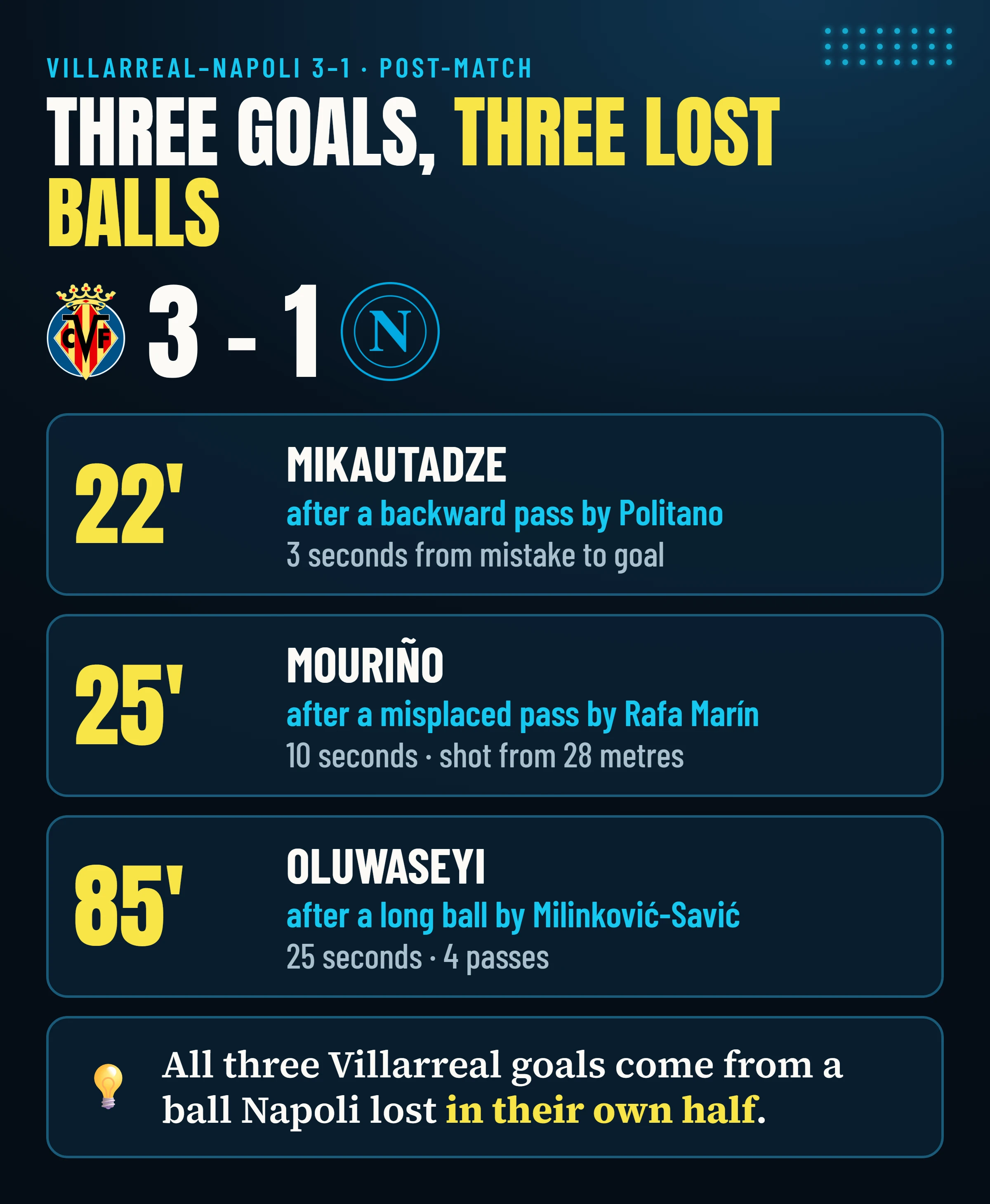
Villarreal–Napoli ended 3-1. In the pre-match we wrote that the weak spot of the game was the lost ball and that Villarreal would pay for it the most.
The opposite happened. All three Villarreal goals came from a ball Napoli lost in their own half.
Three goals, three mistakes
The first goal came at 22′. Napoli had just won the ball and Politano tried a backward pass towards his own box. Mikautadze intercepted it and shot straight away: goal, three seconds after the mistake.
The second, at 25′, came while Napoli were trying to build out from the back. Lots of short passes between Rafa Marín, Rrahmani and McTominay, then a pass from Marín from the wing towards the centre that ended up with Villarreal. Ten seconds later Mouriño shot from distance, almost 30 metres, and scored.
In neither case was Villarreal pressing hard: in the first half they allowed many passes before stepping in. That is why the two mistakes look more like a passing choice than the result of constant pressure.
The third, at 85′, we tell later. It too comes from a long ball Napoli lost.
The game, though, is not reduced to this. Napoli also did many things well.
A promising start
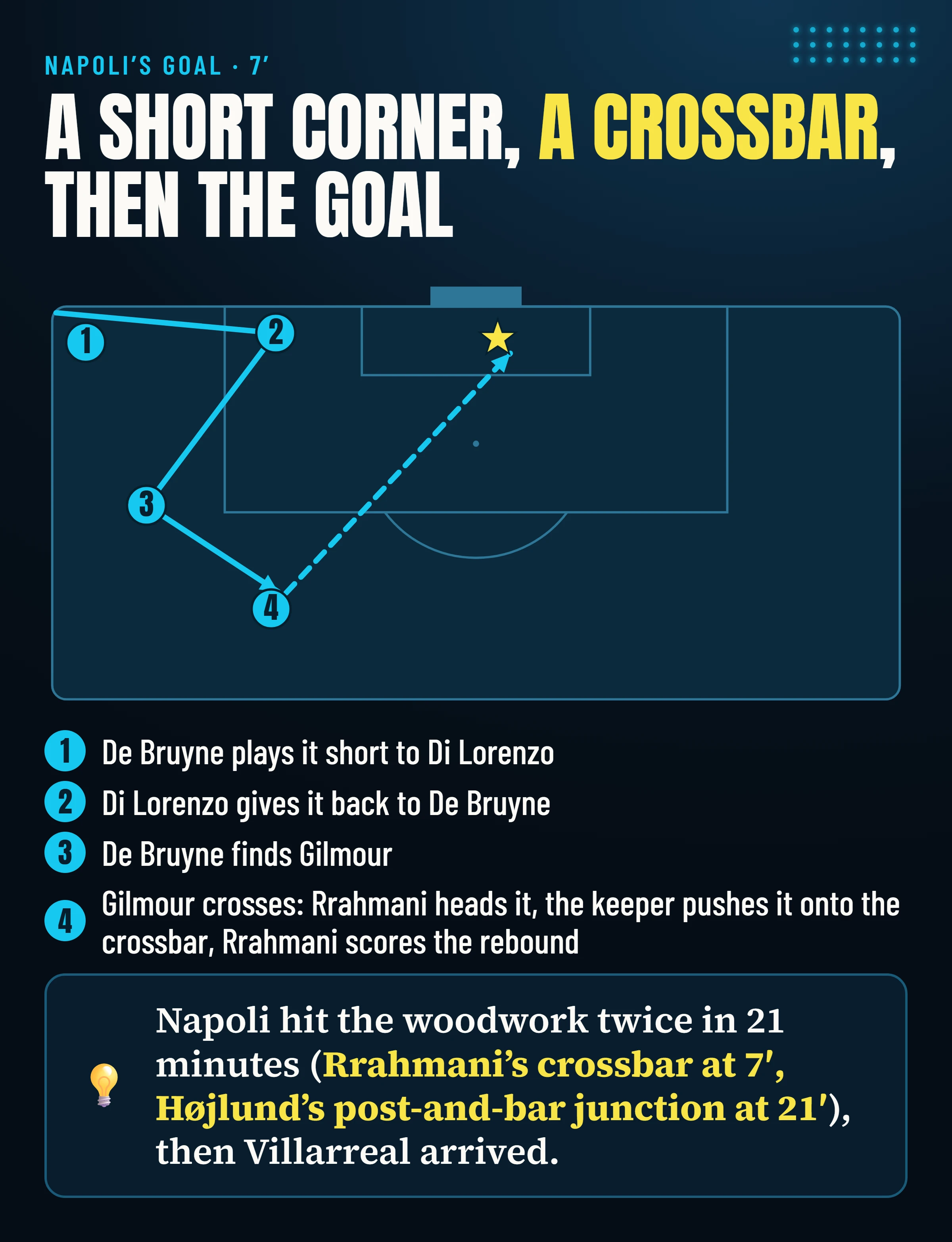
At 7′ Napoli were already ahead, from a short corner: De Bruyne to Di Lorenzo, back to De Bruyne, then Gilmour. His cross reached Rrahmani, who headed it: the goalkeeper deflected it onto the crossbar and Rrahmani scored the rebound.
At 21′ came the second hit of the woodwork, by Højlund, who struck the junction of post and bar from a few metres. A minute later came the equaliser. In 22 minutes Napoli had shot four times, always from inside the box, and had already hit the woodwork twice.
The possession paradox
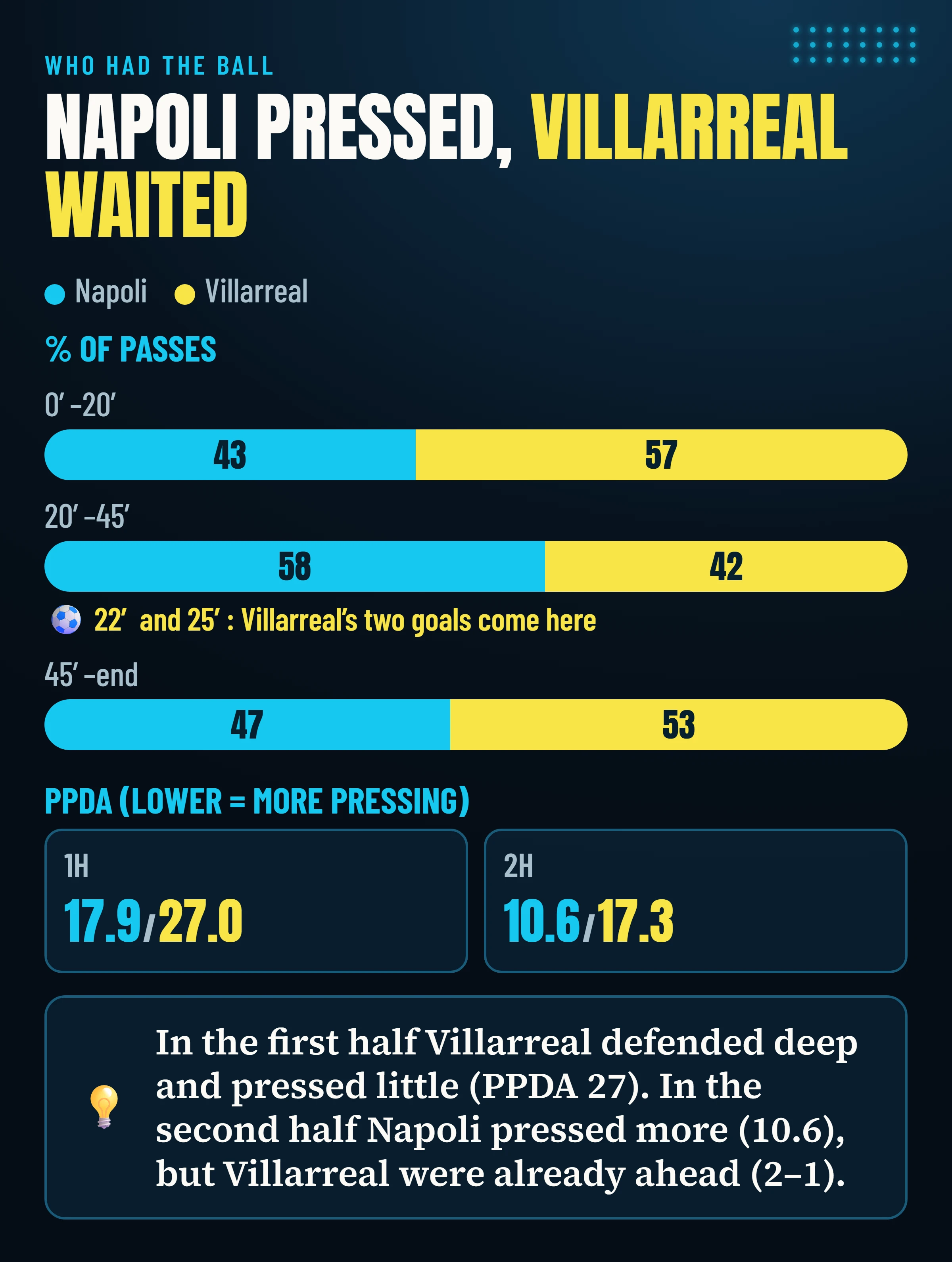
In the pre-match we asked which Villarreal would show up, the high one of the home games or the cautious one of Madrid. They chose the second path: they pressed little, especially in the first half, and in the second half they dropped even deeper. Napoli defended higher and pressed more.
The ball changed hands three times. Villarreal had more of it in the first 20 minutes, Napoli between the 20th minute and half-time, Villarreal again in the second half.
And here is the paradox: Napoli conceded the two goals in the only stretch in which they had more of the ball. When you control it, every wrong pass out from the back becomes a gift.
Against a low Villarreal, Napoli looked for the cross: 18 against the Spaniards’ 6. But only one in three found a teammate, and only three produced a shot.
Napoli, in general, built out well: they lost 10 build-ups out of 22, against Villarreal’s 17 out of 22. Villarreal lost more build-ups than in any other game analysed. But Napoli got little out of this weak spot: their recoveries ended in a shot in few cases and never in a goal.
Giovane was there, and started
In the pre-match, based on the press of 12 October, we had written that Giovane was not on the UEFA list. That was true until Monday afternoon. That day Napoli changed the list and put Giovane in place of Costantino Favasuli.
Favasuli got hurt with Italy Under-21 on 1 October: a second-degree tear of the right rectus femoris, out until November, as Corriere dello Sport wrote. UEFA rules allow a player with a long-term injury to be replaced until matchday six of the league phase. When Favasuli has recovered he can return to the list, and at that point Giovane will come off: according to Corriere dello Sport Napoli should re-register him before the trip to Manchester.
Giovane started, behind Højlund, next to De Bruyne. It was not the only thing we had read differently: in midfield Lobotka did not play, McTominay did next to Gilmour, and McTominay came off after an hour, as was said on the eve. Napoli played with a back three, Politano and Di Lorenzo on the flanks, two number tens behind Højlund. Villarreal, without Pépé, with a 4-4-2.
The two teams’ pivots
Villarreal started where we had described them in the pre-match: from the centre-backs. Renato Veiga was the most involved player in the game (98 passes played or received) and the one with the most forward passes. With him Comesaña, Gueye and right-back Mouriño, who besides scoring was also one of their most active players in build-up.
In Napoli the ball went mostly through Rrahmani (109 passes, the most involved), with De Bruyne, Di Lorenzo and Badiashile among the players who most often carried the ball forward. It is a team that builds from the back and tries to move the ball up with patience: exactly the kind of game in which a mistake in build-up hurts most.
Shooting well isn’t enough
Napoli shot almost always from close: 10 shots out of 11 from inside the box. Villarreal, instead, shot much more from outside. But they scored with three of their four shots on target.
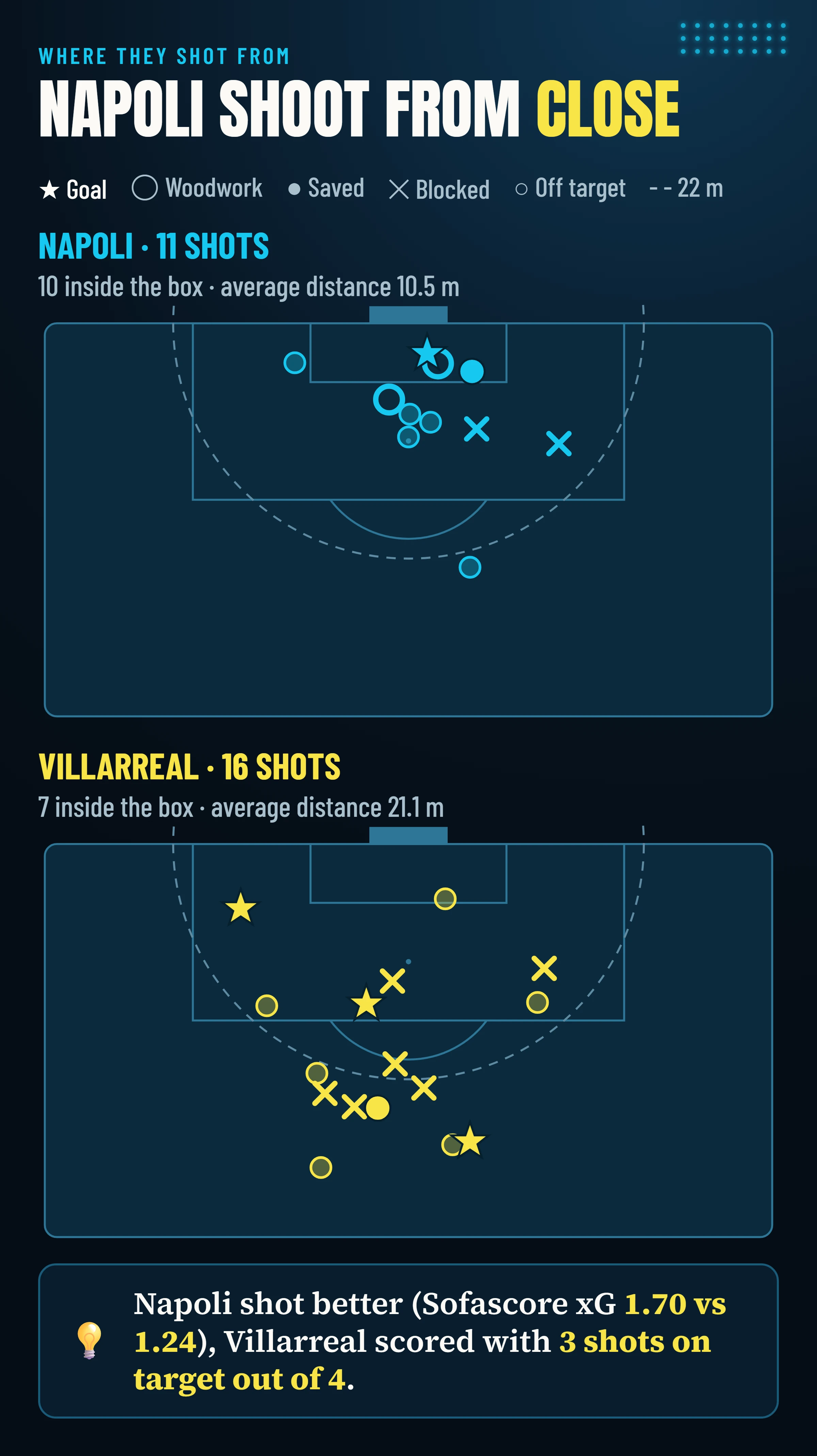
Sofascore’s xG says the same: Napoli 1.70, Villarreal 1.24. Napoli created more, Villarreal scored more. It is an external figure, calculated with their model, and should be read as an order of magnitude.
More than half an hour without a shot
Napoli’s last shot of the first half was De Bruyne’s, at 43′. The next one was at 76′: more than half an hour without shooting, while Villarreal tried four times, without scoring.
Napoli, in this phase, also pressed higher than before, but without turning it into chances. Villarreal, ahead, dropped even deeper.
In this part Allegri changed almost half the team: Lang, Spinazzola and Neres after the hour, then Lobotka and Lucca at 71′, with the defence moving to four. Villarreal answered with Oluwaseyi and Freeman at 62′ and Foyth at 67′.
Napoli had one last flurry: four shots in six minutes, between 76′ and 81′, all from inside the box. None went in.
At 85′ the third lost ball
The third goal came four minutes after Napoli’s last chance. Badiashile won the ball near his own box and passed it to Milinković-Savić, who went long: ball lost.
From there Villarreal needed 25 seconds. Mouriño played long down the wing, Freeman won the ball, then came Foyth, Oluwaseyi and Saliba, and Oluwaseyi again for the goal. Three of the players involved had come on from the bench.
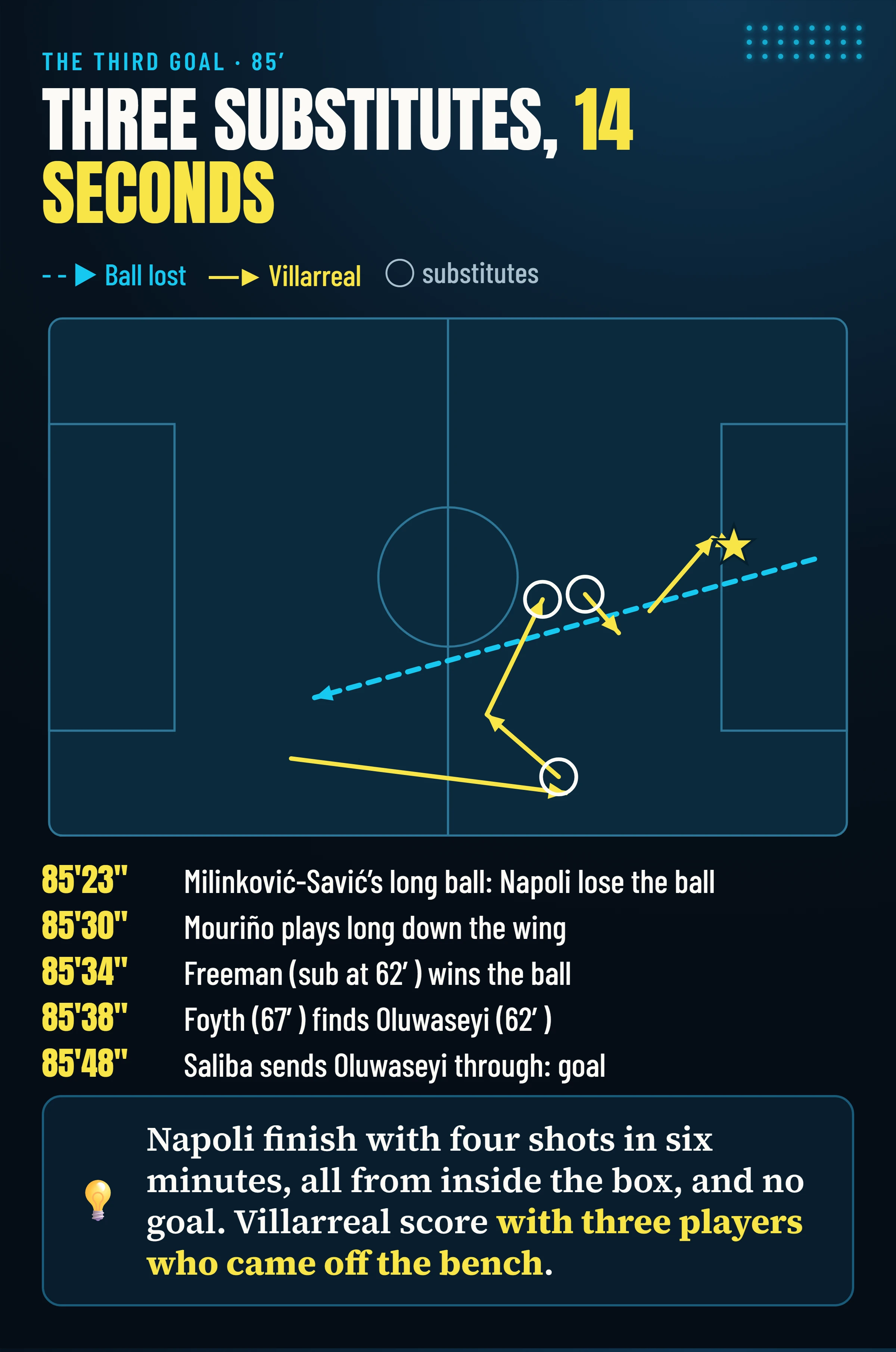
In the pre-match we wrote that the game could be decided in the last quarter of an hour, and that whoever had more energy and better substitutions would win. That is how it went.
The data don’t say whether Napoli were tired or struggling to concentrate: they only say that, for the third time in the same game, a ball lost near their own box became a goal.
The right predictions and the wrong ones
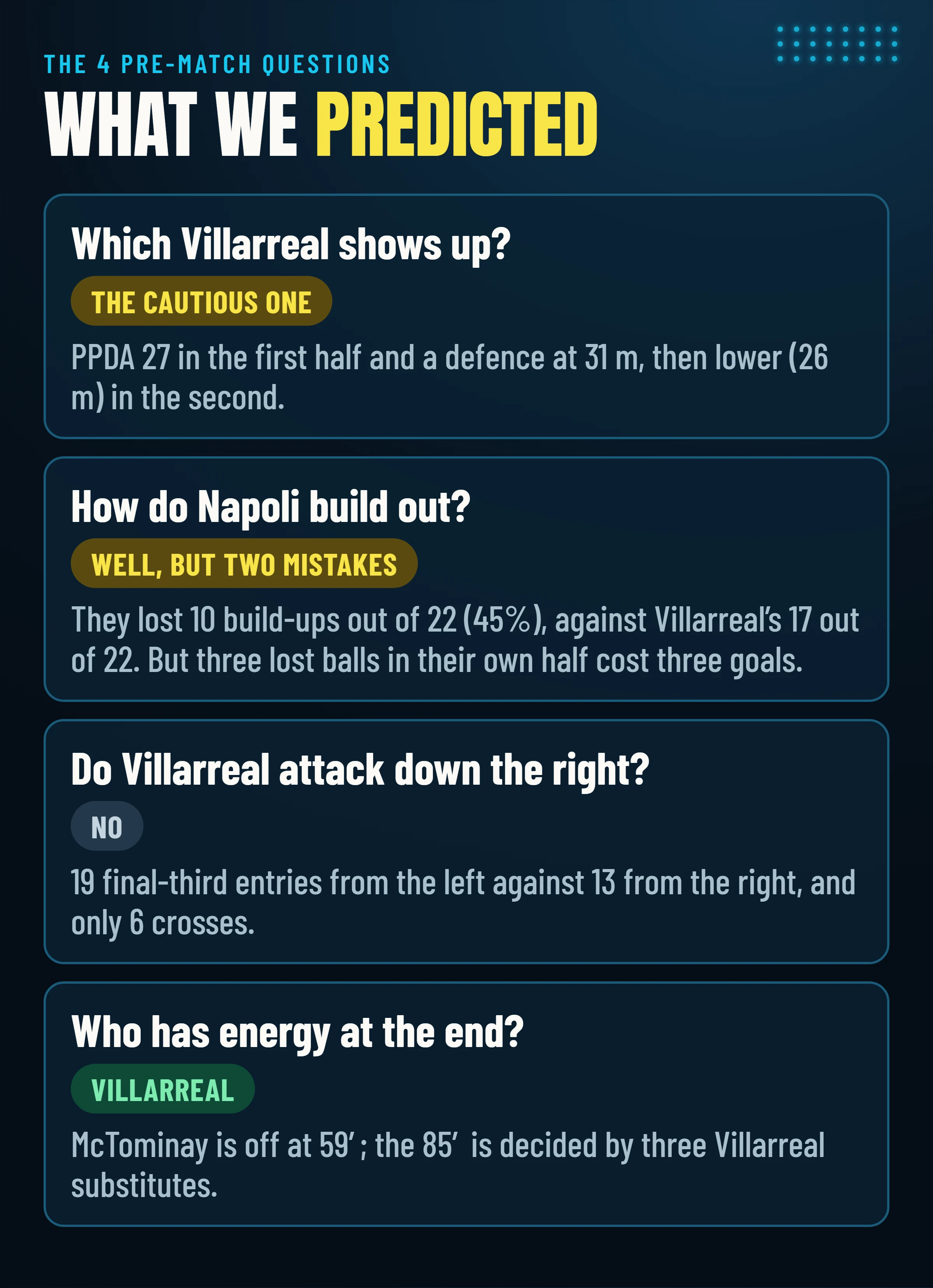
Some we read well. Villarreal showed up in the cautious version, the weak spot in their build-up was really there and the ending decided the game. McTominay played as expected: starter, but for an hour.
Others not. Giovane started, Lobotka didn’t, and Villarreal attacked more from the left than from the right, with very few crosses.
Above all, we read the risk from the wrong side. Villarreal pay for lost balls, the game confirms it. But this time it was Napoli who lost them in the wrong place and paid for them.
Zero points after two matchdays
After Arsenal, Napoli are still on zero points after two Champions League matchdays. On territory and chances they were no worse than Villarreal: more crosses, shots from close, two hits of the woodwork. But the three lost balls weighed more than all the rest.
On Saturday Napoli go to Venezia in the league. What to watch will be the same: how they build out when ahead and after a mistake.
Napoli created more, but lost the ball three times in their own half and Villarreal made them pay three times.