
Villarreal–Napoli, on Tuesday evening at 21:00 at the Estadio de la Cerámica, is matchday 2 of the Champions League league phase. Both are on zero points: Napoli lost at home to Arsenal, Villarreal at Dortmund.
After the Frosinone post-match, the question is simple: is the risk of losing the ball on the other side this time? To find out we analysed six Villarreal games this season, up to Saturday’s match at the Bernabéu.
The picture that emerges is not that of one team, but of two.
A depleted Napoli and a Villarreal without Pépé
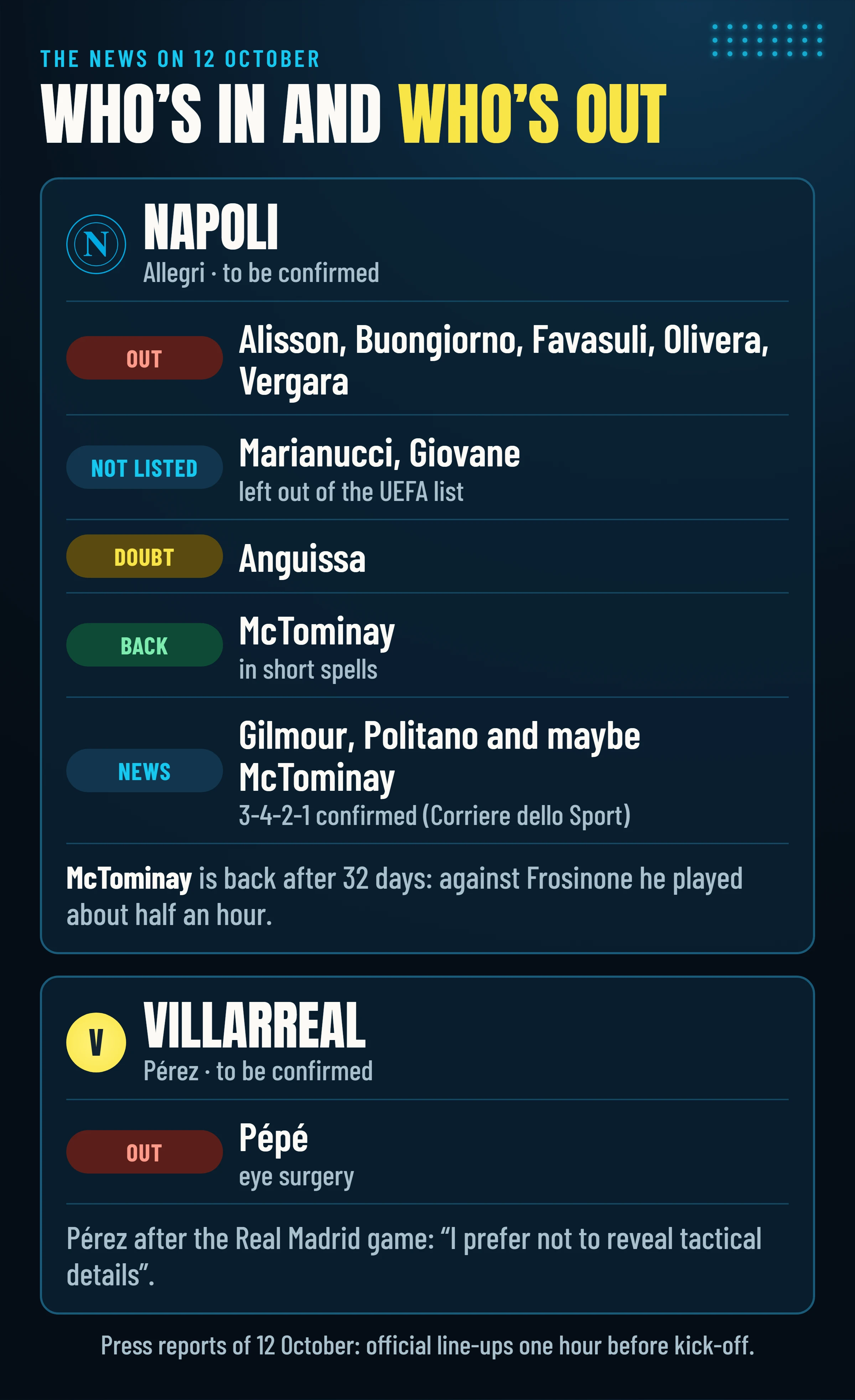
The news comes from the press and is updated to Monday 12 October. Official line-ups arrive one hour before the game.
Napoli have several absentees. Alisson, Buongiorno, Favasuli, Olivera and Vergara are out, and Marianucci and Giovane are not on the UEFA list. Anguissa, out with an adductor injury, is the only one who can recover.
According to the Corriere dello Sport, Allegri confirms the 3-4-2-1 from Saturday, but could change three players: Gilmour next to Lobotka (with De Bruyne further forward), Politano on the right and McTominay, back against Frosinone 32 days after heart surgery, who played about half an hour. Whether he starts is one of the open questions.
Villarreal have lost Pépé, who had eye surgery in recent days: he misses the game. Iñigo Pérez, after the Real Madrid game, said he did not want to reveal tactical details so as not to help Napoli.
Data sample. The analysis uses six Villarreal games (Atlético, Deportivo, Dortmund, Betis, Levante and Real Madrid) and the seven Napoli games already analysed. These are few matches: the numbers show tendencies, not certainties.
Villarreal change skin depending on the opponent
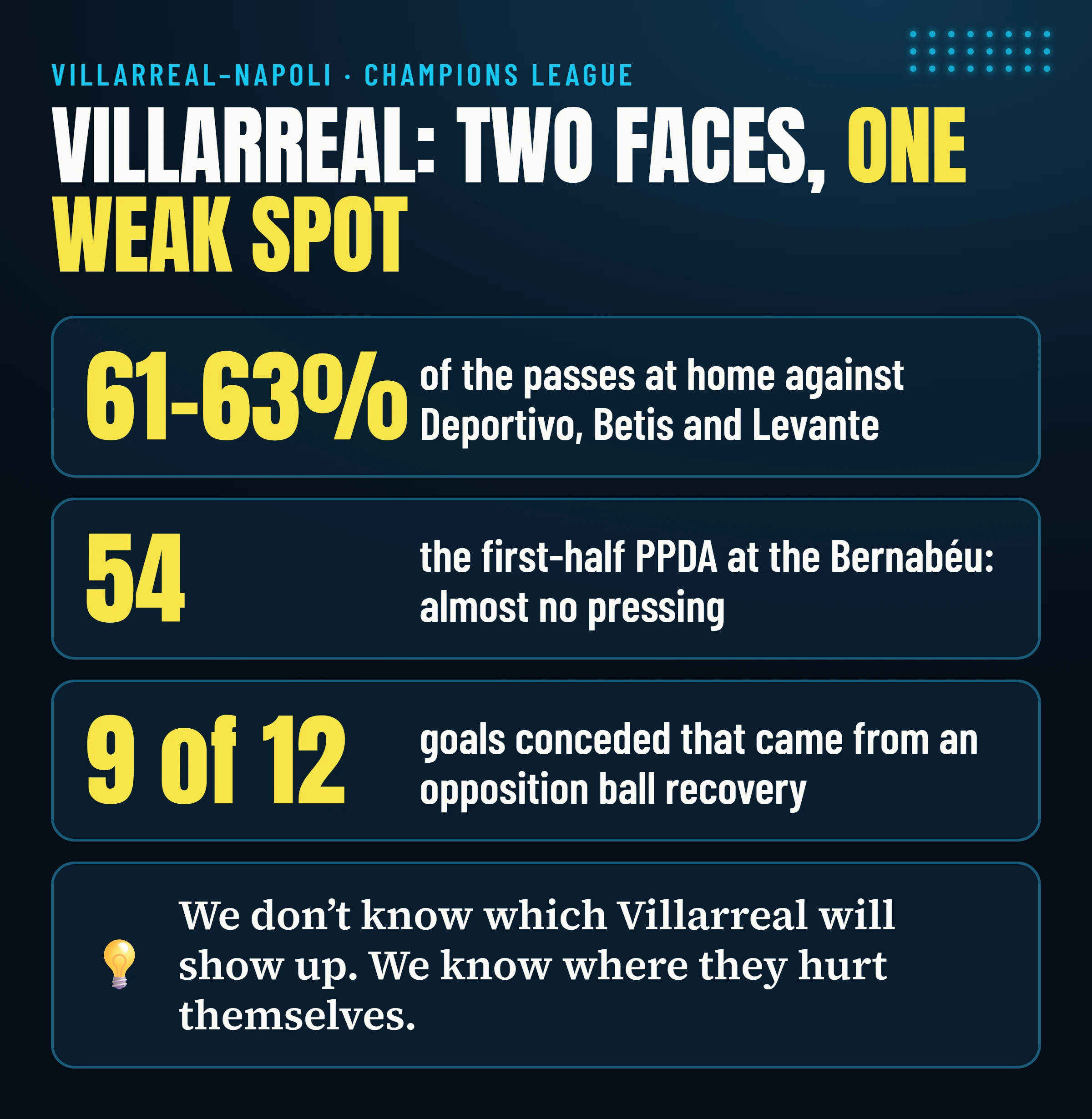
At home against Deportivo, Betis and Levante, Villarreal had 61–63% of the passes and pushed the team forward: 73, 73 and 38 final-third entries. Against stronger opponents, away from home, they changed face.
At the Bernabéu, on Saturday, they played much deeper. According to what the press reported after the game, Pérez defended with five, with Foyth man-marking Bellingham and the full-backs tucked in. The data point the same way: the team’s centre of gravity stayed in its own half and the forwards were far from the opposition box, especially in the first half.
And yet it was not a passive team. In Madrid Villarreal had 53% of the passes and shot more than Real (15 shots to 11), even if none went in. Diomande’s goal came at 62′.
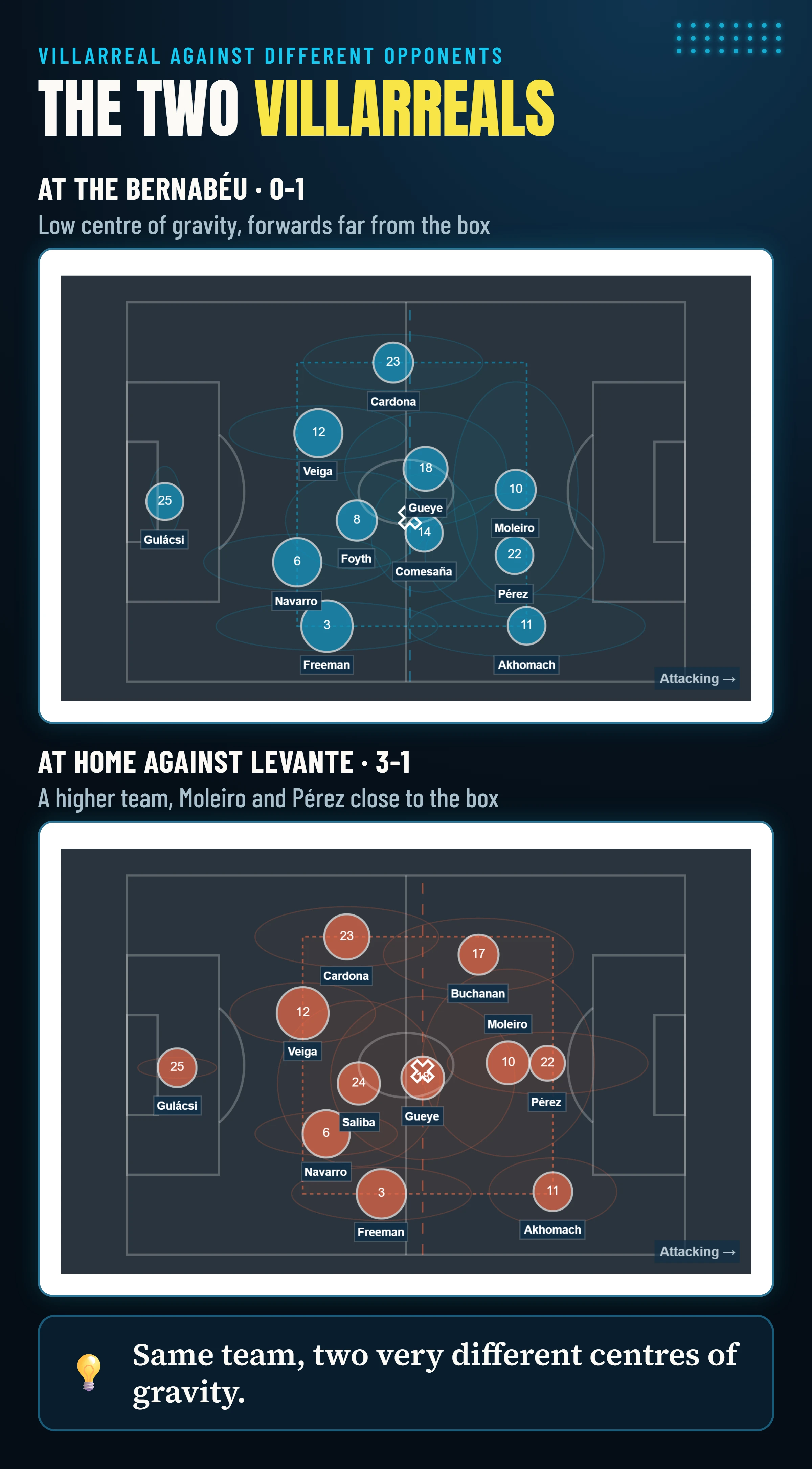
Against Levante, three weeks earlier, the team was much higher: Moleiro and Pérez stood close to the opposition box.
One question remains open. Tuesday is the Champions League, at home, against a strong side, and the data have no identical precedent: home against small opponents, away against stronger ones. Which of the two faces will we see? Pérez isn’t saying.
The pressure changes from one half to the other
Pressing is measured with PPDA: how many passes you let the opponent make before stepping in. The lower the number, the more the team presses.
Villarreal have pressed differently in the two halves. Against Deportivo and Betis they started slowly (PPDA of 18.3 and 16.1) and raised the pressure a lot in the second half (8.9 and 9.8). Madrid was the most extreme example: 54 in the first half, almost no pressing, and 10.6 in the second.
It is not a rule. Against Dortmund the opposite happened (from 9.4 to 21.5), against Atlético the pressure stayed the same and against Levante it dropped. But in three games out of six Villarreal changed gear after the break.
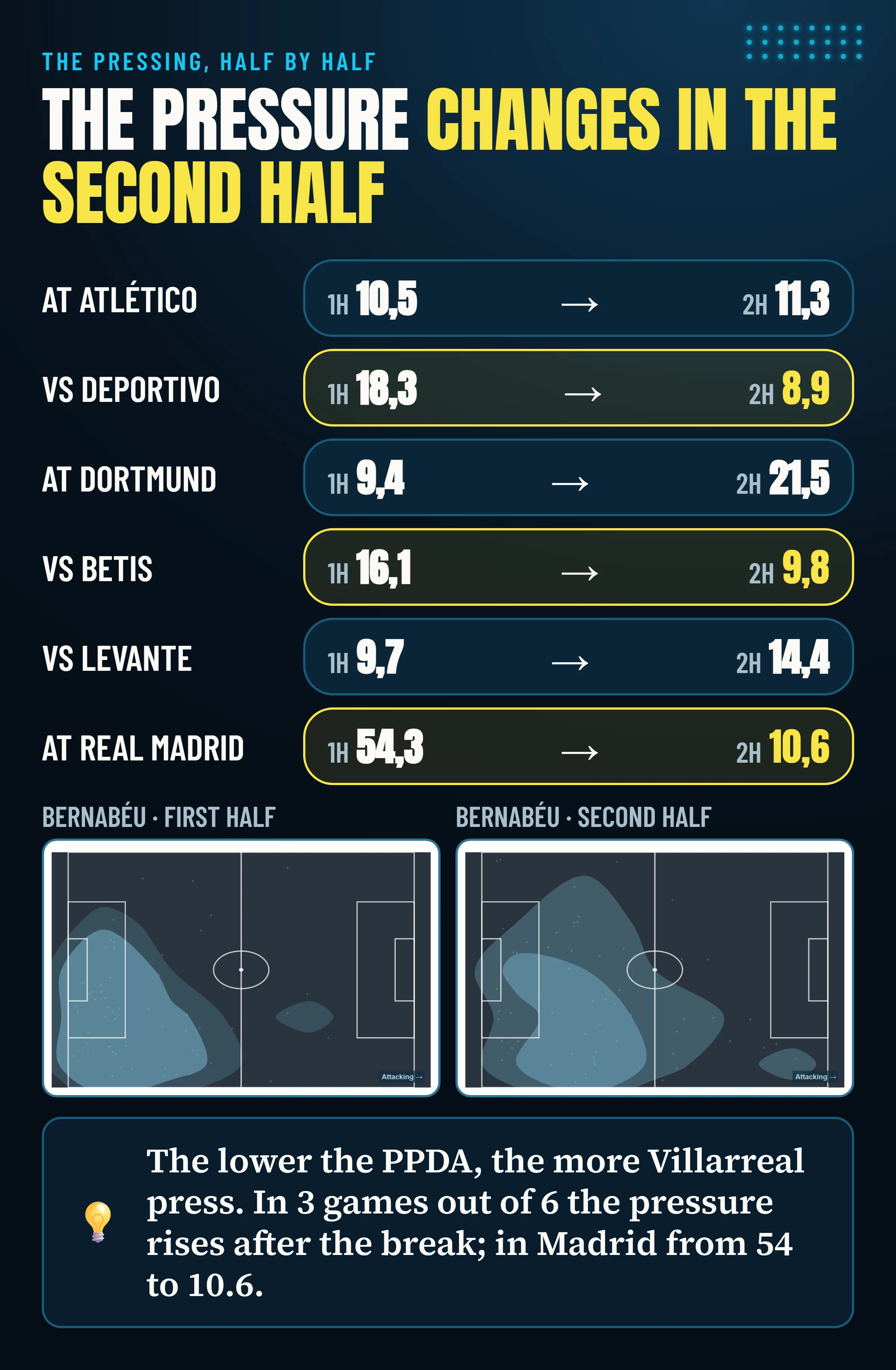
For Napoli this means the first half could be calmer than the second, and that building from the back risks being tested especially after the break.
A necessary clarification: in the post-match we wrote that Villarreal press consistently (PPDA between 10.9 and 12.2) in the five games analysed at the time. With Real Madrid the picture is more nuanced.
Villarreal pay for every lost ball
The strongest figure in the whole sample is one: nine of the twelve goals Villarreal conceded come from an opposition ball recovery. For Napoli, in the seven games analysed, it is three out of seven.
Atlético, Deportivo, Dortmund, Betis and Levante scored this way, often within seconds: Dortmund’s first goal two seconds after the recovery, Betis’s Natan’s two, Aubameyang’s, with Deportivo, four.
It is not only about counter-attacks. Against Deportivo, Cruz’s goal comes after a 97-second, 22-pass move, but it still starts from a ball lost by Villarreal.
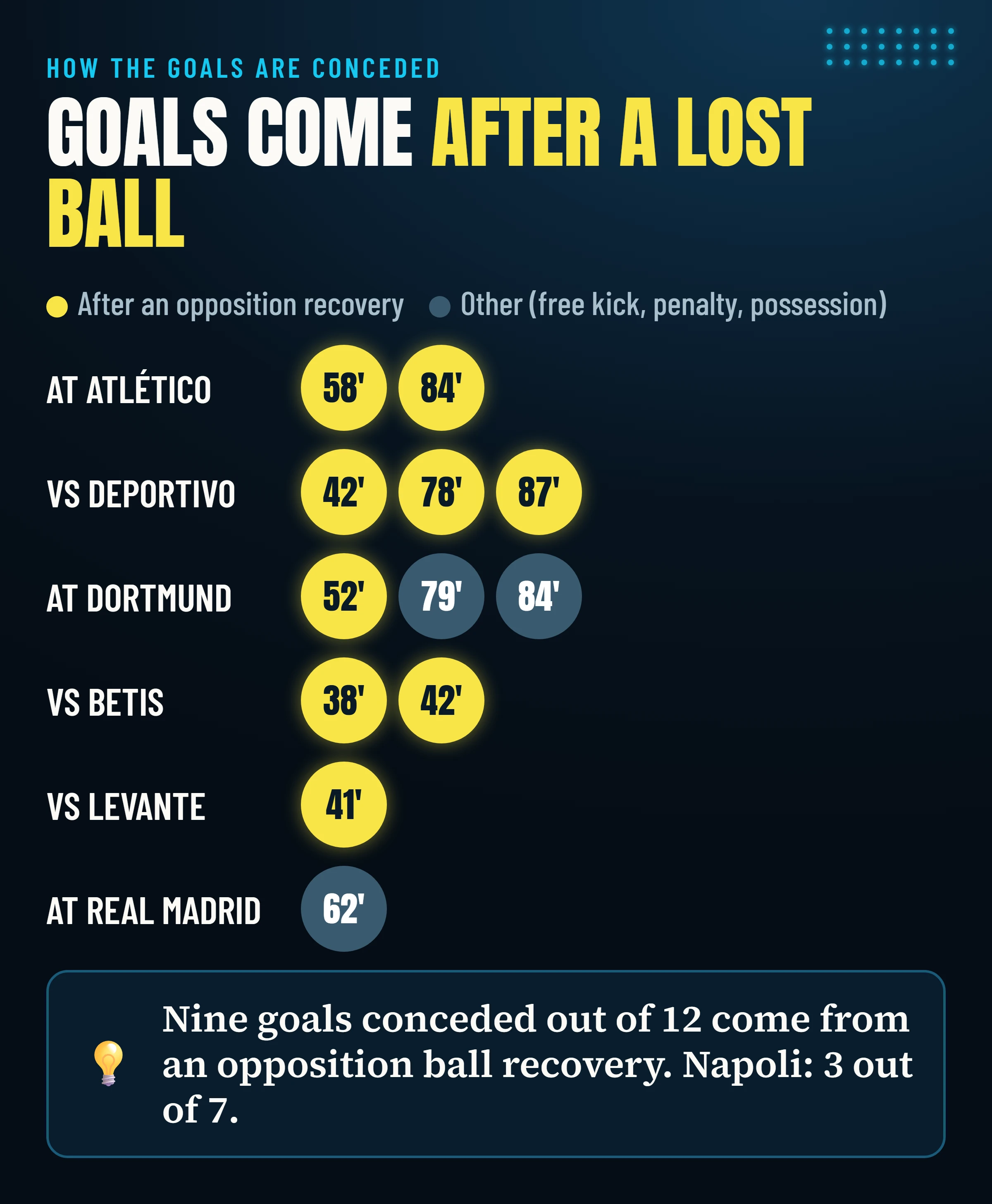
Villarreal, however, also know how to hurt in transition: four of their ten goals, against Deportivo and Levante, came from a ball recovery.
Villarreal build through the centre-backs
Villarreal build mostly through the centre-backs. Renato Veiga is the player with the most passes played or received in four games out of six, with a maximum of 202 against Levante and 11 forward passes. Navarro and Freeman, the right-back, complete the triangle.
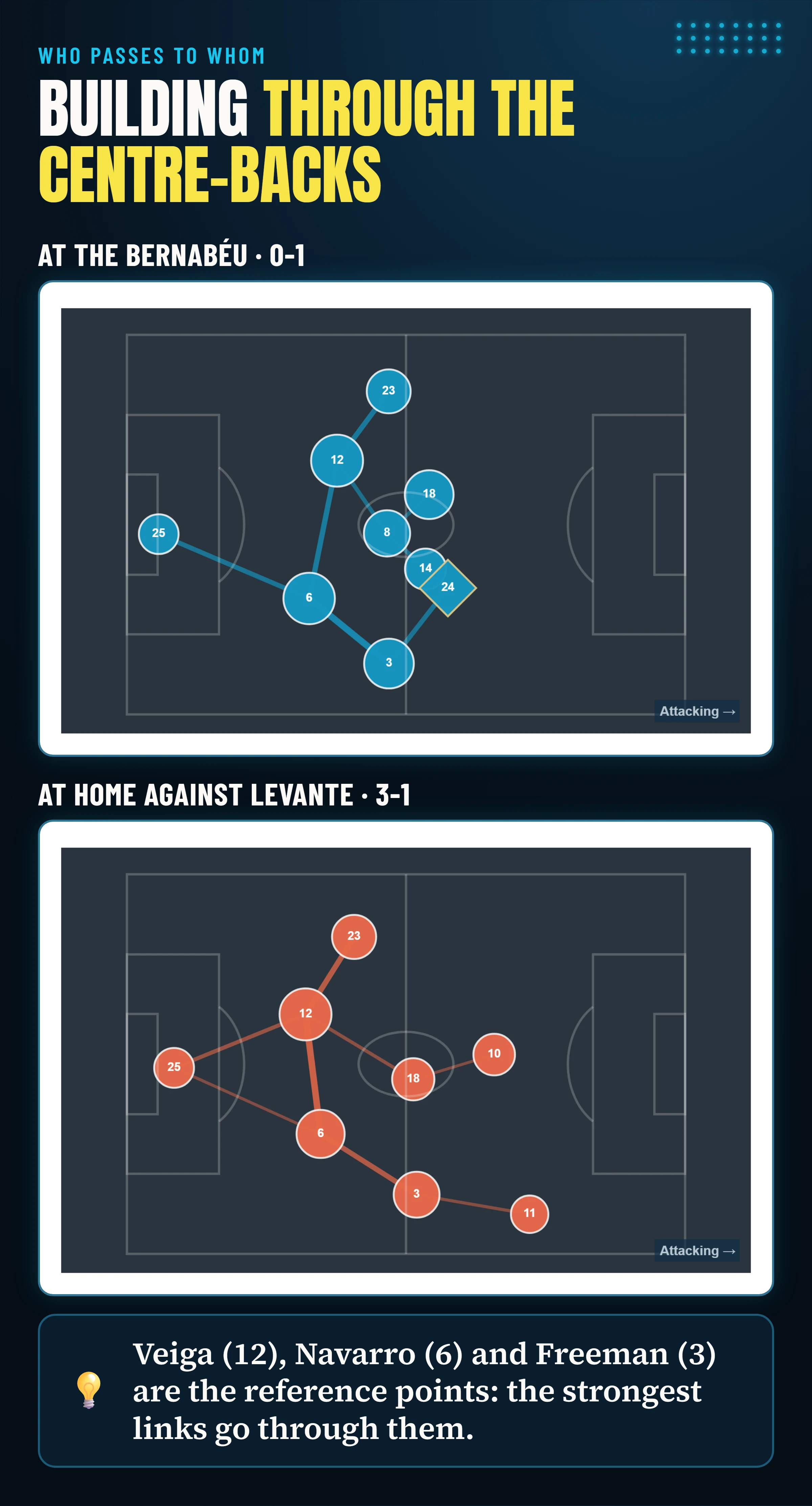
When facing strong sides away from home, the build-up suffers: they lost 47% of their sequences against Atlético, 43% at Dortmund and 56% at Real Madrid. At home, against smaller opponents, between 22% and 36%.
Here Napoli have a choice to make. In their seven games they pressed a lot against sides that keep little of the ball (PPDA between 10 and 11 with Genoa, Bologna and Fiorentina) and much less against those that keep it (between 17 and 21 with Como, Inter, Arsenal and Frosinone).
At home Villarreal are a team that keeps the ball (61–63% of the passes). By precedent, therefore, Napoli might press little. But pressing high is exactly what would give them more chances to exploit Villarreal’s weak spot, which is building under pressure.
With a reduced squad and McTominay in short spells, pressing high costs energy. If Allegri accepts the risk, Villarreal will be tested at their most fragile point. If not, Villarreal will build more calmly and the game will move to lost balls in midfield.
Can Napoli relax? It depends on which Villarreal
Napoli know that losing the ball when building out doesn’t always cost: against Frosinone it went well, against Inter and Arsenal much less so. Against Villarreal it depends on which Villarreal shows up.
At La Cerámica, in the three home games analysed, Villarreal made opponents lose between 48% and 68% of their build-ups from the back. If they show up with the high face, Napoli risk finding themselves in the same situation. If instead they choose the cautious version seen in Madrid, building out will be easier, but there will be less space to break into.
Without Pépé, Villarreal attack in the same way
Pépé was one of Villarreal’s most dangerous players (11 shots in four games), but his absence should not change the design of the attack. Villarreal have already played two games without him, against Levante and Real Madrid, and played them almost like the others.
First of all, the most used side is almost always the right (five games out of six). With Pépé, in the four games he played, 44% of final-third entries came from the right. Without him, in the next two games, 46%.
Then, the way of getting into the box. The most used crossing route is the same (from the right flank towards the centre of the box) in five games out of six. Against Levante there were 21 crosses, against Real Madrid 11.
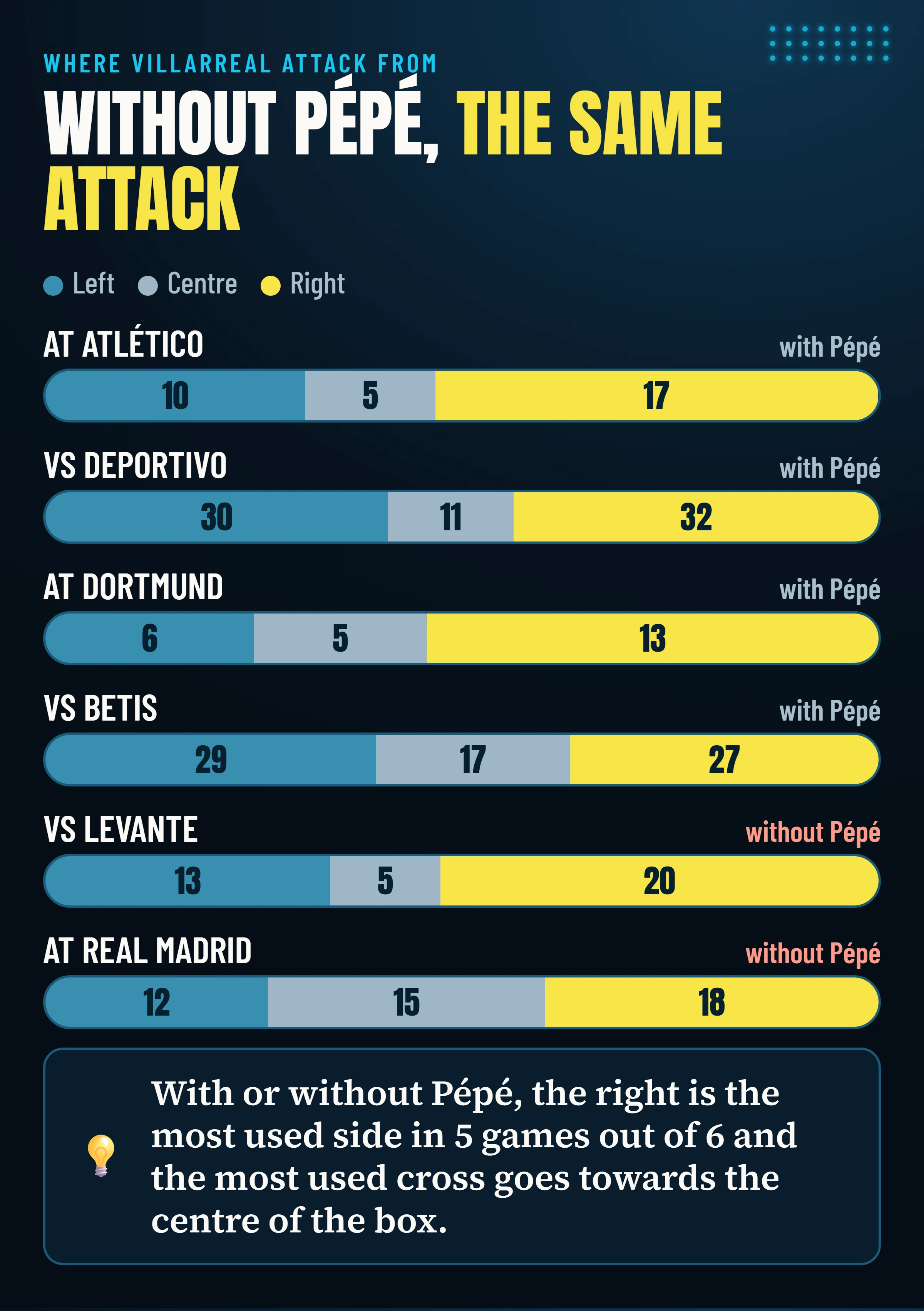
What changes is who crosses. Usually Pépé or Buchanan took the crosses; in the last two games the player with the most crosses was Moleiro, who against Levante also provided 7 passes that ended in a shot.
For Napoli this means looking at the same side. Villarreal come down the right, so against Napoli’s left: Badiashile, Spinazzola and Lang in the post-match shape, unless Allegri changes something.
The game can be decided in the last quarter of an hour
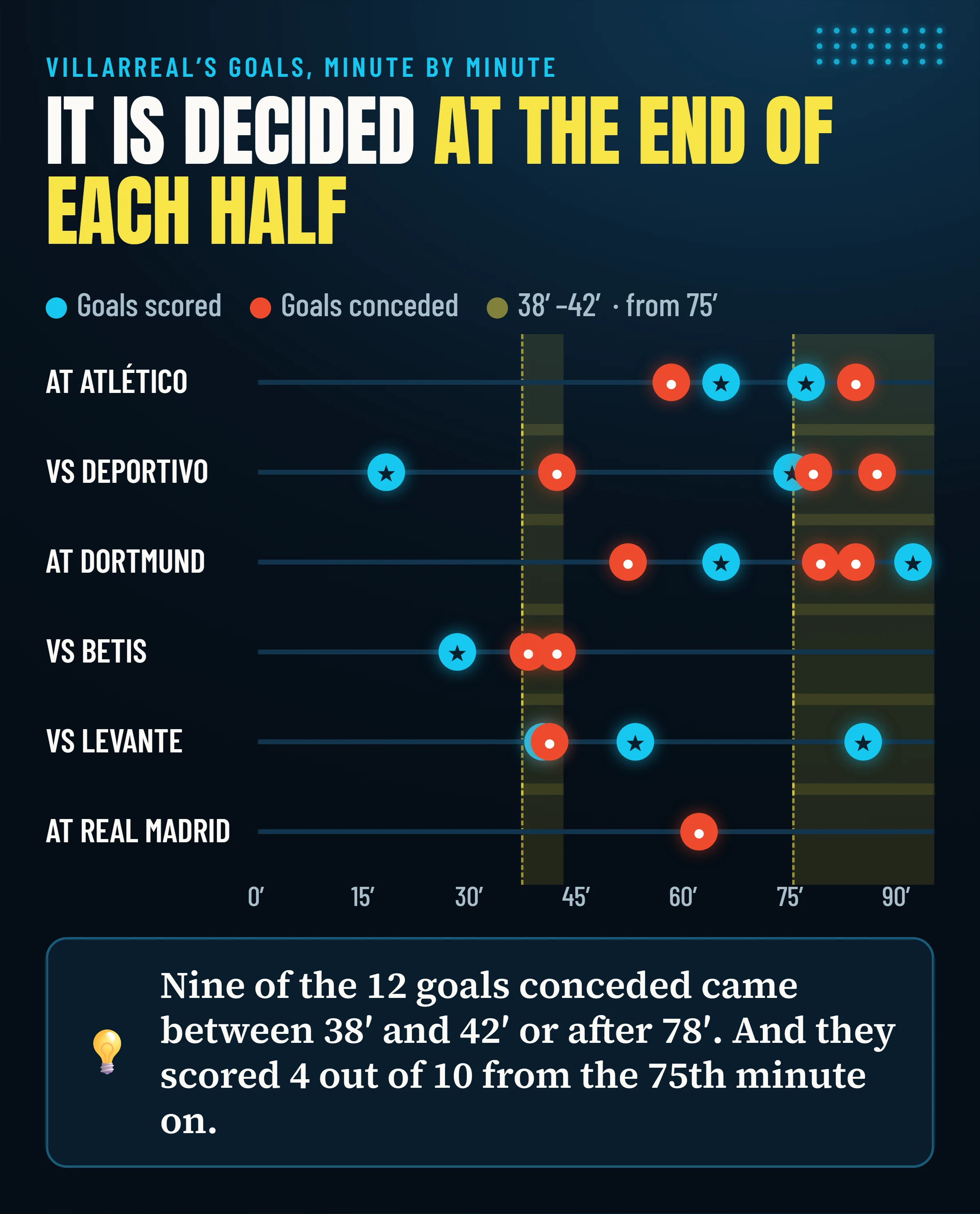
Villarreal live the ends of halves in a particular way. Of the twelve goals conceded, four came between 38′ and 42′ and five after 78′: nine out of twelve in two short windows.
They also score late: four of their ten goals came from the 75th minute on. Against Dortmund, Deportivo and Atlético the ending decided or changed the game.
Napoli also live on endings. In their last seven games they scored three times from the 81st minute (two at Genoa and the third against Frosinone, at 93′) and conceded three from the 74th on (two against Inter, one against Arsenal).
Napoli arrive at this ending with a McTominay in short spells and a bench that against Frosinone provided the assist for the third goal. That assist was Giovane’s, who is not on the UEFA list on Tuesday. Whoever has more energy and better substitutions could make the difference.
The four things to watch on Tuesday
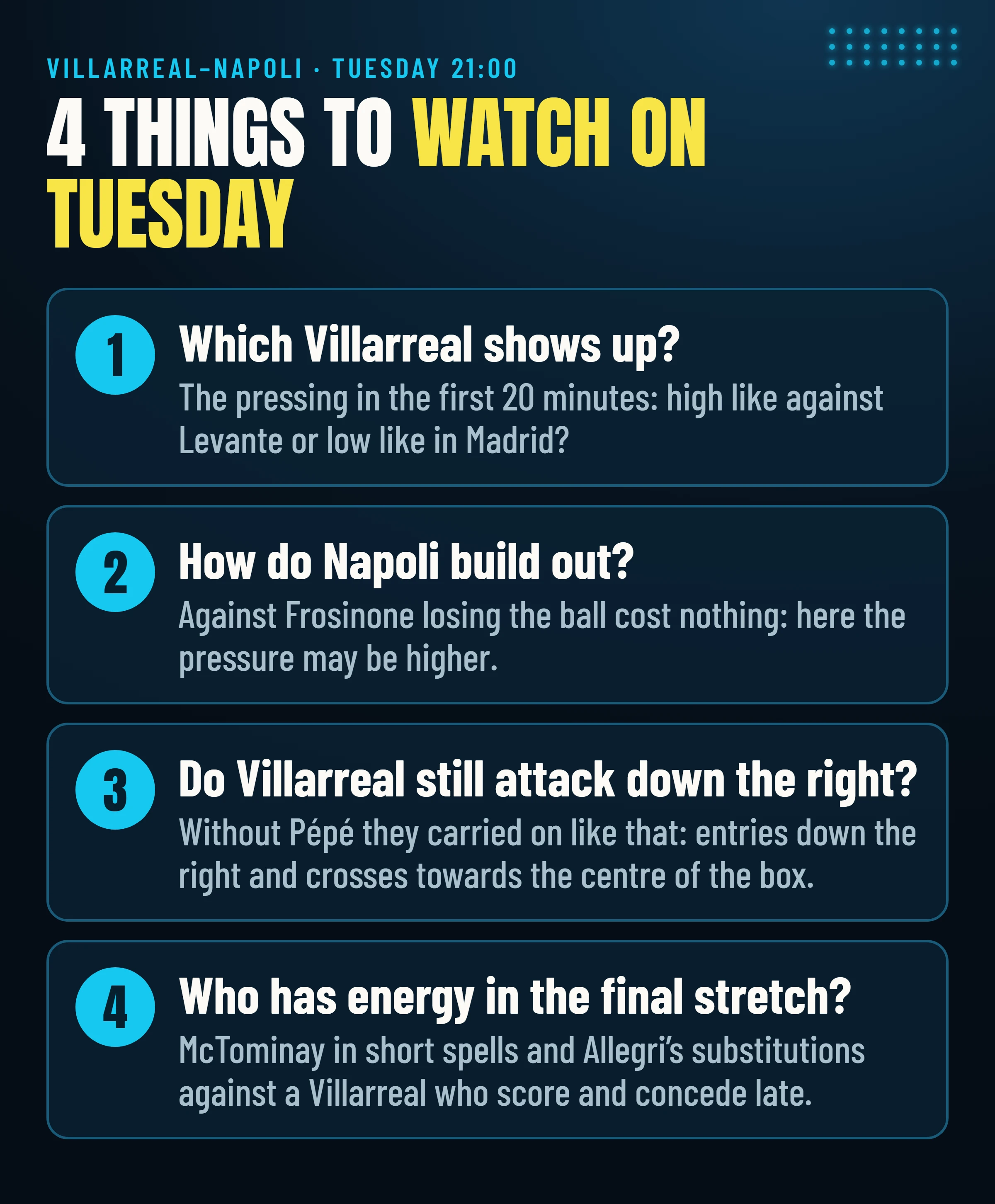
A game of faces and of endings
Villarreal–Napoli doesn’t look like a game to be solved with a single idea. Villarreal can show up in two ways and Napoli, today, have more absences than certainties.
There is, however, a constant: Villarreal pay for lost balls. If Napoli can take advantage and protect their own, the rest of the game changes.
The difference could be made by whoever makes fewer mistakes, especially in the last quarter of an hour.